A crane that operates without a documented inspection record is operating illegally. An overhead gantry crane in a manufacturing plant is subject to OSHA 1910.179, which mandates frequent inspections (daily to monthly) and periodic inspections (1 to 12 months) depending on severity of service and operating environment. Yet 73% of industrial facilities still manage crane inspection schedules using spreadsheets disconnected from equipment condition data, with no automated tracking of when inspections are due, no escalation alerts when inspections slip past their deadline, and no centralised audit trail when regulators arrive unannounced. The result is not just compliance gaps — it is legal liability, safety risk, and production downtime when equipment that should have been inspected fails during operation. This guide covers the mandated inspection frequencies for every major equipment class in industrial plants — cranes, conveyors, pressure systems, and electrical assets — with the scheduling framework that keeps your equipment inspection programme audit-ready and compliant.
Equipment inspection frequency guidelines are legally mandated intervals at which industrial equipment — cranes, conveyors, pressure vessels, electrical systems — must be examined, tested, and documented by qualified personnel. These intervals are determined by OSHA standards, industry codes (API, ASME, IEC), equipment criticality, operating environment, and failure history. Non-compliance triggers enforcement citations, production shutdowns, and worker safety incidents that could result in prosecution under the Corporate Manslaughter Act or equivalent statutes.
The Regulatory Framework — Understanding Your Inspection Obligations
Industrial equipment inspection requirements are not optional recommendations. They are legal obligations enforced by OSHA, API, ASME, and equivalent regulatory bodies in your jurisdiction. Understanding which regulations apply to your equipment is the foundation of an effective inspection programme.
Requires cranes to be inspected at two tiers: frequent inspection (daily to monthly) and periodic inspection (1 to 12 months) depending on severity of service and environment. Initial inspection before first use is mandatory. All inspection records must be signed by qualified inspector and retained.
Bucket elevators and manlifts require periodic inspection covering steps, rails, belt tension, handholds, pulleys, brakes, and electrical switches. Inspection record including date, inspector signature, and equipment serial number must be maintained and made available to OSHA representatives on demand.
Pressure vessels require internal inspection every 3–5 years and external inspection annually or quarterly depending on vessel type, operating conditions, and fluid service. Thickness measurements, corrosion inspection, and NDT methods (ultrasonic, radiographic) required per API 510. Certification and report retention mandatory for compliance audits.
Equipment in hazardous (classified) areas requires inspections at intervals ranging from 6 months to 5 years depending on equipment type and area classification. Risk-based assessment determines actual frequency. Competent and certified personnel required. Documentation and audit trail essential for regulatory submission.
Equipment-Specific Inspection Frequencies — The Complete Reference
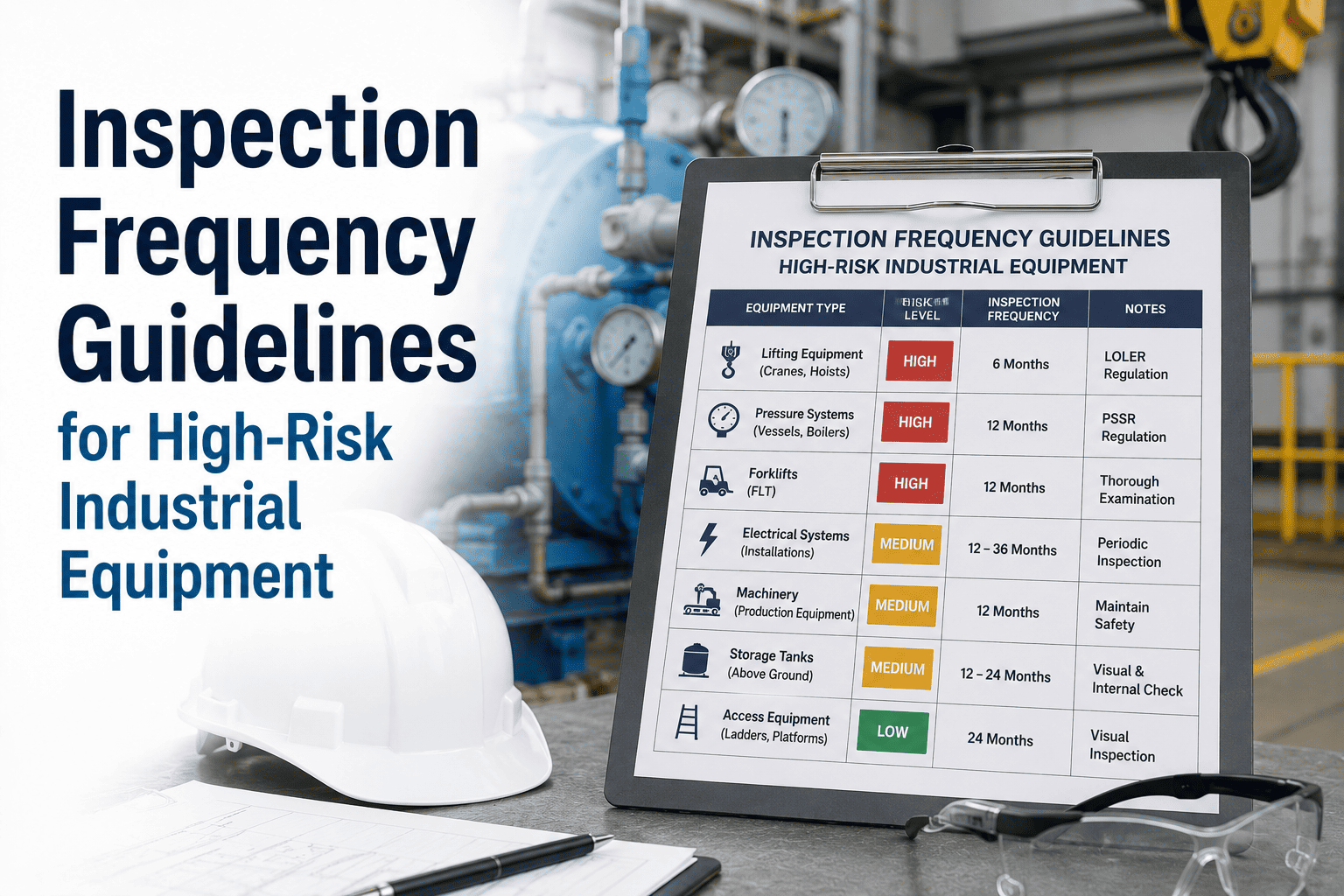
These are the mandated inspection intervals for the most common high-risk equipment classes in industrial facilities. Frequencies vary based on operating environment, severity of service, and failure history.
Automated inspection scheduling eliminates spreadsheet gaps, triggers escalation alerts when inspections are due, and maintains the audit-ready documentation that regulators demand. Digital inspection software keeps your equipment programme compliant and your workers safe.
Risk-Based Inspection — Adjusting Frequencies to Your Operating Context
Regulatory frequencies are baselines. Your actual inspection intervals should account for equipment criticality, operating environment, failure history, and maintenance condition. Risk-based inspection allows you to justify either tighter or extended frequencies to regulators — but only with documented risk assessment and condition evidence.
A crane that lifts molten metal requires more frequent inspection than a crane lifting cardboard boxes. A pressure vessel containing toxic material requires shorter intervals than one containing benign fluid. Criticality assessment determines whether you tighten frequencies beyond regulatory minimum.
Equipment operating in corrosive environments, extreme temperatures, or continuous duty (24/7 operation) accumulates wear faster than equipment operating in benign conditions or intermittently. Environmental monitoring and historical degradation data justify adjusted inspection frequencies — both tighter and, in rare cases, extended.
Equipment with a history of prompt maintenance, no significant failures, and condition scores within normal ranges may qualify for extended certification (up to 3 years) under API 510 and equivalent programmes. Conversely, equipment with recurring issues requires tighter inspection until root cause is closed.
Aging equipment approaching end-of-life may justify more frequent inspection than replacement equipment operating under identical conditions. Ultrasonic thickness trending, metallurgical assessment, and condition-based trending inform RUL estimates and inspection interval adjustments supported by technical evidence.
Building Your Inspection Frequency Programme — Implementation Steps
A compliant inspection programme is not a static document. It is a living system that tracks due dates, automates scheduling, escalates overdue inspections, and maintains complete audit trail documentation.
Create a complete equipment register including crane model and SN, pressure vessel identification, electrical asset tag, conveyor route. Classify each asset by equipment type, criticality level (high/medium/low), and applicable regulatory standard. This registry becomes the foundation of your scheduling system.
Based on OSHA, API, ASME, and industry standards applicable to each equipment type, assign the baseline inspection frequency. Document the regulatory standard and any modifications based on manufacturer recommendations, insurance requirements, or risk assessment.
Evaluate criticality, operating environment, condition history, and remaining useful life for each asset. Document any frequency adjustments beyond regulatory baseline with supporting technical evidence. Obtain engineering review and management approval for non-standard intervals.
Enter all asset inspection frequencies into a digital system that automatically calculates due dates, triggers 30-day and 7-day escalation alerts, and routes inspection assignments to qualified personnel. Automated scheduling eliminates the "forgotten inspection" failure mode that creates compliance gaps.
Create standardised checklists for each equipment type aligned to regulatory requirements. Require inspector signature, date, equipment ID, and findings on every record. Store all documentation in a centralised, searchable system. This audit trail is your defence in regulatory investigations.
Track inspection completion rates, recurring findings, and asset condition trends over time. If certain equipment consistently accumulates findings at inspection, tighten the frequency or escalate for root cause investigation. If equipment runs clean inspections multiple cycles, extended certification may be justified.
Digital inspection software automates due-date tracking, generates escalation alerts, and maintains audit trails that satisfy OSHA, API, and equivalent regulators. No more scattered spreadsheets. No more missed deadlines. Sign up for a free trial and see how automated inspection scheduling transforms compliance readiness in days.
Inspection Documentation — What Regulators Expect to See
When OSHA or an equivalent regulator arrives for an inspection, they will request your equipment inspection records. Here is what a compliant documentation package includes.
A documented calendar or schedule showing the mandated inspection frequency for each asset, the rationale for that frequency (regulatory standard or risk assessment), and the next scheduled inspection date. This demonstrates your knowledge of regulatory obligations and active compliance management.
Every completed inspection documented with date, time, equipment ID, inspector name and signature, findings, deficiencies identified, and corrective actions assigned. Standardised checklist covering all critical components per regulatory requirement. Digital records with audit trail are superior to paper forms.
Documentation showing that overdue inspections triggered alerts, escalation was communicated to responsible personnel, and corrective action was taken. Regulators expect to see active oversight, not just periodic inspections buried in files.
When an inspection identifies a deficiency, documentation showing corrective action taken, closure date, and follow-up verification. Regulators assess not just whether you found problems, but whether you systematically fixed them and prevented recurrence.
Frequently Asked Questions
Continue Reading: Equipment Inspection and Compliance
Stop Managing Inspections With Spreadsheets — Build a Digital Compliance System
73% of industrial facilities rely on spreadsheets to track equipment inspection schedules. The result is missed deadlines, compliance gaps, and expensive OSHA citations. Digital inspection software eliminates this risk entirely. Automated scheduling keeps inspection due dates front-and-centre, escalation alerts prevent missed deadlines, and audit-ready documentation satisfies regulators on demand. Your inspection frequencies are already mandated by OSHA, API, and ASME. Now get them on a system that actually tracks them. Start your free trial today and deploy digital inspection scheduling in your facility within days — no IT project, no consultant required.