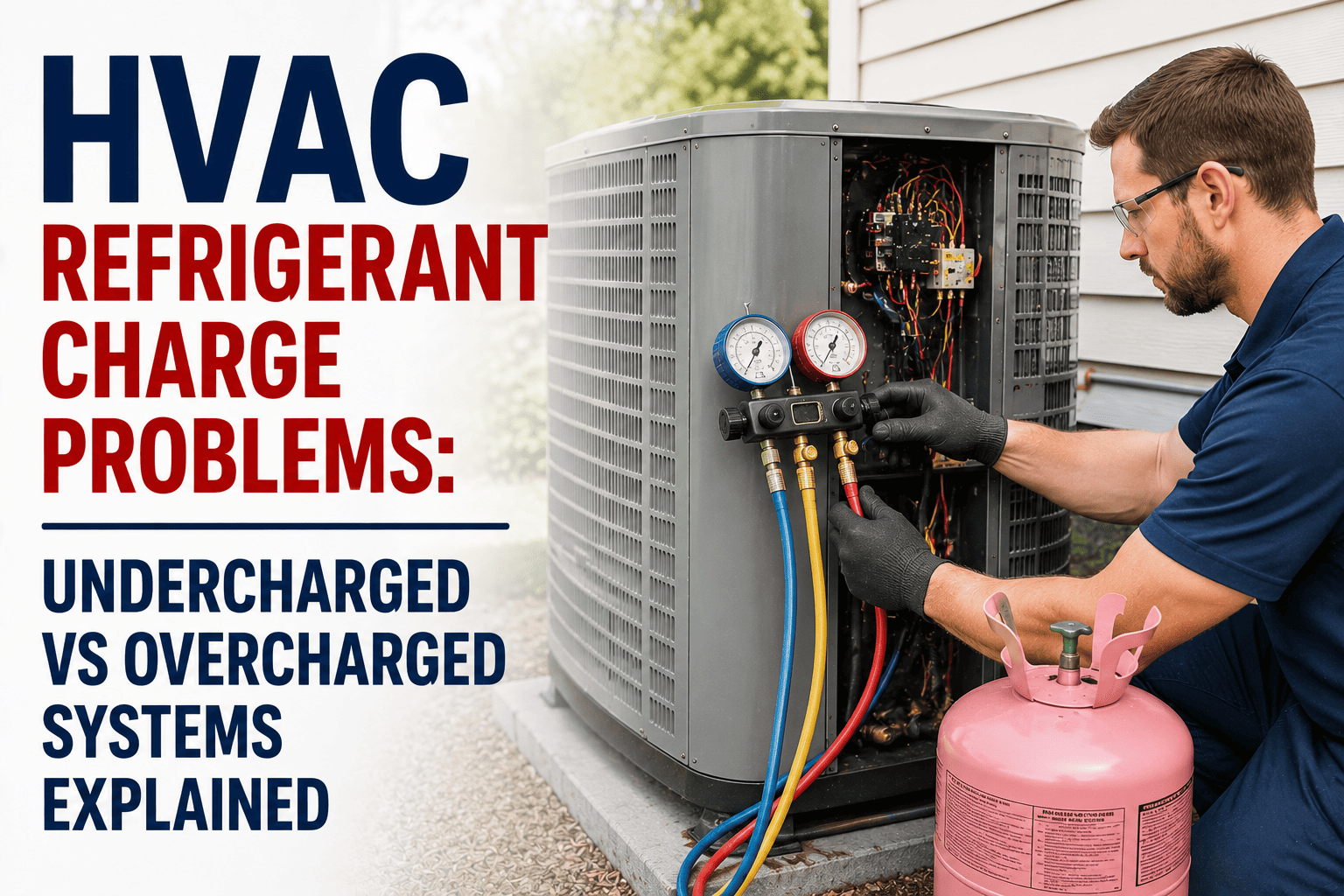
Your HVAC system is running — but something feels off. The air is not as cold as it should be, your energy bill climbed without explanation, and the compressor sounds different. Before you call it a refrigerant leak, consider this: the real culprit may not be how much refrigerant escaped, but whether the system was charged correctly in the first place. An undercharged or overcharged HVAC system is one of the most misdiagnosed — and most damaging — conditions a commercial facility can ignore. Start a free trial to see how Oxmaint tracks refrigerant-related fault codes and maintenance history before small charge errors become compressor failures.
30%
Of commercial HVAC systems operate with an incorrect refrigerant charge at any given time
20%
Energy efficiency loss caused by just a 10% undercharge — a cost most facilities never trace back to refrigerant
$3K
Average compressor repair cost when refrigerant charge problems go unaddressed for a single season
2
Diagnostic measurements — superheat and subcooling — that tell you everything about your refrigerant charge
What You Will Learn
This guide explains what refrigerant charge is, how undercharged and overcharged systems behave differently, the diagnostic methods that actually confirm charge problems, the warning signs your team must act on, and the prevention practices that keep refrigerant issues from becoming compressor failures.
What Refrigerant Charge Actually Means
Refrigerant charge refers to the precise amount of refrigerant inside your HVAC system. It is not a fluid level you top off — it is a calibrated measurement that determines how effectively your system can absorb heat from inside and reject it outside. Too little refrigerant and the system starves. Too much and the system chokes. Either condition forces components to work outside their design range, accelerating wear and consuming more energy to deliver less comfort.
How the Refrigerant Cycle Works
Refrigerant flows through four stages: compression, condensation, expansion, and evaporation. At each stage, it must be at the right pressure and temperature. Correct charge ensures the refrigerant transitions between liquid and vapor at the right points in the cycle — maximizing heat transfer and protecting every component it passes through.
Why "More Is Not Better"
Adding extra refrigerant does not increase cooling capacity. The system is engineered around a specific charge weight. Excess refrigerant has no room to expand in the evaporator, liquid refrigerant can slug back into the compressor, and discharge pressures climb beyond safe limits — all while cooling performance drops and energy consumption rises.
Undercharged vs Overcharged: Side-by-Side
Both conditions damage equipment and waste energy — but they damage different components in different ways. Knowing which condition you are dealing with determines what diagnostic steps come next.
| Indicator |
Undercharged System |
Overcharged System |
| Suction Pressure |
Low — refrigerant starvation at evaporator |
High — excess liquid flooding back |
| Discharge Pressure |
Low — compressor underloaded |
Elevated — compressor overloaded |
| Superheat |
High — refrigerant fully evaporates too early |
Low — liquid refrigerant reaches compressor |
| Subcooling |
Low — insufficient liquid in condenser |
High — condenser flooded with excess liquid |
| Evaporator Coil |
Ice formation — moisture freezes on starved coil |
Ice possible — poor heat absorption from flooding |
| Compressor Risk |
Overheating — runs hot without adequate refrigerant mass |
Liquid slugging — liquid refrigerant destroys valves |
| Cooling Output |
Below design — longer run times, never reaches setpoint |
Below design — system shuts off early or runs constantly |
Signs of an Undercharged HVAC System
Undercharging is the more common of the two conditions. It almost always begins with a refrigerant leak — a slow one that may go unnoticed for months until performance degrades visibly. Sign up to Oxmaint to track refrigerant-related fault codes as scheduled maintenance items, not reactive events.
Key Sign
Insufficient Cooling
The system runs but cannot reach the thermostat setpoint. Spaces feel warm despite the unit running at full capacity. This is the most common first complaint — and it leads most technicians to add refrigerant before checking for a leak.
Key Sign
Longer Run Times
The system runs much longer than usual to achieve target temperature — or never shuts off at all. This extended operation shows up immediately on the energy bill and puts cumulative wear on the compressor and fan motors.
Key Sign
Ice on Evaporator Coil
With insufficient refrigerant, the evaporator coil drops below freezing. Moisture in the air freezes on the coil surface, restricting airflow further and compounding the problem. Ice on an evaporator coil is always a diagnostic red flag — never ignore it.
Key Sign
Hissing or Bubbling Sounds
A hissing sound near refrigerant lines or the indoor unit often indicates an active leak — the source of the undercharge. Bubbling sounds in the sight glass (if equipped) confirm refrigerant flashing to vapor before it reaches the metering device, a direct result of low charge.
Key Sign
Elevated Compressor Temperature
Refrigerant also cools the compressor motor windings. When charge is low, the compressor runs hot. Sustained high discharge temperatures accelerate insulation breakdown and shorten compressor life significantly — often by years.
Key Sign
Environmental Risk
Refrigerant leaks are an environmental concern. Many common refrigerants are greenhouse gases. Facilities have regulatory obligations around leak detection and repair — an untracked refrigerant charge loss can create compliance exposure beyond just the equipment damage.
Signs of an Overcharged HVAC System
Overcharging happens less frequently than undercharging, but it is almost always caused by human error — a technician adding refrigerant without first diagnosing the actual charge condition. The result is a system under high mechanical stress that may fail without obvious warning. Book a demo to see how Oxmaint logs technician service records and refrigerant additions as part of your HVAC asset history.
01
High Discharge Pressure
The most consistent overcharge indicator
Excess refrigerant floods the condenser and raises condensing pressure above design limits. The compressor must work against elevated head pressure on every stroke, drawing more current and generating more heat. High-pressure safety switches may trip repeatedly — a symptom that gets logged as a nuisance fault when the real cause is overcharge.
Diagnostic Step
Measure subcooling at the liquid line. Subcooling above 15°F (compared to the manufacturer's target of 10–12°F) is a reliable overcharge indicator. Do not add refrigerant until subcooling is verified against manufacturer specs.
02
Liquid Slugging at the Compressor
The most destructive consequence of overcharge
When excess liquid refrigerant reaches the compressor suction port, it cannot be compressed — liquid is incompressible. The compressor attempts to compress it anyway, bending or fracturing internal valve reeds, breaking connecting rods, and destroying the compressor in a single event. This is called liquid slugging and it is one of the most expensive single failure modes in HVAC.
Diagnostic Step
Check suction superheat — values below 5°F indicate liquid refrigerant approaching the compressor. If low superheat is confirmed on a system that has recently been serviced, remove refrigerant before restarting the compressor.
03
Short Cycling and Erratic Operation
High-pressure trips cause rapid on-off behavior
An overcharged system frequently trips its high-pressure safety cutout, shuts down, resets, and attempts to restart — only to trip again. This short cycling puts mechanical stress on the compressor motor during each start and creates voltage spikes on the electrical supply. The pattern looks like a controls fault until someone measures the refrigerant charge.
Diagnostic Step
Log the high-pressure trip setpoint and the actual discharge pressure at each trip. If discharge pressure is consistently within 10–15% of the high-pressure cutout, rule out overcharge before checking controls or sensors.
04
Increased Energy Consumption
Higher amps with less cooling output
An overcharged compressor draws more current to overcome elevated head pressure while delivering reduced cooling. The system consumes more energy to do less work. Unexplained energy bill increases following a refrigerant service call are a common and overlooked indicator that the system was overcharged during that service.
Diagnostic Step
Compare compressor amperage against the nameplate RLA (Rated Load Amps). Sustained operation above RLA in moderate ambient conditions, with no load explanation, points to refrigerant-side overcharge or restriction.
Every Refrigerant Service Call Should Generate a CMMS Record
Oxmaint logs refrigerant additions, technician service notes, pressure readings, and fault code history against each HVAC asset — so when the charge problem recurs next season, your team has data, not guesswork. Sign up free or book a demo to see HVAC asset intelligence live.
How to Diagnose Refrigerant Charge: Superheat and Subcooling
Pressure readings alone cannot confirm a charge problem — they only show one dimension of system operation. The two measurements that actually confirm refrigerant charge status are superheat and subcooling. Every HVAC service call involving refrigerant should include both before any refrigerant is added or removed.
Superheat
Measured at the suction line — for fixed-orifice systems
Superheat is the temperature rise of refrigerant vapor above its saturation point at suction pressure. It tells you whether liquid refrigerant fully evaporated in the evaporator or is still present (low superheat) or evaporated too early (high superheat).
Normal Range
10°F to 15°F at the suction line — verify against manufacturer specification
High Superheat (>15°F)
Refrigerant starvation — low charge, restriction, or airflow problem at evaporator
Low Superheat (<5°F)
Liquid refrigerant approaching compressor — overcharge or metering device failure
Subcooling
Measured at the liquid line — for TXV systems
Subcooling is the temperature drop of liquid refrigerant below its saturation point at condenser pressure. It confirms that the refrigerant leaving the condenser is fully liquid and ready for the metering device. Subcooling is the primary charge indicator for TXV systems.
Normal Range
10°F to 12°F at the liquid line — remains relatively constant regardless of ambient temperature
Low Subcooling (<8°F)
Undercharge — insufficient liquid refrigerant in the condenser circuit
High Subcooling (>15°F)
Overcharge or liquid line restriction — condenser flooded with excess refrigerant
Diagnostic Rule of Thumb
High superheat with low subcooling — the system is undercharged. Low superheat with high subcooling — the system is overcharged. If both superheat and subcooling are high simultaneously, suspect a liquid line restriction or plugged filter drier, not a charge problem. Never add refrigerant based on pressure alone without verifying these two measurements first.
Refrigerant Charge Prevention: What Separates Good Facilities From the Rest
Refrigerant charge problems are almost entirely preventable through structured PM and consistent service documentation. The facilities that handle this well are not doing anything extraordinary — they are doing the basics consistently and logging everything.
| Prevention Task |
Frequency |
What It Prevents |
| Superheat and subcooling verification |
At every service call |
Unnecessary refrigerant additions that cause overcharge |
| Electronic leak detection inspection |
Semi-annual |
Slow leaks that cause gradual undercharge and compressor overheating |
| Filter drier replacement |
Annually or after any system opening |
Moisture contamination that mimics low charge symptoms |
| Refrigerant addition logging with quantity recorded |
Every service event |
Pattern blindness to recurring charge loss from unrepaired leaks |
| Condenser coil cleaning |
Annually / when approach temp rises |
High condenser pressure that mimics overcharge behavior |
| Compressor amp trend monitoring |
Monthly |
Early detection of overcharge-related current elevation before compressor damage |
Why Charge Problems Keep Recurring in the Same System
A refrigerant charge problem that comes back within 12 months is not a refrigerant problem — it is a leak that was never found, or a service practice that was never corrected. These are the patterns that turn a $300 refrigerant top-off into a $3,000 compressor replacement.
Pattern 01
Refrigerant Added Without Finding the Leak
The system was low on charge. Refrigerant was added. No leak search was performed. Six months later the system is low again. Same technician, same refrigerant addition, same unresolved root cause. The leak may be at a Schrader valve, a brazed joint, or a corroded line — none of which are visible without a proper leak search.
Pattern 02
Overcharge from the Previous Service Call
A technician added refrigerant based on low suction pressure without checking superheat or subcooling. The real cause was a dirty evaporator coil reducing heat absorption — not a charge deficit. The system now has excess refrigerant. The next technician sees high discharge pressure and suspects a different problem entirely, because no one recorded what was done at the prior call.
Pattern 03
No Record of Refrigerant Quantity Added
The service record says "added refrigerant" but does not say how much, at what pressures, or what the superheat and subcooling were before and after. The next technician has no baseline. They cannot tell if the current readings represent an improvement, a regression, or a different problem entirely — so they start from scratch every time.
Pattern 04
Filter Drier Moisture Masking Real Charge Readings
A saturated filter drier restricts liquid flow and mimics undercharge symptoms — low suction pressure, high superheat, reduced cooling. Refrigerant gets added to a system that did not need it. The drier was due for replacement months ago but was not on the PM schedule. The result is an overcharged system with a failing drier and no one aware that either condition exists.
How Oxmaint Closes This Gap
Oxmaint records every refrigerant addition — quantity, date, technician, pressure readings, and service notes — against the specific HVAC asset. When a charge problem recurs, the pattern is visible in the asset history before it becomes a compressor failure. PM tasks like leak detection, filter drier replacement, and subcooling verification are scheduled, tracked, and flagged when overdue — not discovered during the next emergency service call. Book a demo to see how HVAC refrigerant history is managed in Oxmaint.
Frequently Asked Questions
Q
Can I add refrigerant myself without an EPA certification?
No. In the United States, handling refrigerants requires EPA Section 608 certification. This applies to purchasing, recovering, and adding refrigerants to any HVAC or refrigeration system. Improper refrigerant handling is both a regulatory violation and a safety risk. Always use a licensed HVAC technician for refrigerant work.
Q
How do I know if my system is undercharged or overcharged without calling a technician?
You can identify the likely condition by symptoms. Undercharge typically shows as inadequate cooling, ice on the indoor coil, and hissing sounds near refrigerant lines. Overcharge typically shows as high-pressure trips, short cycling, and increased energy bills after a recent service. Confirmation requires pressure gauges and temperature measurements — call a certified technician to diagnose and resolve either condition.
Q
What happens if an overcharged system is not corrected quickly?
An overcharged system left running will eventually experience liquid refrigerant reaching the compressor — a condition called liquid slugging. This can destroy internal compressor valves in a single event. Even before that point, sustained operation at elevated head pressure degrades compressor windings and accelerates bearing wear, shortening service life significantly. The longer the overcharge persists, the higher the eventual repair cost.
Q
How does a CMMS help manage refrigerant charge issues across a facility?
A CMMS captures the service history that makes charge problems visible before they repeat. By logging every refrigerant addition by quantity, date, and associated pressure readings, it becomes possible to identify systems that are losing charge faster than expected — confirming a leak exists even before the technician finds it. Scheduled PM tasks for leak detection and filter drier replacement are tracked to completion, not left on a paper checklist that no one reviews. This transforms refrigerant management from reactive to predictive.
Stop Diagnosing Refrigerant Problems From Memory
Oxmaint links every HVAC service event — refrigerant additions, pressure readings, fault codes, and PM records — into a single asset history. Recurring charge problems become visible patterns, not repeated surprises. AI-assisted root cause analysis, automated work order generation, scheduled leak detection tasks, and compliance documentation — live within 5 weeks.
AI Root Cause Analysis
Refrigerant Service History
Automated PM Scheduling
HVAC Asset Intelligence