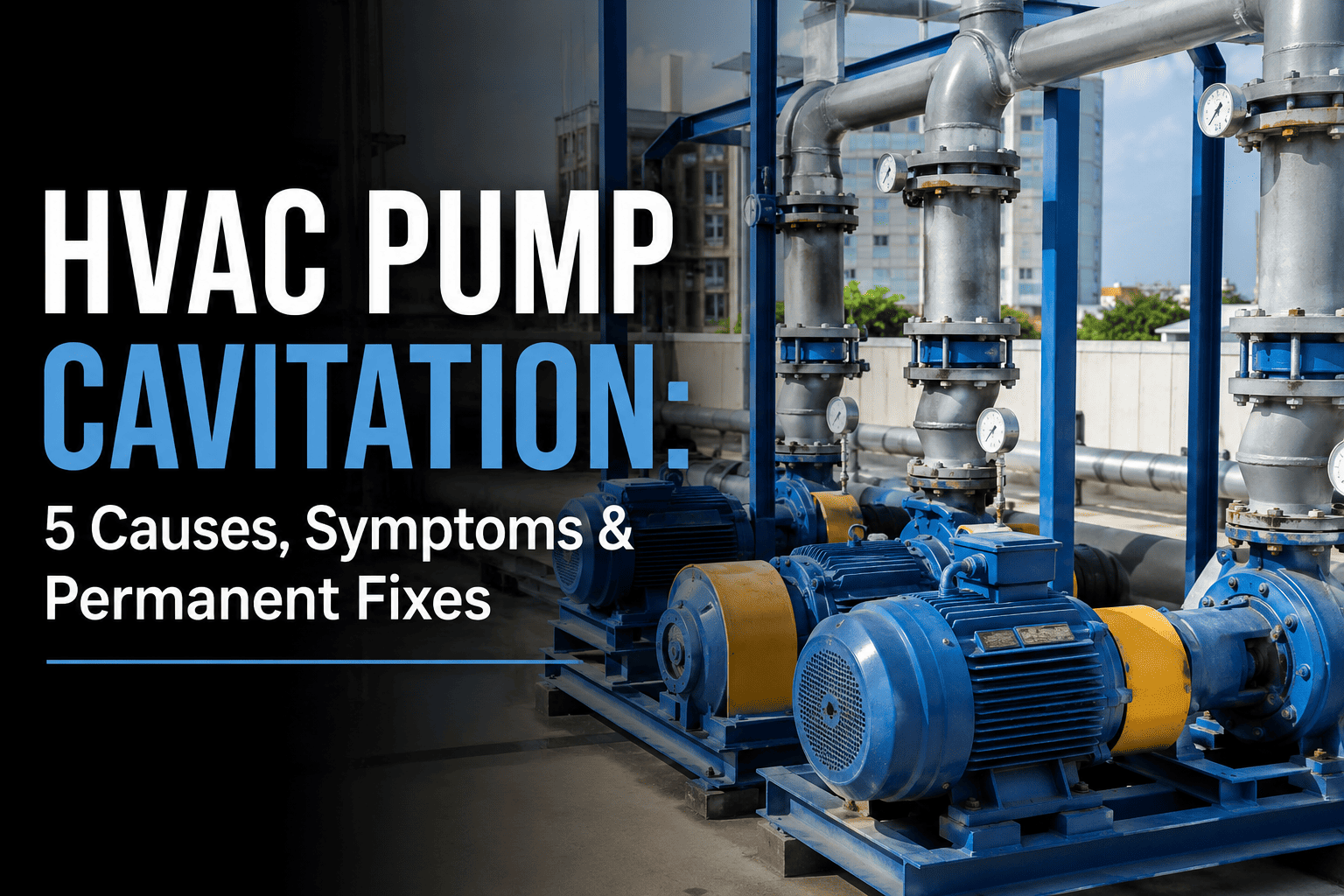
A cavitating HVAC pump sounds like it is pumping gravel. That noise is not an acoustic curiosity — it is vapor bubbles imploding against your impeller at thousands of cycles per minute, eroding metal, destroying bearings, and degrading seals with every hour of operation. The pump is not the problem. The conditions the pump is operating in are. Start a free trial to see how Oxmaint's CMMS tracks pump vibration history and pressure trends before cavitation causes impeller failure.
80%
Of centrifugal pump failures in HVAC systems involve cavitation as a contributing or primary cause of impeller and bearing damage
$18K+
Typical cost of unplanned chilled water pump replacement including parts, labour, and system downtime in a commercial building
5
Root causes of HVAC pump cavitation covered here — each with a permanent fix, not a patch
6mo
Average time between first cavitation symptom and impeller failure when root cause is not addressed
The Core Principle
Cavitation occurs when suction-side pressure drops below the fluid's vapor pressure — water flashes to steam, forms bubbles, and those bubbles collapse violently as pressure recovers. The pump is always the victim. The cause is always upstream: inadequate inlet pressure, restricted suction, oversized operation, or system design that was never right. Fix the conditions, not the pump.
How to Know Your HVAC Pump Is Cavitating
Cavitation produces a recognisable symptom cluster. Any single symptom warrants investigation. Two or more together confirm cavitation is occurring and that impeller damage is already in progress.
Symptom 01
Grinding or Crackling Noise
The unmistakable sound of cavitation — described as pumping gravel, marbles rattling, or rocks moving through the casing. The noise is the acoustic signature of vapor bubbles collapsing against the impeller. It changes intensity with flow rate and system pressure.
Symptom 02
Lower Than Expected Flow
Vapor pockets inside the impeller reduce the effective pumping volume. The system delivers less GPM than the pump curve specifies at the operating point. Zones may report inadequate cooling or heating with no obvious blockage in the distribution circuit.
Symptom 03
Excessive Vibration
Implosing bubbles generate micro-shockwaves that produce measurable vibration beyond normal operating levels. If vibration readings at the pump housing are elevated without a mechanical imbalance explanation, cavitation should be the first diagnosis — not bearing wear.
Symptom 04
Bearing and Seal Failures
Repeated bearing replacements on the same pump — with no apparent overloading — is a strong cavitation indicator. The continuous micro-shock loading from collapsing bubbles accelerates bearing fatigue at a rate far beyond normal wear. Seal leaks following bearing replacement are a secondary consequence.
Symptom 05
Pitted or Eroded Impeller
When the pump is opened during a repair, a pitted, cratered, or roughened impeller surface is visual confirmation of sustained cavitation damage. This surface erosion reduces hydraulic efficiency, increases power draw, and cannot be reversed — the impeller requires replacement.
5 Root Causes of HVAC Pump Cavitation — and Permanent Fixes
Each cause below is followed by its permanent fix. Temporary measures — reducing pump speed, adding discharge valves — only mask the symptom. The fix must address the condition that is causing suction-side pressure to drop below vapor pressure.
01
Insufficient Net Positive Suction Head (NPSHa < NPSHr)
The system cannot deliver adequate pressure to the pump inlet. NPSHa — available net positive suction head — falls below the pump's NPSHr (required). This is the fundamental physics of all cavitation. Every other cause listed below is a specific mechanism that reduces NPSHa below the threshold.
Permanent Fix
Calculate NPSHa for the actual operating conditions and compare against the pump curve's NPSHr line. If NPSHa is within 1–2 metres of NPSHr, the system has no safety margin. Solutions include raising the supply tank or reservoir height (increases static head), reducing suction pipe length and fittings (reduces friction losses), or selecting a pump with a lower NPSHr rating for the same duty point.
NPSHa = Static head + Barometric pressure − Friction losses − Vapour pressure. If this number is less than NPSHr at your flow rate, cavitation is mathematically inevitable.
02
Blocked or Restricted Suction Strainer
A partially or fully blocked Y-strainer on the pump suction creates a pressure drop exactly where the system can least afford one. The strainer was designed to protect the pump — when it is not cleaned, it becomes the cause of the failure it was installed to prevent. This is among the most common and most avoidable causes of HVAC pump cavitation in commercial systems.
Permanent Fix
Clean the suction strainer immediately. Install a differential pressure gauge or sensor across the strainer so that increasing blockage is visible in the BMS before it drops suction pressure to cavitation threshold. Add suction strainer cleaning to a monthly or quarterly PM work order — not as a response to cavitation symptoms, but as a scheduled task that prevents them.
Track strainer differential pressure trends over time in your CMMS. A rising trend between cleanings means the strainer is undersized for the system contamination level — upsize it.
03
Pump Operating Far from Design Point
Every centrifugal pump has a Best Efficiency Point (BEP) on its performance curve. Operating significantly to the left or right of BEP — too little or too much flow — creates internal pressure imbalances. In both cases, the result is low-pressure pockets forming inside the volute that allow vapour bubble formation. An oversized pump forced to throttle at partial flow is a common HVAC cavitation scenario that goes unrecognised for years.
Permanent Fix
Plot the actual operating point against the pump curve using measured flow and differential pressure. If the pump operates consistently outside 70–120% of BEP flow, it is wrongly sized for the duty. For an oversized pump, installing a variable speed drive (VSD) to modulate motor speed to match actual system demand keeps the pump operating near BEP across variable load conditions. This also reduces energy consumption significantly.
VSDs eliminate the throttling valve workaround — the most common temporary fix that keeps the pump running inefficiently while accelerating cavitation damage.
04
High System Water Temperature
Vapour pressure rises with water temperature. As system water temperature increases above design — from a chiller fault, setpoint change, or bypass operating in manual — the same suction pressure that was previously safe falls below vapour pressure and cavitation begins. This is why pumps that run correctly in winter cavitate in summer when condenser water temperatures are elevated or the chiller plant is under stress.
Permanent Fix
Verify system water temperature setpoints are within the range the pump was selected for. Confirm that the chiller plant maintains chilled water supply temperature within design limits during peak conditions. For condenser water pumps, check that cooling tower performance is maintaining the design condenser supply temperature — elevated condenser water temperature raises vapour pressure in the pump circuit and creates cavitation risk even when pump installation is correct.
Link pump cavitation work orders to chiller and cooling tower fault history in your CMMS. Temperature-driven cavitation is always a system-level event, not an isolated pump fault.
05
Insufficient System Pressurisation (Closed Loop)
In closed hydronic loops, the pressure reducing valve (PRV) setting and expansion vessel charge maintain static system pressure. If the PRV is set too low, if the expansion vessel diaphragm has failed, or if there has been a slow system leak that has reduced static pressure, the entire loop operates at a lower pressure — and suction-side pressure at the pump falls below the cavitation threshold during operation.
Permanent Fix
Check static system pressure at the pump suction gauge when the system is at rest. Verify the PRV setting provides adequate cold fill pressure — typically 1.5–2 bar minimum on commercial systems depending on building height. Test expansion vessel pre-charge pressure and replace the vessel if the diaphragm has failed. Track system pressure trends in your CMMS: a gradual downward drift over weeks confirms a slow leak that must be found before cavitation recurs.
Pressurisation faults also cause boiler and chiller lockouts from low-pressure interlocks. A cavitating pump and a low-pressure fault on the chiller appearing at the same time usually share a single upstream cause.
Your Pump Has Already Logged the Cavitation Warning
Suction pressure trends, strainer differential pressure, vibration readings — Oxmaint's CMMS connects these signals into a pre-cavitation alert before your impeller needs replacement. Sign up free or book a demo to see it live.
The Cavitation Damage Timeline — What Happens If You Wait
Cavitation damage is progressive and non-reversible. Each stage below represents a measurable escalation in repair cost and system impact. Sign up to Oxmaint to catch the early signals before the timeline advances.
First Noise — No Visible Damage Yet
Occasional grinding sound, slightly reduced flow, vibration readings marginally elevated. The impeller surface has micro-pitting beginning. System performance still within acceptable range. This is the lowest-cost intervention point — fix the root cause now and no components need replacement.
Consistent Noise, Flow Deficit Measurable
Crackling sound present on every operating cycle. Flow rate measurably below design GPM. Zones beginning to report inadequate capacity during peak load. Bearing temperature slightly elevated. Impeller pitting is progressing and the pump is drawing more power to compensate for reduced hydraulic efficiency.
Bearing and Seal Failures Begin
First bearing failure. Seal begins leaking after bearing replacement due to misalignment from cavitation-induced vibration. Repair cost now includes bearing, seal, and labour — but the impeller is still salvageable at this stage if the root cause is corrected simultaneously. Most facilities at this stage treat the bearing as the problem, replace it, and reinstall into unchanged cavitating conditions.
Impeller and Casing Failure — Full Replacement
Impeller eroded beyond repair. Casing surface pitting may be present. Motor windings at risk from sustained abnormal current draw. Full pump replacement required, plus system downtime, emergency labour rates, and possible chiller or AHU impact from loss of distribution. Cost is 5–10 times what it would have been at Week 1–4 intervention.
HVAC Pump Cavitation — Preventive Maintenance Schedule
| Frequency |
PM Task |
Cavitation Cause Prevented |
| Weekly |
Visual check — noise, vibration, system pressure gauge, suction strainer differential pressure indicator |
Early symptom detection; blocked strainer before it causes suction pressure drop |
| Monthly |
Suction strainer clean and inspect, system static pressure log, pump amp draw vs design check |
Blocked strainer cavitation; low system pressurisation drift; operating point deviation |
| Quarterly |
Expansion vessel pre-charge pressure test, PRV setpoint verification, vibration measurement at bearing housings |
Loop pressurisation failure; early bearing wear from cavitation micro-shock loading |
| Annual |
Plot actual operating point on pump curve, inspect impeller for surface condition, bearing and seal replacement per OEM interval, system water temperature setpoint audit |
Off-BEP operation, early impeller erosion identification, temperature-driven cavitation |
| Post-Repair |
Confirm root cause was corrected before reinstating pump — verify suction pressure, flow rate, and vibration baseline within 48 hours of restart |
Prevents reinstating a repaired pump into unchanged cavitating conditions — the single most common cause of repeat failures |
Why Cavitation Repeats in the Same Pump
The bearing is replaced. The pump is reinstalled. The noise returns within 60 days. This is the most common HVAC pump failure pattern in facilities without a CMMS. The corrective action closed the repair ticket — it never addressed why NPSHa dropped below NPSHr. Oxmaint links every pump repair to the root cause work order, tracks suction pressure trends against design values, and flags when post-repair operating data deviates from baseline — before the second bearing fails. Book a demo to see the pump asset intelligence workflow.
Frequently Asked Questions
Q
Is HVAC pump cavitation the same as air in the system?
No — they produce similar noises but have different causes and different solutions. Air in the system is entrained gas that entered through a leak, poor filling procedure, or inadequate air separator. Cavitation is water vapour formed when suction-side pressure drops below the liquid's vapour pressure — it is a phase change, not a gas intrusion. Bleeding air from the system will not resolve cavitation. Addressing the suction pressure condition will.
Q
Can a variable speed drive (VSD) fix pump cavitation?
A VSD can reduce or eliminate cavitation caused by operating far from the pump's Best Efficiency Point. By modulating motor speed to match actual system demand, the pump operates closer to BEP across varying load conditions, reducing the internal pressure imbalances that cause cavitation at off-design flow rates. A VSD does not fix cavitation caused by a blocked strainer, low system pressurisation, or elevated fluid temperature — those require separate corrective actions.
Q
How quickly does cavitation damage an impeller?
This depends on cavitation severity and impeller material. In a moderately cavitating commercial HVAC pump, surface pitting begins within weeks. Measurable performance degradation — reduced flow, elevated power draw — typically appears within 2–3 months. Bearing failures and seal leaks follow at 4–5 months. Full impeller failure requiring replacement occurs at 6–12 months in most commercial HVAC scenarios. Severe cavitation — from a completely blocked strainer or major pressurisation failure — can destroy a pump significantly faster.
Q
What maintenance records should I keep for HVAC pump cavitation events?
Every cavitation event should be recorded against the pump asset with: the date and operating conditions when first identified, the root cause determined (not just the symptom), all corrective actions taken including parts replaced, and the post-repair verification data — suction pressure, flow rate, vibration readings — to confirm the root cause was resolved. Without post-repair verification data in a CMMS, there is no way to confirm the fix worked or to detect if the same condition recurs. This is the documentation gap that causes most repeat HVAC pump failures.
Stop Replacing Bearings. Fix the Cavitation.
Oxmaint tracks suction pressure trends, strainer differential pressure, vibration baselines, and post-repair verification data against every pump asset — so your team identifies cavitation conditions before the impeller is damaged, not after the third bearing replacement. AI RCA, automated PM scheduling, CAPA closure tracking, and full compliance documentation in one platform.
Pump Asset Intelligence
AI Root Cause Analysis
Automated PM Scheduling
CAPA Closure Tracking
Post-Repair Verification