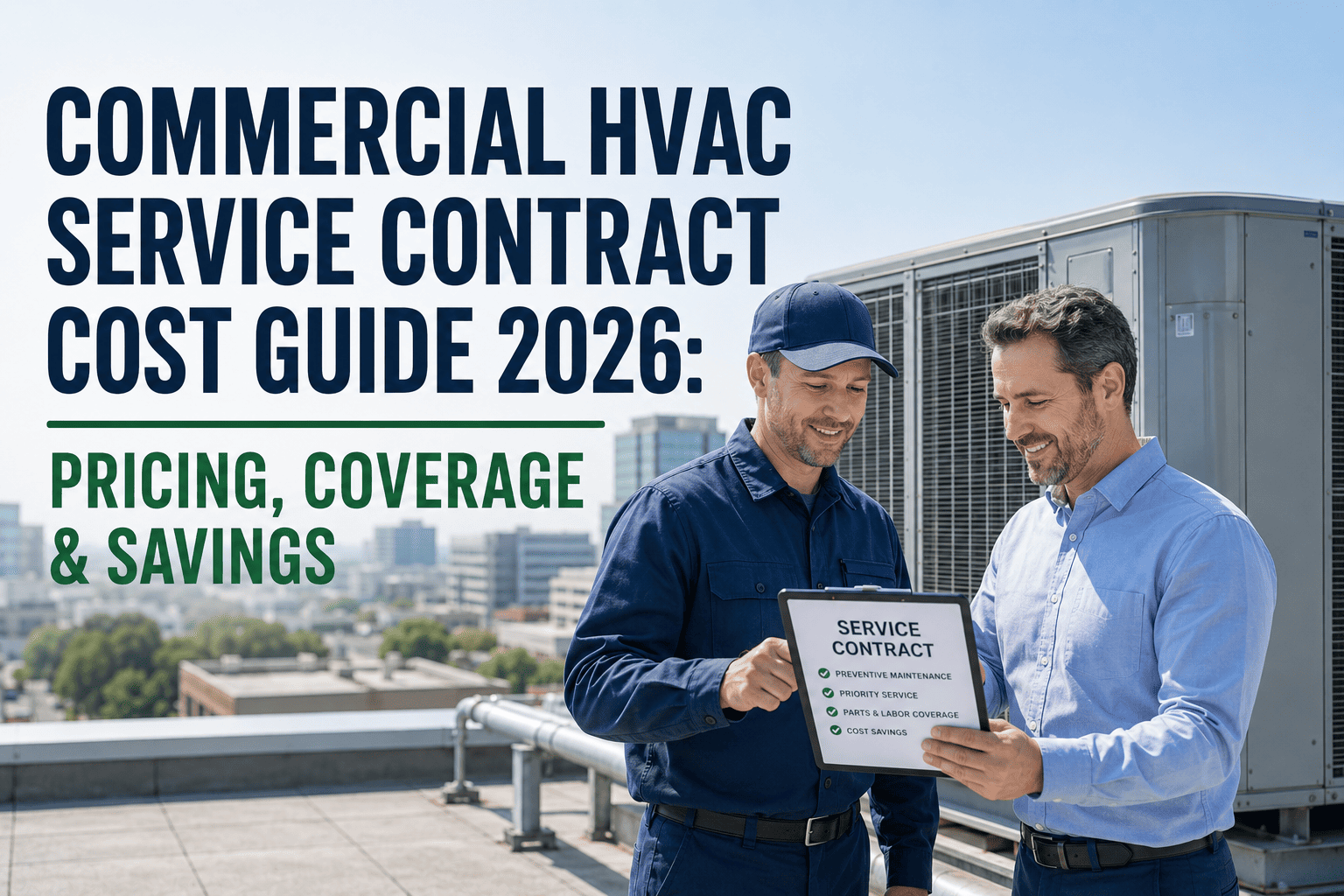
Commercial HVAC service contracts range from $500 to $50,000+ per year — and what you pay depends entirely on what you get. Most facility teams overpay for coverage they do not need, or underbuy and absorb emergency repair costs that dwarf the savings. This 2026 guide breaks down every contract type, pricing factor, and coverage decision so your team negotiates from knowledge, not guesswork. Start free on OxMaint and track your HVAC contract performance against actual asset cost data.
Know What Your HVAC Contracts Are Actually Delivering
OxMaint logs every PM visit, repair event, and parts cost against each HVAC asset — giving you the data to hold vendors accountable and prove contract ROI to leadership.
The 4 Contract Types — And What Each Actually Covers
Every vendor pitches their contract differently. The names change, but the structure falls into four tiers. Understanding exactly what is and is not covered is the only way to compare quotes fairly. Book a demo to see how OxMaint helps you track vendor performance against contract commitments.
Tier 1
Inspection-Only
$500 – $1,500 / yr
Periodic check-ins: filter changes, basic visual inspection, simple performance checks. No repair coverage — emergencies billed separately at standard rates.
Covers
Filter changes
Visual inspection
Basic diagnostics
Repairs
Parts
Emergency callouts
Best for: small retail, low-criticality spaces
Tier 2
Preventive Maintenance (PMA)
$1,500 – $5,000 / yr
Scheduled PMs with belt inspection, lubrication, condensate drain cleaning, electrical checks, and thermostat calibration. Most repair and emergency costs remain your liability.
Covers
Scheduled PM visits
Minor adjustments
Priority scheduling
Discounted repairs
Emergency labor
Major parts
Best for: mid-size offices, multi-unit buildings
Tier 3
Full Labor Contract
$5,000 – $20,000 / yr
All labor for repair, replacement, and maintenance is covered at a fixed annual cost. You pay for parts and equipment separately — the contractor absorbs labor overruns.
Covers
All scheduled PMs
All repair labor
Emergency labor
System reporting
Parts and equipment
Replacement units
Best for: large offices, multi-site portfolios
Tier 4
Full-Coverage Contract
$10,000 – $50,000+ / yr
All-inclusive: labor, parts, emergency service, and sometimes equipment replacement. Fully predictable cost. The contractor carries all repair and failure risk.
Covers
All labor
All parts
Emergency callouts
System reporting
Equipment replacement
Capital upgrades
Best for: hospitals, data centers, food service
2026 Pricing Reference: What Facilities Actually Pay
Contract pricing scales with building size, equipment count, system complexity, and coverage tier. These ranges reflect 2025–2026 national averages from documented facility and industry data. Sign up free on OxMaint to build your own per-asset cost baseline.
Small Commercial
Retail, café, small office — single RTU or basic split system
$500 – $1,500
per year
One avoided emergency repair pays for 2–3 years of coverage
Mid-Size Office
Multiple units, zoned cooling — 10,000–50,000 sq ft
$1,500 – $5,000
per year
50,000 sq ft with 8 RTUs + 4 splits: $8,000–$16,000 on standard plan
Large Commercial
Office towers, shopping centers, 100,000–300,000 sq ft
$5,000 – $20,000
per year
PdM platform adds $30,000–$60,000 but returns $98,000–$188,000 annually
Hospital / Data Center
Critical-environment facilities with 24/7 HVAC dependency
$20,000 – $50,000+
per year
Full-coverage contract is essential — one cooling failure costs $300,000+/hr
7 Factors That Drive Your Contract Price Up or Down
Two buildings the same size can receive quotes that differ by 3x. These are the variables that move the needle — and the ones worth negotiating before you sign.
01
Equipment Count and Type
Chillers, cooling towers, and AHUs cost significantly more to maintain per unit than standard rooftop units. A building with a central chiller plant commands a higher contract base than one with equivalent capacity across packaged RTUs.
02
Equipment Age and Condition
Older equipment requires more frequent servicing and carries a higher parts risk. Contractors price this in. A building with systems past their design life will pay 20–40% more for the same coverage tier than a building with newer equipment.
03
Visit Frequency
Quarterly visits cost more than semi-annual, but prevent more failures. For high-criticality assets, quarterly or monthly inspections deliver the strongest ROI. For low-load equipment, semi-annual is often sufficient.
04
Coverage Scope
Labor-only contracts transfer parts risk to you. Full-coverage contracts transfer all risk to the vendor — at a premium. The right choice depends on your equipment age, system criticality, and appetite for budget variability.
05
Emergency Response Terms
Response time guarantees — 2-hour, 4-hour, next-business-day — meaningfully change contract cost. For critical facilities, 2-hour response terms can add 15–30% to annual contract value. Get these terms in writing before signing.
06
Operating Hours and Facility Use
Year-round, 24/7 operation accelerates wear dramatically. A data center or hospital HVAC system running continuously degrades faster than a 9-to-5 office system — and contractors price that load profile into the contract.
07
Geographic Region
Labor markets vary significantly. Commercial HVAC technicians bill $110–$190 per hour in 2026 depending on region — with coastal markets running at the high end. Local supply chain access for parts also affects emergency repair pricing in contracts.
The Hidden Costs Most Teams Miss When Budgeting
The sticker price on a maintenance contract is never the whole story. Facilities routinely underbudget by 25–40% because they miss costs that do not appear on the service invoice. Sign up free and OxMaint will help you capture the full picture per asset, not just per contract year.
PM
Parts Markup on Non-Contract Repairs
Even on PMA contracts, parts for non-covered repairs often carry a 20–40% vendor markup over market rate. Without a CMMS tracking parts costs per asset, this markup compounds invisibly over time.
EN
Energy Penalty from Deferred Faults
A fouled heat exchanger or degraded fill media not caught during a PM visit silently increases energy consumption. According to Energy Star, unmaintained HVAC systems can increase energy use by up to 60% — a cost that never appears on a maintenance invoice.
DT
Downtime Between Contract Response and Repair
Contracts quote response times, not resolution times. A 4-hour response to a chiller failure still means hours or days of downtime if parts are not stocked locally. Factor resolution time — not just response time — into your contract evaluation.
CP
Capital Replacement Not Covered
Most contracts — even full-coverage tiers — exclude capital replacement of major equipment. A chiller that exceeds its repair cost threshold becomes a budget surprise unless your asset cost data already shows the trend coming.
Contract Value Calculator: What You Are Actually Getting
Before signing, run this quick comparison. It shows the true cost-benefit of each contract tier against your building's actual risk profile. Book a demo to see how OxMaint helps you build this analysis from your own maintenance records.
Scenario
Inspection-Only
PMA
Full Coverage
Annual Contract Cost (mid-size)
$800
$2,500
$8,000
Emergency repairs included
None
Discounted
Included
Average emergency repair cost if failure occurs
$5,000–$22,000
$2,500–$11,000
$0
Failures prevented annually
1–2 minor
3–5 events
Up to 90%
Total cost if 1 major failure occurs
$5,800–$22,800
$5,000–$13,500
$8,000 (fixed)
What to Demand in Every Contract — Before You Sign
SL
Response Time SLAs in Writing
Verbal commitments mean nothing at 2am when your chiller trips. Require specific, written response time guarantees tied to penalty clauses or service credits. Know the difference between response and resolution.
SC
Scope Exclusions Listed Explicitly
Every contract has exclusions. Refrigerant charges, coil replacements, control board failures — get the exclusion list in writing and price those risks separately in your maintenance budget contingency.
RP
Service Reports After Every Visit
Without written service records, you cannot track condition trends, hold vendors accountable, or build the asset history that predictive maintenance depends on. Require reports — and log them in OxMaint against the specific asset.
PR
Parts Pricing Transparency
For labor-only and PMA contracts, get a written commitment on parts markup percentages over market cost. Without this clause, emergency parts on non-covered repairs can carry 40–60% markups that compound across a multi-year contract.
How OxMaint Maximizes Your Contract ROI
A service contract is only as valuable as the data proving it performed. OxMaint gives facility teams the asset cost history, PM completion records, and failure pattern reports that turn a vendor relationship into a measurable, accountable investment. Sign up free — no sensor hardware required to start.
Track
Every PM visit and repair against the specific asset — not just the invoice date
Compare
Contract cost vs. actual repair spend per asset over rolling 12 and 24 months
Flag
Assets with rising repair frequency that signal contract tier upgrade or replacement
Report
Export documented evidence of maintenance ROI to justify budget requests to leadership
Get More From Every HVAC Service Contract
OxMaint tracks PM completion, repair history, and asset cost trends — so you always know whether your contract is delivering, and have the data to renegotiate when it is not.
Frequently Asked Questions
How much does a commercial HVAC service contract cost in 2026?
Commercial HVAC service contracts range from $500 per year for a single small-system inspection plan to $50,000+ annually for full-coverage agreements on large, critical-environment facilities. A 50,000 sq ft office building with multiple rooftop units typically pays $8,000–$16,000 annually on a standard preventive maintenance plan. Mid-size offices commonly spend $1,500–$5,000. Large commercial facilities with chillers and complex systems run $5,000–$20,000 on labor-covered plans. Start free on OxMaint to begin tracking your per-asset maintenance costs today.
What is the difference between a PMA and a full-coverage HVAC contract?
A Preventive Maintenance Agreement (PMA) covers scheduled visits, minor adjustments, and sometimes discounted repairs — but emergency labor and major parts remain your liability. A full-coverage contract includes all labor, parts, and emergency callouts at a fixed annual cost, transferring the repair risk entirely to the vendor. For critical environments where downtime has outsized business impact, full coverage is worth the premium. For lower-criticality spaces, a PMA with documented asset history in a CMMS can deliver most of the value at lower cost. Book a demo to see how OxMaint helps you make this decision with real data.
Is a commercial HVAC maintenance contract worth the cost?
Yes — for virtually every commercial facility. A single avoided emergency repair typically pays for two to three years of a basic maintenance contract. One compressor failure caught early costs $3,500–$8,000 versus $18,000–$45,000 at breakdown. Commercial contracts also prevent up to 90% of system failures when properly structured and executed, according to industry research. The ROI case is strong at every tier — the question is which tier is right for your equipment profile and risk tolerance.
What should every commercial HVAC service contract include?
At minimum: written response time guarantees with defined penalties, an explicit list of coverage exclusions, written service reports after every visit, and transparent parts pricing terms for non-covered repairs. Contracts without written exclusion lists and SLAs are the most common source of budget surprises and vendor disputes. Always demand documentation — and log it in a CMMS so condition history accumulates against each asset over time, not just in a file drawer.