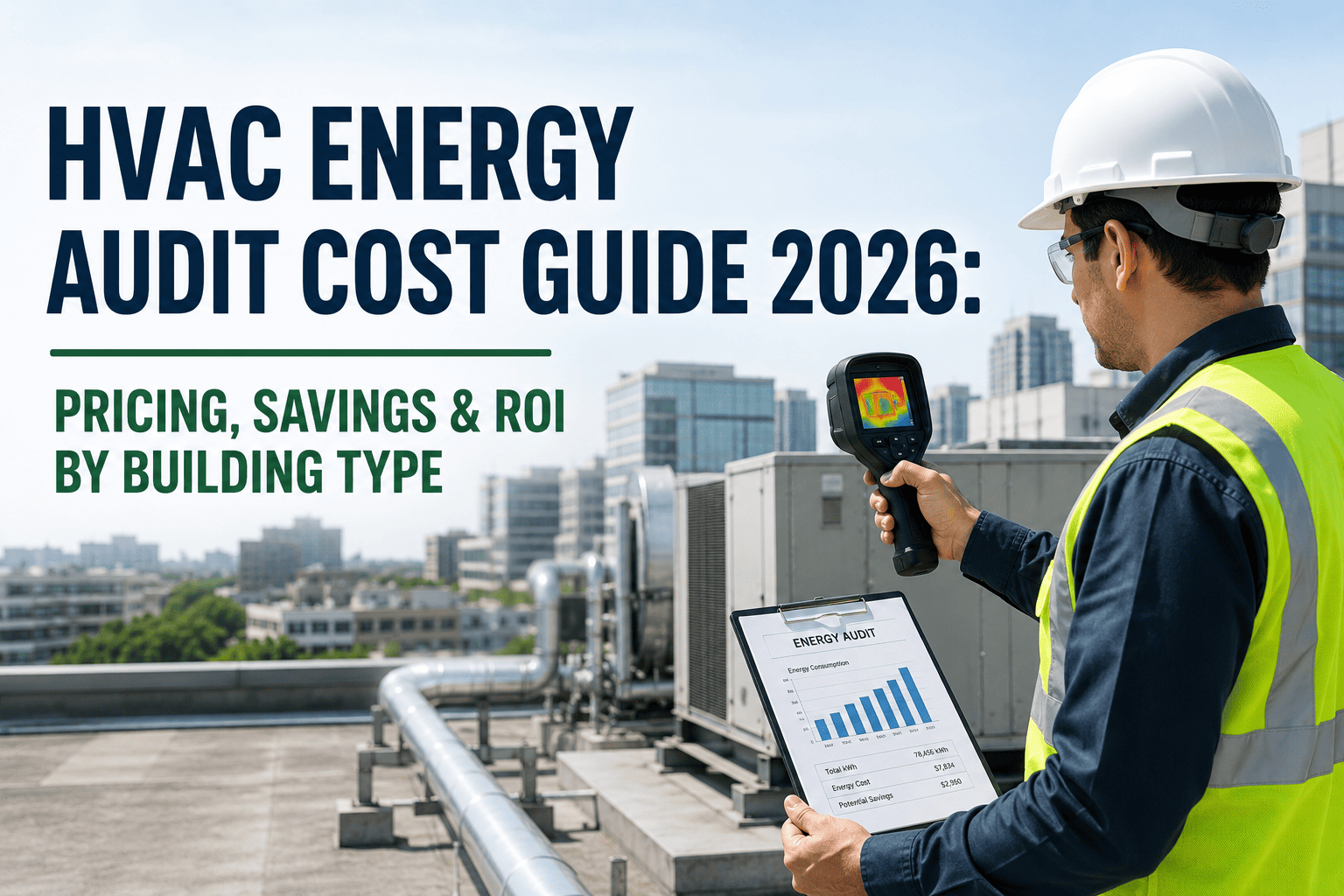
HVAC accounts for 40 to 50 percent of total energy use in most commercial buildings. Yet a 2025 BOMA survey found that 62 percent of facility managers were unaware of the specific ROI an energy audit could deliver — leaving average potential savings of 20 to 30 percent untapped. An HVAC energy audit does not just tell you where energy is escaping. It builds the investment case to fix it. Sign up for Oxmaint to start tracking your HVAC energy and maintenance data, or book a demo to see how the platform supports audit preparation and post-audit implementation tracking.
$0.05–$0.50
per sq ft — commercial HVAC energy audit cost range across ASHRAE Levels 1 through 3
10–30%
energy savings typically identified from a Level 2 audit — DOE confirmed benchmark
40–50%
of total commercial building energy consumed by HVAC — the single largest target for savings
1–3 yrs
typical payback on energy recovery retrofit measures identified through HVAC audit
The Three ASHRAE Audit Levels: What You Are Buying
Commercial HVAC energy audits follow the ASHRAE Standard 211 framework, which defines three progressively deeper levels of analysis. Selecting the wrong level is the most common reason facility managers get an audit report that collects dust rather than drives action. Each level produces fundamentally different deliverables — and carries a different price tag. Book a demo to see how Oxmaint's energy module supports audit data collection and post-audit ECM tracking.
ASHRAE Level 1
Walk-Through Assessment
5–10% savings identified
Structured walkthrough plus 12 months of utility bill review. Visual inspection of HVAC, lighting, and controls. Identifies no-cost, low-cost, and capital-intensive opportunities — without detailed financial modelling. Best used as a screening tool before committing to a Level 2 scope.
Best for: Benchmarking, screening, pre-lease due diligence, buildings under 20,000 sq ft
ASHRAE Level 2
Energy Survey & Analysis
10–30% savings identified
The industry standard for most commercial buildings. Adds detailed system-by-system analysis, end-use breakdowns, engineering-based savings estimates, and simple payback calculations for each energy efficiency measure (ECM). Each identified measure gets cost, savings, and payback data. This is the level that produces an actionable implementation roadmap.
Best for: Most mid-size and large commercial buildings, ESG reporting baseline, retrofit investment planning
ASHRAE Level 3
Investment-Grade Audit
20–50% savings identified
Takes Level 2 findings and develops them into project-ready specifications. Includes vendor bids, calibrated energy modelling, measurement and verification plans, and detailed financial projections for board-level approval. The precision reduces investment risk — you are paying for certainty, not estimates. Used when capital decisions require executive or lender sign-off.
Best for: Performance contracts, major retrofit financing, LL97 / MEES compliance strategies, large campus or portfolio decisions
Audit Cost by Building Type: 2026 Reference Pricing
Building complexity — system count, age, BMS integration, and occupancy type — drives cost more than square footage alone. A 50,000 sq ft hospital audits differently from a 50,000 sq ft office box. These ranges reflect Level 2 audit pricing, which is the most commonly procured scope. Sign up for Oxmaint to begin organising your HVAC energy data before an auditor arrives — pre-organised utility and maintenance data can reduce your audit cost by 15–25%.
Small Office / Retail
Under 10,000 sq ft
$1,000 – $3,500
Level 1 or 2. Simple RTU systems. Most auditors use flat-fee pricing at this scale. High-value quick wins typically in scheduling and setpoints.
Mid-Size Office
10,000–50,000 sq ft
$3,500 – $12,500
Level 2 standard. Multi-zone HVAC, lighting, and envelope analysis. ECM list with 10–25 measures typical. HVAC scheduling and VFD retrofits usually top the list.
Large Commercial
50,000–200,000 sq ft
$10,000 – $40,000
Level 2 to Level 3. Chiller, AHU, BMS, and sub-metering analysis. Demand charge reduction opportunities often revealed. Multiple ECMs with 2–8 year payback.
Hospital / Healthcare
Any size, 24/7 operation
$15,000 – $60,000+
Level 2 or Level 3 required. Critical systems, process loads, 24/7 operation complexity, and air quality compliance all add audit scope and cost.
Campus / Multi-Building
200,000+ sq ft
$30,000 – $100,000+
Level 3 for major retrofit decisions. Central plant, district energy, and process load complexity. Sub-metering often installed as part of the audit scope.
Industrial / Manufacturing
Process-dependent
$20,000 – $80,000+
Process load analysis adds significant scope. Compressed air, process cooling, and heat recovery opportunities often account for the highest-value ECMs outside HVAC.
What the Audit Actually Finds: ROI by ECM Category
A Level 2 audit typically produces 15 to 25 energy efficiency measure candidates. Not all are worth implementing. The measures below are the categories that appear most consistently across commercial HVAC audits — ranked by typical ROI and implementation simplicity. Understanding this before you commission an audit helps you evaluate whether the findings are comprehensive and the recommendations realistic. To track implementation of audit recommendations and measure actual savings against projections, book a demo to see Oxmaint's energy performance module.
HVAC Scheduling & Setpoint Optimisation
10–20%
Immediate – 6 months
Low — controls only
LED Lighting Retrofit + Occupancy Sensing
40–60% (lighting load)
1–3 years
Low–Medium
VFD Installation on Fans & Pumps
15–35%
2–4 years
Medium
Energy Recovery Ventilation (ERV)
Up to 50% (ventilation load)
1–3 years
Medium
BMS Upgrade / Fault Detection
5–15%
2–5 years
Medium
High-Efficiency Chiller Replacement
20–25%
4–10 years
High — capital project
Building Envelope Air Sealing
5–12%
3–7 years
Medium
Demand Charge Management
30–50% of demand charge
Under 2 years
Medium
Turn Audit Findings into Tracked Savings
Oxmaint logs HVAC energy performance data, tracks ECM implementation timelines, and measures actual savings against audit projections — giving your team and your finance leadership visibility into whether the audit investment is delivering.
Sign up free to start building your energy baseline, or
book a demo to see the full energy performance module.
The ROI Case: What a $10,000 Audit Can Return
The most common objection to commercial energy audits is the upfront cost. The numbers below show why that framing is usually wrong. These examples are based on 2026 median commercial energy cost data and DOE-confirmed savings benchmarks.
Mid-Size Office — 50,000 sq ft
4.8 months
audit payback period from first-year savings alone
Large Commercial — 200,000 sq ft
3.9 months
audit payback period — 10-year cumulative savings exceed $1.2M with 3% utility escalation
What Reduces — and What Inflates — Your Audit Cost
Pre-organised utility data. Having 12–24 months of utility bills plus maintenance records ready before the auditor arrives reduces billable site time by 15–25% on most Level 2 audits.
Existing BMS / sub-metering. Buildings with operational building management systems reduce data collection time materially — auditors analyse rather than measure.
Simple system configuration. Single-occupancy buildings, standard rooftop unit configurations, and buildings under 20,000 sq ft benefit from flat-fee pricing that can be significantly below per-sq-ft rates.
Utility-sponsored audits. Many major US utilities offer subsidised or free Level 1 audits as part of demand-side management programmes. Always check utility programme availability before going to market.
24/7 or critical environments. Healthcare, data centres, and continuous-process facilities require after-hours access, additional safety protocols, and more complex system documentation — all adding cost.
Ageing or undocumented systems. Buildings with no as-built drawings, equipment without nameplate data, or controls that require reverse-engineering take significantly more auditor time.
Sub-metering installation. Level 3 audits often require temporary or permanent sub-meter installation to capture end-use data. Budget $5,000–$20,000 separately if sub-metering is not already in place.
Multiple buildings or sites. Multi-building campus audits may not scale linearly — mobilisation, travel, and site coordination add cost that per-sq-ft estimates do not capture.
Frequently Asked Questions
QHow much does a commercial HVAC energy audit cost in 2026?
Commercial HVAC energy audit costs range from $0.05 to $0.50+ per square foot depending on ASHRAE audit level, building complexity, and size. A Level 1 walk-through of a 50,000 sq ft office building typically costs $2,500–$5,000. A Level 2 audit of the same building runs $5,000–$12,500. A Level 3 investment-grade audit of a 200,000 sq ft complex can cost $50,000–$100,000+. The median Level 2 audit of a standard commercial office building prices at approximately $0.15–$0.20 per square foot.
QWhat energy savings can I expect from a commercial HVAC audit?
ASHRAE energy audits typically identify savings of 5–10% from Level 1 quick wins, 10–30% from Level 2 comprehensive recommendations, and 20–50% from Level 3 deep retrofit analysis. HVAC scheduling and setpoint optimisation alone — which costs almost nothing to implement — accounts for 10–20% savings in most buildings. VFD installations and energy recovery ventilation typically deliver 15–35% and 40–50% savings respectively on the targeted loads, with payback periods of 1–4 years.
QWhich ASHRAE audit level do I need?
For most commercial buildings without existing audit data, a Level 2 audit is the right starting point. It produces a prioritised list of energy efficiency measures with financial analysis — actionable at the facility management level. Level 1 is appropriate for screening or buildings under 20,000 sq ft. Level 3 is warranted when you need investment-grade financial projections for board approval, performance contract financing, or compliance with mandatory benchmarking regulations (LL97 in New York, MEES in the UK, and similar frameworks).
QHow do I reduce the cost of a commercial energy audit?
Organising 12–24 months of utility bills, equipment inventories, and maintenance records before the auditor arrives is the single most effective cost reduction lever — typically saving 15–25% of billable site time. Buildings with operational BMS systems reduce audit cost further. Always check whether your utility offers subsidised or free Level 1 audits as part of demand-side management programmes before going to market — many major US utilities do. Using a CMMS like Oxmaint to maintain ongoing energy and maintenance records dramatically speeds the data collection phase of any audit.
QWhat happens after the audit is complete?
The audit report is the starting line. The savings come from execution, verification, and preventing the building from drifting back to old operating patterns. A structured implementation plan with tracked ECM status, baseline versus actual energy performance comparison, and regular measurement and verification is what converts audit findings into lasting savings. Without tracking, most buildings lose 30–60% of identified savings within 18 months as operations revert. This is exactly what Oxmaint's energy and maintenance platform supports —
book a demo to see how post-audit tracking works.
Oxmaint: The Platform That Makes Audit Findings Stick
HVAC energy data tracking, ECM implementation logging, maintenance cost records, and performance trending — all in one platform. Facility managers at commercial properties, healthcare sites, and multi-building portfolios use Oxmaint to capture audit savings and keep them.
Start free today, or
book a demo to see the full platform.