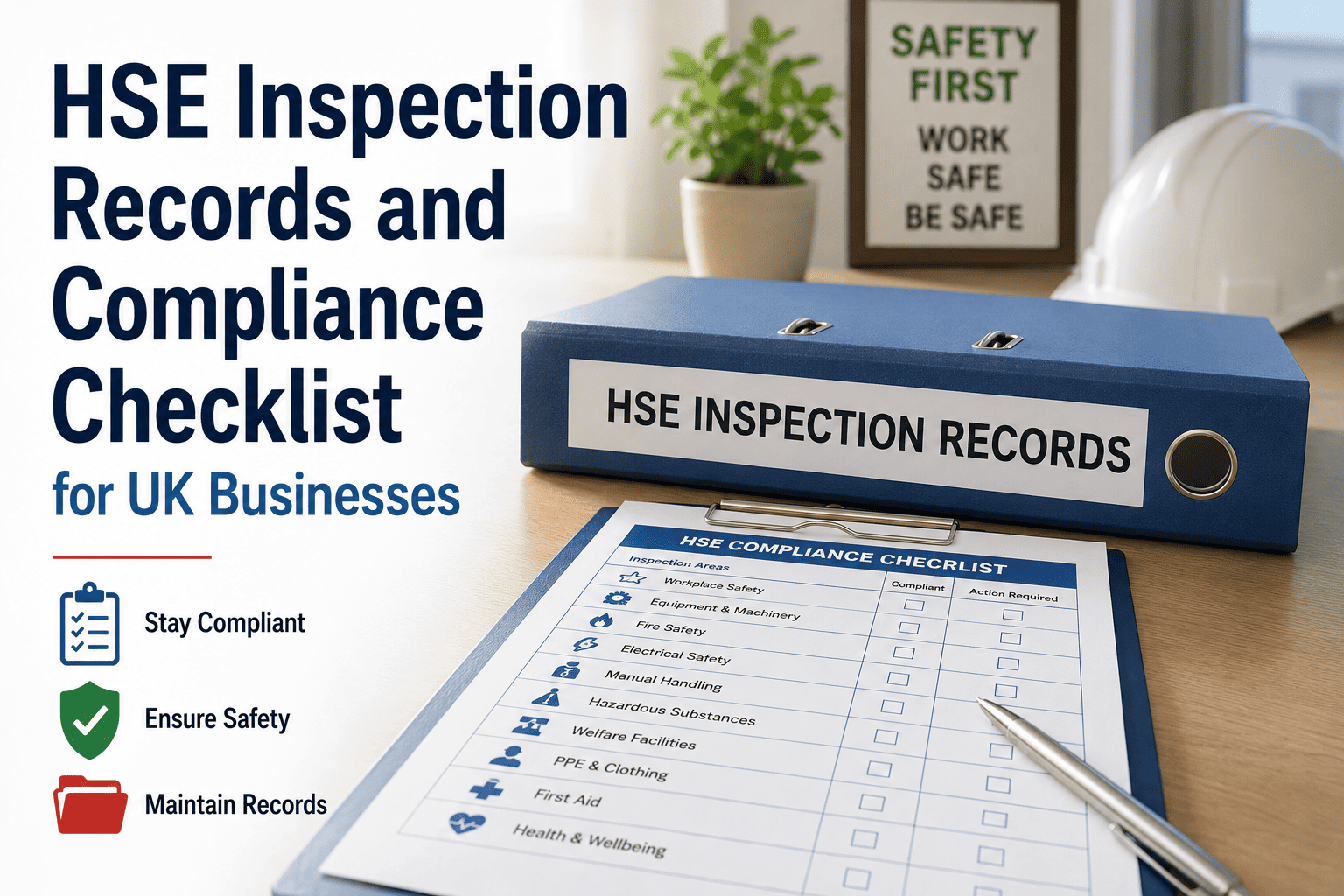
HSE inspections can arrive without warning, and when they do, your business success hinges on one critical thing: documented proof that you've been managing health and safety systematically. According to the Critical Compliance Gap Report 2024, 68% of UK organisations admit they would likely fail an unannounced HSE inspection due to poor record-keeping and inadequate compliance documentation. This is not just a regulatory concern — inspectors now have broad enforcement powers, and failure to maintain proper records can trigger improvement notices, fines reaching millions of pounds, and in serious cases, prosecution.
HSE inspection records are timestamped, auditable documents that prove your organisation has identified hazards, implemented controls, trained staff, and tracked corrective actions. Digital inspection records, compliance checklists, and audit trails must demonstrate "reasonable practicability" — that you've done everything reasonably possible to protect worker health and safety. Without these records, you cannot defend your compliance position when inspectors visit.
The Hidden Cost of Poor HSE Record Keeping
Paper spreadsheets, disconnected folders, and memory-dependent systems create compliance vulnerabilities that inspectors spot immediately. A single HSE visit can expose years of documentation gaps.
Paper forms get lost, spreadsheet versions are unclear, and no one remembers which induction briefing covered which topic. When the inspector asks for training records from six months ago, you scramble to compile fragmented evidence. Even then, missing signatures and incomplete dates undermine your defence.
A hazard is identified on site, but no one knows who raised it, when follow-up was completed, or what was actually fixed. Disconnected systems mean inspections live in one database, corrective actions in another, and training records scattered across email inboxes. This fragmentation proves lethal during investigations.
Without scheduled reminders, inspection cycles slip. Risk assessments expire without renewal. Training records go stale. The HSE's 2025/26 enforcement focus includes proactive inspections across construction, healthcare, and logistics — sectors where outdated documentation triggers immediate improvement notices and follow-up visits.
What HSE Inspectors Actually Look For in Your Records
HSE inspectors arrive with a clear mandate: assess compliance with the Health and Safety at Work etc. Act 1974 and sector-specific regulations. They're not interested in effort — they're hunting for documented evidence of systematic control.
Every significant hazard must have a documented assessment showing who identified it, what control measures were implemented, and when they were reviewed. Vague assessments without specific control details fail inspection scrutiny immediately.
Inspectors expect timestamped records showing who received what training, when they completed it, and evidence they understood the material. Generic "refresher training" every three years no longer suffices — continuous professional development records are now standard expectation, particularly for stress management and first aid.
Every incident, near-miss, and hazard observation must be logged with timestamp, description, reported by, and closure evidence. RIDDOR reporting documentation must show immediate notification to the HSE where incidents meet the threshold. Gaps or delays here trigger additional enforcement scrutiny.
When a hazard is identified, inspectors want to see exactly what was done to address it, who was responsible, the deadline, and evidence that the action was completed. A hazard logged without closure demonstrates poor safety culture and invites escalated enforcement.
Documented safety inspections, equipment audits (LOLER for lifting, PUWER for machinery), fire safety checks — all must be timestamped with findings, observations, and follow-up actions. Missing inspection records in regulated sectors are immediate compliance failures.
Building Your HSE-Ready Compliance Checklist
A systematic checklist ensures no critical documentation is overlooked. Digital compliance checklists improve speed and accuracy compared to paper-based systems, and they generate timestamped audit trails that inspectors can access instantly.
Struggling to Keep Inspection Records Organised and Ready?
Digital compliance platforms eliminate spreadsheet chaos, automatically timestamp every record, and generate inspection-ready audit trails in seconds. Instead of assembling documents when inspectors arrive, you pull a complete compliance package instantly. Start a free trial to see how digital inspection records accelerate your compliance readiness — no setup fees, immediate deployment.
Why Digital Inspection Records Beat Paper and Spreadsheets
The shift from manual systems to digital platforms is no longer optional for serious compliance programmes. Here's why inspectors and regulators expect digital records in 2025.
Key Features Your Digital Compliance Platform Must Have
Not all inspection software is built for HSE compliance. Look for platforms designed specifically for UK regulatory requirements and inspection workflows.
Every inspection, signature, and corrective action is timestamped automatically. Inspectors can see exactly when records were created, who completed them, and what changes were made. This eliminates disputes over record authenticity and strengthens your legal defensibility during investigations.
Templates pre-configured for RIDDOR reporting, COSHH assessments, LOLER equipment checks, fire safety inspections, and incident investigations. These are mapped to UK regulatory requirements, saving time and ensuring no critical compliance field is missed during inspections.
When a hazard is logged, the platform automatically creates a corrective action with deadline, responsible person, and priority level. Overdue actions trigger alerts automatically, and closure is recorded only when corrective action evidence is submitted and verified.
Generate inspection reports, compliance summaries, and audit documentation in seconds. When the HSE inspector asks for your records, you pull a complete, formatted compliance package immediately — no manual compilation, no delays, no missing documents.
HSE Sectors with Heightened Inspection Focus in 2025
The HSE's 2025/26 enforcement priorities target specific sectors with proactive, unannounced inspections. If your business operates in these areas, digital inspection records are now essential compliance infrastructure.
2,700+ inspections in 2024/25. CDM compliance, fall protection, confined space work, and training records now under intense scrutiny. Digital RAMS documentation and site induction records are essential.
Violence and aggression prevention, stress management, and musculoskeletal disorder controls are now central to HSE audits. Training records and psychological health risk assessments are critical.
Manual handling, musculoskeletal risks, and LOLER equipment inspections remain HSE priorities. Digital equipment registers and training records must demonstrate ongoing compliance across all shifting staff.
Violence prevention, stress management risk assessment, and employee health and wellbeing records are now expected. Chemical handling and fire safety documentation remain baseline requirements.
Stress, mental health, and violence prevention are priority areas. All staff training records, risk assessments, and incident documentation must be comprehensive and audit-ready.
Machine guarding, PUWER compliance, occupational lung disease, and asbestos management inspections remain stringent. Equipment register and maintenance records must be complete and current.
How to Transition From Paper to Digital Inspection Records
Moving to digital compliance doesn't require a complete system overhaul. Most organisations deploy digital inspection records within 2 to 3 weeks with no disruption to operations.
Inventory existing inspection forms, checklists, and documentation. Identify gaps, missing audit trails, and inconsistencies in your current system. This creates a baseline for what needs to be migrated to digital format.
Select or build digital inspection templates matching your specific compliance requirements — RIDDOR reporting, COSHH assessments, equipment inspections, incident logs. Pre-populate regulatory requirements and mandatory fields to ensure consistency across all users.
Ensure all staff conducting inspections understand how to use the digital platform, capture required evidence (photos, signatures), and complete checklists correctly. Training should cover both mobile app usage and desktop reporting functions.
Begin conducting inspections digitally and track completion rates via the platform dashboard. Monitor for compliance gaps — overdue inspections, incomplete records, unsigned findings — and address immediately. Within weeks, your audit trail will be complete and inspection-ready.
Ready to Build HSE-Ready Inspection Records?
Digital inspection platforms eliminate documentation stress and ensure your business is always prepared for unannounced HSE visits. Instead of paper chaos, you get timestamped, searchable, audit-ready records in seconds. Start your free trial now — deploy digital inspections in your business within days and see compliance readiness improve immediately.
Frequently Asked Questions: HSE Inspection Records and Compliance
Stop Scrambling for Records — Build Your HSE-Ready Compliance System Today
68% of UK businesses admit they'd fail an unannounced HSE inspection due to poor record-keeping. Digital inspection platforms eliminate this risk entirely. Deploy timestamped, audit-ready inspection records in days, not months. Start your free trial and see how digital compliance transforms your inspection readiness immediately. Book a demo with our team to explore HSE-specific features and deployment timelines.