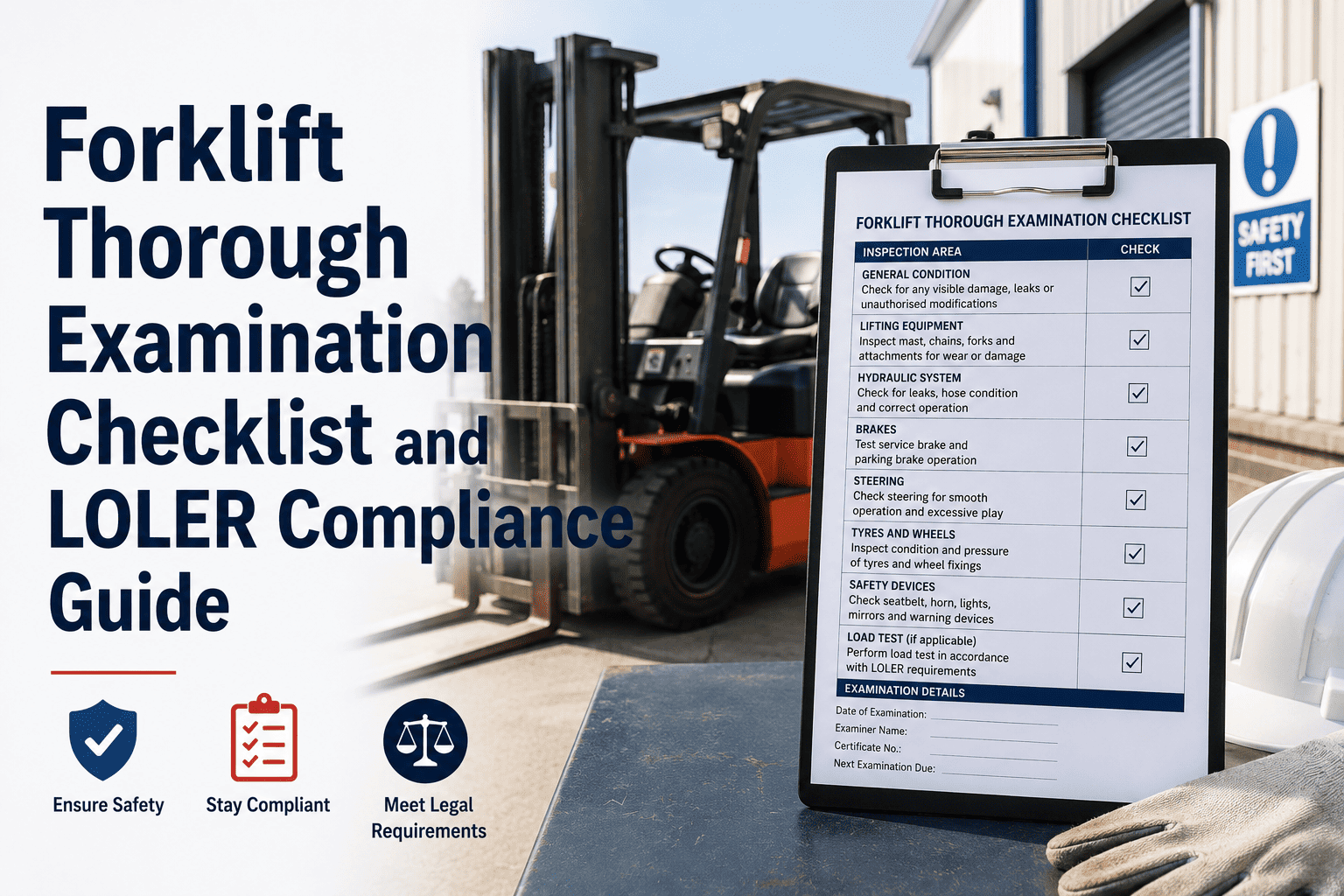
Forklift Thorough Examination Checklist and LOLER Compliance Guide
By Mark strong on May 27, 2026
If your business owns, leases, or hires forklift trucks in the UK, you are a duty holder under LOLER 1998 — and that duty cannot be transferred to a hire company or subcontractor. The forklift thorough examination is a statutory legal requirement, not a manufacturer recommendation. Without a current, signed Report of Thorough Examination on file, your operation is in breach regardless of how well maintained the truck is. Sign up free to manage forklift examination records digitally, or book a demo to see how OxMaint handles LOLER and daily operator checks in one place.
LOLER 1998Forklift ComplianceCFTS Standard
Forklift Thorough Examination Checklist and LOLER Compliance Guide
What UK businesses must do to comply with LOLER and PUWER for forklift trucks — inspection frequencies, CFTS examinations, daily operator checks, and audit-ready records
Maximum LOLER thorough examination interval for forklifts used to lift goods
6 months
Required interval if the forklift is used at any point to lift people
CFTS
Industry standard combining LOLER and PUWER into one accredited examination
Per shift
Frequency required for operator pre-use checks under ACOP L117 and PUWER
What This Guide Covers
01Legal Framework — LOLER, PUWER and CFTS
02Inspection Frequencies by Truck Type
03Thorough Examination Checklist
04Daily Operator Pre-Use Checklist
05Records You Must Hold
06Compliance Readiness Check
Section 01
The Legal Framework — LOLER, PUWER, CFTS and ACOP L117
Forklift truck compliance sits at the intersection of four regulatory instruments. Each one is independent. Satisfying one does not satisfy the others — and each carries its own enforcement consequences.
LOLER 1998
Regulation 9
Lifting Operations and Lifting Equipment Regulations
Applies to forklifts because they raise and lower loads. Requires a thorough examination by a competent person at defined intervals. The examination must produce a signed Report of Thorough Examination (ROTE) — the statutory evidence of compliance. A maintenance service certificate is not a ROTE and does not satisfy LOLER.
Annual thorough examination as minimum
PUWER 1998
Regulations 5–9
Provision and Use of Work Equipment Regulations
Applies to the driving components — brakes, steering, tyres, controls, overhead guard, and operator restraint. Requires equipment to be suitable, maintained in safe condition, and used only by trained persons. Pre-use operator checks are a PUWER requirement, not merely good practice. A LOLER report alone does not satisfy PUWER.
CFTS is the recognised industry standard for forklift thorough examinations in the UK. A CFTS-accredited examination covers both LOLER and PUWER requirements in a single inspection. Non-CFTS examinations may only address LOLER components, leaving PUWER obligations unmet. The CFTS mark on a report confirms dual-regulation coverage.
Combined LOLER and PUWER coverage
ACOP L117
HSE Approved Code
Rider-Operated Lift Trucks: Operator Training and Safe Use
The HSE Approved Code of Practice that translates LOLER and PUWER obligations into practical day-to-day steps for forklift operations. Specifies pre-use operator checks at the start of every shift, operator training requirements, and supervision duties. Compliance with ACOP L117 is treated as evidence of PUWER compliance in most enforcement proceedings.
Defines operator check frequency and content
Hand pallet trucks are exempt from LOLER — the regulation applies only to powered trucks that mechanically raise and lower loads. Manual hand pallet trucks and non-powered sack trucks do not require a LOLER thorough examination, though PUWER still applies to their maintenance and safe use.
Section 02
Forklift Inspection Frequencies — What the Regulations Actually Require
Frequency is set by how the equipment is used, not by the type of truck alone. Get this wrong and the inspection programme is non-compliant even if every inspection is otherwise carried out correctly.
Required Inspection Frequencies by Truck and Check Type
LOLER 1998, PUWER 1998, and ACOP L117 combined requirements
Any forklift that has been involved in a collision, suffered suspected overload, or has been out of service for an extended period must be thoroughly examined before returning to work — regardless of when the last scheduled examination was carried out.
Never Miss a Forklift Examination Date Again
OxMaint sets the correct LOLER frequency per truck, auto-triggers thorough examination reminders, and captures daily operator checks in the same system. Sign up free and configure your entire forklift fleet register from day one.
Forklift Thorough Examination Checklist — What a CFTS Inspection Covers
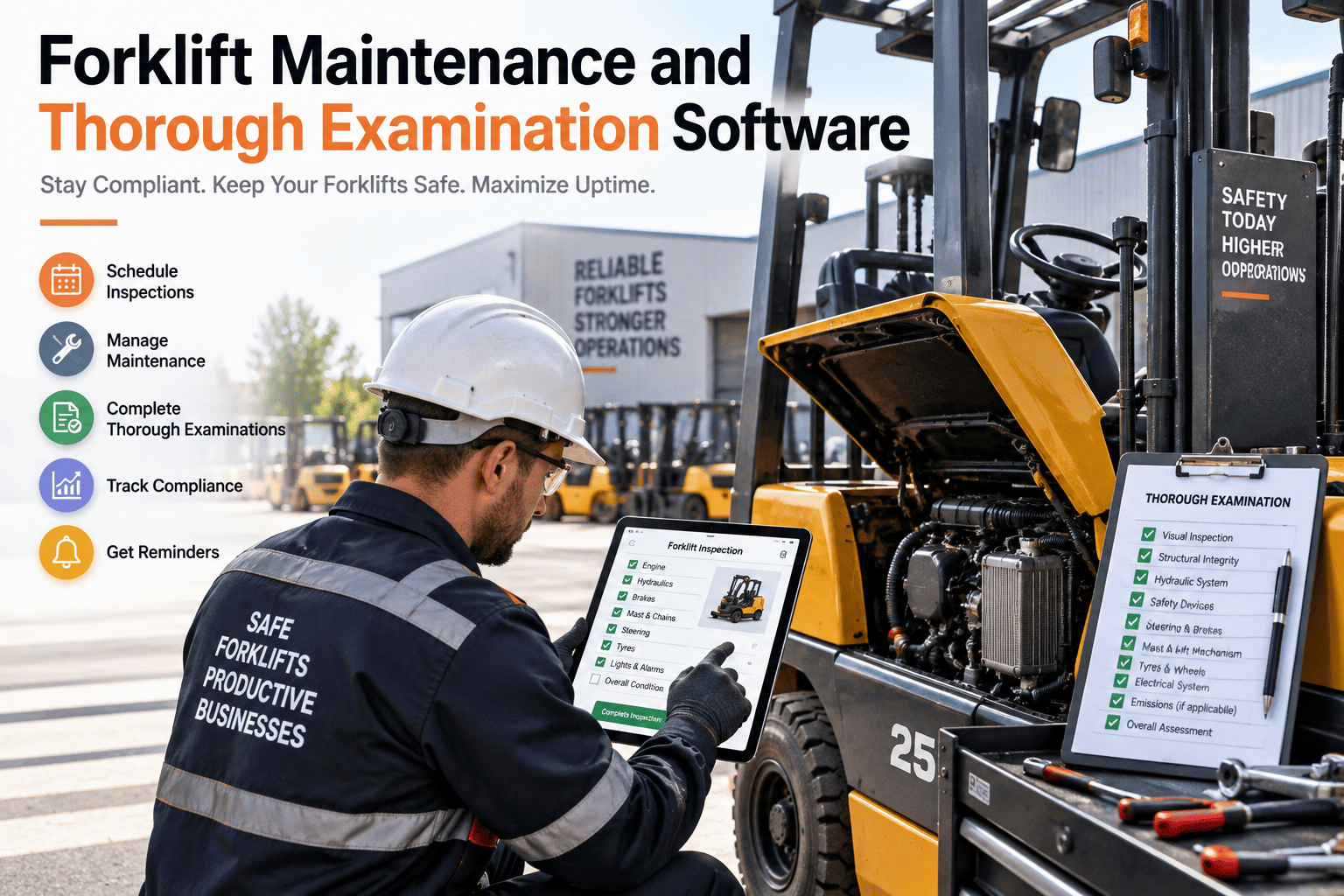
A thorough examination is a structured statutory assessment — not a service and not a visual look-over. A competent examiner will typically take one to three hours per truck. These are the areas the examination must address to satisfy both LOLER and PUWER under the CFTS standard.
Pre-Examination Documents
Previous Report of Thorough Examination (ROTE) on file and available
Maintenance and service history records
Manufacturer's capacity plate and safe working load data
Record of any accidents, collisions, or overload incidents since last examination
Asset register — truck model, serial number, age, and current attachments
Mast Assembly and Carriage
Mast channels — wear, scoring, straightness, and structural integrity
Mast welds — cracks, deformation, corrosion at all weld points
Carriage — condition of carriage plate, rollers, and side play
Load backrest extension — structural integrity, no bends or damage
Tilt cylinders — seals, rod condition, synchronisation
Overhead guard — structural integrity, secure fixing, no deformation
Forks and Fork Arms
Fork heels — crack inspection, the most common fork failure point
Fork blade straightness — no visible bend or twist across full length
Fork thickness — wear measurement at heel against original specification
Fork tip levelness — both forks level within tolerance
Securing pins and positioning locks — present, functional, and undamaged
Fork surface cracks — visual and where required, dye penetrant or magnetic particle test
Lift Chains and Hydraulics
Lift chains — link condition, stretch measurement, corrosion, lubrication
Chain anchor bolts and fixing pins — condition and security
Hydraulic lift cylinder — seals, rod condition, external leaks
Engine or motor — condition, mounts, fluid levels, leaks
Counterweight — secure fixing, no cracks or damage
Tyres, Wheels and Chassis
Tyre condition — cuts, swarf penetration, sidewall integrity, tread wear
Pneumatic tyre pressure — all tyres at manufacturer specification
Wheel rims — condition, flange integrity for pneumatic-fitted rims
Wheel nuts — torque check, all present and correctly tightened
Chassis frame — cracks, deformation, corrosion at stress points
Axle pins and pivots — condition and correct lubrication
Safety Systems and Controls
Seat and seatbelt — secure fixing, belt function and condition
Operator restraint system — presence and correct operation
All operating controls — correct function, no sticking or obstruction
Warning horn — operational
Lights — headlights, reversing light, hazard light where fitted
Reversing alarm — operational where required
Capacity plate — legible and matching current truck configuration
Safety guards — all covers and guards in place and secure
Examination Outcome and ROTE
All defects formally categorised — immediate danger or time-limited
Defects requiring immediate action communicated to duty holder in writing
Report of Thorough Examination signed by named competent person
Next examination due date recorded on ROTE and in asset register
CFTS mark applied to report where examiner is CFTS-accredited
Copy of ROTE retained and available for HSE inspection on request
Section 04
Daily Operator Pre-Use Checklist — ACOP L117 and PUWER Requirements
The pre-use operator check is a PUWER duty, not optional guidance. Under ACOP L117, it must be carried out at the start of every shift by the assigned operator. Checks backdated or completed in bulk are legally worthless and a common HSE finding. Sign up free to capture operator checks digitally at the point of check — timestamped, signed, and instantly retrievable.
Engine Off — Static Checks First
Mast and Carriage
Visible damage, foreign items, correct lubrication on chains
Forks
Cracks at heel, damage, securing pins and positioning locks in place
Charge level, connector condition, no visible damage or leakage on electric trucks
Seat and Seatbelt
Secure fixing, belt retracts correctly, buckle functions
Overhead Guard
Intact, secure, no cracks or deformation
Attachments (if fitted)
Secure at fixing points, hydraulic connections undamaged, only if operator is trained on attachment
Engine On — Operational Checks
Warning Lights and Instruments
All dashboard warning indicators clear, fuel or charge gauge functional
Service Brake
Pedal feel normal, response immediate, no pull to one side
Parking Brake
Engages and holds, releases cleanly
Steering
Normal feel, no unusual play, full lock both directions
Lift, Lower and Tilt Functions
Mast raises and lowers smoothly, tilt forward and back, no jerking or drift
Operating Controls
All hand and foot controls operate correctly with no obstruction
Horn
Audible and operational
Lights and Reversing Alarm
All lights functional, reversing alarm sounds when reversing engaged
Computerised Systems
Truck management system has initialised correctly with no error codes showing
Any defect identified during the pre-use check must be reported to a supervisor immediately and recorded in writing. The truck must not be used until the defect has been assessed and either cleared as safe or taken out of service for repair. Completed check records — including the operator name, date, shift, and outcome — must be retained as evidence of PUWER compliance.
Section 05
Records You Must Hold — LOLER, PUWER and ACOP L117
An inspection without a retrievable record is legally equivalent to no inspection. These are the three layers of documentation every forklift duty holder must be able to produce.
Layer 1
Report of Thorough Examination (ROTE)
Equipment description, serial number, and site location
Date of examination and next examination due date
Safe working load confirmed or revised
All defects found — categorised by immediate or time-limited risk
Name, signature, and employer of the competent person
CFTS mark where examination is CFTS-accredited
Electronic records are acceptable provided they are producible in printed form on request and protected from alteration.
Layer 2
Defect Records and Resolution Trail
Every defect identified in the ROTE formally recorded
Remedial action taken — work done, parts replaced, date completed
Engineer name and sign-off on resolution
Follow-up examination where required before return to service
Open defects clearly identified and tracked to closure
Open defects with no resolution trail are the most common immediate audit finding — and in serious cases trigger a prohibition notice.
Layer 3
Daily Operator Check Records
Operator name and date and shift of every check
Pass or fail outcome for each check item
Defects reported and supervisor notified
Truck status after check — cleared for use or taken out of service
Retained as continuous PUWER and ACOP L117 evidence
Backdated or batch-completed check records are immediately identifiable to an HSE inspector and treated as no records at all.
Section 06
Forklift Compliance Readiness Check
These five questions reflect what HSE inspectors look for when reviewing forklift compliance records. An honest "no" to any of them is a gap that creates legal exposure today. Book a demo to see how OxMaint closes each one automatically.
ROTE on File
Can you produce a current, signed Report of Thorough Examination for every forklift in your fleet within 10 minutes if an HSE inspector requests it today?
If no: you are legally non-compliant regardless of whether the physical examination was carried out.
Overdue Exams
Can you confirm right now which trucks in your fleet have a thorough examination overdue — without checking a paper register or spreadsheet?
If no: overdue thorough examinations are live LOLER breaches accumulating without visibility.
Daily Checks
Are daily operator pre-use check records held for every truck for every shift in the last 12 months — with operator name, date, and outcome recorded?
If no: your PUWER and ACOP L117 evidence trail has gaps that auditors specifically look for.
Defect Tracking
Are all defects identified in ROTE reports tracked through to confirmed resolution — with a remedial work record and closure date on file?
If no: open defects with no resolution record are an immediate audit finding and potentially a prohibition notice.
Attachments
Are all forklift attachments — clamps, rotators, sideshifters — examined every 6 months as lifting accessories under LOLER Reg 9(3)(b)?
If no: attachments are the most commonly missed LOLER compliance gap on forklift fleets.
With OxMaint
All five are handled automatically — ROTE records, daily check capture, defect tracking, attachment schedules, and full audit-ready export in minutes.
What is the difference between a LOLER thorough examination and a routine forklift service?
A routine service addresses lubrication, filter changes, fluid levels, and mechanical wear items as part of a planned maintenance schedule. A LOLER thorough examination is a statutory inspection focused specifically on whether the lifting equipment is safe for continued use — assessing structural integrity, load-bearing capacity, safety critical components, and legal compliance. They are two separate legal obligations. A service certificate does not satisfy LOLER, and a ROTE does not replace the need for a maintenance programme. Both must be in place and both must be evidenced separately. Sign up free to manage both in one system.
Who is responsible for LOLER compliance when a forklift is hired rather than owned — the hire company or the operator business?
Both may have duties, but the operating business — as the person in control of the lifting operation — cannot discharge its LOLER duty simply by pointing to the hire company. The operating business must ensure the hired truck has a current ROTE before it enters service, that any examination due during the hire period is carried out, and that daily operator checks are completed and recorded throughout the hire. Hire company inspection certificates are their own legal document — they do not transfer the duty holder's LOLER obligations.
Do forklift attachments — clamps, sideshifters, rotators — require separate LOLER inspections from the truck itself?
Yes. Forklift attachments are classified as lifting accessories under LOLER Regulation 9(3)(b), which means they require a thorough examination every six months — regardless of how often the truck itself is examined. This is the most commonly missed LOLER compliance gap on forklift fleets. Each attachment must have its own examination record and its own next-due date tracked independently. The CFTS examination standard covers attachments alongside the truck in a combined inspection where the examiner is qualified to assess the attachment type. Book a demo to see how OxMaint tracks attachment examination schedules separately per asset.
Can OxMaint capture daily operator pre-use checks on mobile as well as managing the annual LOLER thorough examination schedule?
Yes. OxMaint supports both layers of forklift compliance in the same platform. Daily operator checks are completed on a mobile device at the point of inspection — timestamped, operator-signed, and immediately visible to supervisors. The annual LOLER examination schedule is managed at fleet level, with automatic reminders as due dates approach and escalation if examinations are missed. ROTE records, defect tracking, and resolution trails are all held against the same asset record. The complete compliance picture — thorough examination history, daily check records, and defect resolution — is exportable as a single audit pack per truck.
UK Forklift Fleet Compliance — Free to Start
LOLER Compliance for Forklifts Is Three Separate Records — Not One
OxMaint manages forklift thorough examination scheduling, daily operator pre-use check capture, and defect tracking through to resolution — all in one platform, with full audit-ready evidence export in minutes per truck.