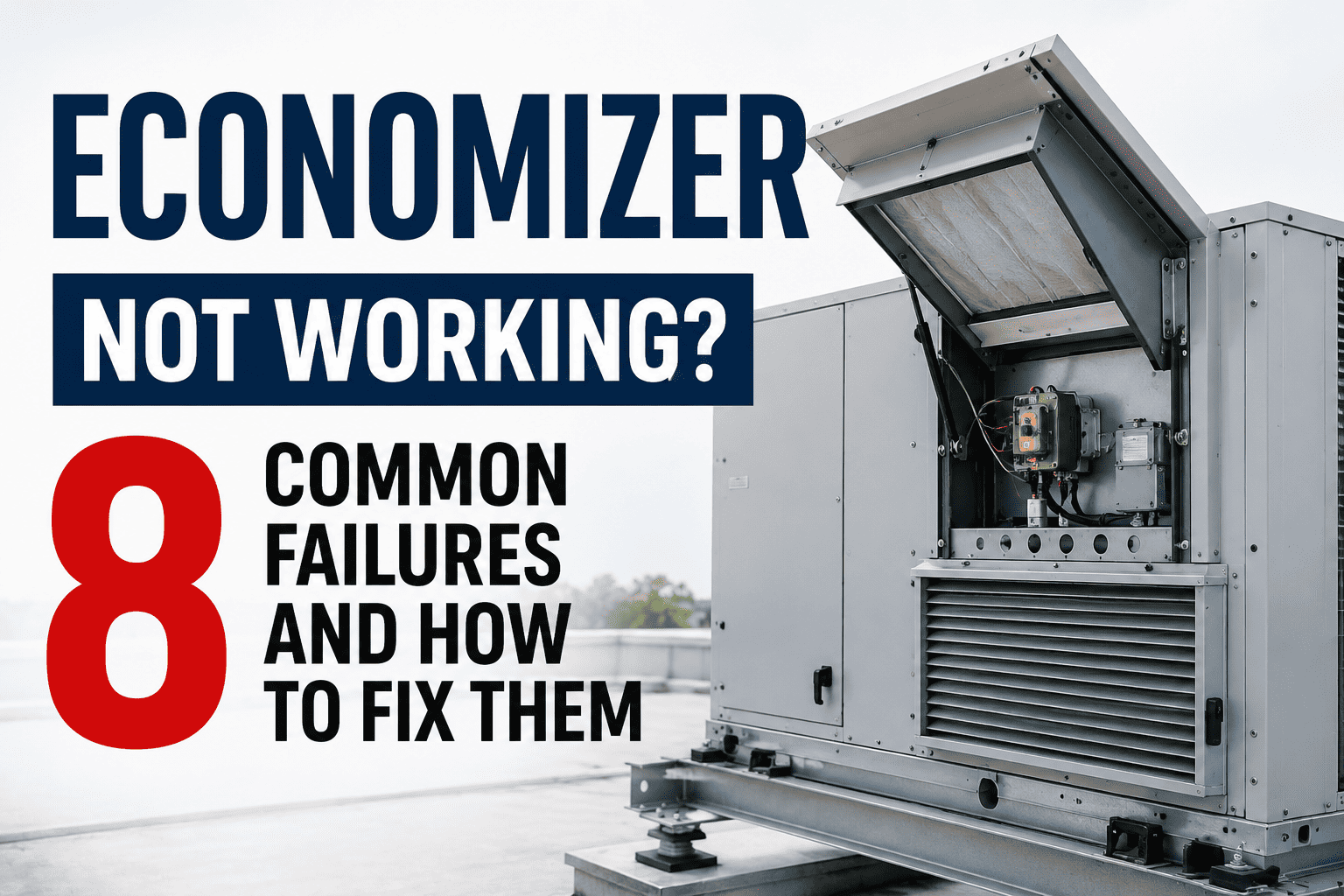
An economizer that stops working does not shut your building down — it silently drains your energy budget. When dampers stick, actuators fail, or sensors drift out of calibration, your rooftop unit keeps running while the "free cooling" you paid to install does nothing. A study by the New Building Institute found that nearly two-thirds of inspected rooftop units had faulty economizers — most of them undetected for months or years. A CMMS like OxMaint keeps economizer maintenance on a documented schedule so failures get caught before they compound into wasted energy and compressor overwork.
Track Every Economizer on a Documented PM Schedule
OxMaint automates damper inspections, sensor calibration reminders, actuator checks, and RTU maintenance — one platform for your entire HVAC asset fleet.
What an Economizer Actually Does — and Why Failure Is Silent
An economizer uses outdoor air to cool a building when conditions allow — reducing or eliminating compressor load during mild weather. When it works, it cuts cooling costs significantly and reduces wear on mechanical equipment. When it fails, the compressor runs when it does not need to, energy bills climb, and nobody gets an alarm. Book a demo to see how OxMaint surfaces these hidden failures through scheduled inspections and work order history.
Sensors Monitor
Outdoor and return air temperature and humidity sensors determine if free cooling conditions exist.
Controls Decide
The economizer control board compares indoor and outdoor conditions and signals damper position.
Actuator Moves
The actuator drives the outside air damper open and the return air damper closed in proportion.
Compressor Rests
Free cooling displaces mechanical cooling — saving energy and reducing compressor wear and cycle count.
8 Common Economizer Failures — Causes and Fixes
Stuck or Binding Damper
The most common economizer failure. Dampers seize in one position — either stuck fully open (flooding the building with unconditioned outdoor air) or stuck closed (eliminating free cooling entirely). Dirt accumulation on linkages, corrosion on pivot points, and mechanical wear from years without lubrication are the primary causes.
Energy bills rising during mild weather. Building feels humid or stuffy regardless of setpoint. Damper visually not moving during rooftop inspection.
Manually inspect damper blades and linkages. Clean debris from all moving surfaces. Lubricate pivot points and linkages per manufacturer spec. Replace seized bearings or damaged blade hardware.
Failed or Weakened Actuator
The actuator is the motor that physically moves the damper. When it weakens, it loses torque and can no longer drive the damper to full open or closed position. When it fails completely, the damper defaults to whatever position it was last in — which may be wide open, drawing unconditioned air nonstop.
Damper stops at partial travel. BAS shows economizer "active" but damper position feedback reads incorrectly. Actuator runs continuously without completing movement.
Test actuator torque output and compare to manufacturer specification. Check actuator amperage with a clamp meter. Replace actuator if torque is insufficient or motor draws abnormal amperage.
Outdoor Air Temperature Sensor Drift
Economizers engage based on outdoor air temperature readings. A sensor that has drifted even a few degrees causes the control system to make wrong decisions — opening dampers when outdoor air is too warm, or refusing to open when free cooling is genuinely available. Sensor drift is gradual and rarely triggers alarms.
Economizer activates during hot weather. Economizer does not activate during cool mild weather. Sensor reading does not match a calibrated reference thermometer held at the same location.
Compare sensor reading to a calibrated reference thermometer. If drift exceeds 2°F, replace the sensor. Ensure the sensor is shielded from direct sunlight and located in an accurate sampling position.
Return Air or Mixed Air Sensor Failure
Enthalpy-based economizers depend on return air temperature and humidity sensors to compare indoor conditions against outdoor air. A failed return air sensor causes the control system to use incorrect baseline data, leading to economizer lockout during good conditions or inappropriate engagement during poor ones.
Flash code 3 or 4 on the economizer module (RA humidity or RA temp fault). Economizer locked out despite mild outdoor conditions. BAS shows implausible return air readings.
Read the economizer module's LED flash code sequence and cross-reference the fault table. Test sensor resistance or voltage output. Replace failed sensor and reset the module after installation.
Faulty or Misconfigured Control Board
The economizer control module manages all sensor inputs and actuator outputs. A failed board causes erratic damper operation, loss of communication with the refrigerant board, or complete economizer lockout. Misconfiguration — wrong high-limit setpoints, incorrect minimum position settings — causes the economizer to behave as if it is faulty even when hardware is intact.
Rapid LED flash code (fast flash = no communication with refrigerant board). Economizer module shows no power despite 24Vac present at terminals. Damper position erratic or unpredictable.
Verify 24Vac at control board terminals. If power is present and module shows no green indicator light, replace the module. If configuration is suspect, reset high-limit and minimum position settings per the unit's service manual.
Incorrect High-Limit or Minimum Position Settings
Many economizers leave the factory or are set during installation with incorrect high-limit cutoff temperatures or minimum position settings. A high-limit set too low locks out the economizer during legitimate free cooling conditions. A minimum position set too high floods the zone with outdoor air even when the system is not in economizer mode, overworking cooling equipment.
Economizer never appears to activate even during cool, dry weather. Space is over-ventilated and humidity is inconsistent. Energy bills are higher than expected in shoulder seasons.
Review and reset high-limit setpoints per ASHRAE 90.1 or local energy code requirements. Set minimum position damper opening per code ventilation requirements for the occupancy type. Verify settings after any control board replacement.
Disconnected or Corroded Wiring
Economizer wiring on rooftop units is exposed to temperature extremes, UV, and moisture cycling over years of operation. Corroded terminals and loose connections cause intermittent control signals — the damper may respond erratically, the actuator may receive no signal, or sensor readings may jump unpredictably. These faults often appear and disappear with temperature changes.
Economizer behavior changes with outdoor temperature swings (a sign of thermally-induced loose connections). BAS intermittently loses economizer point data. Visible corrosion at terminal blocks or weatherhead entry.
Inspect all economizer wiring connections at the control board, actuator, and each sensor. Clean corroded terminals with an electrical contact cleaner. Reseat and torque all terminal screws. Apply dielectric grease at rooftop penetration points.
Blocked or Missing Outdoor Air Filters
Economizers bring outdoor air directly into the air stream. Without functioning outdoor air filters — or with severely clogged ones — dust, debris, and pollen bypass the evaporator coil, fouling the coil surface and degrading heat transfer. Blocked outdoor air filters also reduce the volume of outdoor air the economizer can draw, limiting free cooling effectiveness even when all other components work correctly.
Visible debris accumulation on evaporator coil. Outdoor air damper open but airflow through unit is reduced. Increased coil cleaning frequency required compared to historical baseline.
Inspect outdoor air filters at every RTU PM visit. Replace or clean filters when pressure drop exceeds manufacturer limits. Confirm filter frames are sealed to prevent bypass. Reinstall missing filters immediately.
Failure Impact at a Glance
Each failure mode has a different impact profile. Use this reference when prioritizing which economizer issues to address first across a multi-RTU building or campus portfolio. Sign up free and track these findings as structured work orders in OxMaint.
| Failure Type | Energy Impact | IAQ Impact | Compressor Wear | Detectability |
|---|---|---|---|---|
| Damper stuck closed | High — no free cooling | Medium | High — compressor runs unnecessarily | Low — no alarm |
| Damper stuck open | High — uncontrolled infiltration | High — humidity and contaminants | Medium | Low — no alarm |
| Failed actuator | High | Medium | High | Low |
| OA sensor drift | High — wrong engagement decisions | Medium | Medium | Very Low — gradual |
| Control board fault | High | Medium | High | Medium — flash codes visible |
| Wrong setpoints | Medium to High | Medium | Medium | Very Low — looks normal |
| Wiring corrosion | Medium — intermittent | Low | Medium | Low — intermittent faults |
| Blocked OA filters | Medium — reduced airflow | High — coil fouling | Medium | Medium — visible at inspection |
Economizer PM Schedule — What to Check and When
Economizers are rarely retested after installation. Facilities that add structured economizer tasks to their RTU PM program find failures that would otherwise sit undetected for entire heating and cooling seasons.
Manually verify damper travels full range of motion
Inspect and replace outdoor air filters
Check actuator linkage for binding or looseness
Inspect wiring for corrosion at all terminal points
Calibrate outdoor air and return air temperature sensors
Test actuator torque against manufacturer specification
Verify high-limit setpoints match energy code requirements
Lubricate damper pivot points and linkage hardware
Full functional test — simulate free cooling call and observe response
Read and document all flash codes from economizer module
Verify minimum position settings per current occupancy requirements
Inspect and clean evaporator coil for debris from OA stream
Replace control board after communication fault diagnosis
Replace actuator if torque test fails specification
Replace sensors drifting more than 2°F from calibrated reference
Reroute or replace wiring with signs of UV or moisture damage
How OxMaint Manages Economizer Health Across Your RTU Fleet
Scheduled PM Tasks per RTU
Create quarterly, semi-annual, and annual economizer inspection tasks tied to each rooftop unit asset — auto-generating work orders on schedule so nothing slips through between seasons.
Sensor and Calibration Records
Document every sensor calibration result, flash code event, and actuator test against the specific asset — building a history that makes repeat failures visible before they become expensive patterns.
Work Order Tracking
Every damper inspection, wiring repair, and board replacement is logged with date, technician, and outcome — giving facility managers and auditors a complete economizer service record.
Multi-Building Asset Registry
Manage economizer PM across a single building or a full portfolio of properties — filtering by RTU age, last inspection date, or failure count to prioritize where field attention is needed most.
Stop Losing Energy to Economizers Nobody Is Inspecting
OxMaint puts damper checks, sensor calibrations, and actuator tests on an automatic schedule — so your RTU economizers are verified, documented, and working every season.
Frequently Asked Questions
How do I know if my economizer is working?
The most reliable check is a field observation during conditions that should trigger free cooling — outdoor air below your system's high-limit setpoint (typically 55–65°F). Verify the outside air damper is physically open, the return air damper is partly closed, and the compressor is not running. A clamp meter check on the actuator motor confirms it is drawing power and moving. If energy bills have been rising during mild weather, that is a strong indicator the economizer is not engaging. Sign up free to log inspection results in OxMaint per RTU.
What does an economizer flash code mean?
Most economizer control modules communicate faults through LED flash sequences. Common codes include: 1 flash = actuator fault, 2 flashes = CO2 sensor fault, 3 flashes = return air humidity fault, 4 flashes = return air temperature fault, 7 flashes = outdoor air temperature sensor fault, fast continuous flash = communication failure with the refrigerant control board. Always cross-reference the specific manufacturer's fault table — codes vary by brand and model.
Why is my economizer stuck open?
A damper stuck in the open position is most often caused by a failed actuator that has lost power or torque, a seized damper linkage that the actuator can no longer move back, or a control board fault that has locked the output signal in the open state. A damper stuck open in warm weather is particularly costly — the system pulls in hot, humid outdoor air and fights itself trying to maintain setpoint. Book a demo to see how OxMaint helps flag these failures through structured inspection tasks.
How often should economizers be inspected?
At minimum, economizer dampers, filters, and wiring should be inspected quarterly as part of standard RTU preventive maintenance. Sensors should be calibrated semi-annually and a full functional test — observing actual damper travel in response to a free cooling call — should be performed at least once per year. Many facilities go years without a functional test, which is why two-thirds of inspected RTU economizers are found to be non-functional.
Can a CMMS help manage economizer maintenance?
A CMMS like OxMaint ensures that economizer inspections are not skipped between contractor visits or seasonal service calls. By attaching structured PM tasks to each RTU asset — with checklists for damper travel, sensor calibration, actuator testing, and filter replacement — OxMaint creates the documentation trail that makes economizer failures visible and prevents years of undetected energy waste.