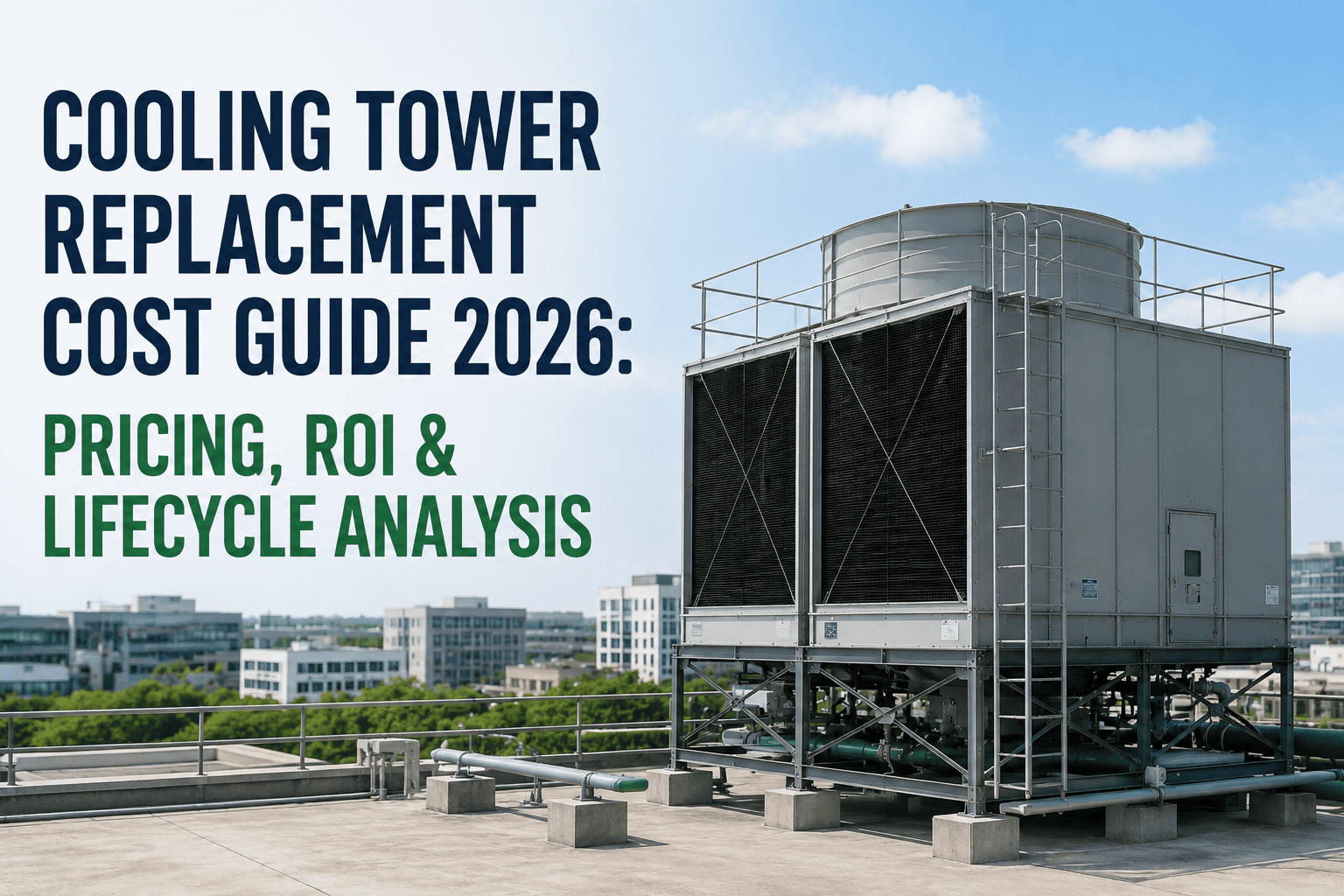
Cooling tower replacement is one of the largest capital expenditure decisions a facility team will make — and one of the most mishandled. Sticker price dominates the conversation while installation, materials, lifecycle costs, and deferred maintenance penalties stay buried in the spreadsheet. In 2026, fully installed cooling tower replacement costs range from $65,000 for a small commercial unit to over $2.5 million for large industrial systems — and installation alone accounts for 30 to 50 percent of total project cost. A CMMS like OxMaint gives facility and capital planning teams the asset condition history, maintenance cost records, and lifecycle data needed to make replacement decisions on facts, not estimates.
Build Your Cooling Tower Replacement Case with Real Asset Data
OxMaint tracks maintenance costs, inspection history, and lifecycle spend per asset — giving you the documented evidence to justify replacement timing and capital investment to leadership.
2026 Replacement Cost Benchmarks by System Size
These are fully installed costs — equipment, labor, rigging, crane where required, and standard site preparation. They do not include hazardous material disposal (add 10–15%), piping and electrical realignment ($10,000–$25,000), or regulatory compliance upgrades that may be triggered by the permit process. Book a demo to see how OxMaint helps capital planners document current asset condition to support project scoping.
Cost by Design Type: What You Are Actually Comparing
Design type affects not just capital cost but energy consumption, maintenance access, water usage, and long-term operational expense. Budget comparisons that look at equipment price alone miss the 20-year cost picture entirely.
| Design Type | Relative Capital Cost | Energy Use | Maintenance Access | Best Application |
|---|---|---|---|---|
| Induced Draft Crossflow | Moderate | Low–Moderate | Easy — side access to fill and basin | Commercial HVAC, light industrial |
| Induced Draft Counterflow | Moderate–High | Low | Moderate — vertical fill requires lift access | Data centers, hospitals, precision cooling |
| Forced Draft | Lower | Higher — base fan recirculation losses | Easy — ground-level fan access | Height-restricted sites, urban rooftop applications |
| Closed-Loop Fluid Cooler | 2–3x Open Circuit | Moderate | Good — no open basin exposure | Food processing, pharma, Legionella risk-sensitive environments |
| Natural Draft (Hyperboloid) | Very High | Very Low — no mechanical draft fans | Complex — large structure, specialist access | Power generation, large chemical processing |
Material Selection: The Biggest Lifecycle Cost Driver
The material you specify at replacement determines your maintenance burden for the next 15 to 50 years. Focusing on unit price without running a 20-year total cost of ownership analysis is the most common capital planning mistake in cooling tower replacement. Sign up free and track your current tower's maintenance cost trend in OxMaint to build the lifecycle cost case before your next capital request.
Hidden Costs That Blow Replacement Budgets
Most replacement cost overruns come from line items that were not included in the initial vendor quote. Budget for these before the project is approved — not after the contract is signed.
Rigging and Crane Mobilization
Rooftop and elevated equipment sites require crane mobilization that can add $15,000–$50,000 to project cost — often quoted separately or excluded from initial bids. Confirm site access requirements before finalizing budget.
Hazardous Material Disposal
Corroded metal, chemically-contaminated basin water, and legacy coatings trigger regulated disposal requirements. Budget an additional 10–15% of equipment cost for compliant removal and disposal.
Piping and Electrical Realignment
New towers often have different connection geometry than the units they replace. Piping rerouting and electrical service realignment commonly add $10,000–$25,000 not reflected in equipment quotes.
Regulatory and Permit Compliance
Replacement projects trigger building permits and, in many jurisdictions, mandatory upgrades to water treatment systems, Legionella management programs, and noise attenuation — especially if the replacement unit has a different footprint or height.
Water Treatment Program Setup
A proper water treatment program is non-negotiable for any cooling tower — scale, biological growth, and Legionella prevention are ongoing operational requirements. Annual water treatment program costs run $5,000–$15,000 for industrial systems and should be included in lifecycle budgeting.
System Downtime and Process Impact
Replacement requires a cooling outage that may affect production, tenant comfort, or data center thermal management. Plan for temporary cooling solutions or schedule replacement during planned shutdowns — unplanned outages during replacement can exceed the project cost in lost productivity.
Repair vs. Replacement Decision Framework
The industry benchmark is the 60% rule: if current repair costs exceed 60% of the installed cost of a new equivalent unit, replacement is the more cost-effective path. But age, material condition, energy performance, and regulatory compliance all feed into the actual decision.
- Unit is under 12 years old (galvanized steel) or under 20 years old (FRP/stainless)
- Repair cost is under 40–50% of installed replacement cost
- Failure is isolated — fill media, fan motor, drive shaft, basin liner
- Unit meets current cooling capacity requirements with no signs of structural degradation
- No regulatory compliance deficiencies triggered by current configuration
- Cumulative maintenance spend has been documented and is within expected lifecycle range
- Unit is over 15 years old (galvanized) or over 30 years old (FRP/stainless)
- Repair cost exceeds 60% of fully installed replacement cost
- Structural corrosion, basin cracking, or frame deformation confirmed on inspection
- System cannot meet peak cooling load requirements — approach temperature has degraded
- Refrigerant or chemical compliance issue is triggered by current tower configuration
- Annual maintenance costs have trended upward for 3+ consecutive years with no single-event explanation
Lifecycle Cost Comparison: 20-Year Horizon
| Cost Category | Galvanized Steel | Stainless Steel | Pultruded FRP |
|---|---|---|---|
| Initial Equipment Cost (500-ton example) | $180,000–$260,000 | $215,000–$315,000 | $265,000–$380,000 |
| Installation | $90,000–$130,000 | $90,000–$130,000 | $75,000–$110,000 (lighter, faster) |
| Annual Maintenance Program | $12,000–$22,000/yr | $8,000–$15,000/yr | $5,000–$10,000/yr |
| Recoating/Corrosion Treatment | $18,000–$30,000 every 5–7 yr | Minimal — periodic inspection | None — corrosion immune |
| Expected Replacement Within 20 Years | Yes — full replacement at year 12–15 | Unlikely if well maintained | No — designed for 35–50+ yr life |
| Estimated 20-Year Total Cost | $580,000–$900,000+ | $440,000–$620,000 | $340,000–$500,000 |
Indicators Your Tower Has Reached End of Useful Life
Structural
- Visible frame corrosion beyond surface oxidation
- Basin cracking or active leakage at seams
- Fan deck deflection under operational load
- Column or beam deformation visible during inspection
Thermal
- Approach temperature has increased 3°F+ from commissioning baseline
- System cannot maintain cooling setpoint during peak summer load
- Fill media degraded — channeling, scaling, or biological fouling confirmed
- Chiller condenser entering water temperature consistently above design
Financial
- Annual maintenance spend trending up for 3+ years without single-event explanation
- Cumulative repair investment exceeds 60% of replacement cost
- Energy consumption per ton-hour has risen measurably from year-one baseline
- Water make-up consumption has increased — indicating basin or distribution losses
How OxMaint Supports Cooling Tower Lifecycle Decisions
Lifecycle Cost Tracking
Every maintenance visit, part replacement, and repair cost is logged against the cooling tower asset — building the cumulative spend record that makes the repair-vs-replacement case with actual numbers, not estimates.
Scheduled PM Checklists
Monthly, quarterly, and annual cooling tower inspection tasks auto-generate as work orders — covering fill media, basin, fan, drive, drift eliminators, and water treatment — ensuring condition data is captured systematically.
Condition Inspection Records
Structural inspection findings — basin condition, corrosion severity, fill degradation — are logged against the asset with date and technician stamps, creating the inspection history capital planners need for replacement justification.
Capital Planning Reports
Export maintenance cost trends, inspection summaries, and asset age data per cooling tower — giving finance and facilities leadership the documented asset health picture to budget replacement investments with confidence.
Know When to Replace — Not Just What It Costs
OxMaint tracks every maintenance dollar spent on your cooling towers, builds the inspection history your capital plan needs, and automates the PM schedules that extend asset life until replacement is genuinely the right call.
Frequently Asked Questions
How much does it cost to replace a cooling tower in 2026?
Fully installed replacement costs in 2026 range from $65,000–$185,000 for small commercial units (up to 200 tons), $180,000–$650,000 for medium industrial systems (250–1,000 tons), and $750,000 to over $2.5 million for large industrial towers (1,000+ tons). Installation labor, rigging, and cranes account for 30–40% of total cost and are often excluded from initial equipment quotes. Always budget separately for hazardous material disposal (add 10–15%), piping realignment ($10,000–$25,000), and regulatory compliance. Sign up free to track your current tower's maintenance cost history in OxMaint before finalizing a replacement budget.
When should a cooling tower be repaired vs. replaced?
The industry benchmark is the 60% rule: if the current repair cost exceeds 60% of the installed price of a comparable new unit, replacement delivers better long-term value. Beyond cost, replacement becomes necessary when the tower shows structural degradation (basin cracking, frame corrosion, fan deck deflection), thermal performance has declined measurably from the commissioning baseline, or annual maintenance costs have trended upward for three or more consecutive years without a single-event explanation. Book a demo to see how OxMaint surfaces these trends from logged maintenance data.
Which cooling tower material offers the best long-term ROI?
Pultruded FRP (fiberglass reinforced plastic) delivers the best 20-year total cost of ownership for most applications. Despite a higher upfront cost, FRP towers offer 35–50+ year design life, zero recoating requirements, and maintenance costs approximately 40% lower than galvanized steel over 20 years. Payback on the FRP premium over galvanized steel is typically 4–7 years through reduced maintenance spend. Stainless steel is the preferred mid-tier option in coastal and chemically aggressive environments where FRP's UV sensitivity may be a concern.
What is the lifespan of a cooling tower?
Lifespan depends heavily on material and maintenance quality. Galvanized steel towers last 12–20 years depending on environment and maintenance rigor. Stainless steel systems reach 25–40 years. Pultruded FRP towers are designed for 35–50+ years. Cooling tower fill media has a shorter independent lifespan of 5–10 years regardless of tower structure material, and should be included in lifecycle planning as a separate replacement line item.
How does a CMMS help with cooling tower capital planning?
A CMMS like OxMaint builds the asset history that capital planning requires — logging every maintenance cost, inspection finding, and repair event against the specific tower asset over years of operation. When cumulative spend trends upward, when inspection records document progressive basin or structural deterioration, or when thermal performance data shows declining approach temperature, that documented history becomes the business case for replacement investment. Without it, capital decisions are made on estimates and gut feel rather than verified asset condition.