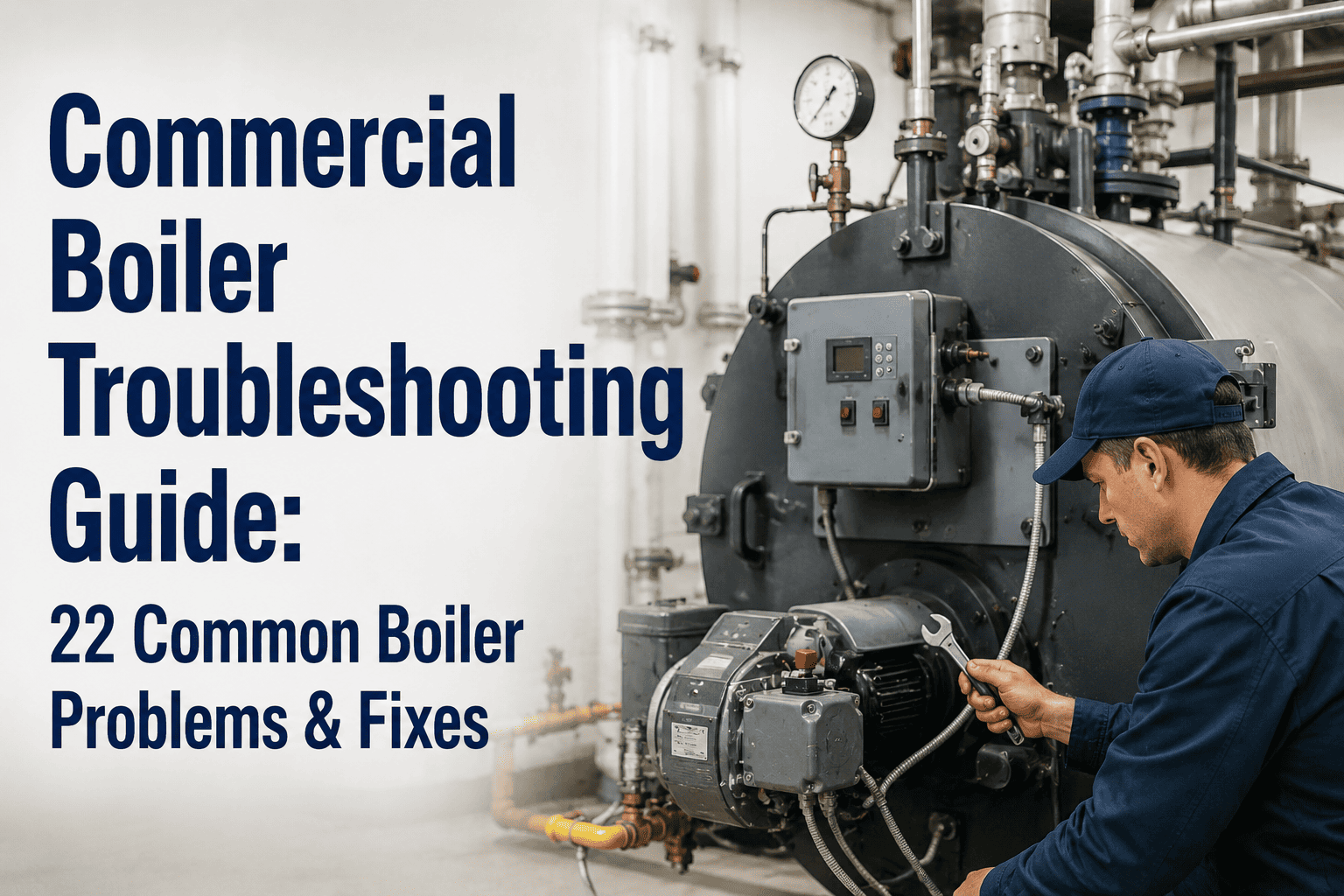
A commercial boiler that trips at 2 AM on the coldest night of the year is not a maintenance problem — it is a facility management failure that started weeks earlier. The warning signs were there: fluctuating pressure, unusual cycling, a minor leak flagged and deferred. Start a free trial to see how Oxmaint's AI-assisted CMMS catches these signals before the boiler room goes cold.
73%
Of commercial boiler failures are preceded by at least one ignored warning sign in the 30 days prior
$38K
Average cost of an unplanned commercial boiler shutdown including emergency repair, downtime, and tenant disruption
22
Distinct failure modes covered in this guide — each with diagnostic steps and the fix your team should run first
4x
Higher repeat breakdown rate in facilities using paper-based boiler maintenance logs vs. digital CMMS tracking
How to Use This Guide
Each of the 22 problems below is structured the same way: what you observe, what it means, and what to do — in plain language your maintenance team can act on immediately. For each failure mode, we also flag whether the root cause is typically a one-time fix or a recurring PM gap that needs to be tracked in your CMMS.
The 22 Most Common Commercial Boiler Problems
01
No Heat or Insufficient Heat
Check thermostat, pilot, gas supply, zone valves
Most common cause: failed thermostat signal or extinguished pilot light. Verify thermostat is calling for heat, check pilot flame, confirm gas supply pressure at the meter, and inspect zone valves for stuck-closed position.
02
Low Water Pressure
Below 1 bar — boiler locks out
Check the pressure gauge — anything below 1 bar triggers lockout on most commercial units. Re-pressurize via the filling loop to 1.5–2 bar. If pressure drops again within days, inspect for a system leak or faulty expansion vessel.
03
Boiler Kettling
Rumbling/banging sounds during operation
Limescale buildup on the heat exchanger restricts water flow, causing steam pockets and the characteristic kettling noise. Power flush the system, treat with a descaling agent, and install a scale inhibitor. This is a recurring PM task — hard water areas need annual treatment.
04
Pilot Light Keeps Going Out
Thermocouple, draught, or gas supply fault
A thermocouple that no longer senses the pilot flame correctly is the most frequent cause. Replace the thermocouple first. If the problem recurs, inspect for draught from nearby vents or a faulty gas solenoid valve not holding pressure.
05
Boiler Keeps Cycling On and Off
Short-cycling — overheating then cutting out
Short-cycling accelerates wear on the heat exchanger and pump. Common causes: oversized boiler for the load, faulty aquastat, blocked circulator pump, or air in the system. Check pump operation, bleed air from radiators, and verify aquastat setpoint matches system design.
06
Water Leaks Around the Boiler
Pressure relief, pump seal, or joint failure
Identify the leak source before acting. Pressure relief valve weeping indicates overpressure — check expansion vessel charge. Pump seal leaks require seal replacement. Corroded pipe joints need re-jointing or section replacement. Never ignore water around a boiler base.
07
Strange Noises — Banging, Whistling, Gurgling
Air, scale, or pump cavitation
Gurgling = air in the system, bleed radiators and check auto air vents. Banging = kettling from limescale. High-pitched whistling = pump cavitation from insufficient system pressure or blocked strainer. Each noise signature maps to a specific diagnosis — train your team to distinguish them.
08
Frozen Condensate Pipe
Common in winter — lockout with fault code
Condensing boilers produce acidic condensate that exits through a plastic pipe — often routed externally where it freezes in sub-zero temperatures. Thaw with warm (not boiling) water, reset the boiler, and lag the external pipe section with insulation. Add pipe inspection to your winter PM checklist.
09
High Water Temperature Shutoff
Overheat safety lockout triggered
The high-limit control cuts the burner when water exceeds safe temperature. Root causes: blocked circulator, closed zone valves trapping heat, faulty aquastat reading low, or clogged heat exchanger. Do not simply reset and restart — find why heat built up before the unit relocks out.
10
Ignition Failure
Spark electrode, gas valve, or control board
If the burner attempts to light but fails: check spark electrode for carbon deposits or cracking, verify ignition lead connection, test gas valve operation with a manometer, and review control board error codes. Many modern commercial boilers log ignition attempt counts — pull the fault history before replacing components.
11
Circulator Pump Failure
No flow — heat builds, boiler locks out
A seized or failed pump means water stops circulating — the boiler overheats rapidly and locks out on high limit. Check pump for rotation (impeller seizure is common after summer shutdown), verify electrical supply to pump, inspect for air lock, and check system strainer for blockage reducing pump load.
12
Faulty Pressure Relief Valve
Weeping or full discharge
A PRV that weeps consistently is telling you the system is regularly exceeding design pressure. Do not simply replace the valve — diagnose why pressure is rising. Failed expansion vessel diaphragm is the most common upstream cause. Replace the vessel first, then replace the PRV if it has been weeping for some time.
13
Gas Valve Malfunction
No gas flow or incorrect gas rate
Gas valve faults require a qualified gas engineer — do not attempt field repair without certification. Symptoms include burner not receiving gas (no flame), burner receiving insufficient gas (weak blue flame, lockout), or incorrect modulation in condensing units. Always pull the fault code log before gas valve replacement.
14
Flue or Exhaust Blockage
CO risk — immediate lockout required
A blocked flue is a life-safety event, not a maintenance ticket. Carbon monoxide cannot exhaust safely. Shut the boiler down immediately, ventilate the plant room, and do not restart until the flue has been inspected and cleared by a qualified engineer. Annual flue inspection must be on your PM schedule.
15
Sludge and Black Water
Magnetite contamination throughout system
Black water from radiator bleed valves or system drains indicates magnetite sludge — iron oxide particles from corroding radiators and pipework. This sludge settles in the boiler heat exchanger, blocking flow and causing rapid component wear. Power flush, fit a magnetic filter, and dose with inhibitor annually.
16
Control Board or PCB Failure
Erratic operation, fault codes, no response
PCB failures often present as intermittent faults — the boiler works for a while, then shows different error codes, then works again. Document every fault code occurrence and time-stamp it. A pattern of escalating or varied codes over 2–4 weeks is a reliable pre-failure PCB signature. Replace before total failure shuts the building.
17
Heat Exchanger Cracking or Corrosion
Late-stage failure — expensive outcome
A cracked heat exchanger allows combustion gases to enter the water circuit — a safety failure. Symptoms: continuous low pressure loss with no visible external leak, CO detector activation, unusual smell from heating system. This is almost always the result of years of untreated limescale, low pH water, or chronic short-cycling. Replacement or boiler replacement required.
18
Uneven Heat Distribution
Cold radiators, zones not responding
Cold-at-the-top radiators: air lock — bleed. Cold-at-the-bottom: sludge settlement — flush. Entire zones cold: zone valve motor failure or wiring fault. Single radiators cold throughout: thermostatic radiator valve stuck closed. Each pattern has a specific fix — misdiagnosis wastes hours of labor.
19
High Fuel Consumption
Efficiency loss — often gradual and unnoticed
A boiler consuming 15–20% more gas than the same period last year is not running efficiently. Common causes: incorrect air-to-fuel ratio (needs combustion analysis and burner tuning), heat exchanger fouling, degraded insulation on distribution pipework, or the boiler is short-cycling and never reaching condensing mode. Combustion analysis annually is a minimum standard.
20
Expansion Vessel Failure
Pressure fluctuations — PRV weeping
The expansion vessel absorbs pressure changes as water heats and cools. A waterlogged vessel (diaphragm failed) cannot do this — pressure swings widely, the PRV weeps, and the boiler cycles between lockout and normal operation. Test vessel pre-charge pressure annually and replace diaphragm or vessel when charge cannot be held.
21
Condensate Trap Blockage
Condensing boilers — acidic condensate backs up
Scale, biological growth, or debris can block the condensate trap, causing acidic condensate to back up into the heat exchanger. The boiler will lockout with a condensate fault code. Clear and flush the trap, check the neutralizer (where fitted), and inspect the drain for partial blockage. Add trap inspection to seasonal PM.
22
Flue Gas Recirculation (FGR) Fault
Low-NOx burners — recirculation valve issue
Modern low-NOx commercial boilers use flue gas recirculation to reduce nitrogen oxide emissions. A faulty FGR valve or damper produces inconsistent combustion, elevated CO readings, and emissions compliance failures. Inspect FGR valve actuator, clean recirculation passages, and verify O2 trim control is functioning correctly. This requires combustion analysis equipment.
Your Boiler Has Already Logged the Next Failure
Every fault code, pressure fluctuation, and temperature deviation is a data point. Oxmaint's AI connects these dots — surfacing the failing component before the 2 AM callout. Sign up free or book a demo to see it live.
Warning Signs You Should Never Defer
Not every boiler warning demands immediate shutdown — but these seven signals always do. Deferring a work order on any of them exposes your facility to a safety incident, a compliance failure, or a failure that costs ten times more than the repair your team postponed.
Stop Now
CO Detector Activation
Evacuate plant room immediately. Do not investigate alone. Carbon monoxide exposure is fatal before symptoms are recognized.
Stop Now
Gas Smell in Plant Room
Shut off gas at the meter, ventilate, do not operate electrical switches. Call the gas emergency line before investigation.
Urgent
PRV Full Discharge
Not weeping — fully open. System pressure has exceeded safe limits. Shut down and diagnose the pressure source before restart.
Urgent
Visible Flue Leaks
Gaps, holes, or disconnections in the flue system allow combustion gases into occupied spaces. Shut down until repaired.
Urgent
Rapid Pressure Loss
Pressure falling faster than 0.2 bar per day means an active leak somewhere in the system. Find and fix before the circuit drains.
Urgent
Escalating Fault Code Frequency
A boiler throwing different fault codes each week is on a failure trajectory. Treat escalating error frequency as a pre-failure indicator, not routine operation.
Urgent
Combustion Test Failure
CO in flue gases above permitted limits means incomplete combustion. Do not leave the unit operating — CO can migrate into building ventilation.
Commercial Boiler Preventive Maintenance Schedule
The 22 problems above share a common thread: most of them are preventable, and the ones that aren't are detectable early enough to avoid full failure. This schedule is the minimum standard — not a best-practice aspiration.
| Frequency |
Task |
Failure Mode Prevented |
| Daily |
Visual check — pressure gauge, no leaks, pilot (if applicable), fault light status |
Catches rapid pressure loss, new leaks, and lockout before they become emergency callouts |
| Weekly |
Fault code log review, system pressure trending, pump operation check |
PCB failure pre-detection, pump seizure early warning, expansion vessel degradation |
| Monthly |
Magnetic filter check and clean, condensate trap inspection, fuel consumption comparison vs prior month |
Sludge accumulation in heat exchanger, condensate lockout, early efficiency loss detection |
| Quarterly |
Zone valve operation test, expansion vessel pressure check, safety valve test (lift and reseat), strainer clean |
Uneven heat distribution, PRV weeping, pump cavitation from blocked strainer |
| Annual |
Full service: combustion analysis, burner clean and tune, flue inspection, heat exchanger inspection, water treatment test, electrode and seal replacement |
Gas valve drift, efficiency loss, CO emissions, limescale accumulation, ignition failure |
| Pre-Winter |
Condensate pipe lagging check, system inhibitor concentration test, antifreeze check (where applicable), controls calibration |
Frozen condensate lockout, corrosion acceleration, freeze damage in exposed pipework |
A paper checklist executed annually catches almost none of these failures in time. A CMMS-driven PM schedule — with automated work order generation, completion tracking, and fault code history linked to each asset — is what separates facilities that prevent failures from facilities that react to them. Sign up to Oxmaint and run your first boiler PM schedule within the first week.
Stop Running Boiler PMs on Paper
Oxmaint generates boiler PM work orders automatically, tracks completion, links fault code history to each asset, and flags overdue tasks before your inspector does. Book a demo to see the boiler maintenance workflow.
Why Repeat Boiler Failures Keep Happening
The same boiler failing for the same reason in back-to-back seasons is not bad luck. It is a corrective action that was never completed, a PM interval that was never updated, or a fault pattern that no one connected across three separate work orders. These are process failures, not equipment failures.
Root Cause 01
The Fix Was Completed, the Cause Was Not
The boiler was repaired. The underlying condition that caused the failure — low inhibitor concentration, incorrect expansion vessel charge, wrong lubrication grade — was noted, assigned, and never followed up. 47 days later: same failure, same repair, same cost.
Root Cause 02
Fault History Lived in One Person's Memory
The engineer who knew this boiler had failed three times in 18 months — always preceded by the same fault code sequence — left. The next technician treated the fourth failure as a new event. The pattern was not in the CMMS because there was no CMMS.
Root Cause 03
PM Intervals Were Never Updated After the RCA
The post-failure investigation determined the heat exchanger needed descaling every 9 months, not 18. That finding was written in a PDF. The PM schedule still runs at 18 months. The same scale-related failure recurs on the same 18-month cycle, with documented evidence that the interval was known to be wrong.
Root Cause 04
Warning Signs Were Logged, Not Actioned
The pressure gauge fluctuation was noted in the logbook three weeks before the failure. The PRV weeping was on the weekly checklist for two months. No work order was raised. Both observations were recorded — neither triggered a corrective action. Paper logs do not chase you.
How Oxmaint Closes This Gap
Oxmaint's AI RCA engine connects every boiler failure event to its sensor history, work order antecedents, and prior fault patterns — surfacing open corrective actions, flagging PM intervals that need revision, and alerting facilities teams to fault code sequences that preceded the last failure before they reach the same endpoint again. Every finding becomes a closed CAPA, not a PDF. Book a demo to see how this works for commercial heating assets.
Compliance Documentation Your Boiler Inspections Must Produce
A boiler that passes visual inspection but cannot produce the required maintenance documentation is a compliance failure waiting to happen. Insurance carriers, local authorities, and certification bodies require evidence — not verbal assurances — that your maintenance program is operating correctly.
Annual Gas Safety Certificate
Required annually for all commercial gas-fired boilers. Must be completed by a Gas Safe registered engineer. Covers combustion analysis, safety device testing, and flue integrity. Non-compliance voids insurance coverage in most policies.
Pressure System Written Scheme
Required under PSSR 2000 for commercial heating systems above certain pressure thresholds. The Written Scheme specifies examination intervals and scope. Failure to operate within the scheme is a criminal offence in the UK.
Water Treatment Records
Evidence of inhibitor dosing, pH testing, and water quality checks is required under BSRIA BG 50 and BS 8552 for commercial heating systems. Insurers increasingly require water treatment records as a condition of boiler cover.
Fault Code and Maintenance Log
A time-stamped record of all fault events, engineer responses, and corrective actions. Required for ISO 45001 CAPA evidence, insurance incident reviews, and demonstrating due diligence in the event of a tenant or occupant claim.
Assembling this documentation from paper logbooks, engineer call sheets, and email chains takes days and is rarely complete. Oxmaint structures every boiler work order, fault event, and PM completion into a compliance-ready record — exportable for any regulatory submission in under two hours. Start a free trial and have your first boiler asset fully documented within a week.
Boiler Compliance Documentation — Ready in 2 Hours, Not 3 Days
Every fault event, PM completion, CAPA closure, and water treatment record structured and exportable from Oxmaint — before the auditor asks for it. Sign up free or book a demo to see the compliance export workflow.
Frequently Asked Questions
Q
How often should a commercial boiler be serviced?
Annually at minimum — this is a regulatory requirement for gas-fired commercial boilers, not a recommendation. High-usage systems in hotels, hospitals, or large commercial buildings benefit from a mid-season inspection at 6 months. Water treatment checks should be quarterly regardless of usage level.
Q
What is the most common cause of commercial boiler breakdown?
Low water pressure, limescale accumulation, and ignition failure account for the majority of commercial boiler callouts. All three are either preventable with correct maintenance intervals or detectable early with regular inspection. The deeper cause in most recurring cases is an open corrective action that was never completed after the first failure.
Q
Can a CMMS help reduce commercial boiler downtime?
Yes — and the mechanism is specific. A CMMS reduces downtime in three ways: it ensures PM tasks are completed on schedule rather than deferred, it links fault code history to each asset so patterns are visible before they become failures, and it closes corrective actions automatically rather than leaving them open on a paper list. Facilities using digital CMMS for boiler maintenance report 4x lower repeat breakdown rates than paper-based equivalents.
Q
What compliance records do I need for a commercial boiler?
The minimum set includes: an annual gas safety certificate from a Gas Safe registered engineer, a written scheme of examination for pressure systems (PSSR 2000), water treatment records covering inhibitor dosing and pH testing, and a time-stamped fault and maintenance log for each boiler asset. Requirements vary by region — OSHA PSM, RIDDOR, and local building regulations may impose additional obligations depending on your jurisdiction and boiler classification.
Your Next Boiler Failure Is Already Signalling — Start Listening
Oxmaint connects fault codes, PM completion records, water treatment logs, and sensor data into a single asset intelligence feed — surfacing the next failure before it happens, not after the emergency callout. AI RCA, automated CAPA closure, PM interval management, and compliance documentation — all live within 5 weeks.
AI Root Cause Analysis
Automated PM Scheduling
CAPA Closure Tracking
Compliance Documentation