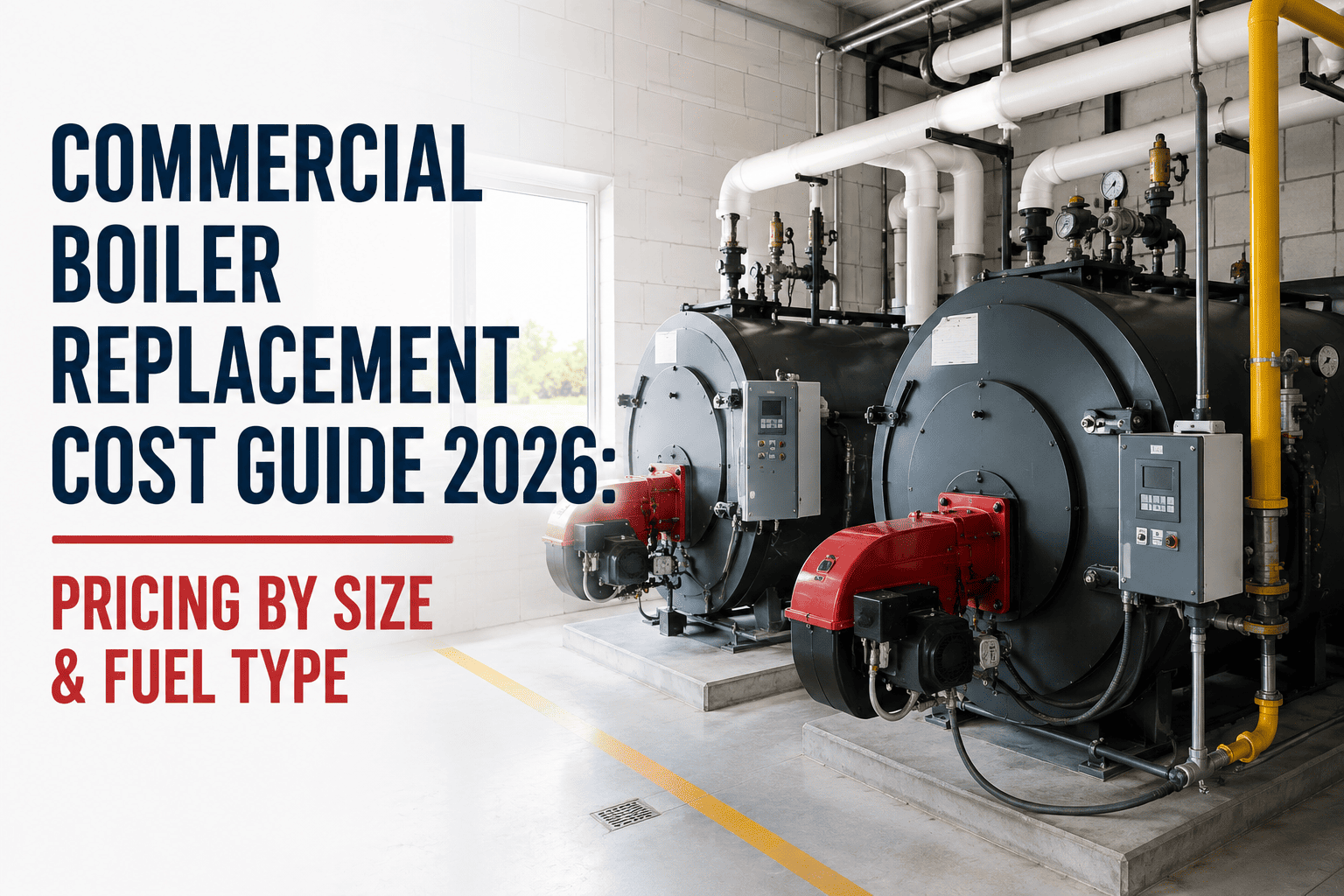
Commercial Boiler Replacement Cost Guide 2026: Pricing by Size & Fuel Type
By Mark strong on June 9, 2026
Commercial boiler replacement is one of the most capital-intensive decisions a facility manager makes — with total project costs ranging from $20,000 for light commercial systems to over $100,000 for large industrial installations. Equipment price is only one layer. Flue work, asbestos abatement, rigging, permitting, and controls integration routinely add $5,000–$20,000 on top of every base quote. This guide breaks down every cost variable by boiler size, fuel type, and efficiency tier so your next capital budget reflects reality. Sign up free to track your boiler asset age and service history in OxMaint, or book a demo to see how proactive replacement planning avoids every emergency premium.
$20K–$100K+
Total installed cost range — light commercial to large industrial
15–25 yrs
Typical commercial boiler lifespan with proper PM compliance
20–40%
Labor surcharge on emergency replacements outside business hours
15–20%
Annual heating cost savings upgrading from 80% to 95%+ AFUE
Track Every Boiler Asset Before Replacement Becomes Urgent
OxMaint connects boiler age, PM history, and repair cost accumulation into a single dashboard — so capital planning happens months ahead, not days before failure.
Commercial Boiler Replacement Cost by Capacity — 2026 Pricing Reference
Commercial boiler capacity is rated in Boiler Horsepower (BHP) or MBH (thousands of BTUs per hour). Cost per unit scales with capacity — but so does every associated installation variable. Use the ranges below as your planning baseline, then layer in the hidden cost section that follows. Sign up to log your existing boiler capacity and track accumulated repair costs against replacement thresholds in OxMaint.
Scroll to view full table
Capacity Range
Typical Application
Equipment Cost
Install Labor
Total Installed
Lifespan (Good PM)
Under 300 BHP
Small offices, schools, multi-family
$15,000–$30,000
$8,000–$15,000
$23,000–$45,000
15–20 yrs
300–600 BHP
Large offices, hotels, hospitals
$28,000–$55,000
$14,000–$22,000
$42,000–$77,000
15–25 yrs
600–1,000 BHP
Industrial, large campuses, district heat
$50,000–$85,000
$18,000–$30,000
$68,000–$115,000
20–25 yrs
1,000+ BHP
Power generation, process steam, utilities
$80,000–$160,000+
$25,000–$50,000+
$105,000–$210,000+
20–30 yrs
Ranges reflect standard gas-fired hot water boilers at mid-efficiency. Condensing (95%+ AFUE) models add 15–25% to equipment cost. Steam boilers run 10–20% higher than equivalent hot-water capacity. Regional labor rates vary — urban markets typically run 20–30% above the midpoints above.
Cost by Fuel Type — How the Choice Affects Every Budget Line
Fuel type affects equipment cost, installation complexity, venting requirements, and ongoing operating cost over the full lifecycle. The right choice depends on what is already in the building and what your energy costs look like over a 15–20 year horizon. Book a demo to see how OxMaint tracks energy cost per asset for fuel-type comparison over time.
Best overall lifecycle value where gas service is available. Condensing gas models recover exhaust heat and achieve 90–98% AFUE — upgrading from 80% to 95% AFUE saves 15–20% on annual fuel costs.
Fuel Oil
$6,000–$30,000 equipment
Efficiency82–90% AFUE (non-condensing)
Operating CostHigher — price-volatile
Install Add-onsTank removal: $400–$3,400; new tank: $1,200–$4,600
Common where gas infrastructure is unavailable. Higher fuel price volatility increases lifecycle operating cost versus gas. High-efficiency oil models cut fuel use 15–25% versus standard units. Fuel tank removal or replacement is a frequently missed budget line.
Electric
$4,000–$18,000 equipment
Efficiency98–100% at the unit
Operating CostDepends entirely on local rates
Install Add-onsPanel upgrade: $500–$3,500; no flue required
Lowest equipment complexity — no flue or combustion venting required. Unit efficiency is near 100%, but operating cost depends entirely on electricity pricing. Panel upgrade requirement is the most common hidden cost. Best suited to facilities where gas is unavailable or off-peak rates apply.
Durable and reliable in older commercial and industrial buildings. Replacement requires steam-specific contractor expertise. Near-boiler header piping replacement is typically required — budget this as a non-negotiable line item alongside the equipment cost.
Know Your Boiler's Real Cost Before the Quote Arrives
OxMaint tracks repair cost history, energy spend per asset, and PM compliance — giving you the numbers to justify fuel-type upgrades and efficiency investments with real data before the capital request is submitted.
The Hidden Cost Layer — Six Line Items Every Base Quote Misses
Commercial boiler replacement is more complex than RTU or chiller work because of the combustion, pressure, and hazardous materials dimensions. These six cost categories are consistently omitted from base quotes — and collectively can add $5,000–$20,000 to any project. Sign up and OxMaint stores full replacement project cost history per asset so every future budget is built from real numbers.
Flue & Venting Upgrades
$800 – $4,000
New PVC venting, chimney liners, or breeching reroutes are required when switching efficiency tiers or fuel types. Condensing boilers vent at low temperatures through PVC — incompatible with existing masonry flues designed for high-temp exhaust.
Asbestos Abatement
$1,500 – $8,000
Buildings constructed before 2000 frequently contain asbestos insulation on boiler jacketing, flue pipes, and nearby pipework. Discovery triggers mandatory certified abatement — a regulatory cost that halts work until resolved. Budget this as a contingency on every older building.
Permitting & Inspection
$150 – $3,000
Commercial boiler work requires mechanical and building permits, ASME stamp verification on the new vessel, and state inspection certification. Industrial steam systems may also require EPA stack emissions testing ($650–$3,500) and NFPA 85 compliance review.
Piping & Header Work
$1,000 – $12,000
New boilers rarely connect directly to existing pipework without modification. Steam systems almost always require near-boiler header replacement. Water line installation for new connection points adds $450–$1,800. Tight mechanical rooms add 10–30 crew hours to any project.
Controls & BAS Integration
$500 – $4,500
Outdoor reset controls, smart thermostats, and Building Automation System integration require programming work beyond the boiler installation scope. Any facility running BAS or BMS should budget controls integration as a separate line item from day one.
Rigging & Site Access
$800 – $5,000
Large commercial boilers require rigging, equipment dollies, or partial structural disassembly to move into mechanical rooms. Basement or roof-level plantrooms add significant labor cost. Old cast-iron boiler demolition and disposal adds a further $1,000–$8,000 on difficult jobs.
Combined Hidden Cost Range
$5,000 – $20,000
Added to virtually every commercial boiler replacement project
Asbestos Buildings — Additional Contingency
+$1,500 – $8,000
Any building constructed before 2000 — budget this as a contingency line
Standard vs. Condensing — The Efficiency Upgrade Business Case
Every boiler replacement is a decision point: replace with an equivalent unit or upgrade efficiency. The numbers favor upgrading in almost every scenario where the facility has a heating-dominated energy profile. Book a demo to see how OxMaint energy tracking supports the upgrade business case with real facility data.
Standard Efficiency
80–89% AFUE
Equipment CostLower upfront
VentingExisting masonry flue usable
Annual Fuel CostFull rate — 10–20% higher
Typical PaybackN/A — no efficiency premium
20-yr Energy CostHighest lifecycle spend
VS
Condensing / High Efficiency
90–98% AFUE
Equipment Cost15–25% higher upfront
VentingNew PVC required — add $800–$3,000
Annual Fuel Cost15–20% lower annually
Typical Payback5–10 years on premium cost
20-yr Energy CostLowest lifecycle spend
Upgrading from 80% to 95% AFUE on a commercial facility spending $80,000/year on heating fuel saves $12,000–$16,000 annually. The premium cost of the condensing unit ($4,000–$8,000 over standard) pays back in under one heating season in most climates. Over 20 years, the condensing unit saves $240,000–$320,000 in fuel costs — making the upfront premium essentially irrelevant on a lifecycle basis.
Repair vs. Replace — The Decision Framework for Commercial Boilers
Repair
Unit age under 10 years with documented PM history
Single repair cost under 25% of replacement cost
No recurring failures on the same component
Parts still manufactured and available
Evaluate
Unit age 10–15 years, mixed maintenance records
Annual repair spend approaching 30–40% of replacement cost
Efficiency clearly below current available technology
Run repair-vs-replace cost analysis before committing
Replace
Unit age 15+ years or poor PM compliance history
Annual repair cost exceeding 40–50% of replacement value
Recurring failures — heat exchanger, burner, or controls
Obsolete fuel type or parts no longer available
OxMaint Surfaces the Repair-vs-Replace Signal Automatically
When accumulated annual repair cost approaches 40% of replacement value, OxMaint flags it in the asset dashboard — giving your team months to plan capital spend rather than days to react to failure. Sign up free and start logging your boiler repair history today.
Quote Itemization Checklist — What to Verify Before Signing
Commercial Boiler Replacement Quote Checklist
Equipment & Labor
Equipment and labor costed separately
Old boiler removal and disposal included
Rigging and site access assessed and costed
Near-boiler piping scope defined
Steam header work scoped (steam systems)
Compliance & Safety
Asbestos survey completed or contingency budgeted
All permits and inspection fees included
ASME stamp verification costed
Flue liner or new venting scoped
Fuel tank removal/replacement costed (oil systems)
Efficiency & Controls
Electrical panel upgrade assessed
BAS/BMS integration scoped separately
Outdoor reset and smart controls included
Utility rebate eligibility confirmed
Equipment and labor warranty quoted separately
Frequently Asked Questions
What is the average commercial boiler replacement cost in 2026?
Commercial boiler replacement costs range from approximately $23,000–$45,000 for light commercial systems under 300 BHP, up to $105,000–$210,000 for large industrial installations above 1,000 BHP, before hidden costs are added. The six most commonly missed line items — flue work, asbestos abatement, permitting, piping, controls integration, and rigging — collectively add $5,000–$20,000 on top of any base quote. Always request a fully itemized proposal before budget approval. Sign up free to track boiler replacement costs per asset in OxMaint.
Is a condensing boiler worth the extra upfront cost for a commercial facility?
In almost every heating-dominated commercial facility, yes. Upgrading from 80% to 95% AFUE saves 15–20% on annual fuel costs. For a facility spending $80,000 per year on heating, that is $12,000–$16,000 annually recovered. The premium cost of a condensing unit over a standard model ($4,000–$8,000) typically pays back in under one heating season. Over a 20-year lifespan, the condensing unit delivers $240,000–$320,000 in fuel savings, making the upfront premium financially negligible on any lifecycle analysis. Book a demo to see how OxMaint energy cost tracking supports the upgrade business case.
What is the asbestos risk in commercial boiler replacement?
Any building constructed before 2000 carries a material risk of asbestos insulation on the boiler jacketing, flue pipes, and adjacent pipework. Discovery triggers mandatory certified abatement — $1,500 to $8,000 depending on scope — and halts all other work until completed. This is the single most budget-disrupting hidden cost in commercial boiler replacement, and it cannot be anticipated without a pre-replacement asbestos survey. Budget this as a contingency line on every older building project regardless of whether asbestos is known to be present.
How does a CMMS help with commercial boiler capital planning?
OxMaint tracks PM compliance, repair cost accumulation, and asset age per boiler — flagging when accumulated annual repair spend approaches the 40–50% of replacement cost threshold that signals replacement is the financially superior decision. This data enables capital replacement to be planned in the budget cycle rather than triggered by failure, eliminating emergency labor surcharges (20–40%), expedited equipment procurement, and the business disruption of unplanned heating outages. Sign up free to start tracking your boiler assets in OxMaint from day one.
Are utility rebates available for commercial boiler replacements?
Many utility providers and state energy programs offer commercial heating efficiency rebates for qualifying high-efficiency boiler replacements. Rebate programs vary by region and require pre-approval before the project is completed. Ask your contractor to confirm utility rebate eligibility as part of the specification process — rebates on commercial equipment can meaningfully offset the premium cost of high-efficiency condensing units. Federal incentives under Section 179D may also apply to qualifying commercial building energy improvements. Book a demo to discuss how OxMaint supports capital planning and energy documentation.
Free to Start — No Implementation Fee
Every Boiler. Every Repair Cost. Every Replacement Timeline. One Platform.
OxMaint gives commercial and industrial facility teams the asset history, PM compliance data, and cost tracking infrastructure to plan every boiler replacement before it becomes a crisis — and justify every capital decision with numbers your CFO can approve.