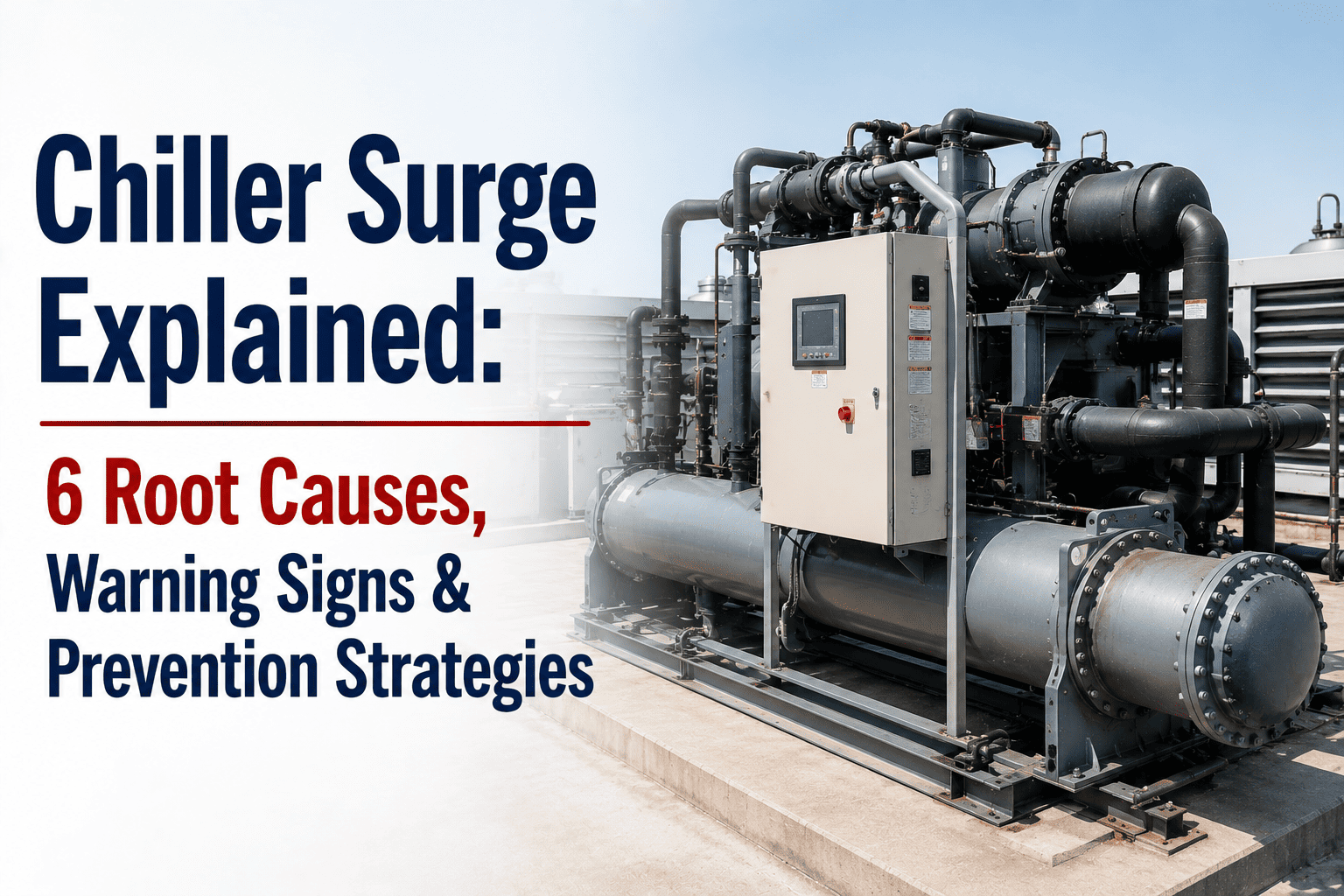
A centrifugal chiller that surges mid-summer is not just a noisy inconvenience — it is a compressor under violent stress, a facility bleeding energy, and a failure that often costs six figures to fix. The warning signs were there weeks earlier: elevated condenser pressure, unusual amperage swings, dirty tube readings ignored at the last PM. Start a free trial to see how Oxmaint's AI-assisted CMMS catches these signals before your chiller room goes into surge.
68%
Of centrifugal chiller surge events are linked to a maintenance gap detected but not acted on within 45 days
$52K
Average unplanned cost when centrifugal chiller surge causes compressor seal or blade damage
6
Root causes covered in this guide — each with diagnostic steps your team can act on today
3x
Higher chiller surge recurrence rate in facilities without digital fault-code tracking in a CMMS
What You Will Learn
This guide covers what chiller surge actually is, why it happens in centrifugal compressors, the 6 root causes that trigger it, the warning signs your team should never defer, and the prevention strategies that separate facilities that prevent surge from those that respond to it.
What Is Chiller Surge — And Why It Destroys Equipment
Chiller surge occurs when the refrigerant pressure inside the condenser exceeds the maximum discharge pressure the centrifugal compressor can sustain. At that point, refrigerant stops flowing forward — it reverses direction and flows back through the compressor impeller. That backflow is violent. It creates acoustic shock, mechanical stress on blades, bearings, and seals, and causes amperage to spike and drop erratically.
Why Centrifugal Compressors Are Vulnerable
Unlike scroll or screw compressors, centrifugal compressors do not physically trap and compress refrigerant. They use kinetic energy from a spinning impeller. When condenser pressure rises beyond the impeller's capacity, the pressure gradient reverses — and refrigerant surges backward through the machine.
What Surge Does To Your Equipment
Each surge cycle places compressor seals, impeller blades, and thrust bearings under shock loading. Repeated surge events accelerate wear on every rotating component. Severe or prolonged surge results in blade fracture, seal failure, bearing damage — and in worst cases, complete compressor replacement.
The 6 Root Causes of Centrifugal Chiller Surge
Every surge event has an upstream cause. These six account for the vast majority of commercial chiller surge incidents — and each one is either preventable, detectable early, or both.
01
Dirty or Fouled Condenser Tubes
Most common — slow and silent efficiency loss
Scale, biofilm, and mineral deposits on condenser tube surfaces reduce heat transfer effectiveness. The refrigerant cannot shed heat into the condenser water circuit efficiently, so condenser pressure climbs. Once it exceeds the compressor's discharge limit, surge begins. This is a classic PM gap — tube fouling builds gradually, the drop in efficiency is unnoticed until the compressor starts surging.
Diagnostic Step
Compare approach temperature (condenser leaving water vs refrigerant condensing temperature). A rising approach temperature over successive readings confirms fouling. Schedule tube cleaning when approach exceeds 2–3°F above design.
02
Low Condenser Water Flow Rate
Pump faults, blocked strainers, reduced setpoints
Insufficient condenser water flow means the refrigerant-to-water heat exchange is reduced — the condenser water leaving temperature rises, condenser refrigerant pressure rises with it. Causes include a failing condenser pump, blocked Y-strainer, partially closed isolation valve, or deliberate flow reduction made to save pump energy. The energy saving is illusory: the resulting surge risk costs far more than the pump power saved.
Diagnostic Step
Verify condenser water flow against design GPM using a clamp-on ultrasonic flow meter. Check pump amps against design FLA. Inspect Y-strainer and confirm all isolation valves are fully open.
03
Poor Cooling Tower Heat Rejection
Dirty fill, fan faults, undersized design
The cooling tower is the chiller plant's heat exhaust pathway. When tower performance degrades — clogged fill media, belt-slipping fans, gearbox faults, or scaled nozzles — condenser supply water temperature rises above design. The chiller then receives hotter water than it can handle at design capacity, condenser pressure climbs, and surge follows. This is often misdiagnosed as a chiller fault when the real issue is upstream in the tower.
Diagnostic Step
Check cooling tower leaving water temperature vs design setpoint at the current ambient wet-bulb temperature. Inspect fill media for scale and biological growth. Verify fan blade pitch and motor amps on each cell.
04
High Ambient Wet-Bulb Temperature
Weather-driven — system design margin matters
Cooling towers reject heat by evaporation — their capacity is directly governed by ambient wet-bulb temperature. When actual wet-bulb conditions exceed the design basis (a common occurrence with climate shifts), the tower cannot produce the condenser water supply temperature the chiller was designed around. Chillers selected to tight design margins with no capacity buffer are especially vulnerable during heatwave conditions.
Diagnostic Step
Cross-reference current wet-bulb temperature against the original cooling tower design specification. If actual wet-bulb regularly exceeds design wet-bulb, the tower was undersized — evaluate cell capacity upgrade or add a supplemental adiabatic pre-cooler.
05
Operation at Low Partial Load
Inherent centrifugal compressor vulnerability
Centrifugal compressors have a minimum stable flow threshold. When chilled water load drops below approximately 20–30% of design capacity, the compressor operates near the surge envelope regardless of condenser conditions. This is common during low-occupancy periods, overnight hours, or building transitions. Running a large chiller at very light load for sustained periods is an operating practice that directly invites surge.
Diagnostic Step
Review chiller load profile logs during early morning and weekend periods. If load regularly drops below 25% of design tons, evaluate switching to a smaller chiller for off-peak periods or installing a hot-gas bypass to maintain minimum stable flow.
06
Non-Condensables or Refrigerant Contamination
Air or moisture in the refrigerant circuit
Air, nitrogen, or moisture that enters the refrigerant circuit accumulates in the condenser and raises condenser pressure independently of heat load. Even a small amount of non-condensable gas can push condenser pressure above the compressor's surge threshold. Low-pressure refrigerant chillers (such as R-123 units) are particularly vulnerable because the system operates below atmospheric pressure — any seal or joint degradation allows air ingress over time.
Diagnostic Step
Monitor purge unit run hours on low-pressure refrigerant chillers — excessive purging indicates non-condensable accumulation. For high-pressure refrigerants, verify system pressure matches saturation tables at ambient conditions. Refrigerant analysis can confirm contamination.
Your Chiller Is Already Logging the Next Surge Event
Condenser approach temperature trends, purge hours, pump amp deviations — Oxmaint's AI connects these signals into a pre-surge alert before the compressor hits its limit. Sign up free or book a demo to see it live.
Warning Signs You Must Never Defer
These signals mean your chiller is already on a surge trajectory. Every one of them is a work order that should be open within 24 hours — not logged in a paper checklist and reviewed at month-end.
Act Now
Rhythmic Noise Shift
A normal-to-high-pitched noise cycling every few seconds is the unmistakable acoustic signature of surge. Do not reset and restart — diagnose the condenser pressure cause first.
Act Now
Erratic Compressor Amps
Amperage spiking and dropping in a repeating pattern — or sustained high amps with no load increase — signals backflow forcing against the impeller. Both patterns indicate active surge.
Urgent
Rising Approach Temperature
A condenser approach temperature trending upward over consecutive readings is the earliest quantifiable warning of tube fouling. Track this number weekly — it is your surge early warning indicator.
Urgent
Excessive Purge Unit Runtime
On low-pressure refrigerant chillers, the purge unit running more than a few hours per week is a confirmed indicator of non-condensable accumulation — a direct surge trigger.
Urgent
High Condenser Leaving Water Temp
If condenser water leaving temperature is consistently above design target, the cooling tower is under-performing — and your chiller is absorbing the consequences in elevated discharge pressure.
Monitor
Sustained Light Load Operation
If your chiller logs regularly show operation below 25% of design capacity for periods exceeding 2 hours, the machine is operating near its surge boundary. Review sequencing and consider off-peak chiller swap-out.
Chiller Surge Prevention: What Actually Works
Prevention is not a one-time fix. It is a set of operating disciplines and PM tasks that run continuously. The facilities that never experience surge are the ones that have converted these from intentions into scheduled, tracked work orders.
| Prevention Strategy |
Frequency |
Root Cause Addressed |
| Condenser tube brush or chemical cleaning |
Annually / when approach temp rises |
Tube fouling — most frequent surge trigger in commercial chillers |
| Condenser water flow rate verification |
Quarterly |
Low flow from pump wear, blocked strainers, or valve drift |
| Cooling tower fill inspection and cleaning |
Semi-annual |
Degraded heat rejection causing elevated condenser supply temp |
| Purge unit log review (low-pressure refrigerants) |
Weekly |
Non-condensable accumulation from air ingress |
| Chiller load profile analysis and sequencing review |
Monthly |
Sustained low partial load operation near surge envelope |
| Refrigerant analysis and leak check |
Annually |
Moisture or air contamination; refrigerant charge verification |
Why Chiller Surge Keeps Recurring in the Same Facility
The same chiller surging in consecutive cooling seasons is not bad equipment — it is an incomplete corrective action, an untracked PM interval, or a pattern that never made it from the paper log into a work order. Sign up to Oxmaint to close this gap before the next cooling season.
Pattern 01
Tube Cleaning Was Done Once, Then Forgotten
The condenser tubes were brushed after last summer's surge. The interval for repeat cleaning was never scheduled. Approach temperature crept back up over 11 months. Same surge, same diagnosis, same repair cost — because the PM schedule was not updated after the corrective action.
Pattern 02
The Purge Log Was Noted, Not Actioned
Excessive purge hours were recorded on the weekly checklist for six weeks. No work order was raised. The non-condensable accumulation continued. The chiller surged under peak summer load when the building needed it most. Paper logs note observations — they do not chase corrective actions.
Pattern 03
The Tower Fault Was Logged Under the Wrong Asset
The cooling tower fan belt failure was repaired and closed as a tower work order. No one linked it to the chiller's condenser pressure history from the same week. When the belt failed again two seasons later, no one recognized the pattern — because the connection between tower performance and chiller surge had never been made in any system.
Pattern 04
The Engineer Who Knew Left — Taking the Pattern With Them
The experienced engineer knew this chiller surged every August when wet-bulb temperature exceeded 78°F. That knowledge was never in a CMMS — it was in their head. Their replacement treated the surge as a new event. The institutional knowledge walked out the door on the engineer's last day.
How Oxmaint Closes This Gap
Oxmaint links every chiller fault event to its sensor history, related asset work orders, and prior surge incidents — flagging PM intervals that need revision, auto-generating CAPA work orders from recurring fault patterns, and surfacing the condenser approach temperature trends that precede surge before your next cooling season begins. Every finding becomes a tracked corrective action, not a paragraph in a PDF. Book a demo to see the chiller asset intelligence workflow.
Frequently Asked Questions
Q
Is chiller surge dangerous to the equipment?
Yes. Each surge cycle places mechanical shock on compressor seals, impeller blades, and thrust bearings. A single surge event may cause no visible damage — repeated or prolonged surge accelerates component wear significantly and can result in blade fracture, seal failure, or bearing failure. The mechanical cost of ignored surge compounds over time.
Q
How do I know if my chiller is surging?
Two primary indicators: an audible noise change from steady operation to a rhythmic high-pitched sound cycling every few seconds, and erratic compressor amperage — spiking and recovering in a repeating pattern. Both symptoms can be observed without test equipment. Confirm with condenser pressure readings against design specifications.
Q
Can chiller surge be prevented entirely?
For most commercial facilities, surge is entirely preventable through consistent execution of the maintenance tasks outlined in this guide — primarily tube cleaning, condenser water flow verification, cooling tower maintenance, and load profile management. Surge that recurs despite maintenance is usually a design margin issue requiring engineering review.
Q
How does a CMMS help prevent chiller surge?
A CMMS prevents chiller surge through three mechanisms: it ensures PM tasks like tube cleaning and flow verification are completed on schedule rather than deferred; it links fault history across related assets (tower, pump, chiller) so patterns become visible before they compound; and it auto-generates corrective action work orders from warning sign observations rather than leaving them in a paper log. Facilities using a CMMS for chiller maintenance report significantly lower repeat surge rates than paper-based equivalents.
Stop Reacting to Surge. Start Preventing It.
Oxmaint connects condenser approach temperature trends, purge unit runtimes, fault code history, and PM completion records into a single chiller asset intelligence feed — surfacing the next surge before it happens. AI RCA, automated CAPA closure, PM scheduling, and compliance documentation — all live within 5 weeks.
AI Root Cause Analysis
Automated PM Scheduling
CAPA Closure Tracking
Chiller Asset Intelligence