As commercial chillers age, facility managers often face a critical decision: repair the existing system or invest in a full replacement. While repairs may offer a lower upfront cost, repeated breakdowns, rising energy consumption, and increasing maintenance expenses can significantly impact long-term operating budgets. A comprehensive cost comparison should evaluate factors such as equipment age, repair frequency, energy efficiency improvements, expected service life, and business downtime risks. Modern chillers typically provide better performance, lower energy costs, and enhanced reliability, which can generate substantial savings over time. By analyzing lifecycle costs and return on investment (ROI), organizations can make informed decisions that align with operational goals and capital planning strategies. This guide outlines the key financial and operational considerations to help determine the most cost-effective path for your facility in 2026.
The Decision That Defines Your Budget
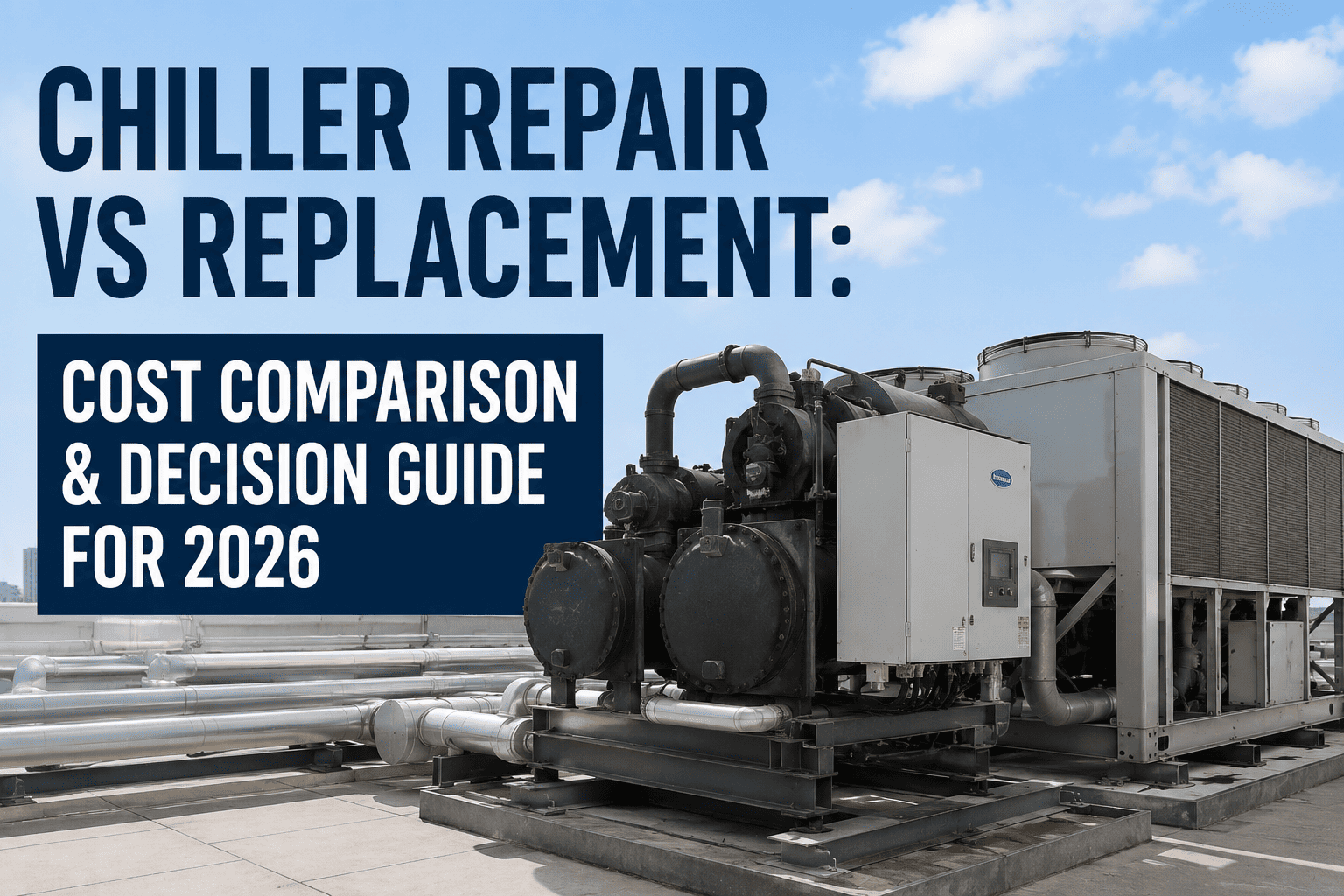
Chiller Repair vs Replacement: Cost Comparison & Decision Guide for 2026
A chiller running at 68% capacity while consuming 94% of its design energy budget is not aging gracefully — it is quietly draining your operations budget. Here is the framework to make the right call before the next emergency forces it.
$18K–$65K
cost of a single unplanned compressor event — often the trigger that forces a reactive replacement decision
50% Rule
when repair cost exceeds 50% of replacement value, replacement wins on lifecycle economics
25%
annual energy cost reduction achievable by upgrading to a modern high-efficiency chiller
Repair vs Replace: The Core Cost Comparison
Before any framework, you need the numbers. Chiller repair costs and replacement costs occupy completely different financial categories. Understanding the ranges — and what moves them — is the foundation of any defensible capital decision. If you want to make this call with real asset data rather than estimates, sign up for Oxmaint to log your chiller's full cost history in one place.
Compressor replacement
$18,000 – $65,000
Heat exchanger repair
$8,000 – $25,000
Controls / VFD replacement
$5,000 – $15,000
R-22 refrigerant recharge (200-ton unit)
$6,300 – $11,700
Emergency callout premium
+25–40% on labour
Repair addresses today's failure. It does not reduce energy waste, eliminate future failures, or reset the warranty clock.
Air-cooled chiller (50–200 ton, installed)
$200 – $600/ton
Water-cooled centrifugal (installed)
$400 – $1,000+/ton
High-efficiency premium
+10–50% on equipment
Crane, permits, electrical upgrades
$7,000 – $25,000
IRA 179D / utility DSM incentives
−$15,000 – −$90,000
Replacement resets the asset clock, recovers 25% energy efficiency, and eliminates legacy refrigerant exposure for 20–25 years.
The Decision Framework: 6 Signals That Point to Replacement
Most repair-vs-replace decisions go wrong because they are made in response to a breakdown rather than ahead of it. These six signals are measurable and trackable — and each one, when present, shifts the lifecycle economics toward replacement. Book a demo to see how Oxmaint surfaces these signals automatically from your chiller's maintenance history.
Repair Cost Exceeds 50% of Replacement Value
The widely used industry threshold. A single compressor event on a chiller worth $150,000 at $65,000 in repair cost clears this threshold — and the repaired compressor carries no warranty reset on the surrounding plant.
Replace signal
R-22 Refrigerant Dependency
R-22 now costs $35–$65/lb versus $4–$8/lb for modern HFO blends. A 200-ton R-22 unit requiring a 180-pound recharge means $6,300–$11,700 in refrigerant alone — recurring, and climbing annually as supply contracts.
Replace signal
Energy Performance Below 80% of Nameplate
A chiller delivering 68% of rated capacity at 94% of design energy is transferring cost to your utility bill every hour. A 25% energy reduction from a modern replacement pays back a significant portion of CapEx over 10 years.
Replace signal
System Age Beyond 15 Years
Commercial chillers last 20–25 years with structured maintenance. Beyond 15 years, parts availability narrows, repair costs accelerate, and the cumulative cost of maintenance may already exceed replacement value when tracked accurately.
Assess carefully
Two or More Major Failures in 24 Months
Repeat major failures on the same asset are the clearest indicator that the chiller has passed its reliable operating threshold. Each repair is a sunk cost that does not extend asset life proportionally.
Replace signal
Incentive Window Open in 2026
IRA Section 179D deductions (up to $5.00/sq ft) and utility DSM programmes ($15,000–$60,000 per qualifying replacement) are budget-cycle-specific. Delaying a replacement decision can mean missing an incentive window that materially changes the payback period.
Time-sensitive
Lifecycle Cost: Where the Real Difference Lives
First-cost comparisons mislead facility managers into under-valuing replacement. The 20-year total cost of ownership tells a different story — especially when energy performance degradation and legacy refrigerant costs are factored in. This is the analysis that gets capital approved at the board level.
Capital outlay (Year 0)
$0 upfront, repairs as they occur
$130,000 – $500,000 installed
Energy cost over 20 years
Baseline — degrading 1–3% annually without major intervention
20–25% lower annually from day one. Compounds to significant savings over asset life.
Repair & maintenance spend
$18K–$65K per major event. 2–3 events probable over 20 years = $50K–$195K cumulative
Standard PM only for first 10–12 years. Major events shift toward years 15–20.
Refrigerant cost
R-22 at $35–$65/lb and rising. Recurring recharge events compound total cost.
Modern HFO blends at $4–$8/lb. Minimal recharge events on new equipment.
Incentives available
None — repairs do not qualify for 179D or utility DSM programmes
$15,000–$90,000 in combined IRA and utility incentives for qualifying replacement
20-year verdict
Higher cumulative cost — but lower Year 0 commitment. Right choice only if asset is under 10 years old with no major failures.
Lower 20-year total cost in most cases once energy savings and incentives are modelled. Payback typically 6–10 years.
Where Repair Still Wins
Replacement is not always the right answer. There are specific scenarios where repair is the disciplined decision — and confusing the two wastes capital. Start tracking your chiller assets on Oxmaint to build the cost history that tells you exactly which scenario you are in.
System Under 10 Years Old
A chiller under 10 years with a first major failure is a strong repair candidate. Full asset life remains ahead. The 50% rule rarely triggers on young equipment, and warranty coverage may still apply on select components.
Repair Cost Under 30% of Replacement
Below the 30% threshold, repair is almost always the right call unless energy degradation or refrigerant type creates a second driver. Document the repair cost in your asset record to track cumulative spend over time.
Replacement Lead Times are Long
In 2026, compressed equipment supply chains can mean 14–26 week lead times on major chiller plant. A repair that buys 12–18 months while a planned replacement is procured properly is a legitimate operational decision.
Building Life is Limited
If the building has 5–8 years remaining in its current use, a replacement investment cannot be recovered on energy savings alone. Repair to maintain function until a building lifecycle decision is made.
The Numbers Behind the Decision: 2026 Benchmarks
Facility managers who made reactive replacement decisions (post-breakdown) reported 35–60% higher total project cost vs planned replacements
Energy efficiency improvement from replacing a 15-year-old chiller with current high-efficiency equipment
Reduction in unplanned downtime events within 12 months of replacement vs continued repair on end-of-life equipment
Maximum incentive offset available (IRA 179D + utility DSM) reducing effective replacement cost on qualifying commercial projects
Make the Repair-vs-Replace Call with Data, Not Gut Feel
Oxmaint tracks every repair work order, PM cost, refrigerant event, and energy performance trend against your chiller asset record — and produces the 3-year cost curve your finance team needs to approve a capital replacement. Stop reconstructing history from spreadsheets the week before a board meeting.
Frequently Asked Questions
QWhat is the typical cost to replace a commercial chiller in 2026?
Installed chiller replacement cost ranges from $200–$600 per ton for air-cooled units and $400–$1,000+ per ton for water-cooled centrifugal systems. A 100-ton air-cooled chiller installation typically totals $130,000–$210,000 fully installed. Hidden costs including crane mobilisation, permits, electrical upgrades, and temporary cooling during replacement add $7,000–$25,000 to most commercial projects.
QWhen does chiller repair stop making financial sense?
The widely accepted threshold is when repair cost exceeds 50% of the current replacement value of the chiller. Additional triggers include R-22 refrigerant dependency, energy performance below 80% of nameplate rating, two or more major failures within 24 months, and asset age beyond 15 years. Any two of these signals together makes a strong case for replacement analysis.
QWhat incentives are available for chiller replacement in 2026?
IRA Section 179D deductions offer up to $5.00 per square foot for qualifying commercial HVAC upgrades. Utility demand-side management programmes provide $15,000–$60,000 for high-efficiency chiller replacements in most major US markets. Combined, these incentives can reduce the effective replacement cost by $15,000–$90,000 on qualifying projects. These programmes are budget-cycle-specific — eligibility and award levels should be verified before finalising replacement timing.
QHow long does a commercial chiller last?
Commercial chillers with structured preventive maintenance typically operate reliably for 20–25 years. Units with poor maintenance histories often fail at 12–15 years. The key variable is not calendar age but maintenance quality and documented service history — which is why asset records matter as much as the equipment itself when making capital decisions.
QHow do I build a capital case for chiller replacement?
A defensible capital case requires three data streams: cumulative repair cost history on the specific asset (not the chiller model generally), energy performance trending showing deviation from nameplate kW/ton, and a modelled lifecycle comparison showing 15–20 year total cost of ownership for repair-path versus replacement. Most finance teams also require incentive-adjusted payback periods. Oxmaint structures all three data streams from your existing maintenance records —
book a demo to see the capital planning module.
Oxmaint: Purpose-Built for HVAC Capital Decisions
From chiller PM scheduling to repair cost tracking to energy performance trending and capital replacement planning — Oxmaint gives facility teams and finance leaders a single source of truth for every asset lifecycle decision.
Sign up free to start building your chiller asset record today, or
book a demo to see how the platform supports capital approval workflows.