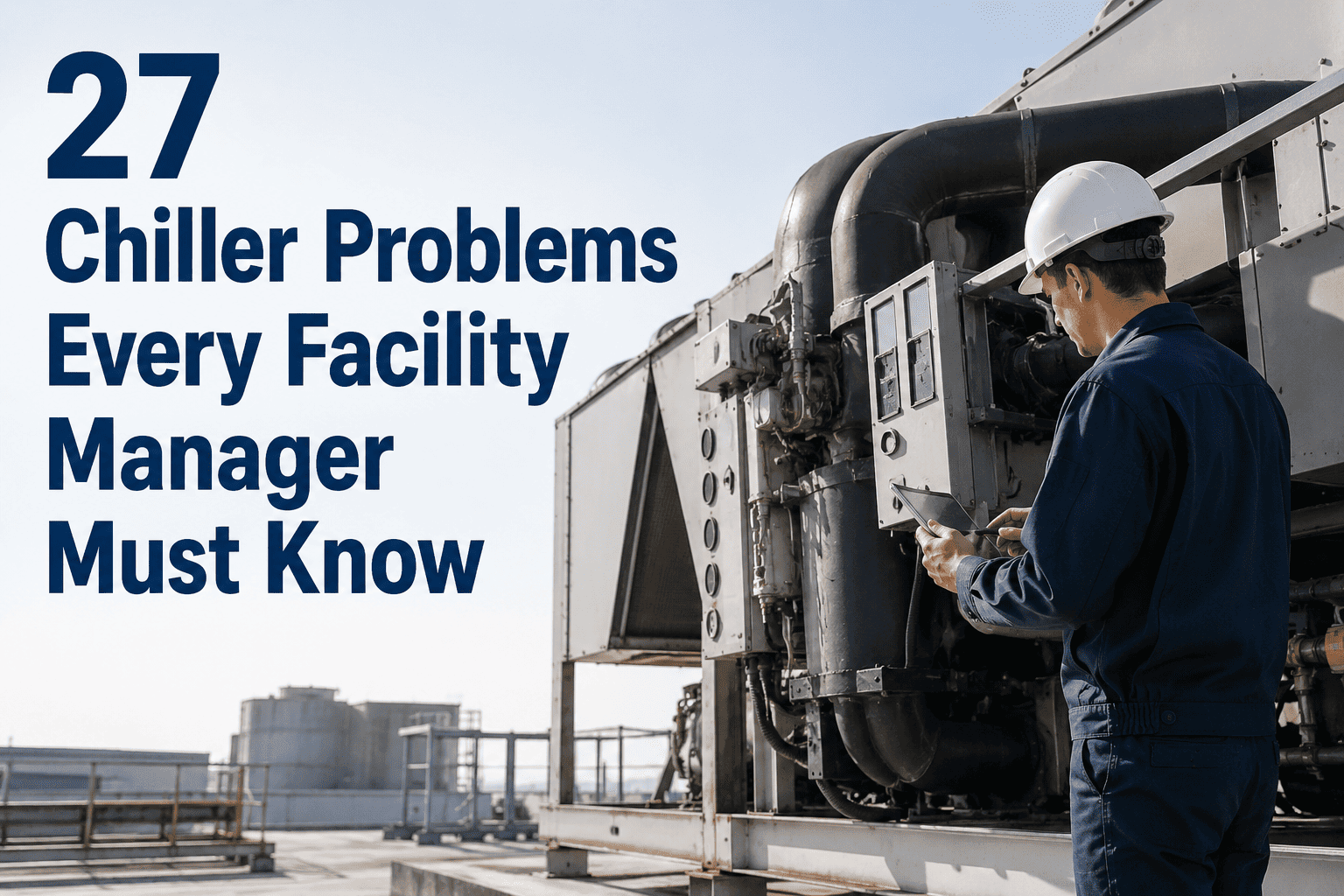
You're managing a 500-ton chiller on the hottest week of the year — and it just tripped offline. Again. The server room is warming up, tenants are calling, and your emergency contractor just quoted $180/hour before they've even arrived. Sound familiar? 75% of commercial chiller failures are preventable — if you know what to look for before the breakdown happens.This guide covers all 27 chiller problems facility managers encounter most often — with warning signs, root causes, and clear troubleshooting steps. Bookmark it. Share it with your team. And at the end, see how a CMMS built for HVAC reliability can stop these problems from repeating.
75%
of chiller failures are preventable with proactive maintenance
$50K
Average daily downtime cost for a 500-ton chiller failure
60%
Fewer emergency callouts with quarterly preventive maintenance
18–25 yrs
Chiller lifespan with proper maintenance vs 12–15 without
The 27 Chiller Problems — Organized by System
How to Use This Guide
Each problem is listed with a severity level, the warning sign to watch for, the most likely root cause, and the immediate troubleshooting step. Problems marked Critical require immediate action. Moderate problems allow a scheduled response window. Routine problems are caught during inspections.
Section 1: Compressor Problems (1–7)
The compressor is the heart of any chiller. When it fails, the entire system goes down. These are the seven compressor problems facility managers report most.
Problem 01
Critical
Compressor Short Cycling
Warning: Compressor starts and stops more than 4 times per hour
Root Cause: Low refrigerant charge, oversized unit, or faulty pressure controls
Fix: Check refrigerant charge and suction pressure. Verify low-pressure cut-out settings. Inspect TXV operation.
Problem 02
Critical
High Compressor Discharge Pressure
Warning: Discharge pressure 10–15% above normal baseline reading
Root Cause: Fouled condenser tubes, non-condensable gases, refrigerant overcharge
Fix: Brush and flush condenser tubes. Purge non-condensables. Verify refrigerant charge against nameplate.
Problem 03
Moderate
Compressor Surge (Centrifugal)
Warning: Rhythmic banging or rumbling sound at low load conditions
Root Cause: Operating outside design envelope, fouled tubes raising head pressure
Fix: Review operating conditions vs design parameters. Clean heat exchangers. Adjust IGV (inlet guide vanes).
Problem 04
Critical
Compressor Oil Failure
Warning: Low oil pressure alarm, discolored oil on sight glass
Root Cause: Oil dilution from refrigerant migration, clogged oil filter, oil pump wear
Fix: Replace oil filter. Check crankcase heater operation. Sample oil for acid and moisture content.
Problem 05
Moderate
High Compressor Amp Draw
Warning: Running amps exceed nameplate by more than 10%
Root Cause: Low suction superheat, refrigerant overcharge, worn compressor internals
Fix: Measure supply voltage for imbalance. Verify refrigerant charge. Check for liquid slugging at suction.
Problem 06
Routine
Vibration and Abnormal Noise
Warning: New grinding, knocking, or rattling sounds at startup or under load
Root Cause: Loose mounts, worn bearings, refrigerant liquid slugging on startup
Fix: Tighten all mounting bolts. Inspect bearing clearances. Ensure crankcase heater is energized 24 hrs before startup.
Problem 07
Moderate
Compressor Overheating
Warning: Discharge temperature above 200°F, thermal protection tripping
Root Cause: Low refrigerant charge, high compression ratio, inadequate motor cooling
Fix: Measure suction superheat. Verify condenser performance. Check motor winding temperatures.
Section 2: Condenser and Heat Exchange Problems (8–13)
Tube fouling is the single most common cause of water-cooled chiller inefficiency. A 0.001-inch scale layer on condenser tubes cuts heat transfer efficiency by 10% and adds 6–8% to your monthly energy bill.
Problem 08
Critical
Condenser Tube Fouling
Warning: Rising approach temperature, increasing condenser pressure over weeks
Root Cause: Scale, biological growth, or sediment buildup — inadequate water treatment
Fix: Mechanical tube brushing. Chemical descaling treatment. Review water treatment program frequency based on local water chemistry.
Problem 09
Moderate
Non-Condensable Gases in System
Warning: High head pressure with normal condenser water temperature and flow
Root Cause: Air infiltration during service, low-pressure system operating below atmospheric
Fix: Operate purge unit (if equipped). Recover and recharge refrigerant. Pressure-test system for leaks at low-pressure zones.
Problem 10
Routine
Cooling Tower Performance Degradation
Warning: Condenser entering water temperature rising above design setpoint
Root Cause: Fouled fill media, broken distribution nozzles, fan blade damage, drift eliminator blockage
Fix: Inspect and clean tower fill. Check fan blade pitch and rotation. Clean strainer basins and nozzles.
Problem 11
Moderate
Evaporator Freezing
Warning: Chilled water leaving temperature near or below 34°F, low flow alarm
Root Cause: Low chilled water flow, refrigerant overcharge, setpoint too low, fouled evaporator
Fix: Verify chilled water flow rate against design GPM. Inspect evaporator tubes. Review leaving water temperature setpoint.
Problem 12
Critical
Refrigerant Leak
Warning: Declining system capacity, low suction pressure, refrigerant odor near equipment
Root Cause: Tube sheet corrosion, valve packing wear, brazed joint failure, vibration fatigue
Fix: Electronic leak detector sweep of all joints. Pressure decay test isolated sections. Document leak location and quantity per EPA 608 requirements.
Problem 13
Routine
Inadequate Cooling Capacity
Warning: Chiller runs 100% but cannot meet building setpoint on design days
Root Cause: Load growth since original design, fouled heat exchangers, low refrigerant charge
Fix: Conduct load calculation review. Clean all heat exchangers. Verify refrigerant charge matches current operating conditions.
Stop Managing Chiller Problems Reactively
Oxmaint's CMMS automatically tracks every chiller fault, schedules PM by equipment condition, and flags repeat failure patterns before they become emergencies. Sign up free or book a demo to see it in action.
Section 3: Water System and Flow Problems (14–18)
Chilled water and condenser water system problems are responsible for a large share of nuisance trips that get attributed to the chiller itself. Always verify flow before diagnosing refrigeration-side issues.
Problem 14
Critical
Low Chilled Water Flow Rate
Warning: Low flow switch trip, large delta-T across evaporator (above 12°F)
Root Cause: Closed isolation valve, failed pump, clogged strainer, air in piping
Fix: Verify all isolation valves are open. Check strainer pressure differential. Bleed air from high points. Confirm pump rotation direction.
Problem 15
Moderate
Water Treatment Failure
Warning: High conductivity readings, visible scale or biological slime in tower basin
Root Cause: Incorrect chemical dosing, biocide failure, improper blowdown cycles
Fix: Test water chemistry against ASHRAE 188 Legionella guidelines. Adjust blowdown rate. Shock treat with biocide. Recalibrate dosing pump.
Problem 16
Moderate
Chilled Water Pump Cavitation
Warning: Rattling noise from pump, fluctuating discharge pressure, reduced flow
Root Cause: Net positive suction head (NPSH) insufficient, air entrainment, clogged suction strainer
Fix: Clean suction strainer. Verify system static pressure. Check for air entrainment at suction. Review expansion tank charge.
Problem 17
Routine
Glycol Concentration Out of Range
Warning: Freezing protection inadequate or heat transfer efficiency dropping
Root Cause: Makeup water diluting glycol over time, glycol degradation, system leaks
Fix: Test glycol concentration with refractometer. Adjust to design concentration. Test pH and inhibitor levels annually.
Problem 18
Moderate
Condenser Water Flow Imbalance
Warning: High approach temperature despite clean tubes, one cell of tower warmer than others
Root Cause: Imbalanced tower cell flow, partially closed balancing valve, nozzle plugging
Fix: Measure flow at each tower cell. Balance distribution using balancing valves. Inspect and clean distribution nozzles.
Section 4: Controls, Electrical and Sensor Problems (19–23)
Modern chillers are as much a controls system as a refrigeration machine. Sensor drift and control logic failures cause real equipment trips — but they are easily mistaken for mechanical faults.
Problem 19
Moderate
Chilled Water Temperature Sensor Drift
Warning: Chiller control disagrees with independent temperature measurement by more than 1°F
Root Cause: Sensor calibration drift, corroded terminal connections, moisture in sensor well
Fix: Calibrate sensor against NIST-traceable reference. Clean and dry sensor well. Inspect and clean all terminal connections.
Problem 20
Critical
Nuisance Safety Trips
Warning: Chiller trips on safety but manual inspection finds nothing obviously wrong
Root Cause: Loose wiring, faulty safety switch, sensor drift triggering protection relay prematurely
Fix: Download fault history from chiller controller. Inspect all safety switch contacts. Never reset a safety trip without identifying the logged fault code.
Problem 21
Moderate
BAS/BMS Integration Failure
Warning: Chiller running at 100% while BMS shows 40% load command, or not responding to remote setpoint
Root Cause: Communication protocol mismatch, BACnet/Modbus addressing error, firmware update breaking integration
Fix: Verify communication protocol and baud rate settings. Check point mapping against chiller submittal. Cycle communication power and re-establish link.
Problem 22
Moderate
Voltage Unbalance at Compressor Motor
Warning: Motor running hot, phase current readings differ by more than 2% between legs
Root Cause: Utility supply imbalance, loose terminal connections, single-phase load on building distribution
Fix: Measure all three phases at MCC. Tighten all power terminal connections. Notify utility if imbalance is on the supply side.
Problem 23
Routine
Pressure Transducer Failure
Warning: Chiller controller showing impossible pressure readings (negative, pegged at max, or erratic)
Root Cause: Refrigerant contamination in sensor port, wiring corrosion, end-of-life transducer
Fix: Cross-reference with independent gauge. Replace transducer. Inspect port for refrigerant oil contamination before installing replacement.
Section 5: Energy Efficiency and Performance Problems (24–27)
These four problems rarely cause immediate failure — but they cost facility budgets thousands of dollars per month and accelerate component wear. They are almost always caught first by a rising energy bill, not an alarm.
Problem 24
Moderate
Declining COP / Rising kW per Ton
Warning: Energy cost per ton of cooling rising month-over-month without load increase
Root Cause: Fouled heat exchangers, worn compressor internals, refrigerant undercharge
Fix: Benchmark kW/ton against original commissioning data. Clean all heat exchangers. Conduct compressor efficiency test per manufacturer.
Problem 25
Routine
Chiller Sequencing Overlap
Warning: Two chillers running at low part-load when one could handle the full building load
Root Cause: Incorrect staging setpoints, BMS control logic error, manual override not reset
Fix: Review chiller plant sequencing logic. Reset any manual overrides. Optimize staging setpoints for current building load profile.
Problem 26
Routine
Chilled Water Reset Not Active
Warning: Chiller maintaining 44°F setpoint at 20% building load on mild days
Root Cause: Chilled water reset strategy disabled, BMS override from a prior service event, incorrect zone valve feedback
Fix: Re-enable chilled water reset logic. Verify zone valve position feedback. 1°F of chilled water reset reduces compressor energy 1–2%.
Problem 27
Moderate
Accelerated Compressor Wear from Low-Load Operation
Warning: Chiller operating below 20% load for extended periods, oil analysis showing bearing wear particles
Root Cause: Oversized chiller relative to current building load, inefficient staging sequence
Fix: Review annual load profile. Consider a smaller lead chiller for low-load periods. Adjust minimum load protection settings per manufacturer guidance.
The Pattern Behind All 27 Problems
Problem 1
Failure happens. PM ticket raised. Equipment fixed. Root cause never documented.
Problem 2
Corrective action opened. System repaired. Follow-up PM interval change never made.
Result
Same failure, 47 days later. Same cost. Same emergency. Repeat failures make up 67% of all chiller events.
A facility team can know all 27 problems in this guide by memory — and still experience repeat failures if the work order system does not link fault events to root causes, and root causes to corrective action closure. That is the gap Oxmaint closes.
Chiller Maintenance Frequency Reference
| Task |
Daily |
Monthly |
Quarterly |
Annual |
| Check operating pressures and temperatures |
Yes |
— |
— |
— |
| Log compressor amps and runtime hours |
Yes |
— |
— |
— |
| Water chemistry analysis |
— |
Yes |
— |
— |
| Refrigerant leak check |
— |
— |
Yes |
— |
| Condenser tube cleaning and inspection |
— |
— |
— |
Yes |
| Oil analysis and filter replacement |
— |
— |
— |
Yes |
| Vibration analysis — compressor and pumps |
— |
— |
Yes |
— |
| Sensor calibration and controls verification |
— |
— |
— |
Yes |
Automate Every Row in This Checklist
Oxmaint generates PM work orders at the right frequency, assigns them to the right technician, and tracks completion — so no inspection is missed and every fault is documented with its root cause. Sign up free and go live in days, or book a demo with your team.
Frequently Asked Questions
Q
What is the most common cause of commercial chiller failure?
Condenser tube fouling is the most frequently reported root cause. Scale and biological growth on heat transfer surfaces forces the compressor to work harder, raising head pressure, increasing energy consumption, and eventually causing compressor surge or thermal shutdown. Quarterly tube brushing and a properly managed water treatment program prevent the majority of these events.
Q
How much does a chiller compressor replacement cost?
Commercial chiller compressor replacements typically range from $15,000 to $50,000 or more for the component alone. Emergency service adds $125–$200 per hour for service fees, $135–$180 per hour for labor (2–4 hours minimum), and after-hours premiums of 50–100%. A single unplanned compressor failure in a 500-ton chiller can exceed $80,000 in total costs including lost production.
Q
How often should a commercial chiller be serviced?
Most commercial chillers require daily operating log review, monthly water chemistry testing, quarterly refrigerant leak checks and vibration analysis, and a full annual shutdown inspection covering tube cleaning, oil analysis, sensor calibration, and controls verification. Critical facilities (hospitals, data centers) move some quarterly tasks to monthly. Facilities following this frequency report 30–45% fewer unplanned outages and equipment lasting 5–8 years beyond industry averages.
Q
Can a CMMS prevent chiller failures, or does it just track them?
A well-configured CMMS prevents failures in three ways: it ensures PM tasks are completed on the right schedule (not forgotten), it documents fault history so repeat failure patterns are visible, and it links corrective actions to root causes so they are actually closed rather than left open indefinitely. Oxmaint's AI RCA engine adds a fourth layer — it cross-references fault events against sensor history and past work orders to surface the probable root cause and any prior corrective action that was opened but never implemented, before the same equipment fails again.
Your Chiller Has Already Told You What Will Fail Next
Oxmaint tracks every work order, fault event, and PM completion across your entire chiller fleet — and surfaces the repeat failure pattern before the next breakdown, not during the emergency debrief. Start free and go live in days. No IT project required.
AI Root Cause Analysis
Automated PM Scheduling
CAPA Tracking
Fleet-Wide Pattern Alerts