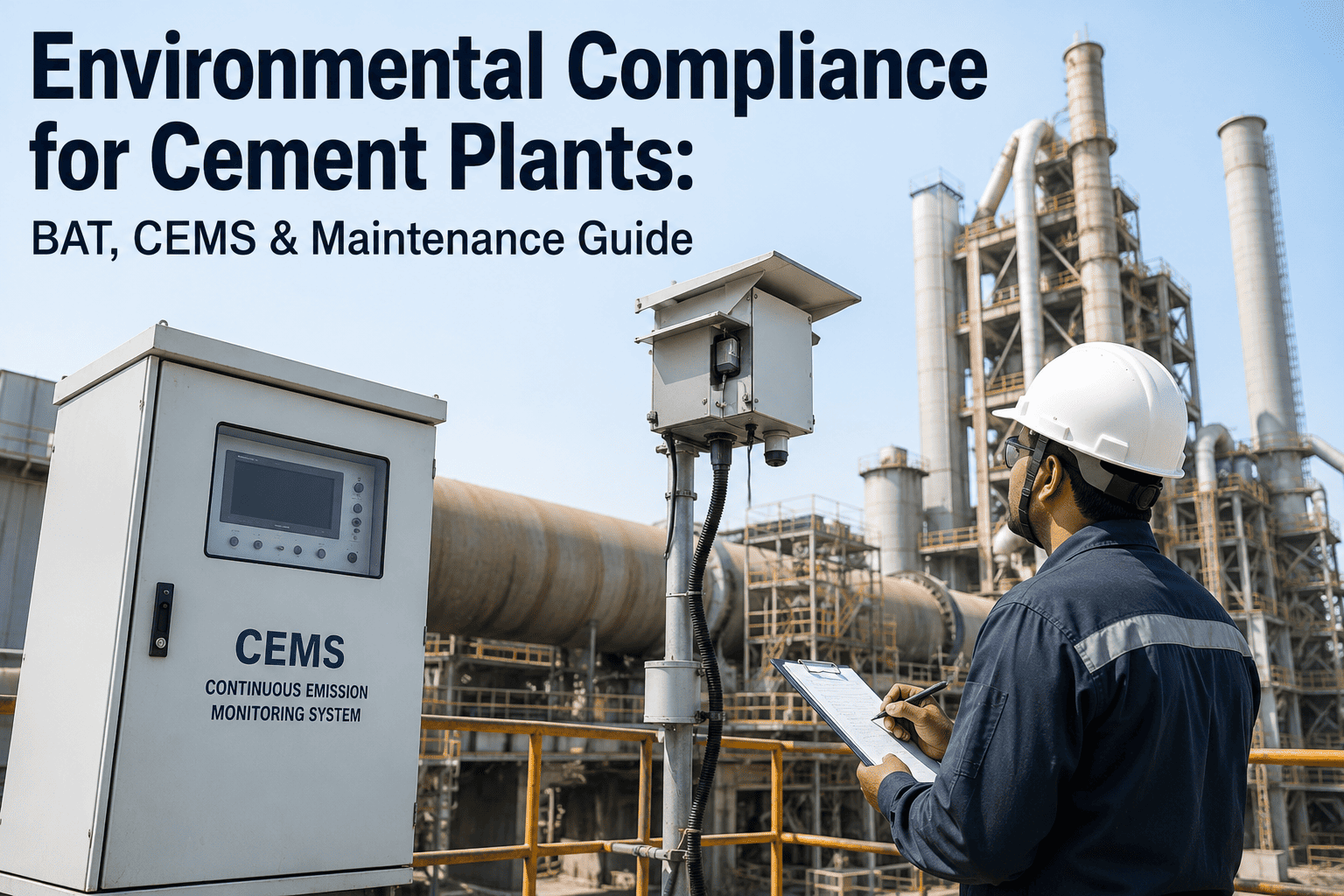
A CEMS analyzer that drifts out of calibration doesn't just create a data gap, it creates a Notice of Violation the moment a 30-minute rolling average crosses the permit limit, and it can trigger a kiln throughput restriction until the system is recertified. Environmental compliance in a cement plant runs on two things working together: Best Available Techniques that keep emissions low at the source, and continuous monitoring that proves it, minute by minute, to a regulator who is watching in real time. Start a free trial to see how Oxmaint keeps CEMS calibration and compliance documentation in one audit-ready record.
90%
Minimum annual CEMS data availability required under Title V permits in the US
40-80
Staff hours typically spent assembling data manually when an inspector arrives unannounced
15-30
Data points generated per minute across a typical CEMS analyzer stack that must be validated and logged
30 min
Rolling average window commonly used to determine an emissions exceedance from continuous data
Why Compliance Documentation Is a Maintenance Problem, Not Just a Paperwork One
Every emission point in a cement plant requires a defined monitoring frequency, a validated calibration record, and a timestamped log available for inspection at any time. When those records live on paper logs or disconnected spreadsheets, there's no automated escalation and no cross-referenced PM schedule, so an analyzer drift can sit undetected until the next scheduled check finds it, well after the exceedance has already happened.
What CEMS Is Actually Watching, Point by Point
| Pollutant |
Typical Range at Stack |
Primary Source |
| NOx |
400-900 mg/Nm³ |
High-temperature fuel combustion in the kiln |
| SO2 |
10-500 mg/Nm³ |
Sulfur content in raw materials and fuel |
| Particulate matter |
5-30 mg/Nm³ |
Raw mill, clinker cooler and material handling dust |
Calibration Records That Are Already Audit-Ready
Oxmaint schedules RATA checklists, tracks daily zero-span checks, and links every analyzer's PM history to the current permit's QA/QC requirements automatically. Sign up for a free trial to see it against your own monitoring points, or book a demo and we'll walk through your compliance documentation workflow.
BAT and Continuous Monitoring: Two Different Jobs
Best Available Techniques
Defines the process and equipment choices that keep emissions low at the source
Sets achievable emission levels regulators expect a compliant plant to meet
Varies by pollutant focus depending on national or regional regulation
Continuous Emissions Monitoring
Proves ongoing compliance with real-time, minute-by-minute stack data
Requires validated calibration and a defensible, timestamped record
Feeds directly into notice-of-violation and permit renewal decisions
How Oxmaint Supports Environmental Compliance Teams
Oxmaint consolidates CEMS calibration schedules, permit-condition-aware acceptance criteria, and multi-framework compliance export in one platform, so an EPA, IED, or CPCB inspection doesn't mean reconstructing records from separate spreadsheets. Non-conformances get flagged the moment they happen instead of surfacing at the next quarterly review, and audit packages that used to take days export in a few hours. Book a demo to see it mapped against your own permit requirements.
Frequently Asked Questions
Q
What does Best Available Techniques actually mean for a cement plant?
BAT is the regulatory principle that a plant should use the process and equipment choices proven to keep emissions as low as achievable for its scale and technology. Regulators reference BAT conclusions to set the monitoring requirements and emission levels a compliant plant is expected to meet, though the specific pollutant priorities differ by country and permit framework.
Q
Why can a small CEMS calibration drift lead to a full Notice of Violation?
Emissions compliance is typically judged against a rolling average, often 30 minutes, calculated from continuous data. If an analyzer has drifted out of calibration and that drift pushes the rolling average above the permit limit, it registers as a genuine exceedance even though the underlying process may not have actually changed.
Q
What records does a plant actually need ready for an inspection?
Typical requirements include CEMS calibration and maintenance records, documentation of any exceedance events with root cause and corrective action, maintenance logs for all emission control equipment with dates and technician signatures, and records showing PM schedules were followed according to the approved operations and maintenance plan.
Q
Why is 90% CEMS availability treated as a hard compliance floor?
Under many Title V and equivalent permits, data availability below that annual threshold is itself a permit condition breach, regardless of whether recorded emissions were within limits. That makes analyzer uptime and calibration discipline as important to compliance as the emission levels themselves.
Turn Audit Prep From Days Into Minutes
Oxmaint gives cement plant compliance teams CEMS calibration scheduling, permit-aware acceptance criteria, and audit-ready documentation exports in one platform. Sign up for a free trial to explore it yourself, or book a demo and we'll walk through it against your own permit requirements.