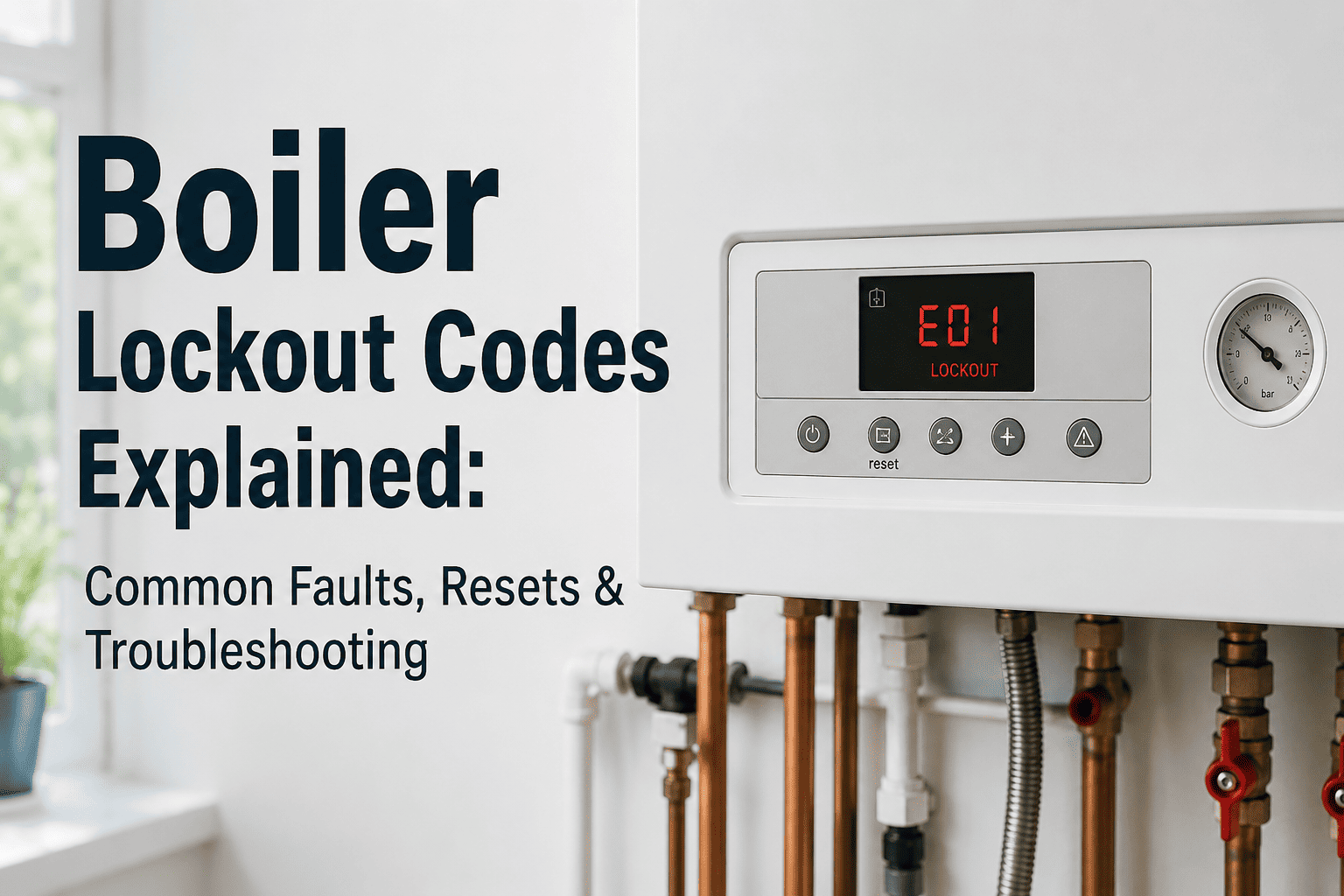
A boiler that locks out does not fail without warning — every lockout code is the control board's final record of what the system detected before it shut down safely. Reading that code correctly is the difference between a 10-minute reset and a 4-hour diagnostic that finds nothing because the actual fault was never investigated. This guide covers the most common commercial boiler lockout codes, what they mean, how to reset them safely, and — critically — which faults must never be reset without first finding and correcting the root cause. Start a free trial to see how Oxmaint tracks boiler lockout history, fault frequency trends, and reset attempt logs against every boiler asset in your portfolio.
68%
Of commercial boiler emergency callouts are triggered by lockout faults that were either previously ignored or reset without root cause investigation
$4,200
Average cost of an unplanned commercial boiler repair including emergency labour, parts, and downtime — versus under $300 for a scheduled corrective action on the same fault
9
Most common commercial boiler lockout fault categories — each with a diagnostic path and a reset decision framework covered in this guide
3x
More likely that a boiler suffers a repeat lockout within 30 days when the reset is performed without a documented corrective action in a CMMS
What a Boiler Lockout Actually Means
A lockout is a safety shutdown — the control board detected a condition outside safe operating parameters and latched the boiler off to prevent damage or a hazardous event. Unlike a soft fault (which allows the boiler to restart automatically), a lockout requires a deliberate manual reset. That deliberate step exists for a reason: it forces a human to acknowledge the fault before the boiler restarts. Resetting without investigating is not maintenance — it is debt accumulation. Every uninvestigated lockout brings the next failure closer and makes it more expensive.
The Lockout vs. Soft Fault Distinction — Why It Matters
Not every boiler shutdown is a lockout. Confusing the two leads to either unnecessary alarm or, worse, resetting a genuine safety lockout as though it were a transient fault. Here is the operational distinction every facility manager and technician needs to apply before touching a reset button.
Soft Fault — Auto-Reset
Transient Condition, No Latch
The control board detected a brief out-of-range condition — a momentary flame flicker, a brief low-water event, a transient pressure spike — and shut down as a precaution. After a short wait period, it attempts to restart automatically. If the condition has cleared, the boiler returns to normal operation. No intervention required. If the boiler auto-resets and runs normally, log the event but treat it as a monitoring point rather than an active fault — unless it recurs within 24 hours, at which point it escalates to investigation.
Hard Lockout — Manual Reset Required
Persistent Fault, Latched Off
The control board detected a condition it determines unsafe to restart from without human acknowledgement — flame failure, low gas pressure, high-limit trip, blocked flue. The boiler is latched off and will not restart until the reset button is pressed or the BMS reset signal is sent. This manual step is the designed intervention point. Before pressing reset: read and record the fault code displayed, identify which category of fault it falls into, and determine whether the underlying condition has been corrected. If it has not been corrected, resetting starts the damage cycle again.
9 Common Commercial Boiler Lockout Codes — Faults, Causes, and Fixes
Fault codes vary by manufacturer — Viessmann, Ideal, Potterton, Vaillant, Remeha, and others each use proprietary numbering. What does not vary is the underlying fault category. The nine categories below cover the overwhelming majority of commercial boiler lockouts. Match your displayed code to the fault description, follow the diagnostic path, and only reset once the identified condition is resolved.
F01
Ignition Failure / No Flame Detected
Flame / Combustion Fault
Common Causes
No gas supply or low gas pressure at the burner. Failed igniter or igniter rod fouled with carbon deposits. Defective gas valve not opening on demand. Incorrect electrode gap. Spark lead failure or loose connection.
Before You Reset
Confirm gas supply pressure is within range at the service connection. Inspect igniter electrode for carbon build-up and correct gap per OEM specification. Test spark lead continuity. Do not reset if gas supply is uncertain — call the gas supply authority first.
If the boiler locks out again within 3 ignition attempts after a confirmed gas-supply reset, the gas valve or control board requires bench testing before further resets.
F02
Flame Loss During Operation
Flame / Combustion Fault
Common Causes
Fluctuating gas supply pressure causing intermittent flame blow-out. Contaminated or worn flame sensor rod not detecting stable flame signal. Flue draught pulling excess combustion air causing flame instability. Partially blocked burner ports reducing flame quality.
Before You Reset
Check gas supply pressure during firing — not just at rest. Clean the flame sensing rod with fine wire wool; a thin oxide layer is sufficient to cause false no-flame detection. Inspect burner ports for partial blockage. Review flue terminal for obstruction or downdraft conditions.
A flame loss fault that occurs only at high fire and not at low fire usually indicates a gas valve modulation fault rather than a supply pressure issue — replace the valve, not the igniter.
F03
High Limit Thermostat Trip
Overheat / Temperature Fault
Common Causes
Insufficient flow rate through the heat exchanger causing localised overheating. Pump failure or pump speed set too low. Air-locked heat exchanger. Scaled heat exchanger reducing thermal transfer. Closed or partially closed zone valves reducing return flow.
Before You Reset
Confirm pump is running and delivering design flow. Check system pressure is adequate — low pressure causes flow starvation. Bleed air from the heat exchanger. Inspect all zone valves for correct open position. Do not reset until the boiler casing temperature has reduced to ambient — resetting a hot boiler can cause thermal shock to the heat exchanger.
A high limit trip that recurs within one heating cycle after reset almost always indicates a heat exchanger scaling problem — a chemical descale is required, not another reset.
F04
Low Water Pressure / Pressure Fault
System Pressure Fault
Common Causes
System water loss through a leak — pipework, radiator valve, pump seal, or heat exchanger. Failed or waterlogged expansion vessel allowing system pressure to rise and vent before dropping. PRV set too low. Incorrectly filled system.
Before You Reset
Check system pressure gauge — a reading below 1.0 bar cold confirms genuine pressure loss, not a faulty sensor. Re-pressurise to 1.5 bar cold fill. Check expansion vessel pre-charge pressure. Inspect for visible leaks before restoring pressure. If pressure drops again within 24 hours of refilling, locate the leak before resetting further.
A boiler that repeatedly loses system pressure is losing water somewhere. Topping up and resetting without finding the leak turns a pipe repair into a boiler replacement.
F05
Flue / Exhaust Gas Fault
Combustion Air / Flue Fault
Common Causes
Blocked flue terminal — bird nesting, debris, vegetation growth around the discharge point. Collapsed or disconnected flue section inside the building. Condensate trap blocked preventing flue gas exit on condensing boilers. Fan failure on forced-draught appliances — the fan proving switch detects no airflow and locks out before ignition.
Before You Reset
Visually inspect the external flue terminal for obstruction. Check flue connections inside the plant room for signs of disconnection or condensate leakage. Confirm the fan rotates freely. Clear the condensate trap drain on condensing boilers. Never reset a flue fault without a physical inspection — combustion products venting internally are a CO hazard.
A flue blockage lockout in winter is frequently caused by condensate freezing at the terminal on condensing boilers. Trace heat on external condensate lines is a preventive measure, not an upgrade.
F06
Low Gas Pressure / Gas Valve Fault
Gas Supply Fault
Common Causes
Gas pressure at the meter or building entry point fallen below minimum operating pressure for the boiler. Gas meter governor failure reducing downstream pressure. Gas valve coil failure — valve not opening despite correct control signal. Excessive demand from multiple appliances simultaneously depleting site pressure.
Before You Reset
Measure gas inlet pressure at the boiler service cock — minimum inlet pressure is specified on the boiler data plate, typically 17–20 mbar for natural gas. If inlet pressure is correct but the fault persists, the gas valve requires testing. Do not attempt to adjust the gas valve — this requires a Gas Safe registered engineer. Contact the gas network if supply pressure is below minimum.
A gas valve fault on a boiler over 12 years old is a replacement decision, not a repair decision. Rebuilt valves on aged boilers produce repeat lockouts within 18 months.
F07
Pump Fault / Flow Failure
Circulation / Hydraulic Fault
Common Causes
Pump seized — most common after a summer shutdown where the pump impeller has corroded to the shaft. Pump capacitor failure causing motor to fail on starting. Flow switch not detecting adequate circulation. Air locked pump. Low differential pressure across the circuit detected by the boiler's internal flow sensor.
Before You Reset
Confirm the pump is energised. If the pump motor hums but does not turn, release the impeller shaft via the pump bleed screw. Check for air lock via the pump bleed point. If the pump turns freely and is energised but the boiler still faults, test the flow switch and differential pressure sensor. Restore full circulation before resetting.
Running pumps at minimum speed for 30 seconds every week during a summer shutdown prevents impeller seizure — the single most common cause of post-shutdown pump faults on commercial boilers.
F08
Sensor Fault — NTC / Thermistor
Control / Sensor Fault
Common Causes
Open-circuit or short-circuit NTC thermistor on flow, return, or flue gas temperature measurement. Loose sensor connector on the control board. Sensor immersion pocket corroded or dry — sensor reading ambient air rather than water temperature. Water ingress on sensor connector.
Before You Reset
Read the resistance of the suspect NTC at a known temperature using the manufacturer's resistance-temperature table. An open circuit (infinite resistance) or short circuit (near-zero resistance) confirms sensor failure. Check connector seating at both the sensor and the control board. Resetting a sensor fault without replacing the failed sensor produces an immediate repeat lockout.
An NTC sensor fault code paired with an illogical temperature reading — 0°C or 130°C displayed in a normal operating boiler — is an open or short circuit sensor fault respectively. Both require replacement, not reset.
F09
Control Board / Communication Fault
Electronics / BMS Fault
Common Causes
BMS communication loss — the boiler is receiving no enable signal from the building management system. EEPROM or firmware fault on the control board itself. Cascade controller communication failure on multi-boiler installations. Power supply voltage excursion damaging the PCB. Electrical interference from nearby variable speed drives.
Before You Reset
Verify the BMS enable signal is present at the boiler terminal strip before resetting. Check communication wiring continuity on cascade-controlled boilers. Confirm supply voltage is within ±10% of rated. A control board fault that persists after confirming all inputs are correct requires a board replacement — the board cannot be field-repaired.
A BMS communication fault that appears after a scheduled BMS update or change in programming is a controls integration issue — the boiler is functioning correctly and the fault is in the control strategy, not the appliance.
Every Lockout Your Boiler Has Ever Generated Is Already the Evidence You Need
Fault code history, reset attempt frequency, time-to-lockout-after-reset — Oxmaint's CMMS captures every lockout event against the boiler asset and surfaces the pattern before the next emergency callout. Sign up free or book a demo to see how boiler asset intelligence works in practice.
The Safe Reset Procedure — Step by Step
A reset procedure that skips the diagnostic steps is not a procedure — it is a gamble. The following sequence applies to all commercial boiler lockouts regardless of manufacturer. It is the minimum safe practice before any reset attempt.
Record the Fault Code Before Touching Anything
Write down or photograph the fault code and any secondary display information. Note the time and operating conditions at the point of lockout. This record is essential for CMMS logging and for identifying whether this is a first-occurrence fault or a repeat. Some control boards clear the displayed code when the reset button is pressed — after which the diagnostic evidence is lost.
Identify the Fault Category — Not Just the Code Number
Cross-reference the code against the manufacturer's fault code table in the service documentation. Identify whether the fault is in the flame/combustion, temperature, pressure, flue, gas supply, circulation, sensor, or controls category. The category determines the physical inspection sequence — not the code number alone.
Perform the Physical Inspection for That Fault Category
Follow the diagnostic steps for the relevant fault category as outlined in the fault table above. Confirm that the condition that caused the lockout has either been corrected or is confirmed absent before proceeding. If the inspection reveals an unresolved condition — a blocked flue, a failed pump, a pressure below minimum — correct the condition first. Document all findings.
Apply the Reset — Once Only
Press the reset button or send the BMS reset signal once. Allow the boiler to complete its full start sequence — typically 30–90 seconds including pre-purge, ignition attempt, and flame proving period. Do not press reset repeatedly during the start sequence. If the boiler fires and runs stably for 5 minutes, the fault is cleared and corrected. If it re-locks immediately, the root cause has not been resolved and further investigation is required before any further reset attempts.
Log the Event in the CMMS Against the Boiler Asset
Record the fault code, the root cause identified (or suspected if unconfirmed), the corrective action taken, the reset outcome, and any follow-up work orders raised. This record is what makes a repeat fault identifiable — without it, the third lockout in six months looks like a first event to the next technician. A CMMS with boiler lockout history linked to the asset is the only way to distinguish a pattern from an isolated event.
Sign up to Oxmaint or
book a demo to build that history from your next lockout event.
Boiler Lockout Prevention — Annual Maintenance Checklist
The majority of commercial boiler lockout faults are preventable through scheduled maintenance. The following checklist is structured by task frequency and maps each task to the lockout fault category it prevents.
| Frequency |
Maintenance Task |
Lockout Fault Prevented |
| Weekly |
Visual check of system pressure gauge, flue terminal inspection, fault code display check, pump operation confirmation. During summer shutdown: run pump for 30 seconds minimum. |
F04 Low pressure, F05 Flue blockage (early detection), F07 Pump seizure |
| Monthly |
System pressure log, expansion vessel pre-charge check, condensate trap inspection and clear on condensing boilers, BMS enable signal verification. |
F04 Pressure fault, F05 Condensate freeze/blockage, F09 BMS communication loss |
| Annual — Pre-Season |
Full combustion analysis and burner clean, heat exchanger inspection and descale if required, gas valve operation test, electrode inspection and re-gap, igniter test, all NTC sensors resistance check, flue integrity inspection, gas inlet pressure measurement. |
F01 Ignition failure, F02 Flame loss, F03 High limit (scaling), F06 Gas pressure, F08 Sensor fault |
| Biennial |
System water quality test and inhibitor level check, pump impeller inspection, expansion vessel diaphragm condition test, control board firmware version check against current release. |
F03 Heat exchanger scaling acceleration, F07 Pump impeller corrosion, F04 Vessel failure, F09 Control board firmware faults |
| Post-Lockout |
Root cause confirmed and documented in CMMS, corrective action completed and verified, post-reset monitoring period of 24 hours with fault code display checked at 1hr and 4hr, follow-up work order raised if root cause was deferred. |
Prevents repeat lockout from unresolved root cause — the most common driver of emergency callouts on commercial boilers |
The Repeat Lockout Pattern — and How to Break It
A boiler that locks out three times in a season is not unlucky — it is operating with an unresolved condition that is regenerating the fault. The most common reason repeat lockouts are not caught is that each event is logged as a separate work order with no linkage to the previous event. The technician who attends the third callout has no visibility of the first two, performs the same reset, and raises the same work order. Oxmaint links every lockout event to the boiler asset, surfaces the fault code history at the point of each new work order, and flags repeat faults automatically — so the third lockout generates a root cause investigation, not a fourth reset. Sign up free to start building that asset history from your next event, or book a demo to see the boiler fault workflow live.
Frequently Asked Questions
Q
How many times can a commercial boiler be reset before it becomes a safety issue?
There is no safe reset count limit that applies universally — the question is whether the underlying fault has been investigated and resolved before each reset. A boiler reset three times in a week, each time following a proper inspection that confirmed no persistent fault condition, is less of a concern than a boiler reset once with no investigation at all. The industry guidance that matters is this: if a boiler enters lockout after a reset more than twice without a corrective action being completed, the boiler should not be reset again until a qualified engineer has conducted a full diagnostic inspection. Repeated blind resets on a combustion fault, in particular, carry CO risk.
Q
Can a BMS system be configured to automatically reset a boiler lockout?
Technically yes — many BMS platforms can be programmed to send a reset signal to the boiler on a lockout event. Whether this should be configured depends entirely on the fault category. Auto-reset via BMS is acceptable for lockouts in the temperature or pressure category where the underlying condition is monitored and logged by the BMS — for example, a brief high-limit trip caused by a transient load condition. It is not acceptable for combustion faults (flame failure, ignition failure, flue blockage) where an automatic restart without human inspection introduces a genuine safety risk. Any BMS auto-reset configuration should be reviewed by a commissioning engineer and documented in the boiler's operating and maintenance manual.
Q
What records should be kept for commercial boiler lockout events?
Each lockout event should be documented with the date and time, the fault code displayed, the boiler's operating conditions at the time of lockout (system pressure, flow and return temperatures if available), the physical inspection findings, the corrective action taken (or the reason no corrective action was possible immediately), the reset outcome, and any follow-up work orders raised. This documentation serves three purposes: it enables pattern identification across lockout events on the same boiler, it provides the evidence base for warranty claims on replaced components, and it forms part of the compliance documentation required under Gas Safe regulations and any applicable insurance requirements for commercial heating plant.
Q
My boiler fault code does not match any of the 9 categories above — what should I do?
Fault codes are manufacturer-specific and the numbering varies significantly. The nine fault categories in this guide cover the physical conditions being detected — the code number is just the manufacturer's reference for that condition. If your displayed code is not immediately recognisable, do not reset without consulting the manufacturer's service manual for that specific model. Most commercial boiler manufacturers provide fault code tables in the installation and commissioning documentation, and many publish them on their technical support sites. If the service manual is not available on site, contact the manufacturer's technical helpline with the model number and displayed code before resetting.
Stop Managing Boiler Lockouts From Memory.
Oxmaint captures every lockout fault code, reset attempt, and corrective action against the boiler asset — building the fault history that turns a repeat emergency into a pattern you can fix in a scheduled work order. AI root cause analysis, automated PM scheduling, Gas Safe compliance documentation, and CAPA closure tracking in one platform designed for facility teams managing commercial heating plant.
Boiler Asset Intelligence
Fault Code History Tracking
AI Root Cause Analysis
Gas Safe Compliance Docs
Automated PM Scheduling