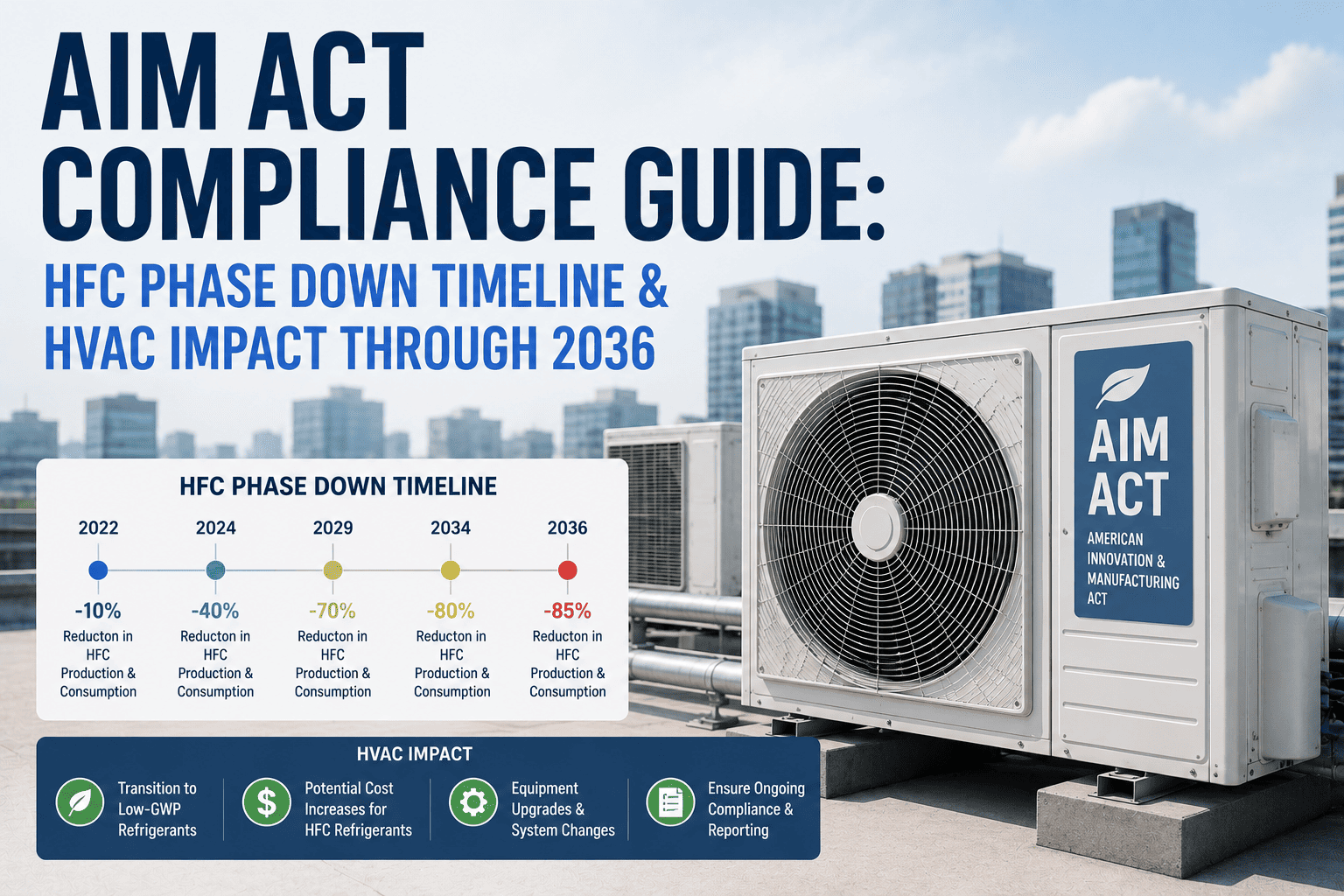
The American Innovation and Manufacturing (AIM) Act is not pending — it is active and accelerating. The phase down of HFC production began in 2022 and hits its steepest drop in 2029, when allowances cut by half overnight. Facilities that treat this as a future problem are already behind: the 15-pound leak repair threshold took effect January 1, 2026, R-410A equipment production ended January 2025, and reclaimed-refrigerant-only servicing requirements arrive in 2029. Sign up free on OxMaint to build a compliance-ready refrigerant management program across your entire HVAC portfolio — before your next EPA audit.
Build Your AIM Act Compliance Program in OxMaint
Refrigerant charge records per asset, automatic leak rate calculations, 30-day repair tracking, ALD sensor schedules, and audit-ready documentation — one CMMS built for the full AIM Act compliance lifecycle across commercial facilities.
What the AIM Act Actually Does
Signed into law in 2020 with wide bipartisan support, the AIM Act directs the EPA to phase down U.S. production and consumption of all hydrofluorocarbons (HFCs) to 15% of historic baseline levels by 2036 — an 85% reduction over 15 years. It aligns the United States with the Kigali Amendment to the Montreal Protocol, which 172 countries have now ratified. The Act operates through three distinct regulatory programs, each with its own compliance obligations and timelines for HVAC facility operators.
HFC Allowance Allocation Program
Controls total U.S. HFC production and consumption by issuing annual allowances to producers and importers. As allowances decrease on schedule, virgin HFC supply shrinks — driving refrigerant price increases and availability constraints for legacy systems still running R-410A, R-404A, and other high-GWP refrigerants.
Technology Transitions Program
Restricts the GWP of refrigerants permitted in new equipment by sector and subsector — most notably the January 2025 ban on new residential and light commercial HVAC equipment above 700 GWP. This is the mechanism that ended R-410A equipment production and mandated the shift to R-454B, R-32, and other A2L alternatives.
HFC Management Rule (ER&R)
The operational compliance program most directly affecting facility managers. Effective January 1, 2026, it covers leak detection, repair timelines, recordkeeping, automatic leak detection (ALD) installation, and — starting 2029 — requirements to use reclaimed refrigerant for servicing. This is the program that adds day-to-day compliance obligations to every covered system.
The Official Phase Down Schedule: 2022 Through 2036
The AIM Act phase down follows a statutory schedule set by Congress, expressed as allowance caps as a percentage of the 2011–2013 production and consumption baseline. Each reduction step creates a new supply environment for facilities managing legacy HFC equipment. Book a demo to see how OxMaint maps your asset refrigerant inventory against the approaching supply constraints.
Phase down begins. 10% reduction from baseline HFC production and consumption. Allowance allocation program activated. Most facilities notice no operational change — this step primarily affects HFC producers and importers. R-410A remains widely available.
A 40% jump down from 90% — the largest single-step reduction in the schedule. HFC production and consumption allowances drop to 60% of baseline. R-410A prices approximately tripled from 2022 to 2026. New R-410A equipment manufacturing banned (January 2025). HFC Management Rule takes effect (January 2026), covering all systems with 15+ lbs of qualifying refrigerant.
Supply cuts in half from the 2024–2028 level. Reclaimed refrigerant becomes the primary servicing source for legacy HFC systems — virgin supply will be insufficient to meet demand. Starting January 1, 2029, servicing of certain refrigeration systems must use reclaimed HFC refrigerants. Facilities still running R-410A equipment face severe supply constraints and cost pressure. Capital planning for equipment replacement should begin no later than 2026–2027.
Further reduction to 20%. Legacy HFC systems become increasingly expensive to service as reclaimed supply tightens. Facilities that deferred equipment transitions in the 2026–2028 window face the steepest costs here. Strategic replacement decisions made now determine operational cost through this period.
The AIM Act's endpoint. HFC production and consumption capped at 15% of the 2011–2013 baseline — permanently. R-454B and R-32 equipment currently qualifies for manufacture through at least 2036. Facilities that complete A2L transitions before 2029 eliminate refrigerant supply risk for the full 15–20 year asset lifecycle of new equipment.
The 2026 HFC Management Rule: Your Immediate Compliance Obligations
The HFC Management Rule is the most operationally significant change for facility managers in the AIM Act's history. Unlike the equipment production bans (which affect OEMs) or allowance caps (which affect refrigerant producers), this rule creates direct obligations for building owners and operators. Sign up free to build your compliance records and leak tracking program in OxMaint before your next service call.
Expanded Coverage Threshold
Systems with 15 lbs or more of HFC refrigerant (or substitutes) with GWP above 53 are now covered — down from the previous 50 lb threshold. EPA estimates approximately 971,000 additional appliances fall under federal compliance requirements for the first time. A small commercial RTU with 18 lbs of R-410A that was previously unregulated is now fully covered.
Annual Leak Rate Thresholds
Leak rate calculations must be performed every time refrigerant is added to a covered system. Allowable annual leak rates are sector-specific: 10% for comfort cooling, 20% for commercial refrigeration, 30% for industrial process refrigeration. Exceeding the threshold triggers a mandatory 30-day repair timeline — with retrofit or retirement consequences if the deadline is missed.
Repair and Retrofit Timeline
If leak rate exceeds the applicable threshold, owners have 30 days for verified repair completion. If repair cannot be completed within 30 days, a formal retrofit or retirement plan must be developed. The system must be retrofitted or retired within one year. This compressed timeline makes proactive leak prevention far less costly than reactive compliance.
Automatic Leak Detection Requirements
New commercial and industrial refrigeration installations with 1,500 lbs or more of qualifying HFC refrigerant must install automatic leak detection (ALD) systems starting in 2026. Existing installations must meet this requirement by 2027. Systems installed between January 1, 2017, and December 31, 2025 must have ALD installed by January 1, 2027.
Reclaimed Refrigerant Mandate (2029)
Starting January 1, 2029, servicing and repair of certain refrigeration systems must use reclaimed HFC refrigerants rather than virgin supply. Facilities that transition to A2L equipment before 2029 avoid this constraint entirely. Those that remain on legacy systems must establish reclaimed refrigerant supply chains and verify reclaimed purity at the point of use.
Recordkeeping for EPA Audits
Owners and operators must maintain per-system refrigerant records including charge additions, leak rate calculations, repair documentation, and retrofit/retirement plans. Records must be available for EPA audit on demand. California's Corporate GHG Disclosure Program additionally requires companies over $1 billion in revenue to report refrigerant leak emissions across all locations.
What This Means for Your HVAC Fleet: Three Scenarios
Legacy R-410A Systems Running Past 2028
Systems with 15+ lbs of R-410A are now under the Management Rule — leak tracking, 10% annual rate limit, 30-day repair mandate. R-410A prices have tripled since 2022 and will continue rising as the 2029 supply halving arrives. Deferring replacement past 2028 means servicing into a reclaimed-only market with sharply reduced availability.
New A2L Equipment Arriving Mixed with Legacy Systems
Most commercial facilities in 2026 are managing a mixed portfolio — some new R-454B or R-32 assets alongside R-410A systems still within useful life. Each refrigerant type carries different leak rate thresholds, PM procedures, technician qualification requirements, and compliance documentation formats. A single unified CMMS approach prevents compliance gaps in the mixed-fleet period.
Fully Transitioned to A2L Equipment
Facilities that complete transitions to R-454B or R-32 equipment before the 2029 supply cut are insulated from the worst legacy-system cost pressures. New A2L systems still require A2L-specific PM procedures, leak detection compliance, and technician certification tracking — but the refrigerant supply and regulatory trajectory is stable through at least 2036.
Compliance Checklist: What Facility Managers Must Do Now
Complete a Refrigerant Asset Inventory
Identify every HVAC and refrigeration system with 15 lbs or more of HFC refrigerant with GWP above 53. Document refrigerant type, charge weight, equipment age, and annual service history. This inventory defines your full compliance exposure under the 2026 Management Rule and should be the first step for any facility not yet tracking at this level.
Establish Leak Rate Tracking Per System
Every time refrigerant is added to a covered system, a leak rate calculation must be performed and documented. Set up a process — manual or CMMS-automated — to capture charge addition amounts, calculate annual leak rate, and flag any system approaching or exceeding the 10% comfort cooling threshold before it triggers the 30-day repair clock.
Implement 30-Day Repair Tracking
When a leak rate threshold is exceeded, a formal repair deadline must begin. Your maintenance system must be capable of generating a dated repair work order, tracking verified completion, and flagging the retrofit or retirement escalation if the 30-day window closes without resolution. Spreadsheet tracking introduces unacceptable risk for this timeline.
Assess ALD Requirements for Large Systems
Commercial and industrial refrigeration installations at or above 1,500 lbs of qualifying HFC must have automatic leak detection installed — new systems from 2026, existing systems by January 2027. Identify which assets cross this threshold, and add ALD installation and calibration to the capital plan and PM schedule immediately.
Build Audit-Ready Documentation
EPA compliance requires per-system records available on demand: refrigerant charge additions, leak rate calculations, repair documentation, ALD test logs, and retrofit or retirement plans where applicable. State enforcement is already active in California, Colorado, Washington, and New York — and ESG auditors are increasingly reviewing refrigerant records alongside financial disclosures.
Plan Legacy System Replacement Before 2028
Equipment replacement decisions made in 2026–2028 determine your cost exposure through 2036. R-410A systems that cannot reasonably be expected to hold below the 10% leak rate with normal maintenance should be prioritized for transition before the 2029 supply halving. Capital planning should model the escalating refrigerant cost trajectory, not today's prices.
Refrigerant Supply Outlook: Understanding the Cost Pressure
| Period | HFC Allowance Cap | Practical Supply Impact | Legacy System Cost Implication |
|---|---|---|---|
| 2022–2023 | 90% of baseline | Modest supply reduction, limited market impact | R-410A pricing stable to slightly elevated |
| 2024–2028 (now) | 60% of baseline | Significant tightening — reclaimed supply filling gaps | R-410A retail prices approximately 3x 2022 levels |
| 2029–2033 | 30% of baseline | Supply halves — reclaimed becomes primary source | Mandatory reclaimed-only servicing; sharp cost escalation |
| 2034–2035 | 20% of baseline | Virgin supply near-zero; reclaimed markets stressed | Servicing legacy systems approaches replacement cost |
| 2036 & after | 15% of baseline | Permanent cap at 15% — reclaimed supply market stabilizes | Only reclaimed available; equipment past useful life |
How OxMaint Powers AIM Act Compliance
Complete Refrigerant Asset Registry
Register every HVAC and refrigeration asset with refrigerant type, full charge weight, GWP, install date, and service history. Filter instantly by refrigerant type, charge weight threshold, or compliance status — giving you a real-time view of your AIM Act exposure across every facility in your portfolio.
Automatic Leak Rate Calculation and Alerts
Every refrigerant addition triggers an automatic leak rate calculation in OxMaint. Systems approaching the 10% comfort cooling threshold generate alerts before the compliance clock starts. Threshold breaches automatically open a dated repair work order with the 30-day deadline tracked to resolution.
Refrigerant-Specific Inspection Checklists
OxMaint assigns PM checklists based on refrigerant type and charge size — covering ALD sensor calibration for large systems, A2L-specific checks for new equipment, and legacy HFC inspection steps for systems still running R-410A or R-404A. One platform, correct procedures for every asset type.
Audit-Ready Compliance Records
Every service event, charge addition, leak calculation, repair action, and ALD test is logged per asset with timestamp and technician attribution. Export EPA-ready reports covering the full charge history and compliance timeline for any system — on demand, without manual assembly from scattered work orders and spreadsheets.
Replacement Prioritization and Cost Modeling
OxMaint surfaces which legacy HFC systems are highest-risk for the 2029 supply constraints — based on current leak rate trends, equipment age, and refrigerant charge size. Give finance teams the data to prioritize capital replacement budgets against the AIM Act timeline rather than reacting to emergency breakdowns.
Frequently Asked Questions
Does the AIM Act ban R-410A servicing in existing systems?
No. Existing R-410A systems can be serviced indefinitely. The AIM Act bans production of new R-410A equipment (from January 2025) and phases down the total supply of virgin HFCs, but does not prohibit servicing or operating existing R-410A systems. The practical constraint is availability and cost — R-410A supply will become increasingly tight and expensive as the phasedown progresses, particularly after the 2029 supply halving.
Which commercial facilities are affected by the 2026 HFC Management Rule?
Any owner or operator of appliances containing 15 pounds or more of HFC refrigerant (or substitutes) with a GWP above 53 is now covered. This includes comfort cooling systems, commercial refrigeration, and industrial process refrigeration. The previous threshold was 50 pounds — so systems in the 15–49 lb range that were previously unregulated are now subject to all Management Rule requirements including leak rate tracking, repair timelines, and recordkeeping.
What happens if a repair cannot be completed within 30 days of exceeding the leak rate threshold?
The owner or operator must develop a formal retrofit or retirement plan and must execute the plan within one year. This means a system that exceeds its annual leak rate threshold and cannot be repaired within 30 days faces a mandated replacement or refrigerant conversion within 12 months. Proactive leak prevention and rapid response are the only way to avoid this outcome.
When does the reclaimed refrigerant mandate take effect?
Starting January 1, 2029, servicing and repair of certain refrigeration systems must use reclaimed HFC refrigerants rather than virgin supply. Facilities that transition to A2L equipment before 2029 avoid this requirement for their new assets. Legacy systems remaining on R-410A, R-404A, or other high-GWP HFCs will need to establish verified reclaimed refrigerant supply chains before the 2029 mandate takes effect.
How does OxMaint help with AIM Act compliance documentation?
OxMaint maintains per-asset refrigerant records including charge addition history, automatic leak rate calculations, repair work order tracking with date and technician attribution, ALD sensor calibration logs, and compliance status tracking — all exportable as audit-ready reports for EPA inspections, state enforcement agencies, and ESG disclosure programs.
Don't Let AIM Act Deadlines Catch Your Portfolio Off Guard
Refrigerant asset inventory, automatic leak rate tracking, 30-day repair deadline management, ALD scheduling, and audit-ready documentation — OxMaint handles the full AIM Act compliance lifecycle so your team stays ahead of every milestone through 2036. Start your free trial or book a demo to see it built around your facility portfolio.