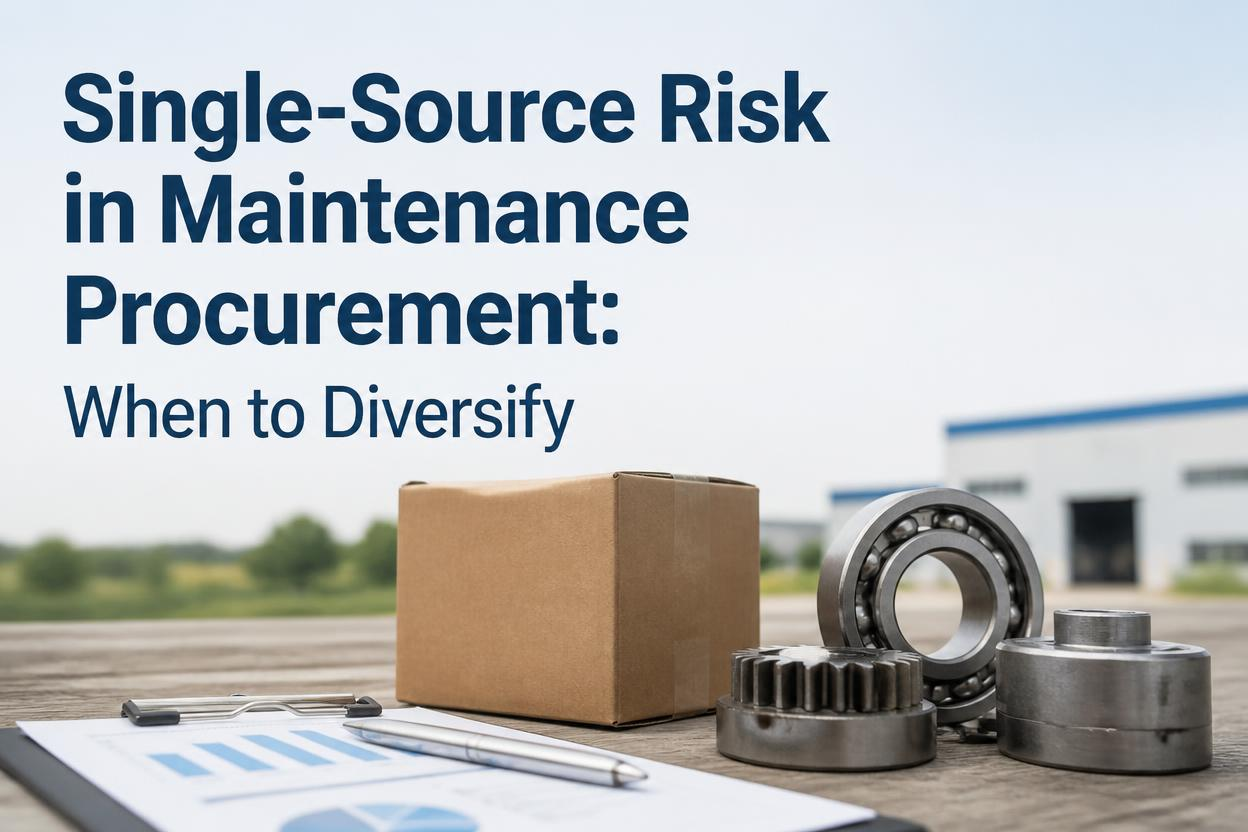
One supplier doing every job well feels efficient right up until they miss a delivery, raise prices without warning, or go into administration mid-contract. Single-source risk is the gap between "this relationship works fine" and "we have no plan B if it doesn't." Sign up to see how Oxmaint tracks supplier concentration across every asset, or book a demo to walk through a live risk register.
1
Point of failure a single-source supplier represents on your entire asset register
3
Risk layers that decide whether to stay single-source or start diversifying
5
Warning signs procurement teams routinely miss until a supplier fails
60
Days a planned dual-sourcing transition takes, versus a scramble under pressure
Before You Decide
Single-sourcing isn't automatically wrong. It's often the cheaper, simpler, better-relationship option. The question isn't "should we always dual-source" — it's whether the supplier in question sits in a risk tier where one bad week could stop work across multiple sites.
What Single-Source Risk Actually Means
Single-source risk is the exposure created when one supplier is the only route to a critical part, skill, or service. It's not about how many suppliers are on your vendor list — it's about how many of them could disappear tomorrow without stopping a work order in its tracks.
The risk sits in three separate layers, and each one needs a different owner and a different response.
Layer 1
Operational Continuity
One breakdown, one truck off the road, one busy season, and the job doesn't get covered.
Layer 2
Commercial Leverage
A supplier with no competitor in the frame sets its own renewal terms and price rises.
Layer 3
Knowledge Concentration
The supplier's engineer is the only person who understands how your legacy plant behaves.
Five Warning Signs You're More Exposed Than You Think
Most procurement teams don't decide to go single-source. It happens gradually, one renewal at a time, until nobody remembers the last time a job was competitively quoted.
Sign 01
No Alternative Quoted in Two Years
If nobody can name a second supplier who could take this work tomorrow, the market rate is a guess, not a fact.
Sign 02
One Engineer Holds the Process Knowledge
If one named individual leaving would set your maintenance schedule back weeks, that knowledge was never actually yours.
Sign 03
Contracts Auto-Renew Without Review
A rolling contract nobody re-reads at renewal is a price rise waiting to happen, quietly, every single year.
Sign 04
Lead Times Have Crept Up Unquestioned
A part that took a week now takes three, and nobody has asked why, because there's nowhere else to go.
Sign 05
Your Risk Register Doesn't Mention Suppliers At All
If supplier concentration isn't logged anywhere, it isn't being managed — it's being hoped about.
See Your Supplier Concentration in One View
Oxmaint flags every asset or contract tied to a single supplier, so risk shows up before it becomes an outage.
Stay Single-Source or Diversify: The Decision
Not every relationship needs a backup. Weigh it against what actually stops if this one supplier can't deliver next month.
Stay Single-Source When
A failure delays a non-critical job by days, not hours
The part or skill is genuinely available from one qualified source
Switching cost outweighs the likelihood of failure
Volume is too low to interest a second supplier
Diversify When
A failure stops production, safety systems, or tenant services
The supplier has raised prices without challenge twice running
Lead times have grown and there's no visibility on why
One person's departure would leave your team guessing
Dual-Sourcing Without Doubling Your Admin
The reason procurement teams avoid diversifying isn't disagreement — it's the paperwork. A second supplier means a second onboarding file, a second set of certificates, a second point of contact to manage. Done in stages, it doesn't have to double the workload.
01
Rank Suppliers by Exposure, Not Alphabet
Start where the risk register already flags a gap
Pull every supplier tied to critical assets and score them on how many alternatives exist today. The bottom of that list is where diversifying pays off first.
02
Qualify a Second Supplier on Low-Risk Work First
Prove the relationship before it carries anything critical
Run the new supplier's onboarding checks in parallel with a small, reversible job. It surfaces gaps in their process before a critical work order depends on it.
03
Split Volume, Not Just the Vendor List
A second supplier who never gets work isn't a backup
Route a genuine share of ongoing work to the second supplier so both stay responsive, competitive, and familiar with your sites.
04
Log the Concentration Score and Revisit It
Diversifying once doesn't mean the risk stays fixed
Set a quarterly review of supplier concentration by asset category, so a new single-source dependency doesn't quietly rebuild itself.
Quick Reference: Risk vs Response
| Risk Signal |
What It Threatens |
Recommended Response |
| No competitive quote in 24 months |
Commercial leverage |
Request market quotes at next renewal |
| One engineer holds process knowledge |
Operational continuity |
Document procedures independently of the supplier |
| Lead times rising without explanation |
Operational continuity |
Qualify a second supplier on standby |
| Supplier tied to critical safety systems |
All three risk layers |
Dual-source immediately, split volume |
Frequently Asked Questions
Q
Is single-sourcing always a bad procurement decision?
No. For low-volume, low-criticality work, one trusted supplier is often simpler and cheaper to manage than two. The risk only becomes a problem when the work is critical and there's genuinely nowhere else to turn if that supplier can't deliver.
Q
How do we spot single-source risk before it causes a disruption?
Score every critical asset or contract on how many qualified alternatives exist. Anything with zero named alternatives goes on the risk register, regardless of how well the current relationship is working.
Q
Won't a second supplier just mean higher costs from lower volume per vendor?
Sometimes, marginally. But that cost buys continuity insurance and keeps the primary supplier's pricing honest. Weigh it against the cost of a stopped line or an unplanned emergency callout rate when the sole supplier can't respond.
Q
Can a CMMS help manage supplier concentration risk?
Yes. A CMMS that ties suppliers to specific assets and contracts can flag where a single supplier covers a disproportionate share of critical work, turning a gut feeling into a visible, trackable risk score.
Turn Supplier Concentration Into a Tracked Risk Score
Oxmaint maps every supplier against the assets and contracts they cover, so procurement can see exactly where a single point of failure exists before it becomes an outage. Risk registers, vendor scoring, and renewal alerts live in one platform.
Supplier Risk Register
Vendor Concentration Scoring
Contract Renewal Alerts
Asset-to-Supplier Mapping