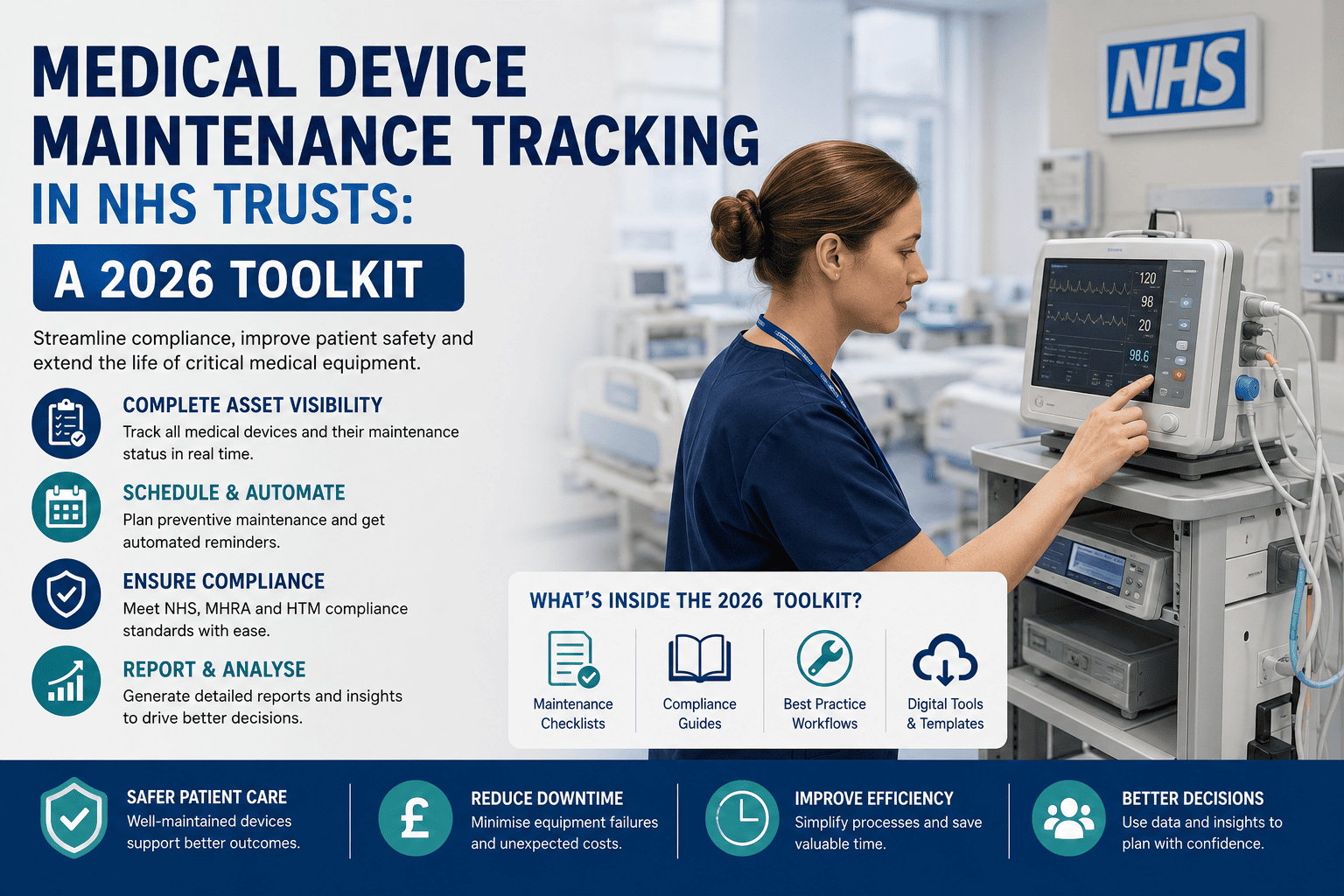
A mid-sized NHS Trust can be responsible for tens of thousands of medical devices, from infusion pumps to ventilators to diagnostic imaging equipment, each with its own calibration schedule, service history, and manufacturer alerts to track. Individual Trusts retain full legal responsibility for equipment safety and compliance even where Integrated Care Boards provide strategic oversight, and accountability cannot be delegated to external contractors, including PFI partners managing equipment under separate contracts. That's a lot of responsibility to carry on spreadsheets and departmental habit. A CMMS like OxMaint gives clinical engineering teams a single, auditable record across the entire device estate, exactly what MHRA and CQC expect to see when they ask.
Track Your Entire Device Estate in One Place
Calibration, service history, recalls, and incident reporting for every device, organised for the audit trail MHRA and CQC expect.
The Four Pillars of a Device Maintenance Toolkit
Asset Register (MEMS)
A complete, accurate inventory of every device on the estate, the starting point every other pillar depends on.
Calibration & PPM
Scheduled calibration and planned preventive maintenance tracked against each device's own required interval.
Recalls & FSNs
Field Safety Notices need a maintained record of what action was taken in response, tied to every affected device.
Incident Reporting
A Medical Device Safety Officer reports adverse incidents to MHRA and other official agencies, drawing on the same asset record.
Where the Regulatory Expectation Actually Sits
| Requirement | Where It Comes From | What Trusts Need to Show |
|---|---|---|
| Equipment fitness for use | Regulation 15 of the Health and Social Care Act 2008 (Regulated Activities) Regulations 2014 | Equipment kept clean, secure, and suitable for its intended purpose |
| Vigilance and trend analysis | Medical Devices (Post-Market Surveillance) Regulations 2024 | Serious incidents reported within defined regulatory timeframes |
| Adverse incident reporting | MHRA Yellow Card scheme | A named safety officer coordinating reports and recall response |
| Inspection readiness | CQC's 2026 framework guidance on premises and equipment | Digital records that can produce evidence quickly during inspection |
Building the Toolkit Across a Large Estate
Consolidate the Device Register
Bring every device, including those under PFI or third-party contracts, into a single, accurate inventory.
Set Calibration Intervals by Device Type
Base each schedule on manufacturer guidance and device criticality, not a single blanket interval across the estate.
Link Recalls to Affected Devices
When a Field Safety Notice arrives, immediately identify every matching device and track the response against each one.
Route Incidents Through One Safety Officer
Keep Yellow Card and internal incident reporting consistent by routing every adverse event through the same process.
Device Maintenance Toolkit Maturity
Departmental Spreadsheets
Each department tracks its own devices independently, with no single view of the Trust's full equipment estate.
Centralised but Manual
A shared register exists, but recall matching and incident reporting still rely on manual cross-checking.
Fully Integrated
Asset register, calibration, recalls, and incident reporting all draw from the same live, auditable record.
Accountability Doesn't Move With the Contract
PFI arrangements and third-party service contracts don't change where legal responsibility sits. Accountability for equipment safety and compliance stays with the Trust, and cannot be delegated to an external contractor, even when that contractor is the one physically maintaining the devices day to day. That makes the Trust's own record, not the contractor's, the one that needs to hold up under CQC or MHRA scrutiny.
With legacy CE-marked devices remaining compliant in Great Britain until at least 31 December 2028, the regulatory landscape is stable enough to invest in a proper toolkit now rather than wait for the next framework change. Sign up free to start consolidating your device register today, or book a demo to see how recall matching and incident tracking work across a full estate.
Keep Accountability Where the Regulation Says It Sits
One auditable record across your device estate, PFI equipment included, ready for CQC and MHRA scrutiny at any time.
Frequently Asked Questions
Does an Integrated Care Board share legal responsibility for device safety?
No, ICBs provide strategic system oversight, but individual Trusts retain full legal responsibility for the equipment they use and manage.
Who should report an adverse device incident to MHRA?
Trusts typically appoint a Medical Device Safety Officer, who coordinates the response to safety alerts and recalls and reports incidents through the Yellow Card scheme.
Are PFI-managed devices exempt from Trust accountability?
No, accountability for equipment safety cannot be delegated to an external contractor, so PFI-managed devices still fall under the Trust's own compliance responsibility.
What happens if a Field Safety Notice is missed?
A missed FSN leaves affected devices in continued use without the manufacturer's required corrective action, which represents both a patient safety risk and a compliance gap during inspection.
Are CE-marked devices still usable in Great Britain?
Yes, legacy CE-marked devices remain recognised for use in Great Britain until at least 31 December 2028, giving Trusts stability while a UK-specific framework develops.