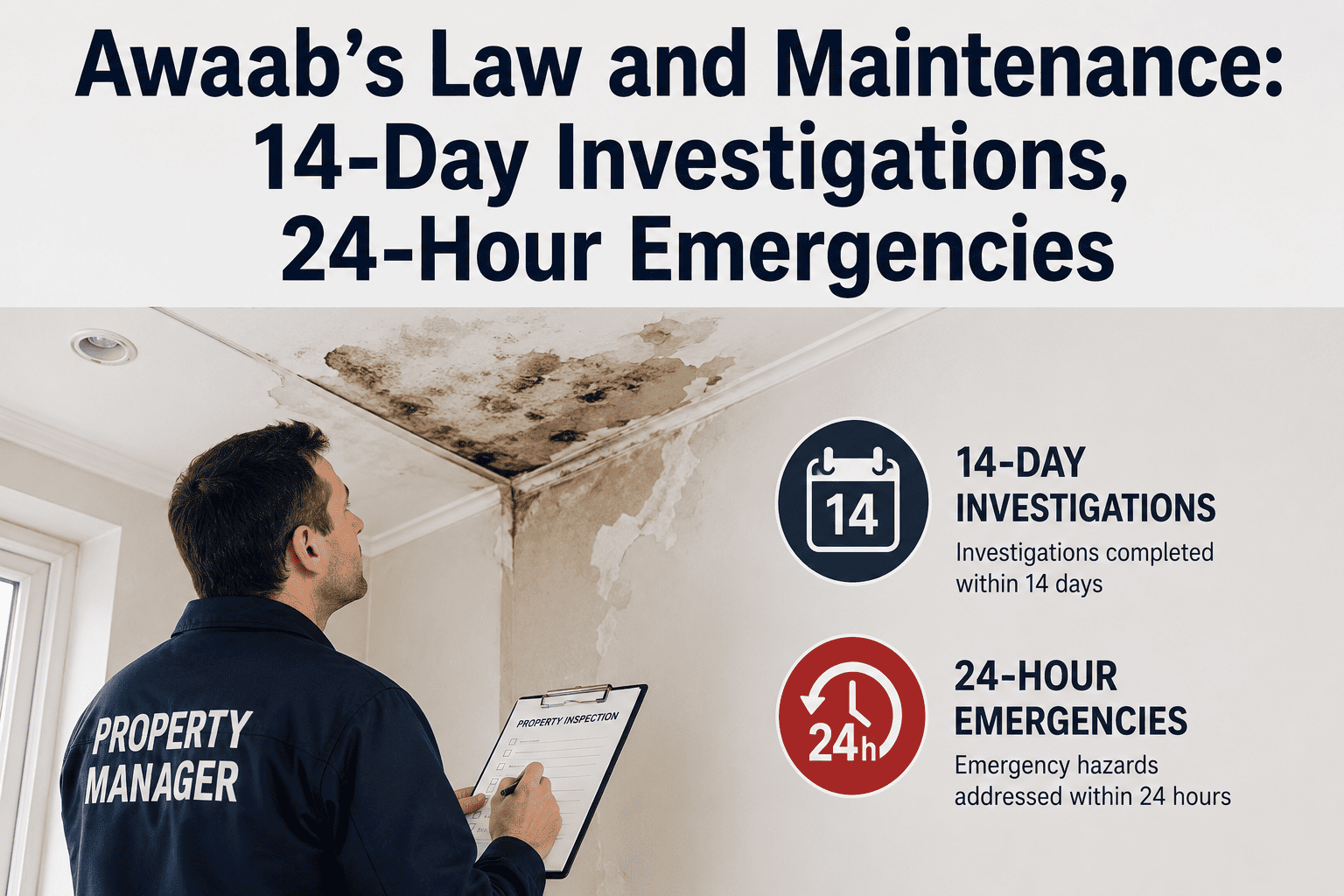
UK social landlords are now working against a clock that did not exist two years ago. Awaab's Law replaces vague "reasonable time" repair language with fixed, legally enforceable deadlines — a set number of days to investigate a hazard, a set number of days to start fixing it, and 24 hours when a hazard is dangerous enough to count as an emergency. For housing managers, this is not a policy to file away. It is a daily operational target that has to be hit on every case, in every property, without exception. Sign up free on OxMaint or book a demo to see how maintenance teams are tracking every Awaab's Law deadline automatically.
10 days
Working days to investigate a significant hazard
24 hrs
Deadline to make an emergency hazard safe
3 phases
Rollout stages running from 2025 through 2027
5 days
Working days allowed to start safety works
What This Guide Covers
01Why Awaab's Law Exists
02The Compliance Timeline
03Significant vs Emergency
04The Three-Phase Rollout
05Meeting Every Deadline
06FAQ
Section 01
Why Awaab's Law Exists — And Why the Clock Matters
Awaab's Law is named after Awaab Ishak, a two-year-old who died in December 2020 after prolonged exposure to mould in his family's social housing home in Rochdale. His death exposed a system where "reasonable time" had no real meaning — landlords could delay indefinitely, and tenants had no fixed date to point to. The Social Housing (Regulation) Act 2023 added Section 10A to the Landlord and Tenant Act 1985, and the Hazards in Social Housing (Prescribed Requirements) (England) Regulations 2025 turned that clause into hard numbers. From 27 October 2025, every registered provider of social housing in England — councils and housing associations alike — must work to fixed timescales or face court action, compensation claims, and Housing Ombudsman scrutiny.
2M+
Homes in England are estimated to have a damp problem — Awaab's Law turns every one of those reports into a timed, documented case rather than a judgment call
Section 02
The Compliance Timeline: What Has to Happen and By When
Every hazard report starts a clock the moment your team becomes aware of it. Miss a step, and the case is a compliance breach — regardless of how good the eventual repair is.
Day 0
Hazard Reported
Tenant reports damp, mould, or another hazard. The landlord assesses whether it is a potential significant or emergency hazard — this marks the start of the timeline.
24 Hrs
Emergency Check
If there are grounds to believe the hazard is an emergency, it must be investigated and made safe within 24 hours, or alternative accommodation offered.
10 Days
Investigation Completed
Significant hazards, including damp and mould, must be investigated within 10 working days — close to two calendar weeks once weekends are counted.
+3 Days
Written Summary Sent
Within 3 working days of the investigation concluding, the tenant must receive a written summary of findings and next steps.
+5 Days
Safety Work Begins
Where a hazard is confirmed, relevant safety work must start within 5 working days of the investigation concluding.
12 Weeks
Works Completed
Remaining and preventive work is normally physically started and completed within 12 weeks, closing out the case.
Every deadline in Awaab's Law needs a timestamp your team can prove.
OxMaint starts the legal clock the moment a hazard is logged, tracks it against working days automatically, and flags any case at risk of breaching its 24-hour, 10-day, or 5-day deadline before it happens.
Section 03
Significant Hazard or Emergency? Getting the Call Right
The clock that applies to a case depends entirely on how it is classified at Day 0. Getting this call wrong at the point of first report is the single most common source of Awaab's Law breaches.
Significant Hazard
10 Working Days to Investigate
A real risk to health or safety that does not require immediate action. Persistent damp or mould with no acute breathing impact typically sits here, along with slow-developing structural or plumbing issues.
No imminent danger to the resident
Investigation, written summary, safety work all timed
Escalates to emergency if it worsens or a vulnerability emerges
Emergency Hazard
24 Hours to Make Safe
An immediate and significant risk of harm. Severe mould affecting a resident's ability to breathe, major leaks, exposed wiring, gas leaks, and broken external doors compromising security all fall here.
Investigation and action both due within 24 hours
Alternative accommodation required if the home cannot be made safe
Vulnerable residents — infants, elderly, respiratory conditions — raise the risk tier
Section 04
The Three-Phase Rollout: 2025 to 2027
Awaab's Law is not a single switch-flip. The government is expanding the list of covered hazards in stages, and each phase adds new categories your maintenance workflows need to be ready for before the deadline lands.
Phase 1 — Oct 2025
Damp, Mould and Emergencies
All emergency hazards, plus significant damp and mould, are in force now under fixed timescales.
Phase 2 — 2026
Wider Hazard Categories
Excess cold and heat, falls, structural collapse, fire, electrical hazards, explosions, and hygiene risks join the timed framework.
Phase 3 — 2027
Full HHSRS Coverage
Every remaining hazard under the Housing Health and Safety Rating System is covered, except overcrowding.
Section 05
Meeting Every Deadline Without Adding Headcount
Manually tracking working-day deadlines across a live caseload of 50, 100, or 200 open hazards is where compliance quietly fails — a spreadsheet does not know when a bank holiday falls, and a missed flag becomes a court case. Purpose-built maintenance software closes that gap.
Automatic Deadline Clocks
The moment a hazard is logged, OxMaint starts counting against the correct 24-hour, 10-day, or 5-day rule — working-day and bank-holiday aware — and flags cases approaching breach before it happens.
Core Gap Solution
Full Audit Trail
Timestamped, photo-documented records are generated automatically for every stage of a case — investigation, findings, and safety work — ready evidence for the Housing Ombudsman or a County Court claim.
Tenant Communication Log
Written summaries and status updates are generated and logged against each case, satisfying the 3-working-day written summary requirement without a separate manual step.
Frequently Asked Questions
Does Awaab's Law apply to private landlords yet?
Not directly. Awaab's Law currently applies only to registered providers of social housing — local authorities and housing associations. The Renters' Rights Bill contains powers to extend equivalent duties to the private rented sector, but this is expected at a later date, likely no earlier than 2027. Private landlords still carry duties under the Homes (Fitness for Human Habitation) Act 2018 in the meantime.
What happens once an investigation confirms a hazard?
If the investigation identifies a significant or emergency hazard, safety work must begin within 5 working days of the investigation concluding, and any supplementary preventive work to stop the hazard recurring must also begin within that same window. Full completion of remaining works is normally expected within 12 weeks.
What happens if a landlord misses a deadline?
Tenants can bring a claim through the County Court for breach of their tenancy agreement, escalate to the Housing Ombudsman, or raise it with the Regulator of Social Housing. Courts can order compensation covering distress, health impact, and loss of enjoyment of the home, alongside an order forcing the work to be carried out.
Built for Awaab's Law Compliance
Awaab's Law does not forgive a missed clock. Neither should your maintenance system.
OxMaint gives housing teams automatic hazard clocks, working-day-aware deadline tracking, and a complete audit trail for every case — live from the moment a hazard is reported, with no manual spreadsheet required.