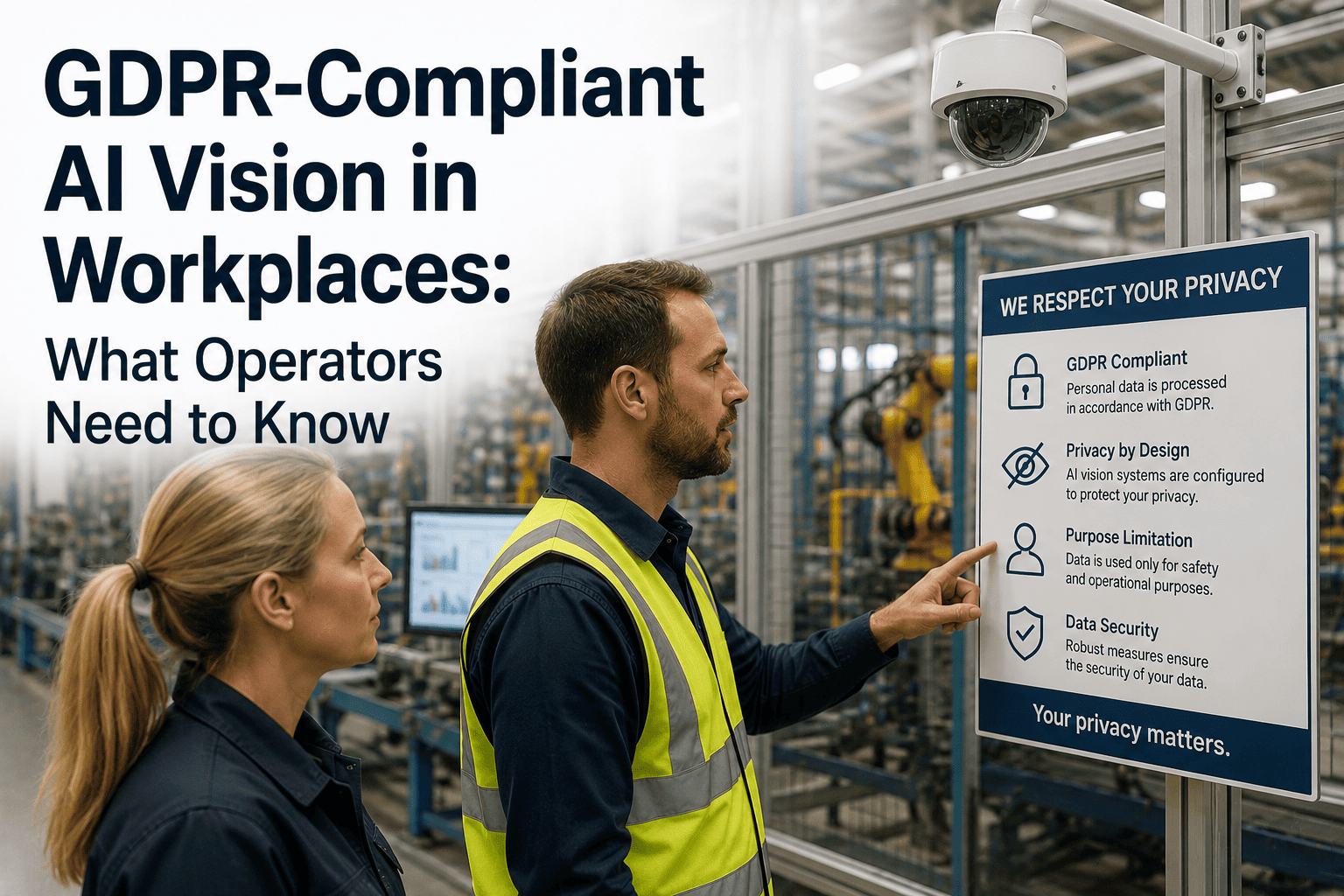
A camera that flags a missing hard hat is one thing. A camera that identifies which specific employee wasn't wearing it, tied to a face, is another thing entirely under UK GDPR. The line between "detecting an event" and "processing biometric data about a named individual" is exactly where most workplace AI vision projects run into trouble, often without anyone realising they'd crossed it. This isn't legal advice, and a data protection lawyer should sign off on any deployment, but understanding where the line sits helps operators ask the right questions before rollout, not after the ICO does. A platform like OxMaint is built to flag events and detections without requiring individual identification unless that's a deliberate, documented design choice.
Deploy Vision AI Without the Compliance Guesswork
Event-based detection designed to avoid unnecessary biometric processing, with the documentation your compliance team will ask for.
Where AI Vision Crosses Into Regulated Territory
Not every camera deployment triggers the same level of scrutiny. These four areas are where workplace vision AI most often runs into UK GDPR obligations.
Biometric Data
Facial recognition used to identify a specific person counts as special category data, needing a stronger legal basis.
Automated Decisions
If a detection triggers a disciplinary or significant outcome without human review, Article 22 protections apply.
Employee Monitoring
Continuous camera coverage of individuals at work sits within ICO guidance on workplace monitoring practices.
Bias & Fairness
A detection model that performs unevenly across groups can raise Equality Act concerns alongside data protection ones.
Lawful Basis Options at a Glance
| Basis | When It Applies | Key Risk |
|---|---|---|
| Legitimate interests | Non-biometric safety or quality monitoring | Must pass a documented balancing test |
| Legal obligation | PPE compliance tied to a statutory duty | Scope must match the specific obligation |
| Explicit consent | Biometric identification of employees | Power imbalance makes consent hard to prove freely given |
| Substantial public interest | Some regulated safety-critical settings | Narrow conditions, needs specific documentation |
Common Compliance Gaps
No DPIA Completed
A Data Protection Impact Assessment is often required before deploying systematic workplace monitoring, yet frequently skipped.
Unclear Retention Periods
Footage and detection data get kept indefinitely by default, rather than a defined, justified retention period.
No Employee Notice
Staff aren't told clearly what's being monitored, why, and how the data will be used before the system goes live.
Untested for Bias
Detection accuracy isn't checked across different groups before the system starts influencing real decisions.
Compliance Maturity
Deployed Without Review
Cameras went live to solve an operational problem, without a formal data protection assessment beforehand.
Reviewed But Undocumented
A DPIA or legal review happened informally, but the reasoning and safeguards were never properly recorded.
Documented & Defensible
Lawful basis, DPIA, retention policy, and employee notice are all documented and ready to show a regulator on request.
The Numbers Behind AI Vision Compliance
The safest workplace AI vision deployments are usually the ones designed from the start to avoid unnecessary identification, not the ones bolting on compliance afterward. Sign up free to explore event-based detection built with this in mind, or book a demo to walk through it with your compliance team.
Build Vision AI Your Compliance Team Will Approve
Event-based detection, clear retention settings, and documentation support designed for UK GDPR and ICO expectations.
Building a Compliant Deployment
Define the Minimum Data Needed
Decide whether the use case actually requires identifying individuals, or if event-level detection is sufficient.
Complete a DPIA
Assess the risk to individuals formally before deployment, with input from legal and data protection teams.
Notify and Involve Staff
Give employees clear, upfront notice of what's monitored, why, and how the data will be used and retained.
Set Retention & Review Cycles
Define how long data is kept, and review the deployment periodically as use cases or regulations evolve.
Frequently Asked Questions
Does every workplace AI camera process biometric data?
No, only if the system is used to identify a specific individual, such as through facial recognition; detecting an event like a missing hard hat without identifying who is wearing it typically doesn't.
Is consent enough of a legal basis for workplace monitoring?
It's often difficult to rely on, since the power imbalance in an employment relationship makes it hard to demonstrate that consent was freely given, which is why other lawful bases are usually more appropriate.
When is a DPIA required for AI vision systems?
A DPIA is generally expected for systematic monitoring of employees or processing that's likely to result in high risk to individuals, and it's best completed before the system goes live.
How does the Equality Act relate to AI vision systems?
If a detection model performs less accurately for certain groups, the resulting outcomes could raise discrimination concerns under the Equality Act, which is why testing for bias matters alongside data protection compliance.
Should legal advice be sought before deploying workplace AI vision?
Yes, this article provides general context rather than legal advice, and a data protection specialist or lawyer should review the specific use case, lawful basis, and documentation before rollout.