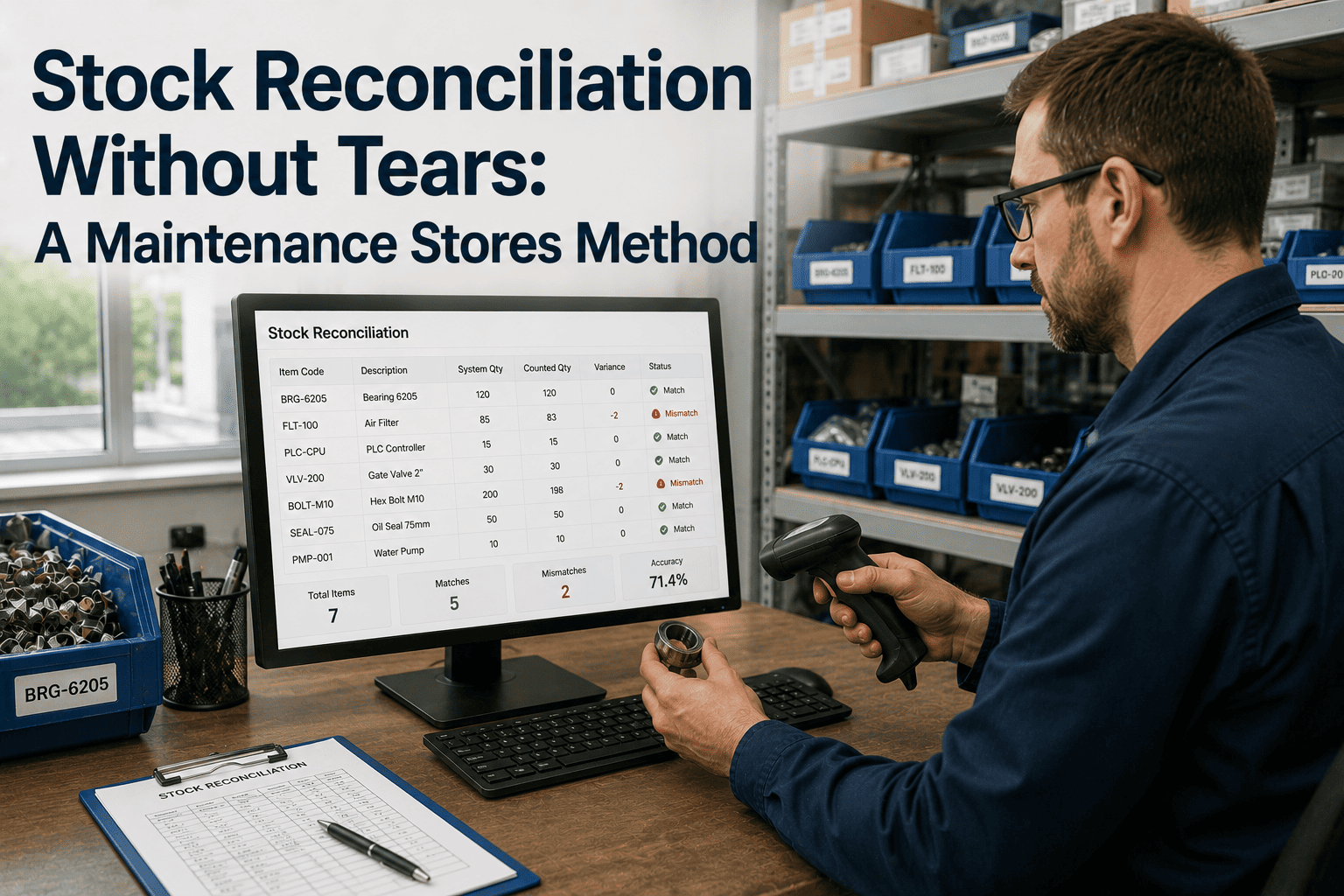
Every stores manager knows the feeling: the year-end stock-take is booked, the finance team wants a variance report by Friday, and half the count sheets don't match what the system says was on the shelf. It isn't usually theft or negligence behind the gap — it's months of unrecorded issues, miscounted bins, and parts moved between locations without a transaction to match. A rolling reconciliation method, built into the way stores already works day to day, turns that one dreaded week into a formality. A CMMS like OxMaint keeps the count current all year, so year-end is just another Tuesday.
Make Year-End Stock-Take Just Another Week
Run rolling cycle counts, set variance tolerances, and track every investigation against a live parts record all year round.
Why Year-End Turns Into a Crisis
The stock-take itself isn't the problem. It's what's been quietly building up underneath it for the previous eleven months.
No Rolling Counts
Without counts spread through the year, every discrepancy surfaces at once, in the one week nobody has spare capacity.
Paper Count Sheets
Manual sheets get transcribed twice before they reach the system, and every transcription is a chance to introduce a new error.
Unexplained Variance
A gap gets written off to adjust the number, because nobody has time to trace it back to the shift or work order that caused it.
Deadline Pressure
Finance needs a signed-off figure by a fixed date, which pushes stores to close variances faster than they can properly be investigated.
Where the Variance Actually Comes From
| What the Count Shows | Typical Root Cause | The Fix |
|---|---|---|
| Part quantity lower than system | Issued against a work order but never recorded at the point of use | Mobile issue logging at the point of pick, not after the shift |
| Part quantity higher than system | Returned unused part never booked back into stock | A simple returns transaction, not a shelf drop |
| Part missing entirely | Moved to a satellite store or van stock without a transfer record | Location transfers logged the same way as issues |
| Duplicate part numbers | Same part added twice under slightly different descriptions | A single master catalogue checked before new parts are added |
The Rolling Reconciliation Method
Set a Cycle Count Calendar
Split the store into zones and count a slice every week, so the whole store is checked several times a year instead of once.
Set Variance Tolerances
Small counting differences on low-value items get auto-approved, so attention goes to the variances that actually matter.
Run a Standard Investigation
Every variance above tolerance follows the same short trail: last transaction, last work order, last user, before it's written off.
Reconcile, Don't Recount
Year-end becomes a sign-off on twelve months of already-investigated counts, rather than one exhausting full recount.
Stores Reconciliation Maturity
Annual Fire Drill
One full count a year, done under deadline pressure, with most variances written off rather than investigated.
Counting but Not Investigating
Cycle counts happen regularly, but variances are logged without a consistent process to trace their cause.
Rolling and Reconciled
Counts, tolerances, and investigations run continuously, so year-end is a formality rather than an event.
What Changes Once Counting Becomes Routine
Stores teams that move to rolling reconciliation usually notice the same thing: the total number of variances doesn't necessarily drop overnight, but the time spent chasing each one falls sharply, because the trail is only a few days old instead of a few months.
None of this needs a bigger stores team — it needs counts, tolerances, and investigations tracked in one place instead of a spreadsheet that only gets opened in December. Sign up free to set up your rolling cycle count calendar, or book a demo to see what a calm year-end actually looks like.
Stop Dreading the Annual Stock-Take
Rolling cycle counts, automatic variance tolerances, and a built-in investigation trail so year-end reconciliation takes a day, not a week.
Frequently Asked Questions
How often should a rolling cycle count actually happen?
Most stores split the warehouse into zones and count a section weekly, so high-value or fast-moving parts are checked several times a year rather than once.
What counts as a variance worth investigating?
A sensible tolerance threshold, often based on value or criticality, filters out small counting noise so investigation time goes to the discrepancies that actually matter.
Does rolling reconciliation replace the year-end stock-take entirely?
Most sites still run a formal year-end sign-off, but it becomes a confirmation of counts already investigated throughout the year rather than a full recount from scratch.
Who should own variance investigations in a stores team?
A named stores lead usually owns the trail, but the fastest resolutions happen when maintenance planners are pulled in for variances tied to specific work orders.
Can this method work with a small stores team?
Yes, spreading counts across the year actually reduces peak workload, which matters more for a small team than it does for a large one.







