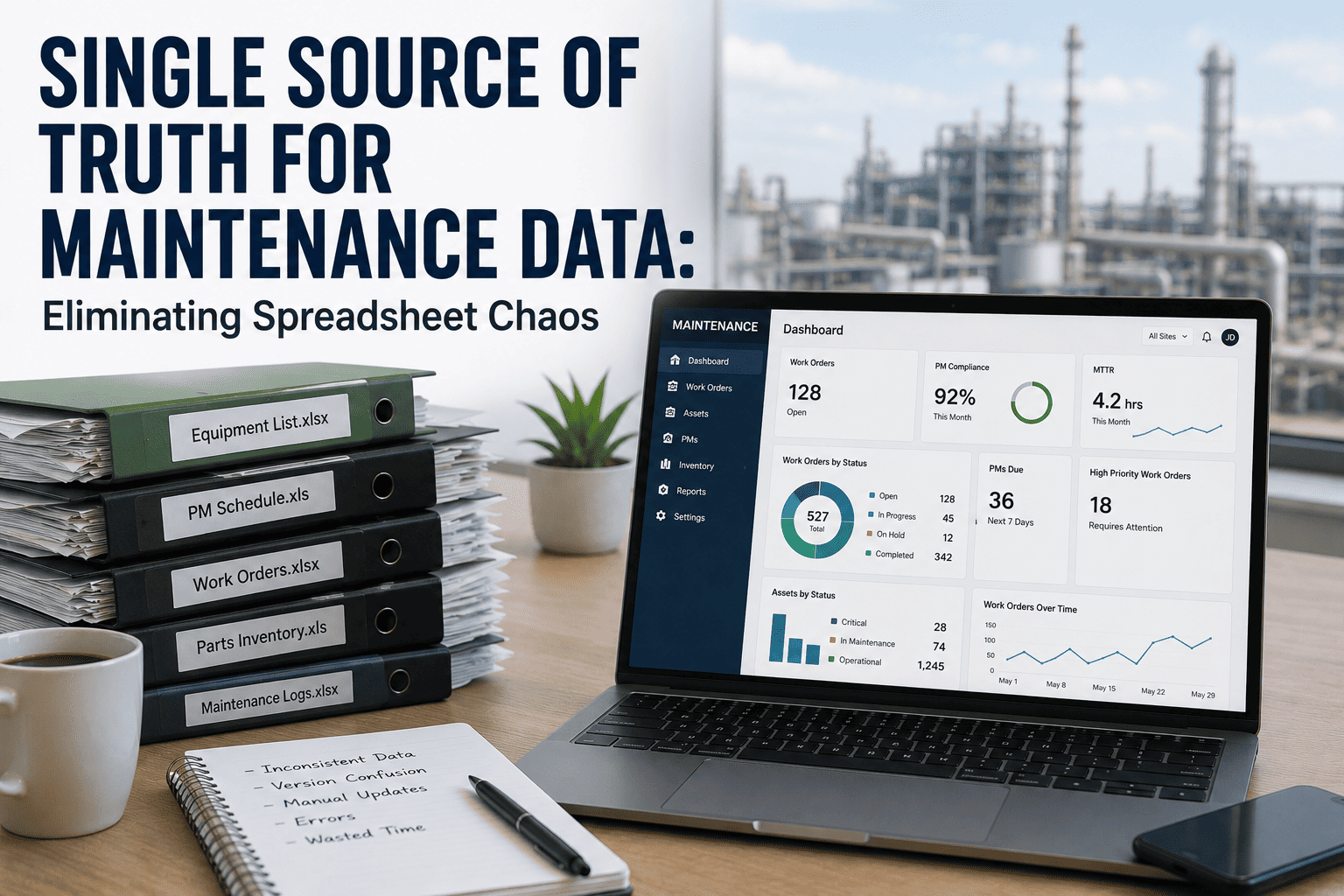
Ask five people at most facilities where the "real" asset list lives and you will get five different answers. The CMMS has some assets. The calibration team keeps a parallel spreadsheet because the CMMS never handled their instrument-specific fields. The ERP has financial depreciation records that do not match operational reality. A departmental tracker covers portable equipment nobody else can see. Each source is confident it is correct, and none of them agree. Gartner predicts that through 2026, 60% of data-dependent initiatives lacking clean, unified data will be abandoned — and maintenance operations are no exception. A CMMS like OxMaint consolidates every one of those scattered sources into one authoritative record, so "which spreadsheet is current" stops being a question anyone has to ask.
Give Your Maintenance Data One Home, Not Five
OxMaint consolidates assets, work history, parts, and PM schedules into a single authoritative system — replacing the shadow spreadsheets nobody fully trusts.
The Myth of the Single Asset Register
Almost every implementation kickoff includes the phrase "single asset register" — one authoritative list of every asset, no duplicates, clear ownership. In practice, very few organizations actually have one. What they have instead is a collection of overlapping, partially maintained sources that each tell a slightly different story. Book a demo to see how OxMaint replaces that collection with one record everyone actually uses.
never fully populated
instrument fields the CMMS lacked
financial depreciation, not operational reality
portable equipment, shadow system
filed, rarely digitized
decisions with no permanent record
What Fragmentation Actually Costs a Maintenance Team
Duplicate Work Orders
Shared spreadsheets create version conflicts and overwritten entries. Two technicians dispatched to the same fault because neither system knew about the other's open ticket.
Silent PM Lapses
When preventive maintenance lives in a spreadsheet, it requires someone to manually check the file every day. If that person is out, the schedule lapses with no alert and no escalation.
Lost Asset History
When a pump fails for the third time this year, can every prior work order and replaced part be pulled instantly? If the answer involves searching old files, the asset history problem already exists.
Audit Exposure
PM schedules based on incomplete data and calibration programs with undocumented intervals create reporting gaps that an auditor can surface at any time — often as the first real visibility into the risk.
Where Maintenance Data Fragments — and Why
Fragmentation rarely starts as chaos. It starts small, one workaround at a time. Sign up free and consolidate these sources into OxMaint before the next workaround gets added on top.
Consolidation Roadmap — From Chaos to One Record
Inventory Every Source
List every spreadsheet, legacy system, and shadow tracker currently holding maintenance-relevant data — including the ones nobody officially sanctioned.
Reconcile Conflicting Records
Where the same asset appears in two sources with different details, determine which source is actually correct rather than guessing or keeping both.
Clean Before You Migrate
Remove duplicates, standardize naming conventions, and backfill missing fields before import — budget 20 to 40 hours of upfront cleanup to prevent months of post-launch correction.
Set a Hard Cutover Date
Retire every legacy spreadsheet on a specific announced day. A soft transition where both systems run in parallel guarantees the old habit wins.
Make the New System the Only Authorized One
Leadership has to reinforce, visibly and repeatedly, that the consolidated system is the sole system of record — not one option among several.
Fragmented vs. Consolidated: The Operational Difference
| Scenario | Fragmented Data | Single Source of Truth |
|---|---|---|
| Asset lookup during a breakdown | Search multiple spreadsheets and ask around | One search returns full asset history instantly |
| Duplicate work order risk | High — two systems, no cross-visibility | Eliminated — one shared queue, one record |
| PM schedule reliability | Depends on someone manually checking a file | Automated triggers, alerts, and escalation |
| Audit readiness | Gaps surface unexpectedly during review | Documented intervals and history on demand |
| Cross-site reporting | Manual reconciliation across formats | Real-time dashboards from one data model |
How OxMaint Becomes Your Single Source of Truth
Pre-Migration Data Audit
Identify quality issues across every legacy source before import — duplicate assets, missing fields, and inconsistent naming get caught and resolved up front, not discovered months later.
Centralized Asset Registry
Every asset, work order, part, and PM schedule lives in one searchable, auditable database — accessible from the field, not buried in a departmental spreadsheet.
Mobile-First Adoption
Technicians log updates directly from the field rather than reverting to a paper workaround — the single biggest factor in whether a consolidated system actually stays consolidated.
Real-Time, Not Static
Work order status, technician workload, and asset condition update live — replacing the static spreadsheet snapshot that was already outdated by the time someone opened it.
Stop Asking Which Spreadsheet Is the Real One
OxMaint consolidates every scattered source of maintenance data into one authoritative, real-time record your whole team can actually trust.
Frequently Asked Questions
What does "single source of truth" actually mean for maintenance data?
A single source of truth means one authoritative record for each asset, work order, and PM schedule — rather than the same information existing in slightly different versions across a CMMS, an ERP, departmental spreadsheets, and email threads. When everyone references the same record, data discrepancies stop appearing and teams stop relying on their own private spreadsheet because they no longer trust the central system. Sign up free to consolidate your sources inside OxMaint.
How do you clean up fragmented maintenance data before migrating it?
Start by inventorying every system and spreadsheet currently holding asset or work order data, including unofficial shadow trackers. Reconcile any asset that appears in multiple sources with conflicting details, remove duplicates, and standardize naming conventions before import. This cleanup typically takes 20 to 40 hours upfront but prevents months of post-launch data entry and correction once the new system is live.
Why do maintenance teams keep using spreadsheets after adopting a CMMS?
Usually because the CMMS did not fully meet a specific team's needs during rollout — a calibration team's instrument fields, a department's portable equipment tracking — so a workaround spreadsheet filled the gap and never got retired. Book a demo to see how OxMaint is configured to cover these edge cases so the shadow spreadsheet never needs to exist in the first place.
How many people touching a shared spreadsheet is too many?
Once more than two people are regularly editing the same maintenance spreadsheet, version conflicts, overwritten entries, and duplicate work orders become close to certain. At that point, data integrity is already compromised — the question is no longer whether problems will occur, but how often they go unnoticed.
How does a CMMS prevent fragmentation from creeping back after consolidation?
A CMMS like OxMaint prevents fragmentation from returning by covering the edge cases that usually drive teams back to spreadsheets — flexible fields, mobile access for every technician, and real-time visibility that makes the central system genuinely faster than a workaround. Combined with a hard cutover date and consistent leadership reinforcement that the system is the sole authorized record, this keeps the single source of truth from quietly becoming one of several sources again.