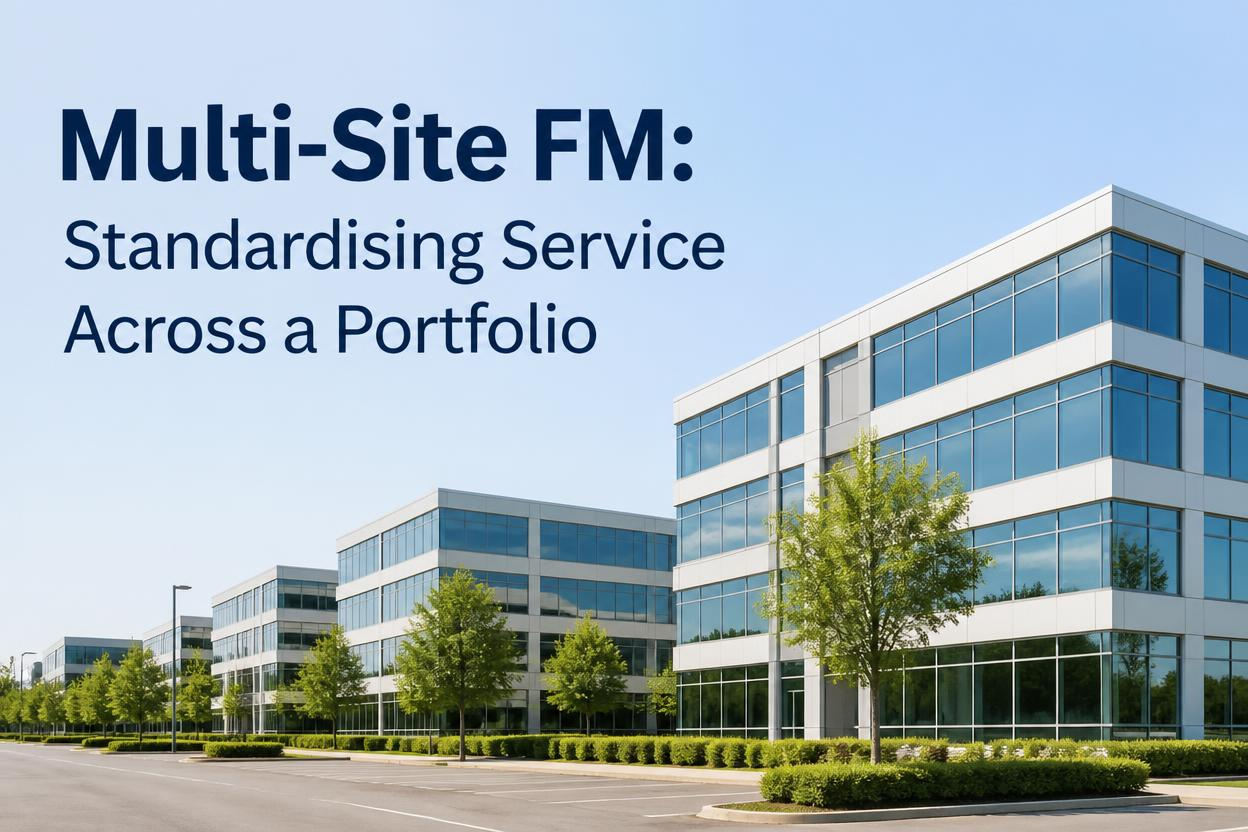
Same brand, same brief, completely different experience walking into site 4 versus site 40. One region's contractor answers a call-out in two hours, another takes two days, and the only person who could explain why is the regional manager who just left. Standardising service across a portfolio isn't about forcing every site to be identical — it's about making sure "identical enough" is actually measured. Sign up to see how a single operating model looks across every site, or book a demo for a portfolio walkthrough.
3
Places standardisation actually breaks: people, process, and data
1
Set of KPIs every site should report against, regardless of contractor
5
Core KPIs strong enough to compare a five-site estate or a five-hundred-site one
4
Stages to roll a standard operating model out without a big-bang cutover
Before You Standardise
Standardising service doesn't mean every site uses the same contractor or the same SLA number. A flagship city-centre site and a low-footfall rural unit can reasonably run different response times. What has to be identical is how you measure, escalate, and report — so a regional director can compare like against like without a translation exercise.
Where Portfolio Standards Actually Break Down
Every multi-site estate has the same brief on paper. What splits sites apart in practice comes down to three things.
Break Point 1
People
A strong regional manager sets a high bar their sites hit. When they leave, the standard leaves with them.
Break Point 2
Process
Each site's contractor was onboarded at a different point, against a different version of the brief.
Break Point 3
Data
One site reports in a spreadsheet, another in a contractor's own portal. Head office sees neither in the same format.
Site-by-Site Management vs a Standardised Portfolio Model
Most estates start on the left and drift there again even after a standardisation project, unless the model is actively maintained.
Site-by-Site Management
Each site manager sources and manages their own contractors
SLAs exist in individual contracts, not a shared standard
Reporting format depends on whoever compiled it last
Head office finds out about a failing site from a complaint
Standardised Portfolio Model
A core set of KPIs applies to every site, whoever the contractor is
Response and completion times are benchmarked by site type
One reporting format rolls up automatically to portfolio level
Underperformance shows up on a dashboard, not in a complaint inbox
One Dashboard for Every Site You Manage
Oxmaint rolls up the same KPIs from every site into a single portfolio view, whatever contractor is on the ground.
The Five KPIs Every Site Should Report On
Keep the core list short enough that every site manager can recite it. These five hold up whether the estate is five sites or five hundred.
| KPI |
What It Reveals |
Reported At |
| First response time |
Whether a contractor is actually reachable when it matters |
Per site, weekly |
| First-time fix rate |
Contractor competence and parts availability |
Per contractor, monthly |
| Reactive vs planned work ratio |
Whether preventive maintenance is actually happening |
Per site, monthly |
| Statutory compliance status |
Legal exposure across the whole estate at any given moment |
Every site, live |
| Cost per site, normalised |
Which sites or regions are quietly running over budget |
Portfolio, quarterly |
Rolling It Out Without a Big-Bang Cutover
Switching every site to a new standard on the same date is how standardisation projects create a portfolio-wide outage instead of fixing one. A staged rollout holds up far better.
01
Pilot on a Small, Representative Cluster
Pick sites that reflect the mix, not the easiest ones
Choose a handful of sites spanning your different contractor relationships and site types, so the pilot actually stress-tests the model.
02
Fix the KPI Definitions Before Scaling
Ambiguity here gets copied to every site that follows
Agree exactly what "first response" or "fixed" means in writing, so two sites can't quietly report the same event two different ways.
03
Roll Out by Region, Not All at Once
Each wave should be small enough to fix mid-rollout
Bring one region onto the standard, capture what didn't work, adjust, then move to the next. It's slower up front and faster overall.
04
Review the Standard Itself Every Year
A standard that never changes eventually stops fitting the estate
New site types, new contractors, and new regulation all shift what "standard" should mean. Revisit it on a schedule, not only when something breaks.
Frequently Asked Questions
Q
Should every site in a portfolio use the same FM contractor?
Not necessarily. National contracts simplify management but can weaken local responsiveness, especially in remote areas. Many portfolios run a mix of national and regional contractors successfully, provided every one of them reports against the same core KPIs.
Q
How many KPIs should a multi-site FM report actually track?
Keep the mandatory core small, around five, so it's realistic for every site to hit consistently. Individual sites or regions can track additional metrics locally, but the shared portfolio report should stay lean enough that nobody skips it.
Q
What's the biggest early warning sign that standardisation is slipping?
Reports that no longer match format. If one site's monthly update looks structurally different from another's, the underlying process behind it has probably already diverged too.
Q
Can a single CMMS realistically handle a hundred-plus site estate?
Yes, provided it's built for portfolio structure rather than a single building. The key requirement is consistent KPI reporting rolled up automatically across sites, not just work order tracking at each one individually.
Standardise Every Site Without Losing Local Flexibility
Oxmaint gives every site the same KPI structure, compliance tracking, and reporting format, whatever contractor is on the ground, so head office finally sees the whole portfolio in one view.
Portfolio KPI Dashboard
Multi-Contractor Support
Estate-Wide Compliance View
Standardised Reporting