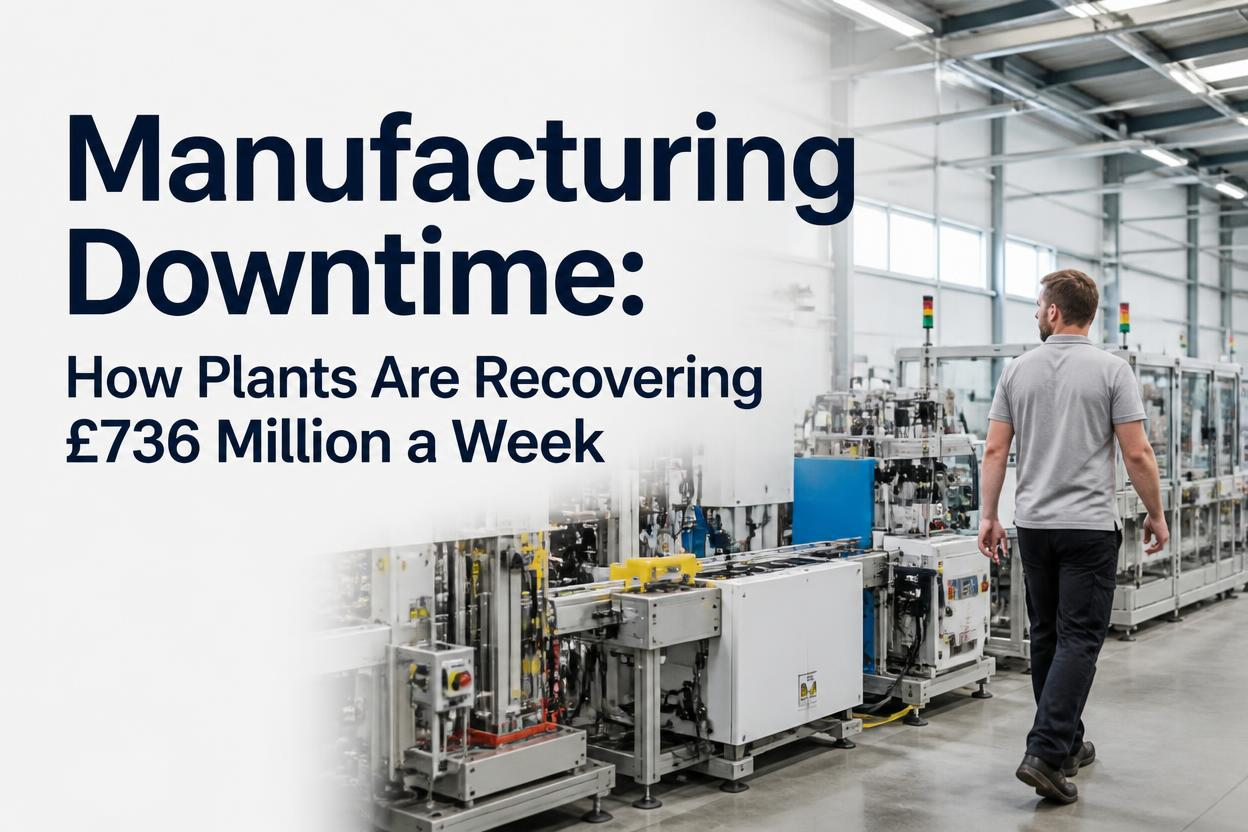
A new industry survey has put a number on something plant directors have felt for years: unplanned downtime isn't an occasional inconvenience, it's a weekly drain on the balance sheet. A 2025 Censuswide survey of over 600 senior decision-makers and maintenance professionals across the UK, US, and Germany found that nearly seven in ten UK manufacturers experienced unplanned downtime in the past year, costing the sector up to £736 million every week.The plants closing that gap aren't the ones with the biggest maintenance budgets — they're the ones treating reliability as a single, connected strategy instead of scattered point fixes. A CMMS like OxMaint is how that strategy gets built, connecting predictive alerts, work orders, and asset history in one place instead of three disconnected tools.
Start Recovering Lost Production Capacity
Connect predictive maintenance, condition monitoring, and work order history in one system, instead of managing downtime with fragmented point fixes.
The Anatomy of the Weekly £736 Million
The headline figure is large enough to feel abstract. Broken into frequency and duration, it becomes a much more familiar picture of a normal week on a normal plant floor.
Frequency and Duration, Side by Side
| Metric | Reported Figure | What It Means on the Floor |
|---|---|---|
| Weekly incident frequency | 46% report 6-10 incidents weekly | Downtime is a routine weekly event, not a rare emergency |
| Higher-frequency plants | 15% face 11-20 incidents weekly | Some sites are absorbing multiple stoppages every single day |
| Typical outage length | 45% of outages last up to 12 hours | A single fault can wipe out most of a production shift |
| Extended outages | 17% report incidents stretching to 72 hours | A worst-case fault can idle a line for the better part of a week |
The Strategies Plants Are Using to Recover Capacity
The report notes UK manufacturers are spreading digital investment across predictive maintenance, digital twins, and condition monitoring — each useful, but only powerful when connected to the same maintenance record rather than run as separate initiatives.
Predictive Maintenance
Failure patterns from historical work orders flag which asset is likely to fail next, before it stops the line.
Condition Monitoring
Live sensor data on vibration, temperature, and pressure catches degradation days or weeks before a breakdown.
Digital Twins
A live model of the asset lets engineers test the impact of a fault before deciding how urgently to respond.
One Connected Record
All three feed the same asset history, so a predictive alert becomes a scheduled work order automatically.
Reliability Programme Maturity
Reactive and Fragmented
Downtime is fixed after the fact, and any digital tools in use don't talk to each other or to the maintenance schedule.
Monitoring but Disconnected
Sensors and predictive tools generate alerts, but someone still has to manually turn them into a maintenance action.
Integrated and Automated
Predictive signals, condition data, and work orders live in one system, closing the gap between alert and action.
Why Fragmented Tools Aren't Closing the Gap
Parker Burke, Group President at Fluke Corporation, described manufacturers as caught in a cycle where downtime erodes competitiveness while too many remain stuck with fragmented fixes, calling for reliability to be treated as a boardroom priority rather than a purely operational one. That gap between having digital tools and actually closing the downtime loop is exactly where most of the recoverable £736 million sits.
A predictive alert that doesn't automatically become a work order is a missed opportunity dressed up as a dashboard. The plants recovering the most lost capacity are the ones where an early warning signal, whatever tool generated it, lands directly on a technician's schedule the same day.
Closing that loop doesn't require ripping out existing sensors or monitoring tools. It requires a system that sits underneath them, turning every signal into tracked, scheduled action. Sign up free to connect your existing monitoring tools to automated work orders, or book a demo to see what closing that gap looks like on your own asset data.
Turn Fragmented Reliability Tools Into One System
Predictive alerts, condition data, and work orders connected in one place, so downtime gets caught before it costs a shift.
Frequently Asked Questions
Where does the £736 million a week figure come from?
It comes from a 2025 Censuswide survey of over 600 senior decision-makers and maintenance professionals across the UK, US, and Germany, commissioned by Fluke Corporation.
Is UK downtime more costly than in other countries?
The survey found the cost per incident in the UK and Germany was notably higher than the global average, pointing to a bigger resilience gap in these markets specifically.
Do predictive maintenance and condition monitoring do the same job?
No, condition monitoring tracks live sensor readings for signs of degradation, while predictive maintenance uses historical failure data to anticipate which asset is likely to fail next.
Why doesn't having these tools automatically reduce downtime?
A tool that generates an alert without automatically creating a work order still relies on someone noticing and acting on it manually, which is where much of the delay creeps back in.
What's the fastest way to start closing the gap?
Connecting whatever monitoring tools are already in place to a system that automatically turns alerts into scheduled work orders is usually faster than replacing the tools themselves.