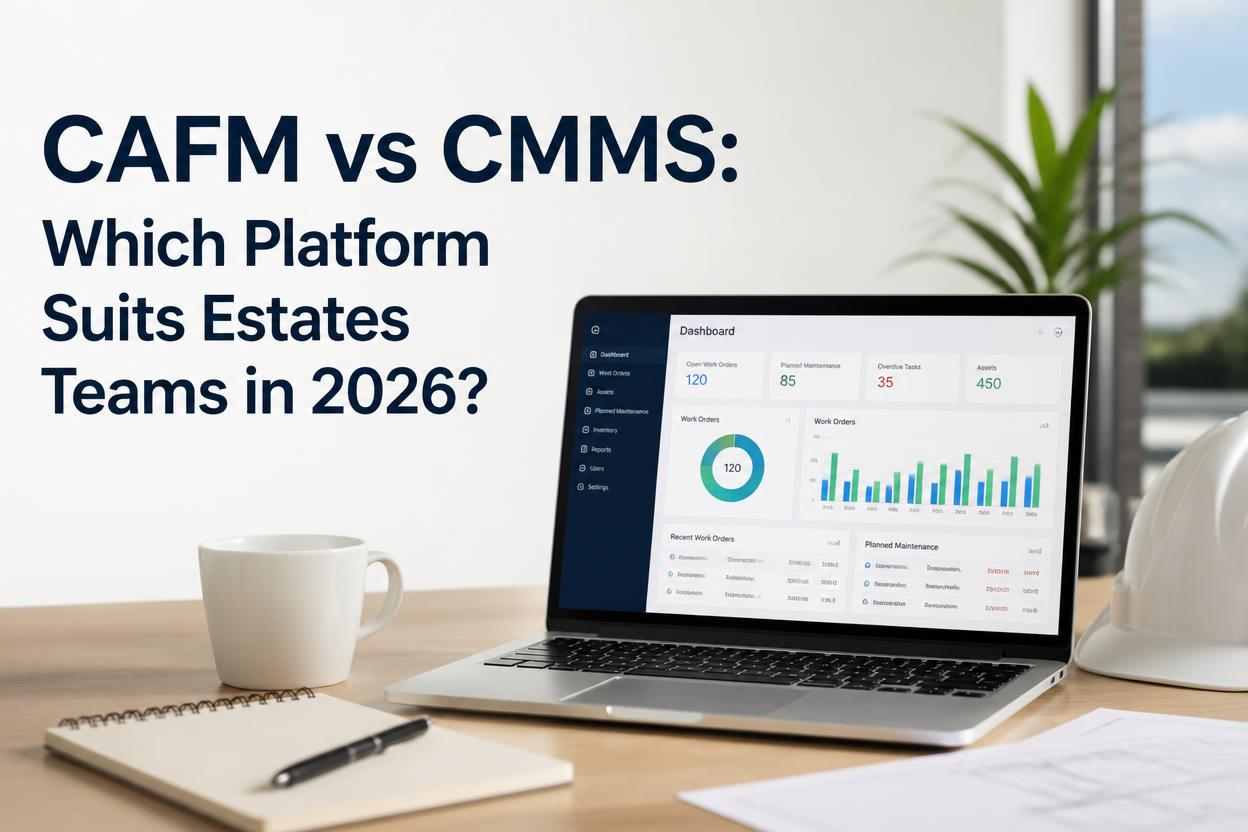
CMMS, CAFM, IWMS, EAM — every FM software vendor pitch in 2026 uses at least one of these acronyms, and most estates teams end up shortlisting the wrong one because they compared feature lists before defining the actual problem they're solving. The right platform isn't the one with the longest feature list. It's the one built around your biggest operational risk. Start a free trial to see where Oxmaint fits your estate.
4
Platform categories FM decision makers now routinely shortlist against each other in 2026
1
Question that should decide your shortlist before a single vendor demo is booked
2x
Roughly how much more complex an EAM implementation typically is compared with a focused CMMS rollout
5
Real shortlist criteria that matter more than any feature checklist a vendor hands you
The One Question That Decides Your Shortlist
Before comparing a single vendor, answer this: is your biggest operational risk asset failure, space and soft FM fragmentation, property portfolio complexity, or lifecycle cost across a large distributed asset base? Each answer points cleanly to one of the four categories below — and most platform regret comes from skipping this question and buying on breadth of feature list instead.
Match Your Biggest Problem to the Right Platform
01
Your Problem: Assets Keep Failing Without Warning
You need a CMMS
If PM schedules are inconsistent, breakdowns feel reactive, and no one can pull up an asset's full failure history in under a minute, a CMMS is the direct fix. It's purpose-built for scheduling, work order tracking, spare parts, and maintenance history — the deepest tool on this list for anything with a service interval and a failure mode.
Typical Buyer
Maintenance and engineering leads, single or few-site estates
Implementation Effort
Low to moderate — often live within weeks
02
Your Problem: Multiple Sites, Contractors, and Both FM Types at Once
You need a CAFM
If your day involves hard FM compliance, soft FM contractor oversight, and space allocation all landing on your desk from multiple sites, CAFM's breadth across both hard and soft FM in one dashboard is the better starting point than a maintenance-only tool. It won't go as deep on pure maintenance workflows as a dedicated CMMS, but it covers more of your actual week.
Typical Buyer
Multi-site FM directors managing hard and soft FM together
Implementation Effort
Moderate — configuration across more workflow types
03
Your Problem: Property Sits on the Balance Sheet as Much as It Houses Operations
You need an IWMS
If lease events, capital planning, and ESG reporting are as much a part of your role as keeping buildings running, an IWMS adds the real-estate and financial layer that CAFM and CMMS don't cover. It's a bigger investment and a longer rollout — appropriate when property is managed as a financial portfolio, not just a set of buildings to maintain.
Typical Buyer
Corporate real estate and large portfolio teams
Implementation Effort
High — often months, with finance system integration
04
Your Problem: Thousands of Assets, Full Lifecycle Reporting Required
You need an EAM
If you're tracking asset acquisition cost, depreciation, and disposal alongside maintenance across a large, distributed asset base — think utilities, transport infrastructure, or large industrial estates — an EAM extends everything a CMMS does with financial and strategic lifecycle planning. It typically costs and implements at a level above CMMS, so it earns its place only at real scale.
Typical Buyer
Utilities, transport, and large asset-intensive industrial estates
Implementation Effort
High — financial and ERP integration typically required
See If a CMMS-First Approach Fits Your Estate
Oxmaint gives estates teams deep CMMS-grade maintenance management with the multi-site and reporting depth many CAFM buyers actually need. Sign up free or book a demo to map it against your shortlist.
Real Shortlist Criteria for FM Decision Makers
Once you know your category, use these five criteria to compare vendors — they matter more than any feature checklist a sales deck hands you. Sign up to Oxmaint to test these against your own asset data before committing.
| Criteria |
Why It Matters |
How to Test It |
| Asset and PM depth |
Shallow maintenance workflows push teams back to spreadsheets |
Load 20 of your real assets and build a live PM schedule in the demo |
| Multi-site support |
Some CMMS tools only handle single-site well |
Ask for a live cross-site reporting view, not a screenshot |
| Integration and API openness |
Determines whether this platform can talk to what you already run |
Request API documentation directly, not a marketing summary |
| Realistic implementation time |
Underestimated rollouts erode confidence before go-live |
Ask for a reference client with a similar estate size and timeline |
| Total cost of ownership |
License price rarely reflects true annual cost |
Get a written quote including training, support, and per-user scaling |
Why Platform Choices Go Wrong
Most FM software regret in 2026 traces back to one of these four decisions made during the buying process, not to any single vendor being genuinely bad.
Gap 01
The Demo Solved a Problem You Don't Have
A vendor demo impressively solved space planning, but your actual pain point was PM scheduling consistency. The demo was memorable, so it shaped the shortlist — even though it wasn't answering your real question.
Gap 02
Category Was Bought for Where the Business Might Be in Five Years
An IWMS was purchased for future portfolio growth that hasn't happened yet. The team pays for capital planning and lease modules going unused, while day-to-day maintenance work runs on a shallower module than a dedicated CMMS would have provided.
Gap 03
Implementation Time Was Never Honestly Scoped
A sales estimate promised go-live in six weeks. Asset data migration alone took twice that, and the gap between promised and real timeline damaged internal confidence in the whole project before the team had even started using it.
Gap 04
No One Priced the Second and Third Year
Year one licensing looked competitive against the budget. Per-user scaling and support tier upgrades in years two and three pushed total cost well past what a more focused platform would have charged for the same core need.
How Oxmaint Fits This Map
Oxmaint is built CMMS-first — deep PM scheduling, multi-site asset visibility, and mobile work orders — with open API integration so it sits cleanly alongside whatever CAFM, helpdesk, or space-management tool the rest of your stack already runs. You get maintenance-grade depth without buying complexity your estate doesn't need yet. Book a demo to see where it sits against your shortlist.
Frequently Asked Questions
Q
Is EAM just a bigger, more expensive CMMS?
Broadly yes, though the difference is scope rather than just scale. A CMMS focuses on maintenance operations — scheduling, work orders, spare parts. An EAM covers the entire asset lifecycle including acquisition cost, depreciation, and disposal, plus deeper multi-site and cross-department integration. Most organisations don't need EAM's full scope unless they're managing very large, distributed asset portfolios with financial reporting requirements attached.
Q
Can we run a CMMS and CAFM together rather than choosing one?
Yes, and many estates do exactly this — a dedicated CMMS handling maintenance depth, connected via API to a CAFM or helpdesk tool handling space and soft FM logging. The key is making sure the two systems share a single asset record rather than each maintaining its own, which is where most integration headaches actually come from.
Q
How long should an FM platform implementation realistically take?
A focused CMMS can often go live within a few weeks for a single or few-site estate, mainly limited by asset data cleanliness. CAFM implementations typically run longer given the broader configuration scope, and IWMS or EAM rollouts, especially with financial system integration, can take several months. Any vendor quoting a timeline dramatically shorter than these ranges deserves a closer look at what's actually included.
Q
What's the single biggest mistake FM decision makers make in 2026 platform buying?
Buying category breadth before confirming depth on the workflow carrying the most operational risk. A platform that looks comprehensive in a sales demo can still be shallow on the one workflow — usually maintenance scheduling or compliance — where a gap actually costs money or creates safety exposure. Test that workflow specifically before signing.
Test Maintenance Depth Before You Commit to a Category
Oxmaint gives your estates team CMMS-grade PM scheduling, multi-site visibility, and open API integration, so you can see exactly how deep your maintenance workflow runs before deciding whether you need more. Asset management, PM scheduling, and reporting live in one platform.
CMMS-Grade PM Scheduling
Multi-Site Asset Visibility
Open API Integration
Mobile Work Orders
Compliance Reporting