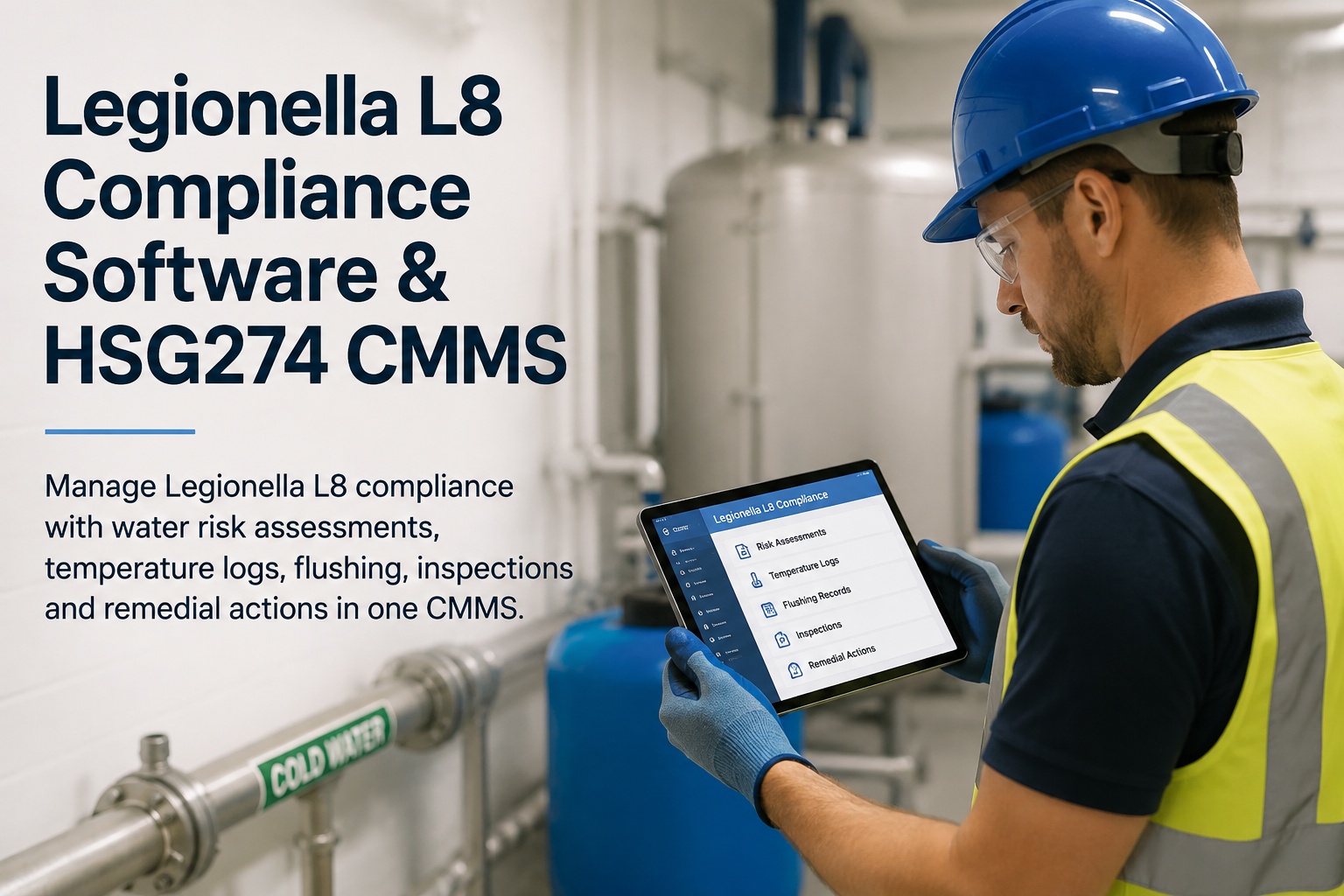
ACoP L8 is the framework the HSE holds you against. HSG274 is the technical manual that shows one accepted way to meet it. Both exist because Legionella pneumophila proliferates silently in water systems between 20°C and 45°C, and duty holders who can't produce evidence of active control get held responsible when someone is infected. Oxmaint gives L8 duty holders one CMMS for the risk assessment, written scheme, temperature monitoring, flushing records, remedial actions and audit trail — audit-ready every day, not annually. Book a demo to see L8 workflows in action.
20-45°C
the danger zone where Legionella proliferates — temperature control keeps water either side of it
5 yrs
minimum record retention required under ACoP L8 — inspection-ready for HSE or local authority
4th ed.
current ACoP L8 (2013) — HSG274 Part 1 updated in 2024, Parts 2 and 3 remain current
L8 vs HSG274 — The Distinction That Trips Most Duty Holders
Confusing L8 and HSG274 is the single most common misunderstanding in water hygiene compliance. L8 is the Approved Code of Practice — it has special legal standing under the Health and Safety at Work etc. Act 1974 and COSHH 2002. Depart from L8 and a court can treat it as evidence of failure to control the risk. HSG274 is technical guidance — three parts covering cooling towers, hot and cold water, and other risk systems. You can vary from HSG274 if you achieve equivalent control and can justify it; you can't vary from the framework duties in L8.
Two Documents · Two Roles
ACoP L8
Approved Code of Practice · 4th ed. 2013
Legal statusSpecial standing
AnswersWhat the law expects
ScopeFramework duties on the dutyholder
DepartureCourt can find fault if departed from
Typical contentRisk assessment, written scheme, competence, records, review
HSG274
Technical guidance · 3 parts
Legal statusGuidance, not law
AnswersHow to meet L8 in practice
ScopePt 1 cooling · Pt 2 hot/cold · Pt 3 other
DeparturePermitted if equivalent control demonstrated
Typical contentTemperatures, frequencies, monitoring detail, biocide regimes
The Temperature Regime — Keeping Water Out of the Danger Zone
Temperature is the primary Legionella control on most hot and cold water systems. The bacteria dies rapidly above 60°C, grows slowly between 45°C and 55°C, thrives between 25°C and 45°C, and survives dormant below 20°C. HSG274 Part 2 sets the specific thresholds duty holders must monitor against, and the sentinel-outlet regime — nearest and furthest hot outlet on each loop, all cold outlets more than 30 seconds from delivery — that samples the whole system without instrumenting every tap.
Legionella Temperature Zones · HSG274 Part 2
Water systems must be kept either side of the 20-45°C danger zone
≥ 60°C
Calorifier outlet — kills Legionella rapidly
≥ 55°C
Hot outlets within 1 minute of running
45-55°C
Slow growth zone · control action needed
20-45°C
DANGER ZONE · Legionella proliferates
≤ 20°C
Cold outlets within 2 minutes of running
The Seven Record Categories Every Duty Holder Must Hold
L8 and HSG274 together mandate seven distinct record categories that duty holders must keep, retain for at least five years, and produce on request during an HSE or local authority inspection. Missing any category is a documented failure to demonstrate continuous control — and continuous control is the standard the enforcement authority holds you to.
Legionella risk assessment
BS 8580-1 aligned assessment by a competent person. Schematics, asset register, identified control measures, review triggers documented.
Written scheme of control
Working document referencing the RA — assets, control parameters, monitoring frequencies, action levels, corrective actions per parameter.
Temperature monitoring logs
Sentinel outlet readings at defined frequency. Dated, signed, tied to the specific outlet on the schematic — not a generic weekly tick.
Flushing records for low-use outlets
Weekly flushing of infrequently-used outlets, dated and signed. Empty guest rooms, unused showers, seasonal buildings — a common enforcement finding when omitted.
Sampling & microbiological results
Legionella, Pseudomonas, TVC results from UKAS-accredited laboratory. Positive results trigger the written response protocol immediately.
Remedial & corrective actions
Every out-of-tolerance reading generates a remedial action with owner, target date, evidence and close-out. Open items past target = enforcement finding.
Training & competence records
Responsible Person, deputies, monitoring staff, contractors. Training dates, refresher intervals, competence evidence retained.
Getting all seven of these into one live system — not seven separate spreadsheets — is what makes an L8 programme genuinely audit-ready. Sign up free to configure your L8 record structure against your existing risk assessment.
See L8 Compliance Workflows Live
Walk through the asset register, temperature monitoring routes on mobile, flushing schedule, sampling record integration and remedial-action close-out — configured against your specific building portfolio. Thirty minutes with the Oxmaint team.
The Responsible Person and the Written Scheme
L8 requires the dutyholder to nominate a Responsible Person to implement the written scheme, with deputies for continuity. This isn't a paper appointment — the Responsible Person needs demonstrable competence, defined authority to take remedial action, and the operational support (records, alerts, escalation paths) to actually do the job. Oxmaint holds the Responsible Person against every asset in scope, escalates overdue tasks to their deputies automatically, and produces the "what did the Responsible Person do about it" evidence trail that HSE inspection specifically probes. Sign up free to assign Responsible Person accountability across your assets.
Expert Perspective — What HSE Inspectors Actually Look For
An HSE inspector on an L8 visit rarely opens a discussion by asking to see the risk assessment. They ask to see this week's temperature monitoring records, this quarter's flushing sheets for room 4B, the corrective action from the failed sample eight weeks ago, and the Responsible Person's sign-off on the last written scheme review. The risk assessment appears when the inspector wants to check whether the ongoing controls actually match what the RA identified — which is where dutyholders relying on annual paper reviews come unstuck. Continuous evidence beats annual assurance every time in an L8 audit.
Continuous vs annual evidence
Continuous monitoring records demonstrate active control. Annual reviews without weekly evidence read as a paper exercise, not a live programme.
Corrective action close-out
An out-of-tolerance reading that never generated a documented response is the single most common enforcement finding. Every reading needs an owner.
Low-use outlet flushing
Vacant rooms, unused showers, seasonal outlets — HSG274 requires weekly flushing. Skipped flushing during quiet periods is a routine finding.
Responsible Person continuity
When the nominated RP leaves and the deputy has no evidence of taking over duties, the compliance chain breaks. Documented handover is essential.
Who Uses Oxmaint for L8 Compliance
The platform is used by the specific duty holder roles that carry L8 accountability: facilities managers with named Responsible Person status running temperature routes, flushing schedules and sampling programmes, estates directors managing L8 obligations across multi-building portfolios, health and safety leads producing compliance evidence for HSE inspection or insurer audit, care home and healthcare facilities managers under enhanced L8 obligations for vulnerable occupants, and housing association / social landlord teams managing L8 across communal areas and shared water systems. Each role sees the same underlying data filtered to their view — compliance dashboard, temperature route on mobile, remedial action backlog or audit evidence pack. Sign up free to configure roles for your L8 team.
Getting an L8 Deployment Live
Deployment starts with importing your existing water system schematics, asset register and risk assessment into the Oxmaint L8 module. Sentinel outlets are placed against the schematic, temperature monitoring routes are configured for mobile, flushing schedules are built around low-use outlet lists, and remedial actions from the latest RA are loaded as open work items with owners. Sampling contractors are given scoped access to upload UKAS results directly against the correct outlets. Most single-site deployments move from initial scoping to live temperature-route operation inside 30 days. Book a walkthrough to see live UK duty holder deployments.
Turn L8 Compliance Into a Live Daily Record
Oxmaint gives L8 duty holders one platform for the risk assessment, written scheme, temperature monitoring, flushing schedules, sampling results, remedial actions and Responsible Person accountability — audit-ready for HSE inspection every day of the year.
Frequently Asked Questions
Does Oxmaint replace a competent Legionella risk assessor?
No — and it isn't meant to. L8 requires a BS 8580-1 aligned risk assessment by a competent person or consultancy, and separate assessments for cooling towers under HSG274 Part 1 and spa pools under Part 3. Oxmaint takes the output of that assessor's work — the identified assets, control parameters, monitoring frequencies, remedial actions and review triggers — and operationalises it: live schedules, monitoring routes on mobile, remedial tracking, audit evidence. The assessor identifies the risk; Oxmaint operates the daily control regime that manages it. Both are required for full L8 compliance.
Can temperature monitoring routes be run on mobile?
Yes. Monitoring staff walk the temperature route using the Oxmaint mobile app — each sentinel outlet displayed with expected thresholds, previous reading and the specific action required if the reading falls outside HSG274 Part 2 limits. Readings are captured on the device with automatic timestamp and staff attribution. Out-of-tolerance readings raise a corrective action immediately, notify the Responsible Person, and remain open in the system until closed with documented evidence. No transcription from paper sheets to spreadsheets to compliance folders — the reading is the record.
How does the platform handle low-use outlet flushing?
Low-use outlets are flagged against the schematic and appear on a weekly flushing schedule for the specific team member responsible. Each flush is captured on mobile with photo or geolocation evidence where required, and any missed flush generates an escalation to the Responsible Person. Vacant hotel rooms, unused guest bathrooms, seasonal-use showers, empty rentals and infrequently-occupied plant spaces all sit in the flushing register — one of the most common areas where paper-based systems break down during quiet periods.
Does the sampling workflow integrate with UKAS-accredited laboratories?
Yes. Sampling contractors and UKAS laboratories can be given scoped access to upload results directly against the correct outlet on your schematic — no manual transcription from PDF sample reports. Positive Legionella or Pseudomonas results automatically trigger the written response protocol, alert the Responsible Person and any escalation contacts, and remain flagged until the resample confirms clearance. Result history is retained against the outlet for the full 5-year retention period required by L8.
Does it produce audit-ready evidence for HSE inspection?
Yes — that's the specific use case for the audit-pack export. Selectable by building, date range or asset, the pack bundles the current risk assessment, written scheme of control, temperature monitoring log, flushing records, sampling results with UKAS certificates, corrective action close-out records, and training/competence evidence into a single PDF ready for HSE, local authority, insurer or internal audit. Runs in one click, in minutes — not the multi-day scramble that paper-and-spreadsheet regimes typically produce when an inspector arrives.