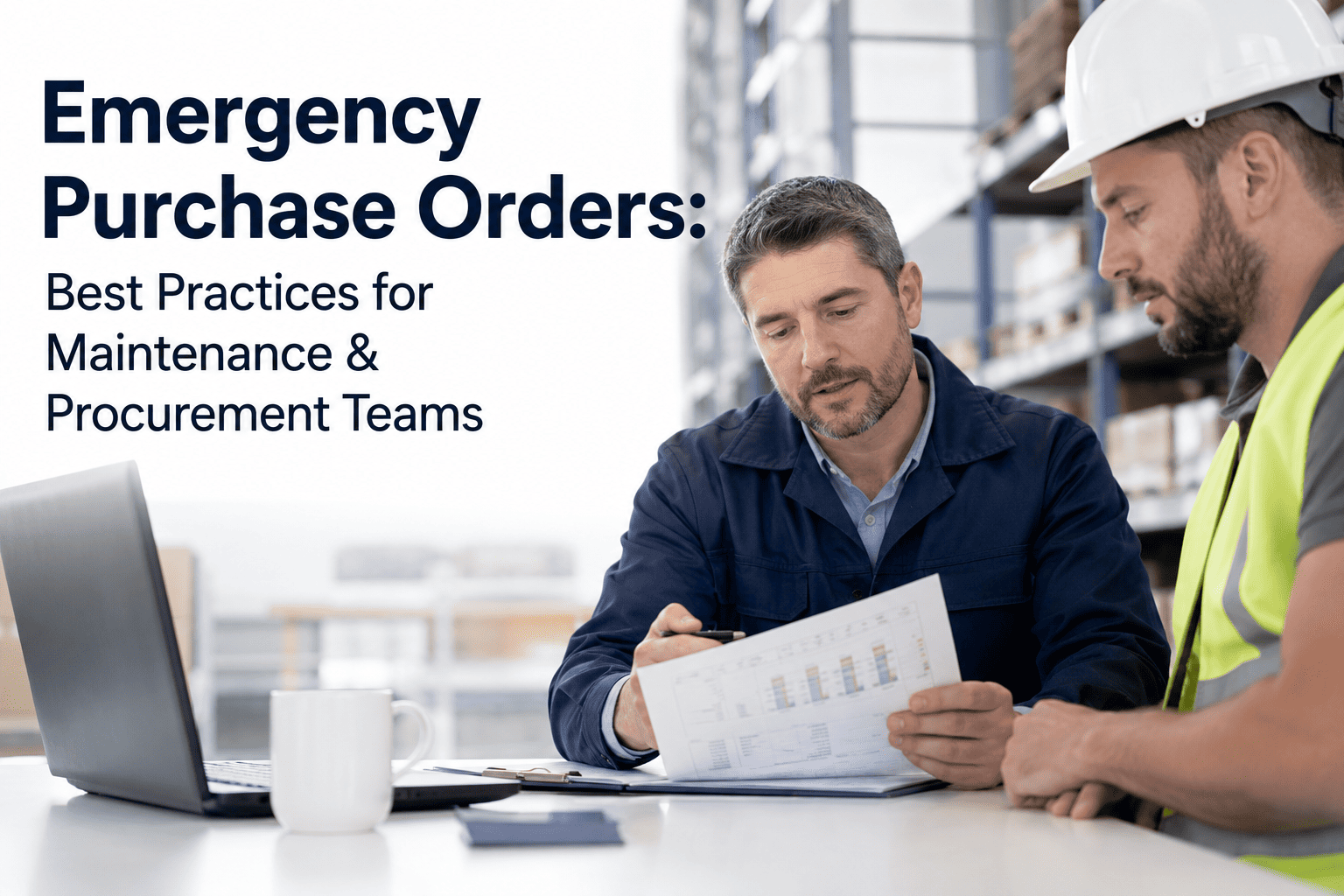
A compressor seizes at 2 a.m. and production stops. In that moment, nobody is thinking about three-tier approval matrices — they are thinking about getting a part on a truck. This is exactly the moment where procurement compliance most often breaks down, because emergency purchasing gets treated as an excuse to skip controls rather than a parallel path that still has them. Unplanned downtime now averages $260,000 per hour across manufacturing sectors, and emergency parts ordered without a plan cost 30 to 40% more than the same part purchased through normal channels. A CMMS like OxMaint gives maintenance and procurement teams a pre-built emergency purchasing path — fast enough for the breakdown, documented enough for the auditor.
Build Your Emergency Purchasing Path Before You Need It
OxMaint lets you pre-configure emergency PO rules, fast-track approvals, and automatic documentation — so the next breakdown doesn't become a compliance gap.
Why "Emergency" Cannot Mean "No Process"
The instinct during a breakdown is to do whatever it takes to get the line running again — and that instinct is correct about urgency, but wrong if it means abandoning every control at once. Emergencies demand speed, not shortcuts. The goal of an emergency purchase order process is not to slow down crisis response; it is to make sure crisis response does not quietly become the way your organization loses visibility into what it spent and why. Book a demo to see how OxMaint keeps both intact at once.
Speed and Control Are Not Opposites — Design for Both
- Pre-approved emergency vendor list, ready before the breakdown happens
- A single designated approver who can authorize immediately, day or night
- A simplified intake form capturing only what is essential in the moment
- Clear criteria for what actually qualifies as an emergency purchase
- Mandatory after-the-fact documentation completed within a defined window
- A timestamped record of who approved the purchase and why it was urgent
- Retroactive PO issuance tied to the asset and work order that triggered it
- Periodic review of emergency purchase volume to catch process abuse
The Emergency Purchase Order Process — Step by Step
Confirm It Actually Qualifies as an Emergency
Not every urgent request is a true emergency. Define qualifying criteria in advance — safety risk, production-stopping failure, regulatory exposure — so technicians and approvers share the same bar instead of guessing under pressure.
Route to the Designated Emergency Approver
A single, named approver — with a backup — authorizes the purchase immediately. This is not the same person who reviews routine $5,000 capital requests; it is someone empowered to make a fast call on incomplete information.
Purchase from the Pre-Approved Emergency Vendor List
Sourcing from vendors vetted and contracted in advance avoids both the compliance risk of an unknown supplier and the worst of the 30–40% emergency markup that comes from cold-calling whoever answers the phone first.
Capture Minimum Viable Documentation in the Moment
At the point of purchase, capture only what is essential: what was bought, from whom, for what asset, and the name of the approver. Anything beyond that can wait until the crisis has passed.
Complete Full Documentation Within a Defined Window
Within 24 to 48 hours, the requester completes the full record — formal justification, cost center, retroactive PO number, and link to the work order. This is the step most often skipped, and the one auditors flag first.
Log the Event Against the Asset and Review the Pattern
Every emergency purchase ties back to the asset that triggered it. Reviewing emergency PO frequency by asset surfaces equipment that needs a maintenance plan, not just another rush order.
What Qualifies as an Emergency Purchase — and What Does Not
| Scenario | Qualifies as Emergency | Why |
|---|---|---|
| Production line down, no redundant equipment | Yes | Active revenue loss accumulating by the hour with no workaround available |
| Safety system or fire suppression component failed | Yes | Direct risk to personnel safety overrides standard procurement timelines |
| Regulatory or compliance deadline at risk | Yes | Missing a compliance window can carry legal or licensing consequences |
| Spare parts inventory running low, no failure yet | No | This is a planning gap, not an emergency — route through standard replenishment |
| Preferred vendor is temporarily out of stock | No | An alternate standard-channel vendor or slightly longer lead time resolves this |
| Requester simply wants faster turnaround on a non-critical item | No | Convenience is not urgency — this belongs in the normal approval queue |
Building an Audit-Ready Emergency Procurement Policy
Pre-Approved Vendor Roster
Negotiate emergency-rate terms with a short list of trusted vendors in advance, so the rate and the relationship are already established before the crisis hits.
Written Qualification Criteria
Document exactly what counts as a qualifying emergency, distributed to every technician and approver, so the standard does not get reinvented under pressure each time.
Named Approver and Backup
Assign a specific person — not a role, a name — with after-hours authority to approve emergency spend, plus a backup so a single point of failure never stalls a real emergency.
Defined Documentation Window
Set a firm deadline — typically 24 to 48 hours — for completing full documentation after the purchase, with automatic reminders so it does not quietly slip.
Spending Ceiling on the Fast Track
Even emergency purchases benefit from a dollar ceiling above which a second approval is required — protecting against a true crisis being used to justify an unrelated large purchase.
Monthly Exception Rate Review
Track what percentage of total purchases route through the emergency path. A rising exception rate signals either a process abuse problem or an asset reliability problem worth investigating.
Reducing How Often You Need the Emergency Path
The best emergency purchase order process is the one you use less often over time. Sign up free and use OxMaint to track which assets are driving repeat emergency purchases — that pattern is usually the strongest signal that a maintenance plan, not a faster PO process, is the real fix.
Track Emergency POs by Asset
An asset generating repeat emergency purchases is broadcasting a maintenance gap. Surfacing that pattern turns a procurement metric into a reliability insight.
Stock Critical Spares Proactively
Identify the parts most often purchased under emergency conditions and stock them on-site. The inventory carrying cost is almost always lower than the 30–40% emergency markup.
Strengthen Preventive Maintenance on Repeat Offenders
Equipment failure causes roughly 42% of unplanned downtime. Assets repeatedly triggering emergency purchases are strong candidates for a tighter PM schedule, not just a faster procurement path.
How OxMaint Supports Emergency Procurement Without Losing Control
Pre-Configured Fast-Track Rules
Define emergency qualification criteria and a designated approver in advance, so the fast path is already built and tested before the next breakdown — not improvised in the moment.
Emergency Vendor Roster
Maintain a pre-approved emergency vendor list inside OxMaint, with pricing and contact details ready so technicians are not searching for a supplier mid-crisis.
Automatic Documentation Reminders
Once an emergency purchase is logged, OxMaint tracks the documentation window and reminds the requester until the full record is complete — closing the gap auditors find most often.
Exception Rate Reporting
Track the percentage of total spend moving through the emergency path by asset, location, and time period — giving you the data to spot process abuse or recurring reliability problems early.
The Next Breakdown Should Not Be a Compliance Gap
OxMaint pre-builds your emergency purchasing path — fast approval, pre-approved vendors, and automatic documentation — so urgency and audit-readiness stop being a trade-off.
Frequently Asked Questions
What qualifies as a true emergency purchase order?
A true emergency purchase order addresses an active, production-stopping equipment failure, a direct safety risk, or an unavoidable regulatory deadline — situations where waiting for standard approval timelines causes measurable harm. Low inventory, vendor stockouts with available alternatives, or simple impatience with normal turnaround do not qualify and should route through the standard procurement process instead. Sign up free to set up your own qualification criteria in OxMaint.
How quickly should emergency purchase documentation be completed?
Most organizations set a 24 to 48 hour window after the purchase to complete full documentation — including formal justification, the retroactive purchase order, and the link to the originating work order and asset. This window is short enough to keep the record accurate while giving the team time to handle the immediate crisis first.
How do you prevent the emergency purchasing path from being abused?
The most effective controls are written qualification criteria that everyone understands, a dollar ceiling above which a second approval is still required even on the fast track, and a monthly review of the exception rate — what percentage of total spend is routing through the emergency path. A rising exception rate is the clearest early signal that the process is being used for convenience rather than genuine emergencies. Book a demo to see how OxMaint tracks this automatically.
Why are emergency parts more expensive than planned purchases?
Emergency parts ordered without a pre-negotiated arrangement typically cost 30 to 40% more than the same item purchased through standard channels, driven by expedited shipping, premium labor rates, and reduced negotiating leverage when a part is needed immediately. Establishing pre-approved emergency vendor relationships in advance secures better terms even under time pressure, since the rate is negotiated before the crisis rather than during it.
How does a CMMS help manage emergency purchase orders?
A CMMS like OxMaint lets teams pre-configure the emergency path before it is needed — defining qualification criteria, designating approvers, and maintaining a vetted vendor roster in advance. Once a purchase is made, the system tracks the documentation deadline automatically and ties the cost back to the specific asset and work order, giving finance and operations the same complete, audit-ready record without slowing down the response to the actual emergency.