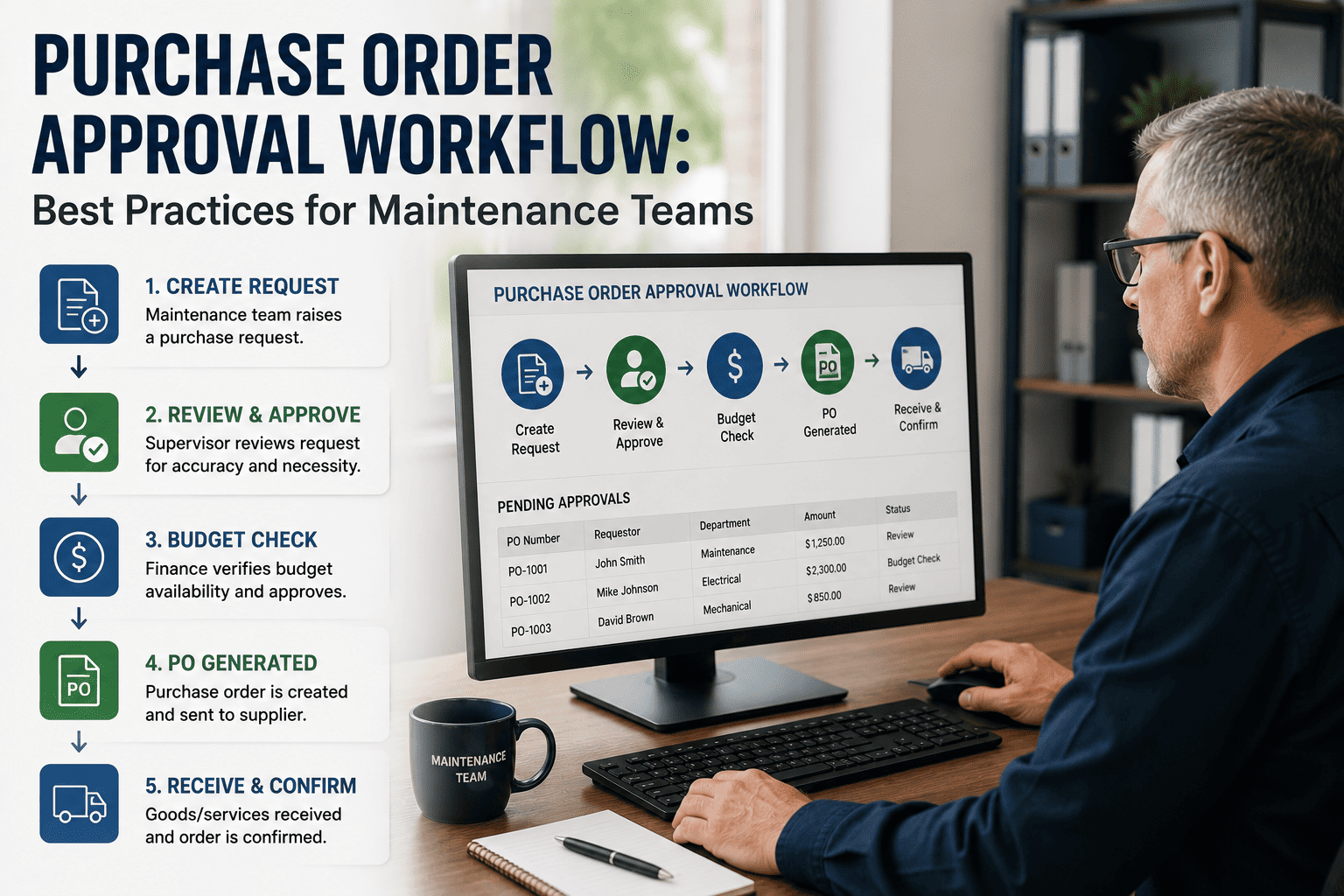
Most maintenance teams do not lack approval controls — they have too many of the wrong kind. A $40 filter order sits waiting for a department head's signature for three days while a $15,000 compressor purchase slips through with a single rubber-stamp click. Research shows that over 55% of organizations identify lengthy approval cycles as a key operational challenge, and senior managers spend up to 30% of their time simply following up on approvals that should have moved automatically. A CMMS like OxMaint lets maintenance teams design an approval hierarchy that matches scrutiny to actual risk — so routine purchases move in minutes and high-value spend gets the review it deserves.
Design an Approval Hierarchy That Matches Risk, Not Habit
OxMaint lets you configure approval rules by dollar threshold, asset criticality, and urgency — so maintenance purchasing moves fast without losing financial control.
Why a Flat Approval Process Fails Maintenance Teams
A purchase order approval workflow exists to answer one question before money leaves the building: is the right person reviewing this purchase at the right level of scrutiny? When every purchase — from a $30 gasket to a $40,000 motor — routes through the same single approver, the workflow optimizes for neither speed nor control. Low-risk purchases stall behind high-risk ones in the same queue, and the approver reviewing everything has neither the time nor the context to catch what actually matters. Book a demo to see how OxMaint separates these tracks automatically.
The Four Pillars of an Effective Approval Workflow
Clear Hierarchy
Every role in the approval chain is defined in advance — who reviews, who authorizes, who escalates. No purchase should ever wait because nobody is sure whose job it is to approve it.
Risk-Based Thresholds
Approval requirements scale with the purchase amount, category risk, and asset criticality — not a flat rule applied to every transaction regardless of size.
Service Level Targets
Each approval level has a maximum response time. When that window is exceeded, the system flags the breach and escalates — rather than letting a request sit silently in someone's inbox.
Audit Trail
Every decision is timestamped and attributed to the approver who made it. This is what makes the workflow defensible during a finance review or compliance audit, not just efficient.
Building the Approval Hierarchy — Level by Level
A well-designed maintenance approval hierarchy is not about adding more layers — it is about matching the right layer to the right risk. Sign up free and configure each of these levels as rules inside OxMaint instead of relying on memory or email forwarding.
Auto-Approved / No Human Review
Routine consumables, common spare parts, and pre-approved catalog items move straight to PO without manual sign-off. This category typically represents the highest volume and lowest risk transactions — automating it frees approvers to focus on purchases that actually warrant judgment.
Single Supervisor Approval
Standard spare parts and planned repair materials require one supervisor's review — confirming the purchase is justified and budget-aligned without introducing multiple handoffs for a moderate-risk transaction.
Critical Asset Fast-Track
A separate routing path — not a separate set of rules abandoned entirely — for repairs on production-stopping or safety-critical equipment. A single designated approver can authorize immediately, with documentation completed after the fact rather than before.
Department Head + Budget Owner
Major components, larger repair contracts, and purchases that meaningfully affect departmental budget require two-level review — one approver confirming operational need, the second confirming budget availability.
Multi-Level / Finance Sign-Off
Large equipment purchases, major contracted services, and anything capital-adjacent route through finance and, in many organizations, up to senior leadership. This is the level where slower turnaround is appropriate — the dollar amount justifies the additional scrutiny.
Sequential vs. Parallel Approval — Which to Use When
Each approver reviews and signs off in order — Level 1 must approve before Level 2 even sees the request. Provides the strictest oversight but adds cumulative wait time at every stage.
High-value purchases, capital-adjacent spend, anything where each approver's review depends on the previous one's findings.
Multiple approvers review simultaneously rather than in sequence. The request only completes once all required sign-offs are in, but nobody is waiting on someone else to finish first.
Purchases needing both operational and budget sign-off where the two reviews are independent — shortening cycle time without removing any required check.
Where Approval Workflows Actually Stall
Cycle time data consistently reveals that the bottleneck is internal, not external. When a vendor delivers in 10 days but internal approval takes 15, the organization blames the supplier for a delay it caused itself.
| Bottleneck Pattern | Root Cause | Structural Fix |
|---|---|---|
| One approver, all requests | No tiered routing — everything funnels to a single person regardless of risk | Introduce threshold-based routing so low-risk purchases bypass that approver entirely |
| Requests sit silently | Approver unaware action is needed — no active notification | Real-time alerts and dashboards that push requests to approvers instead of waiting for them to check |
| Approver on leave, no backup | No designated delegate when the primary approver is unavailable | Build backup approvers into every level with automatic reassignment after a defined wait period |
| Same purchase, multiple approvals | Redundant review layers applied regardless of amount or risk category | Audit the approval matrix and remove layers that do not change the outcome for low-risk categories |
| SLA breaches go unnoticed | No tracked response-time targets per approval level | Assign a maximum turnaround per level and flag breaches automatically for escalation |
Designing Your Approval Matrix — A Practical Checklist
Map the Current Process First
Walk through a real recent purchase order from request to PO issuance. Note every handoff, every wait, and every place data gets re-entered. You cannot fix a bottleneck you have not located.
Define Roles Before Thresholds
Decide who is responsible for creating, reviewing, and authorizing purchases before assigning dollar amounts to each level. Clear ownership prevents the "whose job is this" delay.
Set Thresholds by Risk, Not Just Amount
A $5,000 sole-source purchase from an unapproved vendor carries more risk than a $5,000 order from a long-standing contracted supplier. Build category and vendor risk into the routing logic, not dollar amount alone.
Build in Backup Approvers
Every level needs a named delegate. A single point of failure in the approval chain is one of the most common — and most avoidable — causes of stalled purchasing.
Attach an SLA to Every Level
Define a maximum response window per approval tier and track breaches. Without a measurable target, "slow" stays a feeling instead of a fixable, reportable metric.
Review the Matrix Quarterly
Thresholds that made sense a year ago may no longer match current spend patterns or organizational risk tolerance. Revisit the approval matrix on a fixed schedule rather than letting it calcify.
How OxMaint Powers Maintenance Approval Workflows
Configurable Approval Rules
Set thresholds by dollar amount, category, and asset criticality so each purchase routes through exactly the right level of review — no more, no less.
Critical Asset Fast-Track
Designate equipment as critical so repairs for that asset automatically route through an expedited single-approver path — without bypassing documentation requirements.
Backup Approver Assignment
Assign delegate approvers per level so a request never stalls because the primary reviewer is unavailable — requests automatically reassign after a defined wait window.
Full Audit Trail
Every approval decision is timestamped and tied to the approver, the work order, and the asset — giving finance and compliance teams a defensible record for every purchase made.
Stop Letting One Bottleneck Decide Your Whole Maintenance Budget
OxMaint automates threshold-based approval routing, tracks SLA breaches, and gives every purchase a clear audit trail — so your team moves fast on the right purchases and stays in control of the rest.
Frequently Asked Questions
How many approval levels should a maintenance purchase order have?
Most maintenance teams need three to five levels, scaled by dollar amount and risk — auto-approval for low-value routine items, single supervisor review for standard parts, a separate fast-track for critical asset repairs regardless of cost, and multi-level review for larger purchases. Adding more levels than that typically slows the process without meaningfully improving control. Sign up free to configure your own threshold structure in OxMaint.
What is the difference between sequential and parallel approval?
Sequential approval requires each approver to sign off in order before the next reviews the request — providing the strictest oversight but the longest cumulative wait time. Parallel approval sends the request to multiple approvers simultaneously, so independent reviews (such as operational need and budget availability) happen at the same time rather than back to back. Parallel routing is generally faster when the approvals genuinely do not depend on each other.
How do you prevent approval bottlenecks from a single overloaded approver?
The most effective fix is tiered routing — moving low-risk, low-value purchases out of that approver's queue entirely through auto-approval rules, and assigning a designated backup approver for every level so requests never stall when the primary reviewer is unavailable. Book a demo to see how OxMaint flags approval bottlenecks before they accumulate.
What should an emergency or critical asset approval path look like?
Critical, production-stopping repairs need a single-approver path that authorizes the purchase immediately, with full documentation completed after the fact rather than required before action. This protects uptime on essential equipment while still preserving an audit trail — the goal is removing delay, not removing accountability.
How does a CMMS improve purchase order approval workflows?
A CMMS like OxMaint replaces email-based and verbal approvals with configurable, rule-based routing tied directly to work orders and assets. Thresholds, backup approvers, and SLA tracking are built into the system rather than depending on individual memory, so requests move automatically to the correct level, stalled approvals get flagged, and every decision is logged with a timestamp for audit purposes.