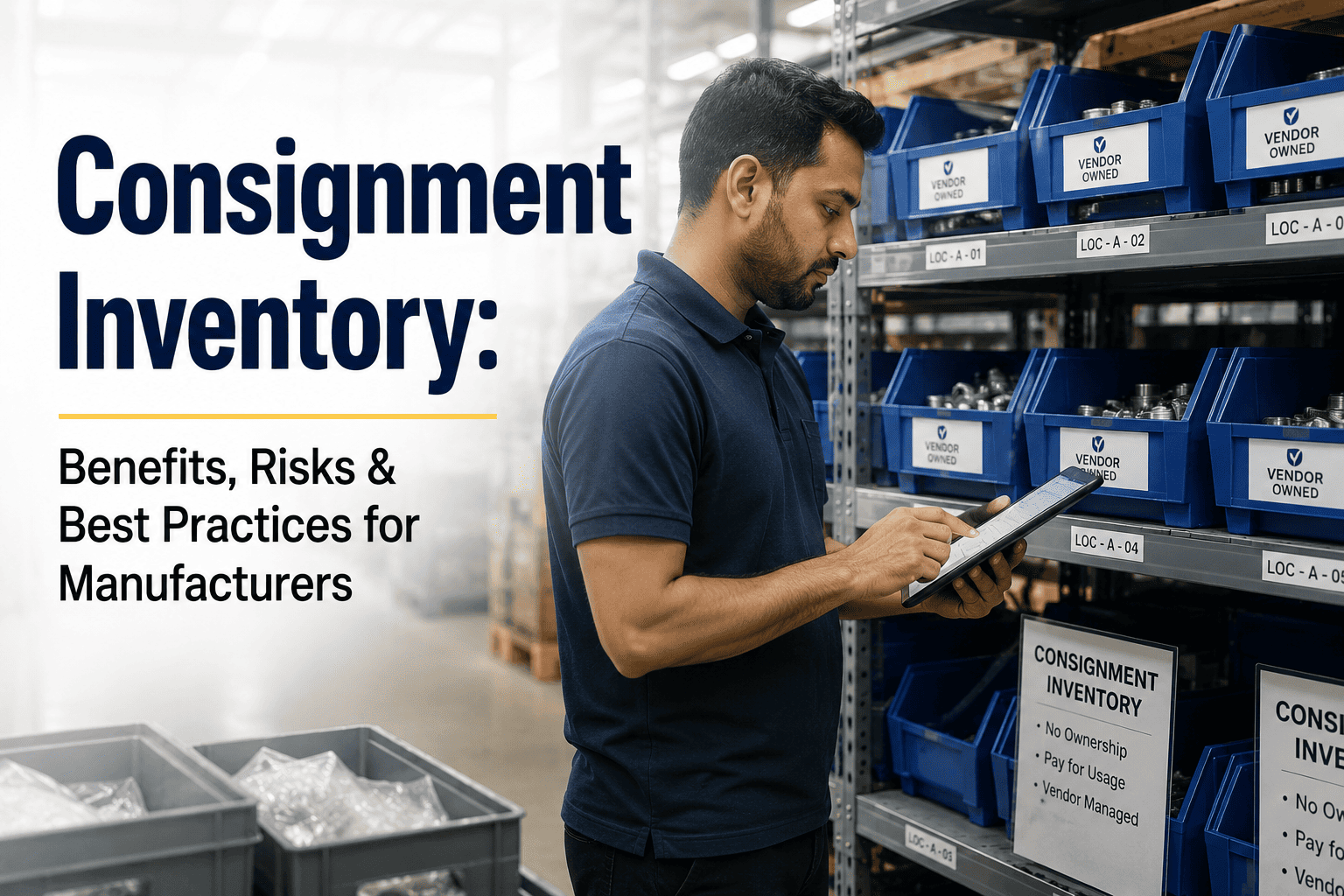
A manufacturer receives a delivery of fasteners, cutting tools, and MRO consumables from a supplier. The materials go straight to the storeroom. Production starts using them immediately. But the manufacturer has not paid a penny — and will not pay until each item is consumed. The supplier retains ownership. The manufacturer carries no inventory risk, no upfront cash outlay, and no carrying cost for those materials until the moment they are used. This is consignment inventory — and for manufacturers managing high-volume, standardised parts, it is one of the most effective tools for freeing working capital without creating supply risk. Converting to a Vendor-Managed Inventory (VMI) consignment model with a 90-day Days Sales of Inventory down to 30 days can release millions in tied-up capital across a typical mid-size operation. Sign up free on OxMaint to track consignment and owned stock side by side across your storeroom and asset register — or book a demo to see how it works across a live manufacturing inventory.
Manage Consignment and Owned Stock in One System
OxMaint tracks owned, consignment, and VMI inventory in a single storeroom view — with consumption reporting, reorder alerts, and work order linkage. Know what you own, what you owe, and what is running low. All per asset, per location, per supplier.
How Consignment Inventory Works: The Mechanics
Consignment inventory is an arrangement where a supplier places stock at a manufacturer's facility but retains legal ownership until that stock is consumed in production or used in maintenance. The manufacturer pays only when consumption occurs — typically reported periodically — not at the point of delivery. Carrying cost, obsolescence risk, and insurance responsibility stay with the supplier until the trigger event.
Agreement Setup
Buyer and supplier negotiate which items are consigned, minimum and maximum stock levels, replenishment triggers, consumption reporting method, payment terms, and what happens with unused or obsolete stock.
Delivery to Site
Supplier delivers stock to the manufacturer's storeroom. Ownership remains with the supplier. The manufacturer records it as consignment inventory — separate from owned stock — and no invoice is raised at this point.
Consumption
The manufacturer uses the part in production or maintenance. At the point of consumption — scanned out from the storeroom, allocated to a work order, or confirmed in a production run — ownership transfers and payment obligation is created.
Consumption Report
Manufacturer sends the supplier a periodic consumption report — daily, weekly, or monthly depending on terms — detailing what was used. The supplier invoices based on this report. Accuracy of consumption tracking is the foundation of the entire arrangement.
Replenishment
When stock falls to the agreed minimum, the supplier replenishes — either automatically via VMI integration or on receipt of a stock level report. With materials available on site, lead time reduces to manufacturing time only — no procurement delay added to the supply chain.
Consignment vs. VMI vs. Standard Purchase: How They Compare
The terms consignment, VMI, and standard purchase are often used loosely in manufacturing conversations. The distinctions matter — they determine who carries ownership risk, who manages replenishment, and what your cash flow exposure looks like. Book a demo to see how OxMaint tracks all three inventory types in a single storeroom view.
Model
Who Owns Stock on Site?
Who Manages Replenishment?
Payment Trigger
Standard Purchase
Manufacturer — from point of receipt
Manufacturer raises POs when stock is low
On delivery or invoice — before use
VMI (Standard)
Manufacturer — ownership transfers at delivery
Supplier manages replenishment using shared data
On delivery, managed by supplier
Consignment (CMI)
Supplier — until consumption
Manufacturer triggers on consumption report
On consumption — after use
Consigned VMI
Supplier — until consumption
Supplier manages replenishment + owns stock
On consumption — maximum cash flow benefit
The Benefits of Consignment Inventory for Manufacturers
When the right parts are in a consignment programme, the financial and operational benefits are material. The key word is right — consignment is not beneficial for every part, and applying it indiscriminately creates its own problems. Sign up free on OxMaint to classify which parts in your inventory are suited to consignment and track them separately from owned stock.
Working Capital Released
Stock on the shelf is not on the balance sheet as a liability until consumed. A manufacturer holding £500,000 in consignable MRO parts that converts to consignment frees that capital for production investment, debt reduction, or capacity expansion. Cutting Days Inventory Outstanding from 90 to 30 days on consigned VMI programmes has been shown to release millions in tied capital for mid-size manufacturers.
Carrying Cost Eliminated
Holding costs — warehousing, insurance, capital cost, and obsolescence risk — run at 20 to 30% of inventory value per year. Under consignment, these costs sit with the supplier until consumption. For a manufacturer with £1M in consigneable stock, that is £200,000 to £300,000 in annual carrying cost transferred away from their P&L.
Obsolescence Risk Shifted
If a product specification changes, equipment is retired, or demand falls, unconsumed consignment stock returns to the supplier without a write-off. This is particularly valuable for semiconductor components, fast-evolving MRO materials, and parts tied to equipment that may be replaced. The supplier retains the risk for materials that are never consumed.
Procurement Workload Reduced
In a VMI-consignment hybrid, the supplier manages replenishment automatically against agreed min/max thresholds. The manufacturer's procurement team no longer raises POs for those parts. Routine, high-volume consumables — fasteners, cutting tools, gaskets, filters — are restocked without procurement intervention. Teams that achieve 15–25% MRO inventory reduction through optimisation programmes most commonly cite VMI and consignment as primary enablers.
The Risks Manufacturers Must Manage
Consignment inventory does not eliminate risk — it redistributes it. The risks that remain on the manufacturer's side are operational rather than financial, and they are fully manageable with the right systems in place.
01
Consumption Tracking Accuracy
The entire model depends on accurate consumption reporting. If parts are consumed but not recorded — common in paper-based storerooms — the supplier invoices for less than was used, then replenishes incorrectly. Shortfalls accumulate invisibly until a stockout makes the discrepancy visible. Barcode scanning connected to work orders, with scan-out required before any part leaves the storeroom, is the minimum standard for a consignment arrangement that functions reliably.
02
Supplier Dependency and Single-Source Risk
A consignment programme ties you more closely to a single supplier. If that supplier has a production issue, a financial problem, or changes their consignment policy, your storeroom can deplete without the normal lead time buffer that owned inventory provides. Critical parts — Vital in the VED classification — should never be solely on consignment without an owned backup quantity sufficient to cover the supplier's typical lead time plus a safety margin.
03
Liability and Damage Disputes
If consignment stock is damaged in the storeroom — fire, flood, or handling damage — the ownership question becomes a liability question. The consignment agreement must explicitly define: who bears the risk of loss or damage while stock is on site, whether the manufacturer carries insurance for the supplier's stock, and what the claims process is. Vague agreements surface expensive disputes when something actually goes wrong.
04
Accounting and Audit Complexity
Consignment stock must be clearly distinguished from owned stock in your storeroom system and balance sheet records. If consignment inventory is inadvertently included in owned stock figures — common in spreadsheet-managed storerooms — it overstates assets, understates liabilities, and creates a misrepresentation that auditors and lenders will identify. Inventory management systems that cannot track ownership status per part create this risk automatically.
Which Parts Belong in a Consignment Programme?
Consignment is most effective for a specific profile of parts. Applying it to every item in the storeroom creates supplier management complexity without proportionate benefit. The ideal consignment candidate meets most of these criteria. Sign up on OxMaint to classify your parts inventory and identify your consignment candidates from your existing stock data.
Good Consignment Candidates
✓High-volume, fast-moving consumables
✓Standardised parts available from multiple sources
✓Relatively predictable demand patterns
✓Parts where obsolescence is a real risk
✓Fasteners, filters, cutting tools, gaskets, MRO consumables, packaging materials, standard electronic components
Poor Consignment Candidates
✗Single-sourced, proprietary, or custom parts
✗Parts with highly unpredictable demand (Z-class in XYZ)
✗Insurance spares held for catastrophic failure events
✗Parts from suppliers with capacity or financial instability risk
✗Any Vital (VED) part where supplier delay would immediately stop production without alternative sourcing
Common Manufacturing Examples
•Cutting tools and inserts (machining)
•Commodity fasteners and fixings
•Hydraulic seals and O-rings
•Lubrication and chemical consumables
•Standard electronic components and fuses
•Packaging materials and labels
Best Practices for Managing Consignment Inventory
The difference between a consignment programme that delivers its promised benefits and one that becomes an accounting headache comes down to process discipline and system quality. These are the practices that determine which outcome you get. Book a demo to see how OxMaint separates consignment from owned stock, automates consumption reporting, and connects issuance to work orders.
TRACK
SEPARATE
Track Consignment and Owned Stock Separately
Consignment stock must be tagged with a distinct ownership flag in your CMMS. Mixing it with owned stock creates balance sheet errors and corrupts consumption reporting. OxMaint supports ownership-status tagging at the part level so the storeroom sees everything in one view while the system accounts for it correctly.
SCAN
EVERY
Scan Every Consumption Transaction
Every part issued from a consignment bin must be scanned out and linked to a work order before it leaves the storeroom. Without enforced scan-out, consumption records drift from reality within weeks — and the supplier's replenishment falls behind actual usage, creating hidden shortfalls.
REPORT
AUTO
Automate Consumption Reporting to the Supplier
Manual consumption reports are a significant risk in consignment programmes. Automated reporting — generated directly from CMMS consumption data at agreed intervals — removes the manual step, reduces disputes, and gives the supplier the accurate signal they need for timely replenishment.
REVIEW
KPIs
Set and Review Supplier KPIs Quarterly
Consignment programmes require active supplier management. Replenishment cycle time, stockout incidents, and invoice accuracy should be reviewed quarterly at minimum. A supplier whose replenishment lags consumption or whose invoices consistently mismatch consumption reports creates risk that erodes the model's benefits faster than any accounting adjustment.
Frequently Asked Questions
What is the difference between consignment inventory and VMI?
Vendor Managed Inventory (VMI) means the supplier manages replenishment decisions — they monitor stock levels and decide when to replenish. Consignment means the supplier retains ownership until the goods are consumed. These two arrangements are separate and can exist independently: a supplier can manage your replenishment (VMI) while you own the stock from delivery, or you can hold consignment stock while you still raise your own purchase orders. The highest cash flow benefit comes from combining both — consigned VMI, where the supplier owns the stock and manages replenishment, and the manufacturer pays only on consumption. Sign up free on OxMaint to track both types in your storeroom.
How should consignment inventory appear on our balance sheet?
Consignment stock you hold on behalf of a supplier — where they retain ownership — should not appear as an asset on your balance sheet. It is not your property until consumed. It should be disclosed as a memorandum item or noted in contingent liability disclosures, depending on your accounting standard. The obligation to pay arises only at consumption. Confusing consignment stock with owned stock overstates assets and understates liabilities — a material misrepresentation that auditors and lenders will identify. Consult your auditor on the correct treatment under your specific accounting framework.
What happens to unconsumed consignment stock if our product or process changes?
This is one of the core advantages of consignment — unconsumed stock that becomes obsolete due to a design change or equipment retirement typically returns to the supplier without a financial write-off for the manufacturer, provided the contract covers return terms clearly. The agreement must explicitly define: the notice period required for changes, the maximum return quantity, any restocking fees, and the condition requirements for returned stock. Vague contracts leave obsolescence risk undefined, which means disputes rather than smooth returns when the situation arises. Book a demo to see how OxMaint flags consignment stock linked to retired equipment for supplier return.
What systems do we need to manage consignment inventory effectively?
At minimum: a CMMS or inventory management system that can tag parts by ownership status, track consumption at the transaction level, generate consumption reports by period, and raise alerts when consignment stock falls below the agreed minimum. Barcode or QR scanning for every issue and return is non-negotiable — manual entry of consumption data introduces the errors that undermine the entire programme. Sign up free on OxMaint to manage consignment and owned inventory with barcode scanning, work order linkage, and automated consumption reporting in one platform.
Track What You Own and What You Owe — In One Storeroom View
OxMaint tracks owned, consignment, and VMI inventory side by side — with barcode scanning for every transaction, automated consumption reporting for supplier reconciliation, reorder alerts, and full linkage to your work orders and asset register. Start free — no hardware, no long setup.