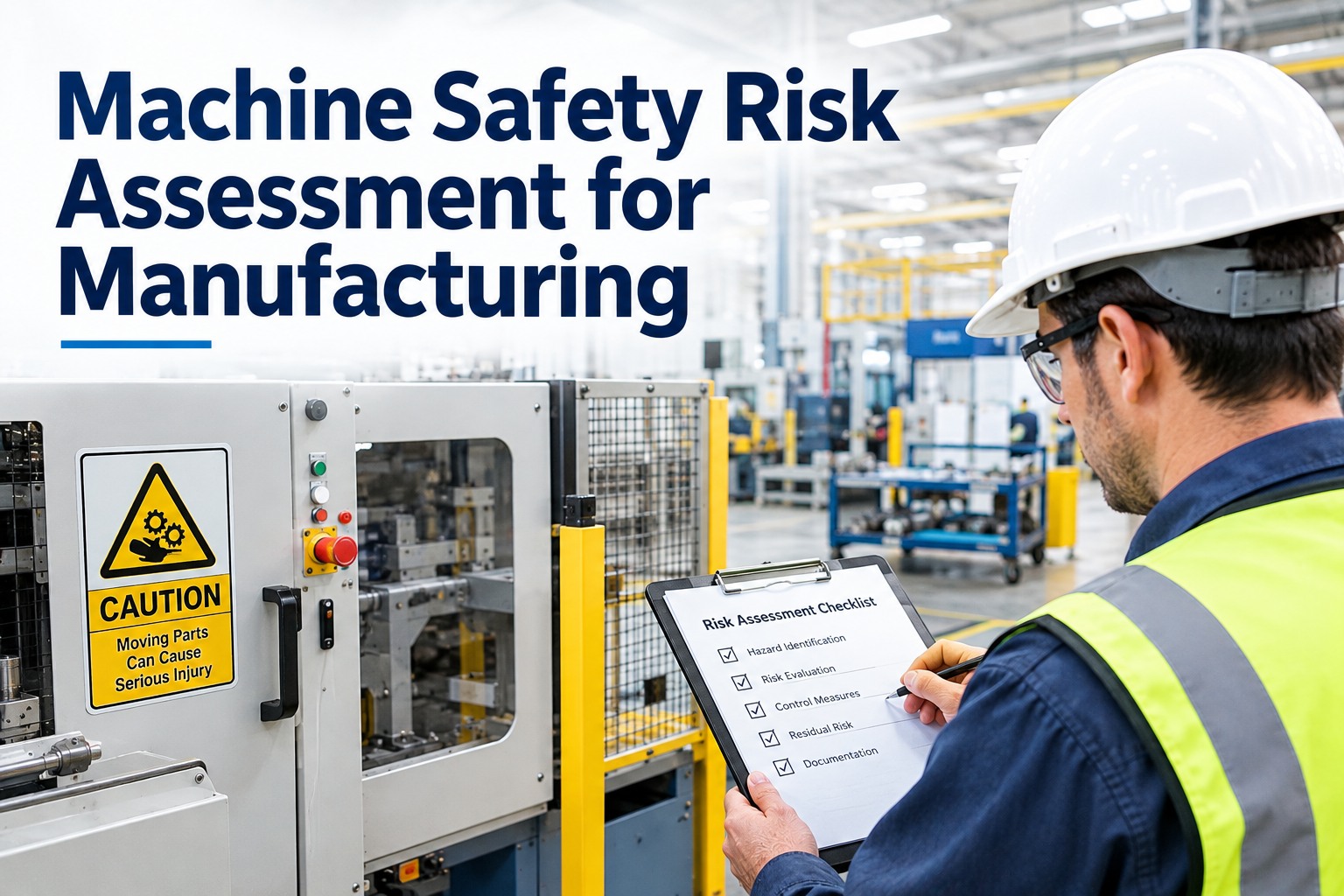
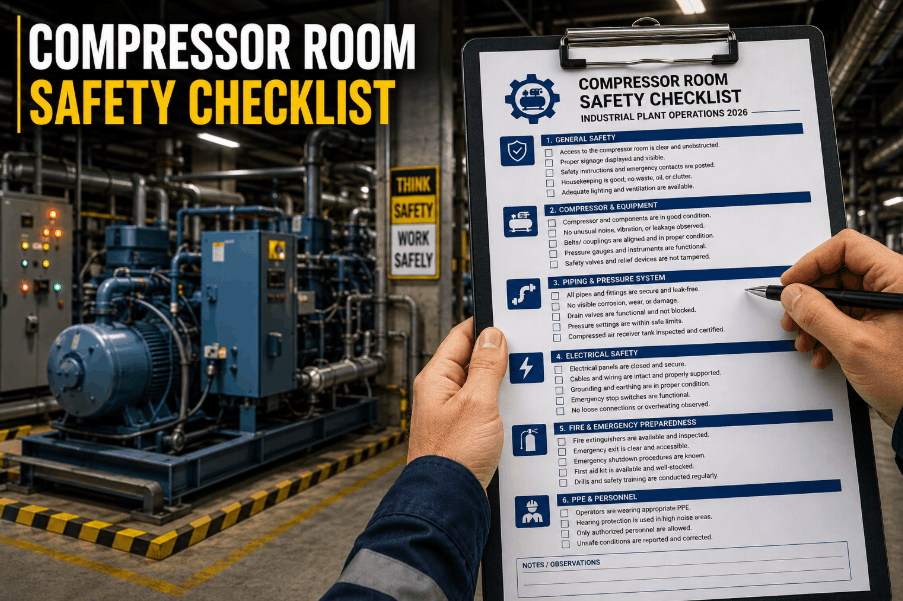
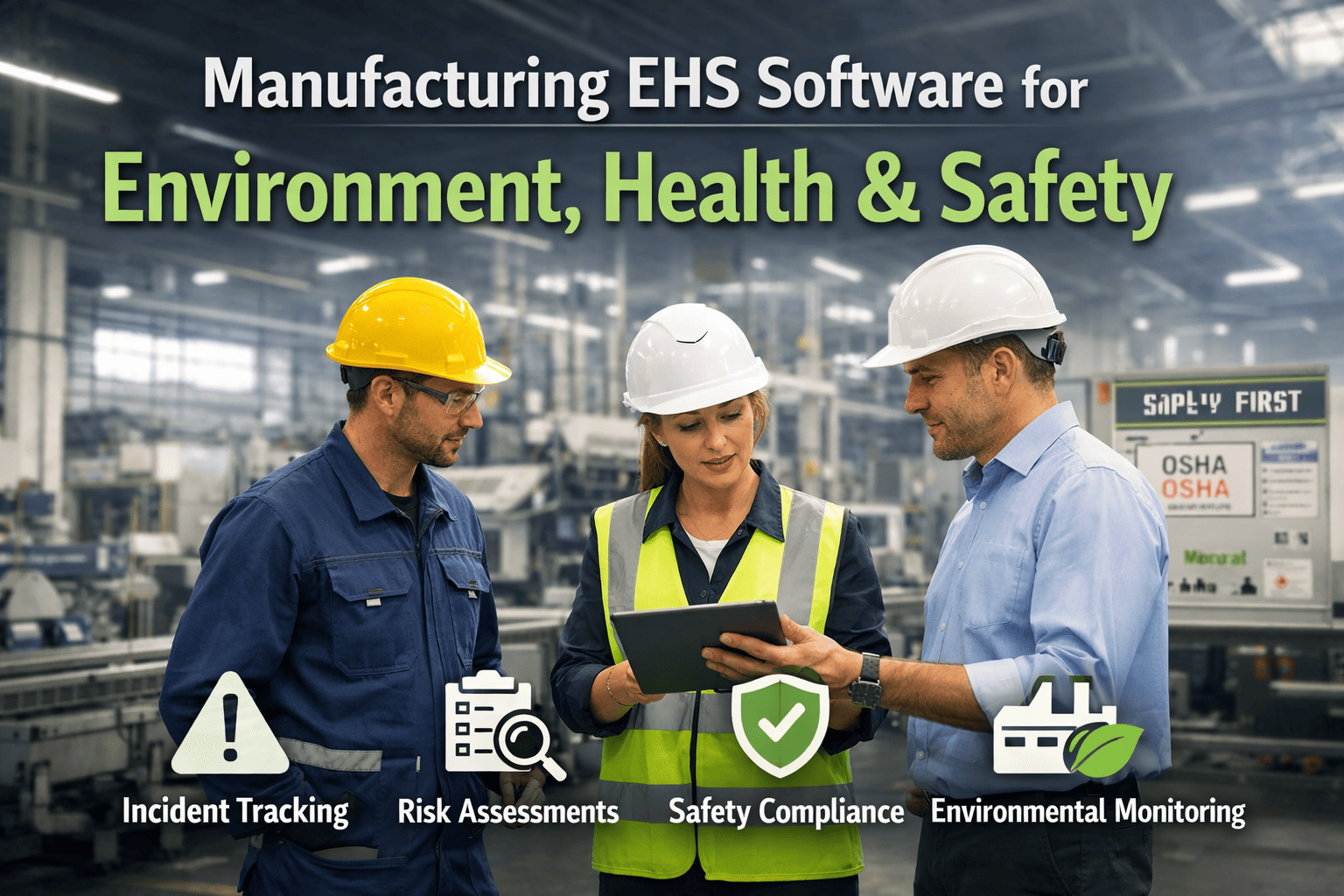
A machine safety risk assessment is a legal requirement in most jurisdictions — and it's where most safety programs quietly fail. Not because the hazards are hidden, but because the assessment lives in a spreadsheet nobody has opened since the last audit, disconnected from the guarding, the lockout procedures, and the engineering change that removed a control six months ago. This guide covers how to conduct machine safety risk assessments for manufacturing plants the way ISO 12100 intends: systematic hazard identification, defensible risk scoring, the control hierarchy, and documentation that actually survives an audit. Start free or book a demo.
Manufacturing · EHS · ISO 12100 · Machine Safety · 2026
Machine Safety Risk Assessment: Find the Hazard Before It Finds Your People
A risk assessment isn't a compliance document you file and forget — it's a living record that ties every hazard to a control, every control to an owner, and every change to a re-assessment. This is how EHS managers run assessments that meet ISO 12100, hold up under audit, and keep pace with the plant floor.
Risk =
Severity
×
Frequency
×
Probability
×
Avoidance
The four elements every defensible machine risk score is built from — per ISO 12100.
Why "We Already Guarded It" Isn't a Risk Assessment
Plenty of plants have machine guards, e-stops, and light curtains — and still can't pass a safety audit or defend an incident. The reason is that safeguards without an assessment behind them are guesses. A machine safety risk assessment is the structured method for identifying every reasonably foreseeable hazard across a machine's whole life cycle — setup, operation, cleaning, maintenance, clearing a jam, decommissioning — estimating the risk of each, and proving the controls you chose actually reduce it. ISO 12100, the type-A standard for machinery safety, defines exactly this methodology, and it's the basis auditors and CE-marking authorities expect. Sign up free and your assessments, hazards, and controls live in one place instead of five disconnected spreadsheets.
3,298
fatal workplace accidents recorded across EU countries in 2023 — machinery remains a leading contributor
Type-A
ISO 12100 is the foundational machinery safety standard underpinning every type-B and type-C standard
Whole-life
hazards must be assessed across every phase — transport, setup, use, maintenance, disposal
The Assessment, Step by Step
ISO 12100 structures the process into an iterative loop: you assess, you reduce, then you re-assess what's left. Skipping the re-assessment is the single most common failure — a new guard can introduce a new pinch point, and if you never look again, you've traded one hazard for another. Here's the loop, in order. Book a demo to see each step tracked as a live record instead of a static form.
1
Define Limits & Scope
Establish the machine's boundaries: intended use, foreseeable misuse, space limits, operating modes, and the full life cycle from install to disposal. An assessment that only covers "normal running" misses the maintenance tasks where most serious injuries actually happen.
2
Identify Hazards
Walk every mode and every task against a structured hazard list — mechanical, electrical, thermal, noise, and the rest. A hazard overlooked here is a control never installed. This is where completeness matters most.
3
Estimate the Risk
For each hazard, score severity of harm against its probability — broken down into exposure frequency, likelihood of the hazardous event, and the operator's chance of avoiding it. This turns "that looks dangerous" into a ranked, defensible number.
4
Evaluate & Decide
Compare each score against your acceptance threshold. Anything above it needs reduction. This is the decision gate that tells you where to spend engineering budget first — the highest-risk hazards, not the loudest complaints.
5
Reduce, Then Re-Assess
Apply controls in priority order, then run the whole loop again on the residual risk. Every control must be verified — and every new hazard it creates caught — before the assessment is closed. This iteration is mandatory, not optional.
The Hazard Categories You Can't Afford to Skip
ISO 12100's Annex B lists hazard types precisely so nothing gets missed — a hazard that isn't on your checklist is a hazard nobody assessed. These are the core categories to run every machine and every task against. Start free and attach identified hazards directly to the asset they belong to, so they resurface on every future review.
Mechanical
Crushing, shearing, cutting, entanglement, drawing-in, impact, and ejection of parts. The moving-part hazards behind most amputations and the primary target of machine guarding.
Electrical
Contact with live parts, arc flash, static discharge, and short-circuit. Often invisible until a maintenance panel is opened — which is exactly why life-cycle scope matters.
Thermal
Burns and scalds from hot surfaces, flames, or hot process material — and cold-related harm from cryogenic or refrigerated equipment.
Noise & Vibration
Hearing loss, tinnitus, and hand-arm vibration syndrome — cumulative hazards that don't announce themselves until the damage is permanent.
Ergonomic
Awkward posture, repetitive strain, excessive effort, and poor workstation layout. The slow-burn hazards that drive long-term injury claims.
Material & Substance
Contact with harmful fluids, gases, mists, dusts, or fumes — plus fire and explosion risk from process materials.
The Assessment Was Perfect. It Just Didn't Match the Machine Anymore.
Six months after the risk assessment was signed off, engineering swapped the feed system and removed an interlock to speed changeovers. Nobody re-ran the assessment. The document still said the hazard was controlled. OxMaint ties every assessment to its asset, so an engineering change flags the linked assessment for review — and the audit trail shows exactly who changed what, and when.
How Risk Scoring Actually Works
ISO 12100 doesn't hand you a fixed formula — it tells you which elements the score must account for, and lets you pick a method. The most defensible approaches break risk into four inputs: how badly someone could be hurt, how often they're exposed, how likely the hazardous event is, and whether they can get out of the way. Assess each, combine them, and you get a rank you can defend to an auditor. Book a demo to score hazards against a consistent scale your whole EHS team shares.
S
Severity of Harm
From a minor reversible injury to permanent disability or death. The single most weighted factor — a rare event with fatal severity still demands action.
F
Frequency of Exposure
How often, and for how long, a person is in the hazard zone. A task done fifty times a shift carries far more risk than the same hazard touched once a month.
P
Probability of the Event
The likelihood the hazardous event actually occurs — driven by component reliability, task complexity, and how much the operation depends on people doing the right thing.
A
Possibility of Avoidance
Can the operator see it coming and react in time? Speed of the hazard, warning signals, and available reaction time decide whether harm is escapable or not.
Where the Numbers Land: A Simple Risk Matrix
A matrix like this turns four subjective judgments into one shared, ranked outcome — Critical and High land at the top of the reduction queue.
The Control Hierarchy: Not All Fixes Are Equal
When a risk scores above your threshold, the order you reduce it in is prescribed — and it matters. A guard that physically stops contact beats a sign asking people to be careful, every time. Work top-down: only drop to the next tier when the one above isn't reasonably feasible, and remember that PPE is the last line, never the first answer. Try OxMaint free and turn each chosen control into a tracked, assignable action instead of a note in a report.
Most Effective
Inherently Safe Design — eliminate or substitute the hazard at the source. Remove the pinch point, lower the voltage, automate the dangerous task. No hazard means no control to fail.
Highly Effective
Engineering Controls & Safeguarding — fixed guards, interlocks, light curtains, two-hand controls. Physical barriers that don't depend on a person remembering to do the right thing.
Supporting
Administrative Controls — lockout/tagout procedures, safe systems of work, training, warning signs, and planned maintenance. They reduce exposure but rely on human compliance.
Last Line
PPE — gloves, guards, hearing protection, eye protection. The final layer when residual risk remains — never a substitute for the tiers above.
The Part That Survives the Audit: Documentation
A risk assessment you can't produce, dated and traceable, is a risk assessment you didn't do — as far as an inspector is concerned. ISO 12100 explicitly requires the assessment and reduction process to be documented and verified. The failure mode isn't doing the work; it's letting the record drift out of sync with the plant. This is exactly where a maintenance and asset platform earns its place. Book a demo to see the full chain — hazard to control to work order to audit log — on one screen.
Assessment Tied to Asset
Every risk assessment links to the specific machine, so hazards, controls, and history live with the equipment — not in a folder someone has to find.
Controls Become Work Orders
A chosen control turns into an assigned, tracked action — guard install, interlock test, LOTO procedure — with an owner and a due date, not a good intention.
Change Triggers Review
When an engineering change or modification touches an asset, its linked assessment is flagged for re-assessment — closing the gap where controls silently go stale.
Complete Audit Trail
Every edit, sign-off, and control verification is time-stamped and attributed, giving inspectors the dated, traceable evidence the standard demands.
Recurring Verification
Safeguard checks, interlock tests, and periodic reviews schedule themselves as preventive tasks, so verification is proven on a cadence, not remembered.
Mobile Floor Capture
QR-tagged assets and offline mobile let the team record hazards and complete checks at the machine, so the record reflects the floor, not a desk.
Run the assessment once, tie it to the asset, and every hazard, control, and verification stays connected to the machine it protects — through every engineering change and every audit. Start free or book a demo to see it on your plant.
"
Our risk assessments used to live in a shared drive that only I understood. When an auditor asked to see the assessment behind a specific guard, it took me half a day to prove the chain. Now every assessment sits on the asset, the controls are actual work orders with sign-offs, and when we modify a line the platform flags the assessment for review. Last audit, the inspector pulled up the whole hazard-to-control history in about two minutes — and moved on.
EHS Manager · Multi-Line Food & Beverage Manufacturing Plant
Frequently Asked Questions
Is a machine safety risk assessment legally required?
In most jurisdictions, yes — it's a legal and technical obligation for both machinery manufacturers and the plants that operate equipment. ISO 12100 provides the recognized methodology and is central to demonstrating conformity, including for CE marking.
What is ISO 12100 and why does it matter?
It's the type-A standard defining the terminology, principles, and methodology for machinery risk assessment and reduction. It underpins the more specific type-B and type-C standards, so nearly every machine safety requirement traces back to it.
How is machine risk actually scored?
By combining severity of harm with probability — where probability breaks into exposure frequency, likelihood of the hazardous event, and the chance of avoidance. A risk matrix or scoring method turns those judgments into a single ranked result.
What order should controls be applied in?
Top of the hierarchy first: inherently safe design, then engineering controls and safeguarding, then administrative controls, and PPE last. You drop a tier only when the one above isn't reasonably feasible.
How often should an assessment be reviewed?
Whenever the machine, its use, or its environment changes — a modification, a new task, an incident, or a new hazard — and on a periodic cadence otherwise. Any change can invalidate the controls the original assessment relied on.
How does a CMMS help with risk assessments?
It ties each assessment to its asset, turns controls into tracked work orders, flags assessments for review when equipment changes, and keeps a dated audit trail — so the record stays in sync with the plant.
Sign up free to map your assets.
Make Your Risk Assessment a Living Record, Not a Filed One.
OxMaint ties every machine safety risk assessment to the asset it protects, turns your chosen controls into assigned work orders, flags assessments for review when equipment changes, and keeps the dated audit trail inspectors demand — so hazards get controlled and stay controlled. Start free — no credit card, unlimited users, forever. Or book a demo.