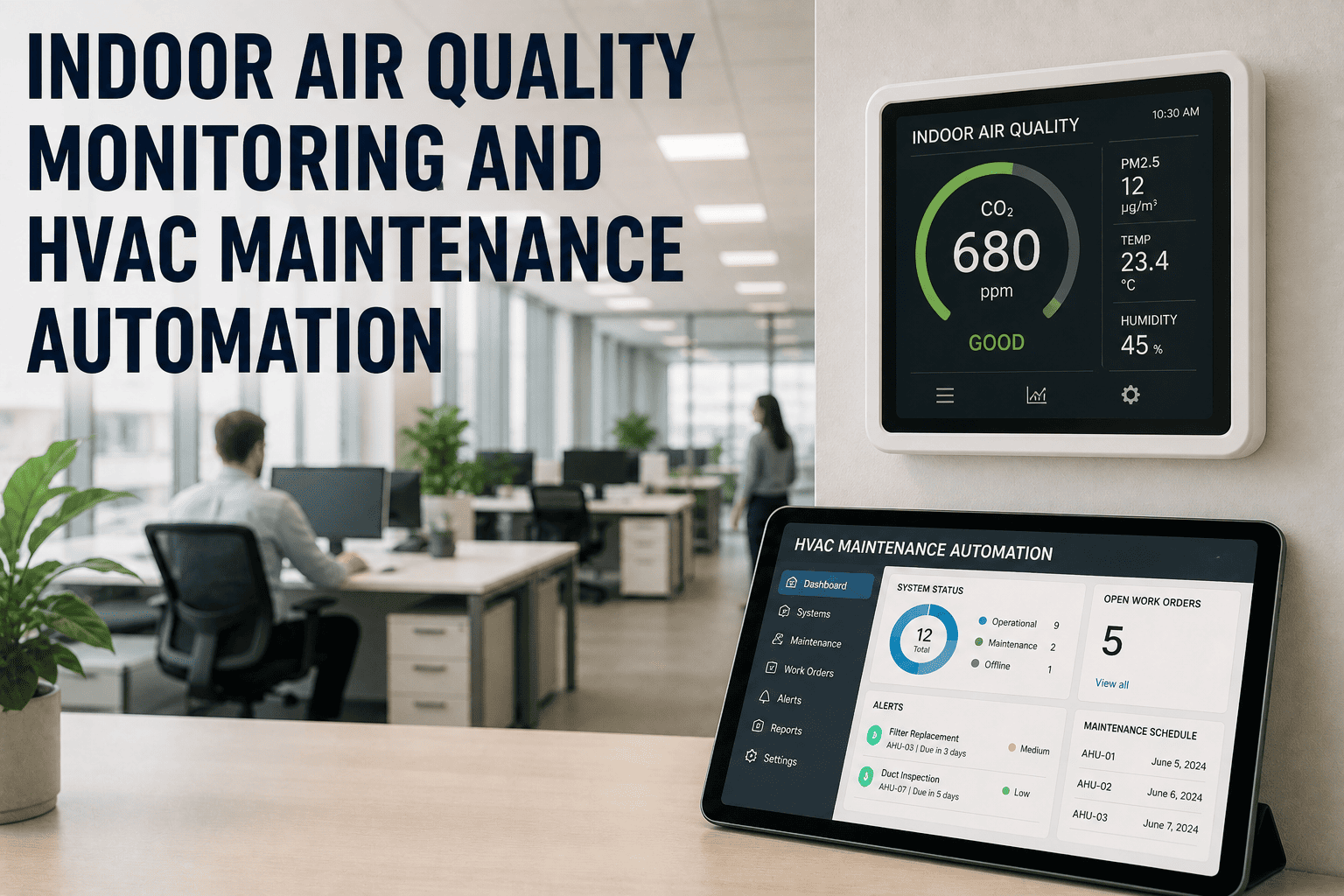
Indoor air quality compliance for HVAC systems is no longer optional — ASHRAE 62.1, WELL v2, and the EPA's Clean Air in Buildings initiative have made CO2, PM2.5, TVOC, and humidity monitoring a baseline requirement for commercial buildings, schools, and healthcare facilities by 2026. Facility managers who rely on manual log sheets or standalone sensors risk failed audits, occupant complaints, and ventilation energy waste of 20–40%. An AI-powered CMMS like OxMaint ties real-time IAQ sensor data directly to work orders, preventive maintenance schedules, and compliance reporting — so you can prove air quality compliance in one dashboard instead of chasing spreadsheets. Start Free Trial to connect your IAQ sensors and automate the entire compliance workflow.
Is your HVAC system ready for 2026 IAQ compliance — or one audit away from a violation?
Real-time CO2, PM2.5, TVOC, and humidity monitoring tied directly to automated work orders. Stop logging air quality by hand and start proving compliance with sensor-driven CMMS workflows.
CO2, PM2.5, TVOC & Humidity: What HVAC Compliance Actually Requires
ASHRAE 62.1-2022 and WELL v2 define specific thresholds for four core indoor air quality parameters. Every HVAC maintenance program must monitor, log, and act on these — not occasionally, but continuously.
Carbon Dioxide
Occupant-generated CO2 is the leading indicator of ventilation adequacy. Levels above 1,000 ppm reduce cognitive function by 15–23% and signal that outside-air dampers, VFDs, or ERVs need immediate attention.
Fine Particulate Matter
Particles under 2.5 microns penetrate deep into lungs. MERV-13 or better filtration is now the baseline — and filter replacement intervals must accelerate when sensor readings trend upward between changes.
Total Volatile Organic Compounds
Off-gassing from furnishings, cleaning chemicals, and building materials spikes after renovations or deep cleans. Source-level ventilation response and carbon-stage filter changes must be triggered automatically.
Relative Humidity
Humidity above 60% accelerates mold growth and condensation on cooling coils; below 30% dries mucous membranes. Humidifier/dehumidifier PM schedules must flex with seasonal load — static calendars fail.
The Real Cost of Reactive IAQ Management: A 180-Asset Facility Scenario
A 120,000 sq ft commercial office with 180 HVAC assets and 1,200 occupants spends an average of $42,000/year on IAQ-related issues when managed reactively. Here is what that looks like broken down — and what changes when sensor data drives automated work orders through a CMMS.
| IAQ Cost Driver | Reactive (Spreadsheet + Manual Logs) | CMMS + Sensor-Driven (OxMaint) | Annual Savings |
|---|---|---|---|
| Failed audit re-inspection | $8,500 (1–2 violations/year) | $0 (auto-generated compliance reports) | $8,500 |
| Over-ventilation energy waste | $18,200 (static outside-air damper settings) | $7,200 (occupancy-based DCV tied to CO2) | $11,000 |
| Filter replacement (emergency) | $6,800 (PM2.5 spikes → rush orders) | $3,100 (trend-based auto-PM triggers) | $3,700 |
| Occupant complaints / dispatch | $5,500 (avg 120 complaints/yr) | $1,100 (proactive alerts cut complaints 80%) | $4,400 |
| Manual log compilation labor | $3,000 (6 hrs/wk × $10/hr burden) | $200 (automated sensor logging) | $2,800 |
| Total Annual Cost | $42,000 | $11,600 | $30,400 |
Switching from reactive log sheets to sensor-driven CMMS workflows cuts IAQ compliance costs by 72% and pays back in under 4 months for a mid-sized commercial facility.
How to Build an IAQ-Compliant HVAC Maintenance Program in 5 Steps
Whether you are preparing for WELL v2 certification, ASHRAE 62.1 compliance, or your 2026 IAQ mandate, the path from manual logging to automated compliance follows the same five-stage timeline.
Deploy IAQ Sensor Network
Install networked CO2, PM2.5, TVOC, and humidity sensors across all zones — minimum one per 1,000 sq ft per ASHRAE guidance. Integrate with BAS/BMS via BACnet or Modbus so readings flow into a single data stream.
Map Sensors to Assets in CMMS
Link each sensor to the AHU, ERV, or exhaust fan that serves that zone in OxMaint. Every asset record now carries its real-time IAQ context — so work orders are triggered by air-quality deviation, not calendar dates alone.
Configure Threshold-Based Triggers
Set rules: CO2 > 1,000 ppm for 15 min → open outside-air damper + log event; PM2.5 > 12 µg/m³ → generate filter-change work order; TVOC > 500 µg/m³ → dispatch inspection. OxMaint auto-creates and assigns the work order.
Shift to Occupancy-Based Ventilation
Replace static damper positions with demand-controlled ventilation driven by real-time CO2 and occupancy data. Typical energy savings: 20–40% on outside-air conditioning loads while staying fully within ASHRAE 62.1 minimums.
Automate Compliance Reporting
Generate audit-ready IAQ reports — sensor logs, threshold excursions, corrective work orders, filter change histories — in one click. WELL v2 and LEED documentation that used to take 40+ hours per submission drops to under 30 minutes.
See OxMaint turn your IAQ sensor data into automated work orders
Book a 30-minute demo and we will map your CO2, PM2.5, TVOC, and humidity sensors to a live compliance dashboard on your own asset list.
OxMaint IAQ CMMS: From Sensor Signal to Closed Work Order — Automatically
OxMaint is an AI-powered CMMS and EAM platform that ingests real-time IAQ sensor data and converts threshold breaches into prioritized, assigned, and tracked work orders — closing the gap between detection and action.
Real-Time IAQ Threshold Alerts
Connect CO2, PM2.5, TVOC, and humidity sensors via API or BACnet. When any reading crosses your configured compliance threshold, OxMaint generates a work order in under 60 seconds — assigned to the right technician with parts and procedure attached.
Predictive Filter & Coil Maintenance
AI analyzes PM2.5 trend curves between scheduled filter changes and predicts remaining useful life. If a filter is loading faster than expected (high-occupancy season, wildfire smoke, construction nearby), OxMaint automatically pulls the next change date forward.
One-Click Compliance Reporting
Every sensor reading, threshold excursion, corrective work order, and filter change is timestamped and stored against the asset record. Generate ASHRAE 62.1, WELL v2, or LEED IAQ compliance reports in a single click — no manual data compilation.
Occupancy-Based Ventilation Optimization
OxMaint correlates CO2 levels with occupancy schedules and automatically adjusts outside-air damper positions via BAS integration. Ventilation scales with actual load — not a static design-day assumption — keeping you compliant while slashing conditioning energy.
What Changes When IAQ Monitoring Meets a CMMS
Facilities that pair sensor networks with a maintenance management system don't just comply — they turn air quality into a measurable operational advantage.
"We failed a WELL v2 recertification audit because our filter change logs had gaps. After deploying OxMaint with IAQ sensors on all 14 AHUs, every PM2.5 spike auto-generates a work order and the audit trail builds itself. Passed recertification with zero findings."
"Our energy bill dropped 28% in the first quarter after OxMaint tied CO2 sensors to damper schedules. We were over-ventilating empty conference rooms for years. The compliance reports are a bonus — the savings paid for the system in 90 days."
IAQ Compliance for HVAC: Frequently Asked Questions
What are the IAQ compliance requirements for HVAC systems in 2026?
ASHRAE 62.1-2022 requires continuous ventilation rate compliance, while WELL v2 and LEED v4.1 add monitoring mandates for CO2 (below 1,000 ppm), PM2.5 (below 12 µg/m³), and TVOC (below 500 µg/m³). The EPA's Clean Air in Buildings initiative further recommends real-time monitoring and actionable ventilation plans. By 2026, most jurisdictions and certification bodies expect continuous sensor-based documentation — not manual spot checks. You can Book a Demo to see how OxMaint maps these requirements to automated work orders.
How does a CMMS help with indoor air quality compliance?
A CMMS bridges the gap between IAQ sensor data and maintenance action. When CO2, PM2.5, TVOC, or humidity readings cross compliance thresholds, the CMMS automatically generates, assigns, and tracks corrective work orders — with full timestamped audit trails. This replaces manual log sheets, ensures threshold breaches are addressed within SLA windows, and produces compliance reports in minutes instead of weeks. OxMaint adds AI-driven predictive scheduling so filter and coil maintenance adapts to real contamination trends, not static calendars.
What CO2 level triggers an HVAC compliance action?
ASHRAE 62.1 recommends keeping indoor CO2 below 1,000 ppm (roughly 700 ppm above outdoor ambient). WELL v2 sets a harder limit at 800 ppm for new construction. When CO2 exceeds these thresholds for more than 15 consecutive minutes, the HVAC system should increase outside-air supply — and a work order should be generated to inspect dampers, VFDs, or ERV performance if levels do not recover within 30 minutes. OxMaint automates this entire trigger-and-response chain.
How often should HVAC filters be changed for PM2.5 compliance?
MERV-13 filters in commercial HVAC systems typically need replacement every 3–6 months, but the correct interval depends on real-time PM2.5 trends. If sensor readings between scheduled changes trend upward by more than 20%, the filter is loading faster than expected and the change date should be pulled forward. OxMaint's predictive engine analyzes PM2.5 curves and automatically adjusts PM schedules — eliminating both premature changes and the far more costly scenario of a clogged filter causing a compliance excursion.
Can OxMaint integrate with my existing IAQ sensors and BAS?
Yes. OxMaint accepts IAQ sensor data via REST API, BACnet, Modbus, and MQTT — covering the vast majority of networked CO2, PM2.5, TVOC, and humidity sensors on the market. If your building automation system already aggregates sensor feeds, OxMaint can ingest from the BAS layer instead. Setup typically takes 2–4 weeks depending on sensor count, and our team maps every sensor to the correct HVAC asset during onboarding. Start Free Trial to test the integration with your sensor stack.
Make IAQ Compliance Automatic — Not Another Spreadsheet
Connect your sensors, automate your work orders, and generate audit-ready IAQ reports in one click. OxMaint turns indoor air quality from a compliance burden into a measurable operational win.
Free 14-day trial · No credit card