HVAC audit documentation is the structured record of maintenance activities, warranty compliance evidence, and energy benchmarking reports that facility and reliability teams must produce on demand — for an internal QA review, an insurance inspection, an ASHRAE Level 1 energy audit, or a manufacturer warranty claim. Being audit-ready means every work order, PM task, parts replacement, and meter reading is time-stamped, attributable, and retrievable in minutes, not days. Teams that rely on spreadsheets or paper logs typically spend 20–40 hours scrambling to assemble a single audit binder, and missing or incomplete records are the leading cause of denied compressor and chiller warranty claims. OxMaint's AI-powered CMMS generates this documentation automatically — every completed work order, asset history entry, and KPI report becomes an instant, exportable audit artifact. Start Free Trial and turn your next audit into a five-minute export.
Can you produce a complete HVAC audit binder in under 10 minutes?
If a warranty auditor or ASHRAE reviewer walked in tomorrow, your maintenance records either protect thousands of dollars in compressor and chiller warranties — or they forfeit them. OxMaint turns every work order, PM checklist, and meter reading into audit-ready HVAC documentation you can export on demand.
What counts as audit-ready HVAC compliance documentation?
Audit-ready HVAC documentation is a complete, chronologically defensible record that proves every piece of equipment received the right maintenance at the right interval — by the right technician, with the right parts — and that energy performance was tracked against a benchmark. A 300-asset commercial portfolio typically generates 4,000–6,000 individual maintenance records per year; without a CMMS, assembling even half of them for a single audit takes weeks.
Warranty Evidence Trail
Time-stamped PM completions, filter and belt replacements, and refrigerant logs that map to the OEM preventive maintenance schedule. Manufacturers like Trane, Carrier, and Daikin require proof of quarterly coil cleaning and annual refrigerant-level checks — missing one interval can void a 5-year compressor warranty worth $8K–$18K per unit.
Energy Benchmark Reports
kBtu/sq-ft/year tracking per building or system, normalized for heating and cooling degree days, benchmarked against ASHRAE/CBECS median EUI targets. A 10% drift from baseline EUI typically signals degrading coil efficiency, stuck economizer dampers, or refrigerant undercharge — each costing 3–8% in excess energy spend.
Regulatory & Insurance Logs
Refrigerant leak-rate calculations (EPA Section 608), cooling-tower legionella compliance, boiler annual inspection certs, and NFPA 70B electrical-maintenance records. Insurance carriers increasingly require documented PM evidence before renewing property policies — gaps can trigger 15–25% premium surcharges.
How much do missing HVAC audit reports actually cost?
Consider a 180-asset commercial portfolio spending $42,000/year on HVAC maintenance tracked in spreadsheets. When a compressor fails in year 3 of a 5-year warranty, the manufacturer requests 12 quarters of documented filter changes, coil cleanings, and refrigerant-pressure logs. If even two quarters are missing or illegible, the $14,000 compressor replacement is denied — plus the $3,200 in emergency labor. That single gap costs more than three years of CMMS software.
| Documentation Gap | Audit / Claim Impact | Typical Cost per Incident | CMMS Prevention |
|---|---|---|---|
| Missing quarterly PM record | Warranty claim denied | $8,000 – $18,000 | Auto-scheduled PM with mandatory completion sign-off |
| No refrigerant leak-rate log | EPA Section 608 violation | $44,519 per-day fine (max) | Refrigerant add-on logged per work order; auto leak-rate calc |
| No energy benchmark baseline | Undetected efficiency drift | $12K – $25K/yr excess energy | Meter data → EUI dashboard vs ASHRAE/CBECS benchmark |
| Illegible paper work orders | Auditor rejects binder | 20–40 hrs re-creation labor | Digital work orders with photo and signature attachments |
| No parts replacement trail | Repeated failure root-cause unknown | $3K – $9K per repeat call | Full asset history: every part, date, cost, and technician |
HVAC audit preparation: a 4-week timeline to full compliance
Whether you are preparing for an ASHRAE Level 1 energy audit, an insurance renewal inspection, or a manufacturer warranty review, the same documentation stack applies. Here is a proven 4-week path from scattered spreadsheets to a defensible audit binder — accelerated significantly if your team adopts a CMMS like OxMaint.
Asset & Warranty Inventory Baseline
Catalog every HVAC asset: make, model, serial, install date, warranty start/end, and OEM PM requirements. Cross-reference with existing work-order history to flag intervals with zero documented maintenance. A 180-asset inventory takes 2–3 days in a CMMS with CSV import vs. 2 weeks manually.
PM Schedule Reconciliation
Map each asset to its OEM preventive maintenance schedule — filter changes, belt inspections, coil cleaning, refrigerant-level checks, economizer calibration. Identify any PM tasks that are overdue or have no assigned technician. In OxMaint, overdue PMs surface automatically on the dashboard in red.
Energy Benchmark Establishment
Pull 12 months of utility data and calculate EUI (kBtu/sq-ft/yr) per building. Benchmark against CBECS regional medians or ASHRAE Building EQ targets. Flag any building more than 15% above median for Level 1 audit prioritization. OxMaint ingests meter data and auto-generates the benchmark chart.
Audit Binder Compilation & Dry Run
Export: (1) asset register with warranty status, (2) 12-month PM completion log with sign-offs, (3) refrigerant log with leak-rate calcs, (4) energy benchmark report, (5) parts replacement history. Run an internal mock audit — if you can produce all five in under 10 minutes, you are audit-ready.
How OxMaint generates audit-ready HVAC documentation automatically
OxMaint is an AI-powered CMMS and EAM platform that turns your daily maintenance execution into structured, exportable audit artifacts — no separate documentation effort required. Every work order completion, PM check, meter reading, and parts issuance feeds a live asset history and compliance dashboard. Here is how OxMaint maps directly to the four documentation pillars an auditor expects.
Auto-Generated Warranty Trail
Every PM completion captures technician name, date-time stamp, digital signature, and before/after photos. Export a full warranty evidence report per asset in 2 clicks. Outcome: 100% of PM records audit-defensible; warranty claim denial rate drops to near-zero.
Energy Benchmarking Dashboard
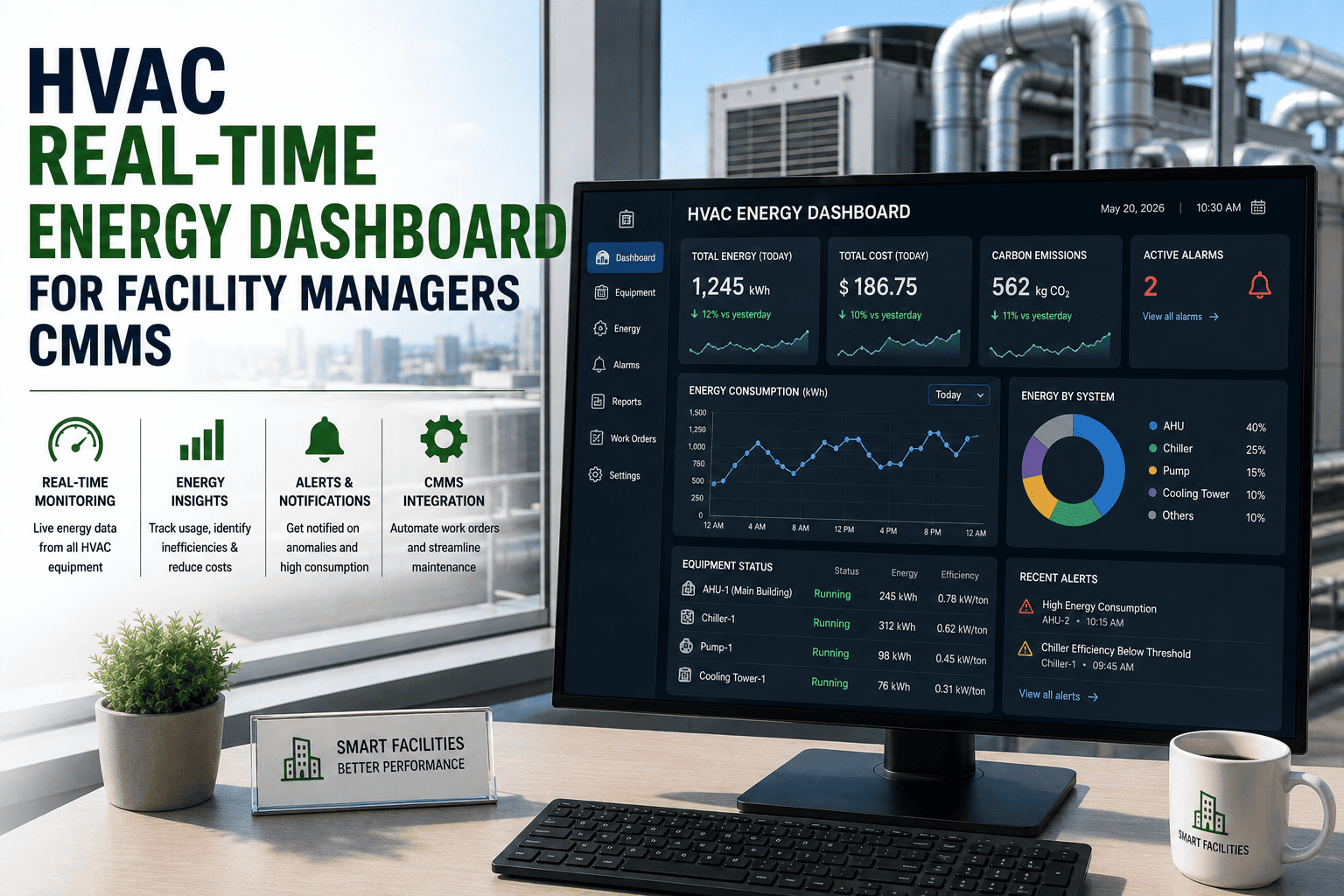
Ingest meter data or manual readings; OxMaint calculates EUI per building, benchmarks vs CBECS/ASHRAE medians, and flags drift beyond 10%. Outcome: detect efficiency degradation 2–3 months earlier; cut excess energy spend 6–12%.
One-Click Audit Exports
Generate a complete audit binder — asset register, PM log, refrigerant records, parts history, energy report — as a timestamped PDF or CSV package. Outcome: 20–40 hours of audit prep reduced to under 10 minutes.
Regulatory Compliance Alerts
Configurable triggers for EPA 608 refrigerant leak-rate thresholds, cooling-tower legionella tasks, and boiler annual inspections — with auto-escalation if a compliance task is missed. Outcome: zero missed regulatory deadlines; eliminate $44K+ per-day fine exposure.
Spreadsheet vs CMMS: HVAC audit documentation compared
Most teams do not realize how much audit risk they carry in spreadsheets until they compare side-by-side. The difference is not just time saved — it is the difference between a paid warranty claim and a denied one, between a clean insurance review and a premium surcharge.
| Audit Requirement | Spreadsheets / Paper Logs | OxMaint CMMS |
|---|---|---|
| PM completion evidence with sign-off | Manual entry; often missing signatures and dates; illegible handwriting | Digital sign-off with timestamp, photos, and GPS on every work order |
| Warranty claim documentation | 2–4 weeks to assemble; 20–40% of records missing or incomplete | One-click PDF export per asset; 100% record completeness |
| Energy benchmark (EUI) tracking | Manual utility-bill data entry; no normalization for degree days | Automated EUI calculation with CBECS/ASHRAE comparison and drift alerts |
| Refrigerant leak-rate compliance (EPA 608) | Calculated manually in a separate spreadsheet; high error rate | Auto-calculated from refrigerant-add logs; threshold alerts triggered |
| Audit response time | 20–40 hours per audit cycle | Under 10 minutes — live dashboard + export |
| Parts replacement traceability | Scattered across invoices and work-order notes; hard to search | Full parts-issuance log linked to asset history; searchable in seconds |
See audit-ready HVAC documentation on your own assets
Book a 30-minute demo and we'll show you how OxMaint turns your existing work orders and PM schedules into a defensible audit binder — exported in under 10 minutes.
HVAC audit documentation: frequently asked questions
What is HVAC audit documentation?
HVAC audit documentation is the complete, time-stamped record of preventive maintenance, repairs, parts replacements, refrigerant logs, and energy benchmark data for every piece of HVAC equipment in a facility. It proves to warranty auditors, insurance inspectors, and regulators that maintenance was performed on schedule and per OEM specifications. A CMMS like OxMaint generates this documentation automatically as technicians complete work orders.
How do I prepare for an HVAC warranty audit?
Gather 12–36 months of PM records (depending on warranty terms), including dates, technician names, parts used, and any photos. Cross-reference each record against the OEM maintenance schedule to confirm no intervals were missed. The fastest path is to use a CMMS that auto-archives this data — you can book a demo to see how OxMaint exports a full warranty evidence report per asset in two clicks.
What is an energy benchmark for HVAC systems?
An HVAC energy benchmark is the Energy Use Intensity (EUI) of a building or system, measured in kBtu per square foot per year, compared against a standard such as CBECS regional medians or ASHRAE Building EQ targets. Tracking EUI over time reveals efficiency drift — a 10% increase from baseline typically signals degraded coils, stuck dampers, or refrigerant undercharge, costing 3–8% in excess energy.
How long should HVAC maintenance records be kept for audits?
Most OEM warranties require 3–5 years of documented maintenance, while EPA Section 608 refrigerant records must be retained for at least 3 years. Insurance carriers and corporate QA programs often request 5–7 years. A cloud-based CMMS like OxMaint retains records indefinitely with no manual archiving, so you are always prepared regardless of the look-back period.
Can a CMMS automatically generate HVAC compliance reports?
Yes. A CMMS designed for HVAC maintenance — like OxMaint — automatically logs every work order completion, PM check, refrigerant addition, and meter reading into a structured asset history. From there, it generates compliance reports (warranty evidence, EPA 608 leak-rate calcs, energy benchmark dashboards, and full audit binders) as exportable PDF or CSV packages, eliminating 20–40 hours of manual assembly per audit cycle.
Make your next HVAC audit a 10-minute export
Stop scrambling through spreadsheets and paper logs. OxMaint's AI-powered CMMS generates warranty-defensible, ASHRAE-benchmarked, EPA-compliant HVAC documentation automatically — every work order, every PM, every part, on record.
Free 14-day trial · No credit card