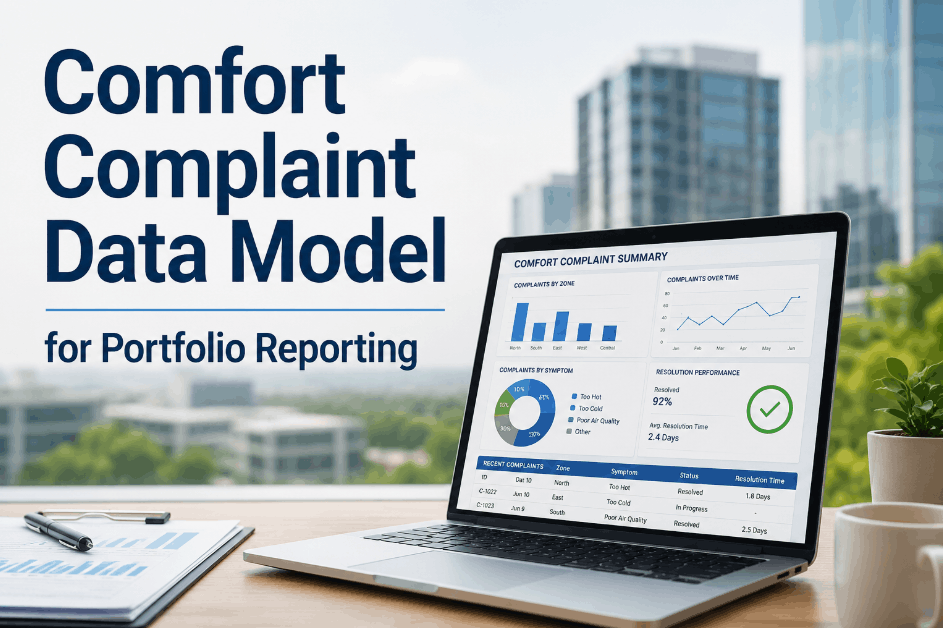
HVAC complaint escalation is rarely a service quality problem — it is a measurement problem. When response time, resolution lag, and repeat visit frequency are tracked separately or not at all, facility managers lose the operational visibility needed to identify where the service delivery chain is breaking down. Sign Up Free on Oxmaint and consolidate your HVAC work order flow, technician response data, and complaint outcomes in one CMMS platform so escalation decisions are driven by performance data rather than occupant pressure. Facilities that track these metrics together reduce repeat complaint rates, improve technician dispatch efficiency, and give leadership the reporting foundation to evaluate service team performance objectively. Book a Demo to see how Oxmaint structures complaint tracking and response time reporting across multi-site facility portfolios.
The Core Metrics Behind HVAC Complaint Escalation Management
Effective escalation management requires tracking three linked metrics together: initial response time, resolution lag, and repeat visit frequency. Each tells a different part of the story — and none is sufficient alone. A fast initial response that doesn't resolve the issue produces repeat complaints. A resolved complaint that recurs three times in thirty days signals a systemic equipment or process failure that single-work-order tracking will never surface. Sign Up Free on Oxmaint to capture all three metrics on every HVAC complaint work order and build the reporting foundation escalation management requires.
Time elapsed from complaint submission to first technician contact or site arrival. This metric reflects dispatch efficiency, technician availability, and work order routing speed. Targets vary by facility type — critical environments typically require response within 2 hours; standard commercial facilities within 4–8 hours during business operations.
Total time from complaint submission to confirmed resolution and work order closure. Resolution lag measures the full service delivery cycle — including parts procurement, follow-up visits, and approval delays. High resolution lag on recurring complaint types identifies systemic gaps in parts inventory, technician training, or escalation routing.
Number of work orders generated for the same complaint type on the same asset within a defined window — typically 30 or 90 days. Repeat visit frequency identifies complaints that were closed without true resolution and assets generating disproportionate service demand relative to their replacement cost.
Percentage of complaints within each category (temperature, airflow, noise, humidity) that require escalation beyond the first responding technician. High escalation rates within specific complaint categories identify training gaps, tooling deficiencies, or equipment complexity mismatches between technician skillset and asset type.
Response Time Benchmarks by Facility Type and Complaint Priority
Setting escalation thresholds requires response time benchmarks calibrated to actual operational requirements — not generic industry averages. Book a Demo to see how Oxmaint's work order priority system allows facility teams to configure response time targets by asset criticality and complaint type.
| Facility Type | Complaint Priority | Response Target | Resolution Target | Escalation Trigger |
|---|---|---|---|---|
| Healthcare / Critical | Emergency — temperature exceedance | 30–60 minutes | 4 hours | No response in 30 min |
| Commercial Office | High — zone comfort failure | 2–4 hours | Same business day | No resolution in 8 hours |
| Retail / Public Space | High — customer comfort impact | 2 hours | 4 hours | No response in 1 hour |
| Light Industrial | Medium — operational disruption | 4–8 hours | Next business day | No resolution in 24 hours |
| Multi-Unit Residential | High — habitability concern | 2–4 hours | 24 hours | No response in 2 hours |
| Education | Medium — classroom comfort | 4 hours | Same day | No resolution in 8 hours |
Building an Escalation-Ready HVAC Complaint Workflow in Oxmaint
Configure Priority-Based Work Order Routing
In Oxmaint, HVAC complaint work orders are created with priority levels that route automatically to the appropriate technician tier. Emergency complaints reach the on-call technician immediately; standard comfort complaints enter the queue with defined response time targets visible to both dispatchers and field staff.
Log Response Time at Every Work Order Touchpoint
Oxmaint captures timestamps at complaint submission, technician assignment, first response, and work order closure — so response time and resolution lag are calculated automatically, without manual reporting. These timestamps form the data foundation for escalation threshold monitoring.
Identify Repeat Complaints Across the Asset History
Oxmaint's work order history links every complaint to the specific HVAC asset — so repeat complaint patterns are visible across the asset lifecycle, not just within a single work order. Supervisors can see which assets are generating recurring complaints and whether resolution quality is actually closing the issue.
Report on Escalation Rates by Technician and Complaint Type
Oxmaint's maintenance reporting breaks down escalation frequency by technician, complaint category, and site — giving operations managers the data needed to identify training gaps, workload imbalances, and complaint types that consistently exceed resolution targets without escalation pathway improvements.
Use Trend Data to Negotiate Vendor SLA Performance
For facilities relying on third-party HVAC service vendors, Oxmaint's response time and resolution lag data provides the documented performance record needed for SLA compliance reviews and contract renewal negotiations — replacing vendor-reported metrics with independently captured field data.