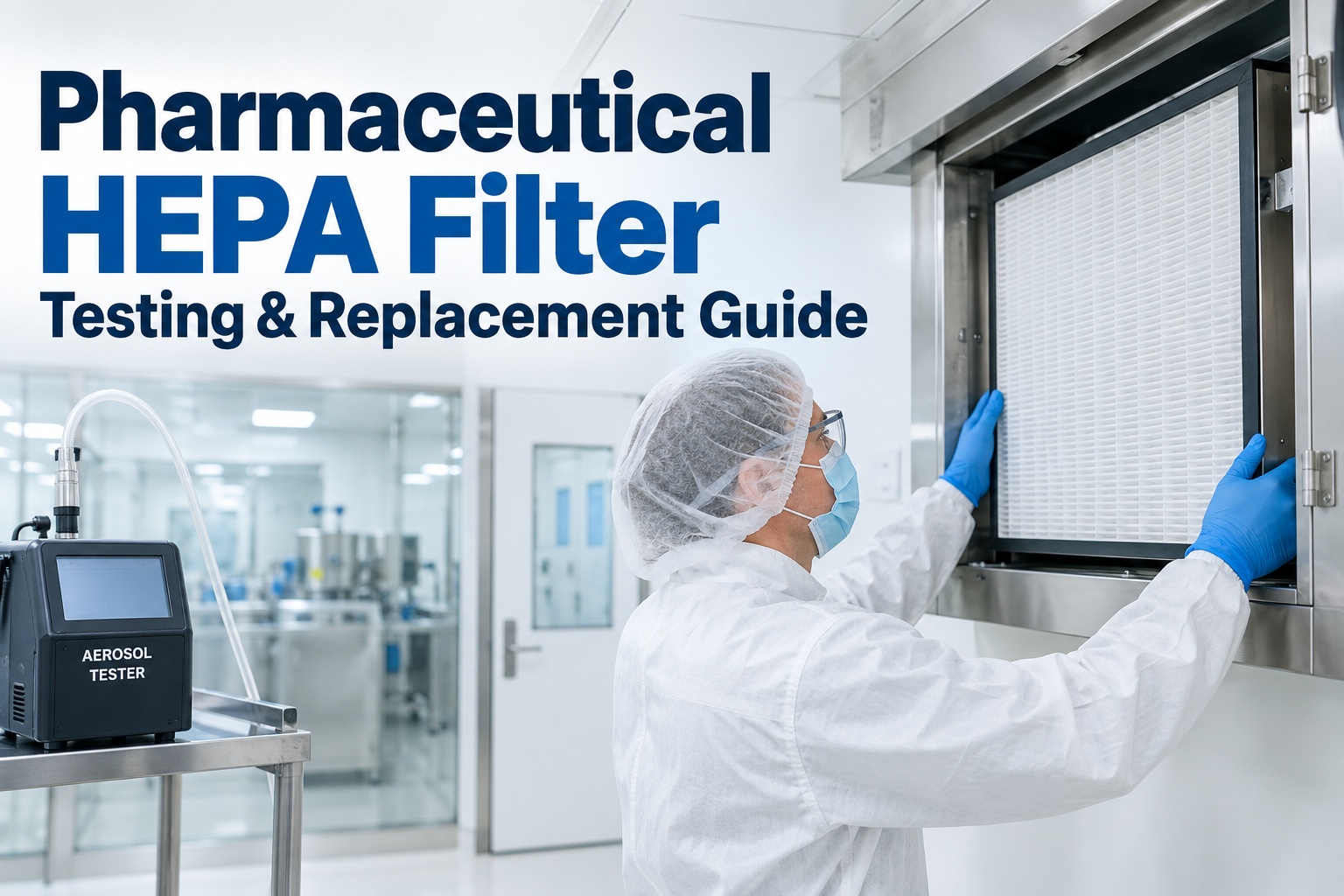
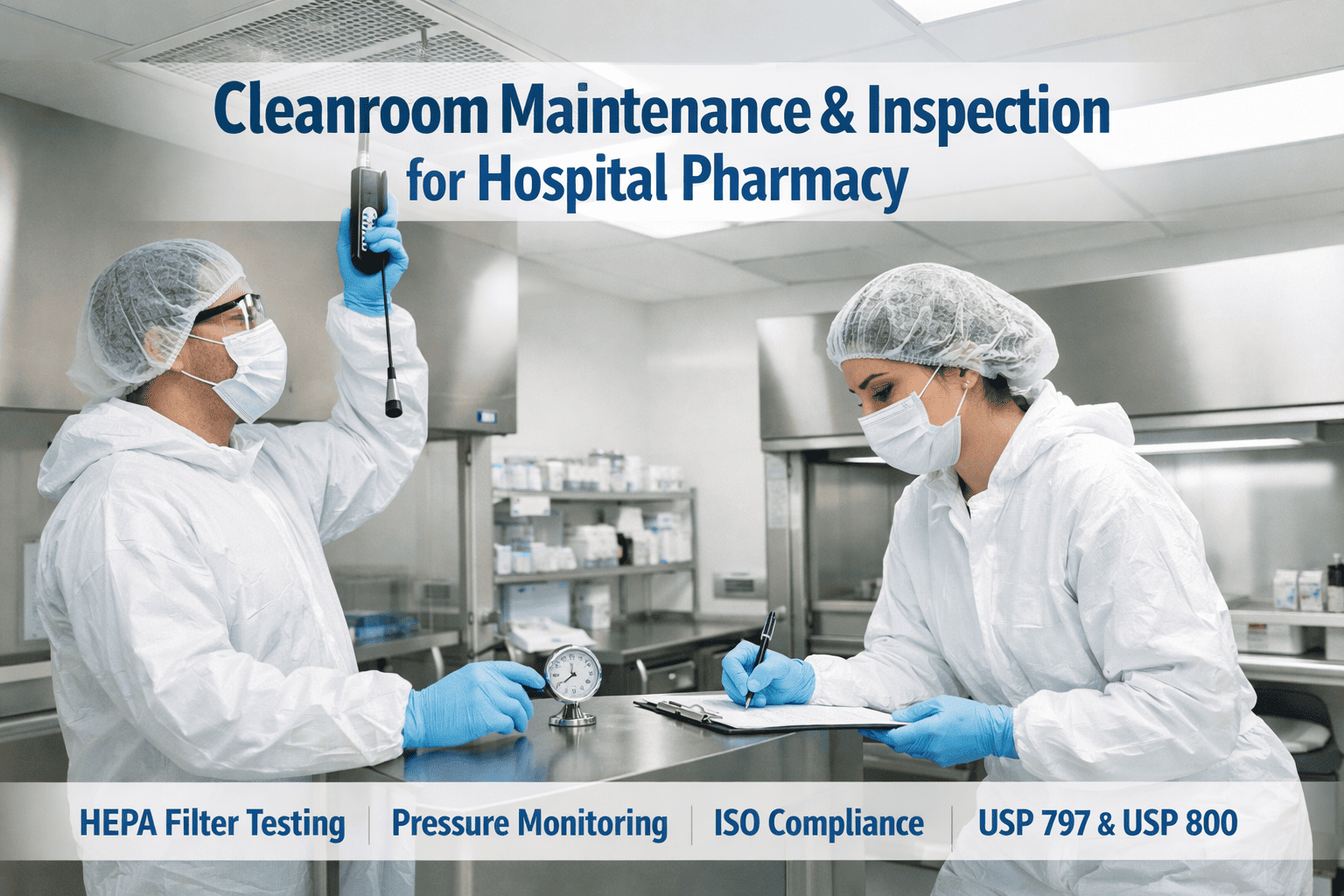
A HEPA filter is the only contamination barrier in a pharmaceutical cleanroom that gives no sign it has failed. The air still moves, the room still reads clean on a good day, and a pinhole leak in the media or a failed gasket seal stays invisible until a batch is lost or an auditor finds it first. That's why testing isn't optional housekeeping — it's the proof that the barrier is still intact. This guide covers pharmaceutical HEPA filter testing and replacement end to end: the PAO leak-test method and its acceptance limit, the grade-based retest cadence under EU GMP Annex 1 and ISO 14644-3, differential-pressure-driven replacement, and the documentation discipline that survives an audit. Start free on OxMaint to schedule every test and log every certificate, or book a demo.
Pharmaceutical HEPA Filter Testing & Replacement
The barrier you can't see working — until testing proves it still is.
99.97%+
minimum HEPA efficiency at 0.3 µm — H14 media reaches 99.995% for the strictest aseptic zones
0.01%
maximum downstream penetration allowed in a PAO scan — any local peak above this is a leak
6 mo
integrity retest interval for Grade A/B (ISO 1–5) sterile zones; 12 months for lower grades
2× ΔP
the differential-pressure replacement trigger — when resistance doubles its initial value
Why HEPA Filters Are GMP-Critical, Not Facility Infrastructure
It's tempting to treat a HEPA filter like any other HVAC consumable. Regulators don't. Under FDA 21 CFR 211.42, cleanroom air handling must be designed to prevent contamination, and EU GMP Annex 1 explicitly makes filter integrity testing part of the contamination control strategy for aseptic processing. A single filter leak isn't a maintenance ticket — it's a potential batch loss, a failed audit, and a documented nonconformance requiring investigation. The filter is the barrier between the product and the particles that would ruin it, and its integrity has to be demonstrated on a schedule, not assumed.
The Regulatory Stack
FDA 21 CFR 211.42 — air systems must prevent contamination
EU GMP Annex 1 (2022) — integrity testing in the CCS for Grade A/B
ISO 14644-3 — the technical test methods and protocols
IEST-RP-CC034 — the how-to for probe position and leak scanning
PIC/S & WHO GMP — aligned with Annex 1 for global manufacturers
ISO Tells You How · GMP Makes It Mandatory
ISO 14644-3 defines what to test and how — aerosol type, scan rate, acceptance criteria. The GMP frameworks (FDA, EU Annex 1, PIC/S, WHO) are what make that testing mandatory in high-grade spaces. You need both: the method from ISO, the obligation from GMP. When an authority asks you to test "against a standard," they must name it — default to ISO 14644-2/-3 if they can't.
The Four Tests Every Cleanroom Filter Faces
"HEPA testing" isn't one test — it's a family, each answering a different question. Confusing them is how facilities end up with a pressure log and no proof the filter is actually leak-free. Here's what each one checks and when it matters.
Integrity
PAO Aerosol Scan
The primary in-situ leak test. Inject sub-micron aerosol upstream, scan the downstream face, frame, and gasket with a photometer. Answers: is the media or seal breached?
Airflow
Velocity & Uniformity
Measures face velocity across the filter against a design target (often 0.35–0.45 m/s). Answers: is the filter still moving enough air to hold the room's air-change rate?
Loading
Differential Pressure
Tracks resistance across the filter via a Magnehelic gauge or manometer. Rising ΔP means the filter is loading with dust. Answers: how much life is left before replacement?
Room
Particle Count & Recovery
Classifies the cleanroom per ISO 14644-1 and confirms recovery after a disturbance. Answers: is the whole system delivering the cleanliness grade it's certified to?
A rising differential pressure tells you the filter is loading — it does not prove the filter is leak-free. A clogged filter and a leaking filter are different failures, caught by different tests. You need both the ΔP log and the PAO scan.
Inside the PAO Leak Test
The aerosol photometer scan — historically called DOP testing, now performed with PAO (polyalphaolefin) after DOP was reclassified as a potential carcinogen — is the definitive proof of filter integrity. PAO delivers equivalent test physics and is accepted by FDA, EMA, and ISO 14644-3. The four steps below are the whole method.
1
Challenge Upstream
Inject a stable sub-micron PAO aerosol upstream of the filter — typically 10–80 µg/L — with even mixing across the whole filter bank so the challenge is uniform.
2
Scan Downstream
Move a calibrated photometer probe across the filter face, frame, and perimeter seal at a defined slow scan rate (≈5 cm/s) — the gasket is where leaks hide most.
3
Read Against 0.01%
Any local downstream reading above 0.01% of the upstream concentration is a leak. Record every peak — location and magnitude — not just a pass/fail.
4
Classify & Remediate
A pinhole may be repairable within limits; media or seal damage means replacement. Document the finding, the fix, and the re-test that confirms it's resolved.
Never Miss a Retest Date Again — Free Forever
Register every HEPA filter as an asset with its grade, install date, initial ΔP baseline, and next test due. Schedule PAO scans, airflow checks, and particle counts as recurring work orders. Store the certificate and scan chart against the filter. When the auditor asks, the record is one search away. No card, no time limit.
Retest Cadence · By Cleanroom Grade
How often you must re-verify integrity scales with how critical the zone is. GMP and ISO 14644-3 mandate leak tests on a fixed cadence, tightened for the sterile grades where a leak matters most. This table is the reference for building your test calendar.
| Cleanroom Grade | ISO 14644-1 Class | Integrity Retest | Why This Cadence |
|---|
| Grade A / B |
ISO 5 (and 1–5 zones) |
Every 6 months |
Aseptic core — a leak here directly threatens sterile product |
| Grade C |
ISO 7 |
~12 months |
Supporting cleanroom — tested as appropriate to risk |
| Grade D |
ISO 8 |
~12 months |
Lower-grade support — annual verification typical |
| Any grade |
After any event |
After install / repair / move |
A new or disturbed filter is unproven until re-scanned |
ISO 14644-3 sets a maximum retest interval of 24 months for standard installations; GMP tightens this to 6 months for Grade A/B. Always test against the stricter of the applicable requirements.
When to Replace · Reading the Signals
GMP and ISO don't fix a maximum HEPA lifespan — a terminal filter often runs 3–5 years — because replacement is driven by condition, not the calendar. Four signals tell you the filter's service life is over. Any one of them is enough.
Differential Pressure Doubles
The core standard: replace when resistance reaches ~2× the initial baseline (many facilities set the trigger at 1.5×). This is why logging the initial ΔP at install is non-negotiable.
Airflow Drops Below Target
If the fan is at maximum but face velocity still falls below the design threshold (e.g. under 0.35 m/s), the filter can't hold the air-change rate — replace immediately to protect yield.
Leak Test Fails Irreparably
A PAO scan peak above 0.01% that can't be patched within acceptance limits means the media or seal is compromised. No amount of pressure headroom saves a leaking filter.
Visible Media Damage
Tears, discoloration, mold spots, or heavy loading on the downstream face. Physical damage overrides every other reading — a damaged filter is out of service on sight.
Protect the investment: good pre-filtration (F7/F9 class) shields the terminal HEPA from clogging and extends its life. Replacing a cheap pre-filter on schedule is how you avoid replacing an expensive HEPA early.
How OxMaint Runs the HEPA Program
Every filter, every test, every certificate lives on one asset record — so integrity testing, ΔP trends, and replacement planning are part of the same maintenance workflow as the rest of the cleanroom, not a separate binder that's out of date the moment an auditor opens it.
Register
Filter as GMP Asset
Each HEPA logged with grade, location, model, install date, initial ΔP baseline, and the factory EN 1822 scan chart — the reference every future test compares against.
Schedule
Cadence by Grade
PAO scans every 6 months for Grade A/B, annually for C/D, plus after any install or repair — each recurring automatically so no retest date slips.
Trend
Differential Pressure
Log ΔP readings against the baseline and watch the curve climb toward the 2× trigger — replacement forecast before airflow ever falls out of spec.
Store
Certificates & Scans
Every test report, photometer scan, and calibration record attached to the filter — traceable instrument calibration included, as GMP requires.
Close
Leaks to Work Orders
A failed scan generates a numbered work order — repair or replace, re-test to confirm, closure verified. The whole investigation trail in one place.
Report
Audit-Ready History
Produce the full test-and-replacement history for any filter on demand — for FDA, EMA, or MHRA — instead of reconstructing it under audit pressure.
Prove Your Cleanroom Barrier Is Intact — On Demand
Free forever plan — no card, no time limit. Register every HEPA filter, schedule integrity testing by grade, trend differential pressure toward replacement, and keep a traceable, audit-ready record for every certificate. Or book 30 minutes and we'll map your facility's filter program end to end.
Frequently Asked Questions
What's the difference between DOP and PAO HEPA testing?
They're the same method with a different challenge aerosol. DOP (dioctyl phthalate) was the original but was reclassified as a potential carcinogen, so the industry moved to PAO (polyalphaolefin), which delivers equivalent test physics and is accepted by FDA, EMA, and ISO 14644-3. Both inject a sub-micron aerosol upstream and scan the downstream face with a photometer; the 0.01% penetration limit is the same.
How often must pharmaceutical HEPA filters be integrity tested?
Grade A/B (ISO 1–5) sterile zones require a leak test every 6 months; lower grades (C/D) are typically annual. Any filter must also be re-tested after installation, repair, or relocation. ISO 14644-3 allows up to 24 months for standard installations, but GMP tightens the sterile-zone requirement — always follow the stricter rule.
Is differential pressure enough to decide when to replace a filter?
No. Rising ΔP shows the filter is loading with dust, but it says nothing about integrity — a filter can be clogged and leak-free, or lightly loaded and leaking. Use ΔP (replace at ~2× initial resistance) alongside airflow velocity, the PAO leak test result, and visual inspection. Any one of those four hitting its limit is grounds for replacement.
How long do pharmaceutical HEPA filters last?
GMP and ISO don't set a maximum lifespan because it depends on the environment, but terminal HEPA filters commonly run 3–5 years under normal cleanroom conditions. Good pre-filtration extends that considerably by keeping dust off the expensive terminal filter. Replace on condition — pressure, airflow, leak test, or damage — not on a fixed calendar.
What documentation do auditors expect for HEPA testing?
A traceable record for each filter: the test method and aerosol used, upstream concentration, scan results with any peaks noted, acceptance criteria, and calibration certificates for the photometer and aerosol generator. Leak testing must be validated and documented, and records must demonstrate ongoing integrity for FDA, EMA, and MHRA review.
Start free or
book a demo.