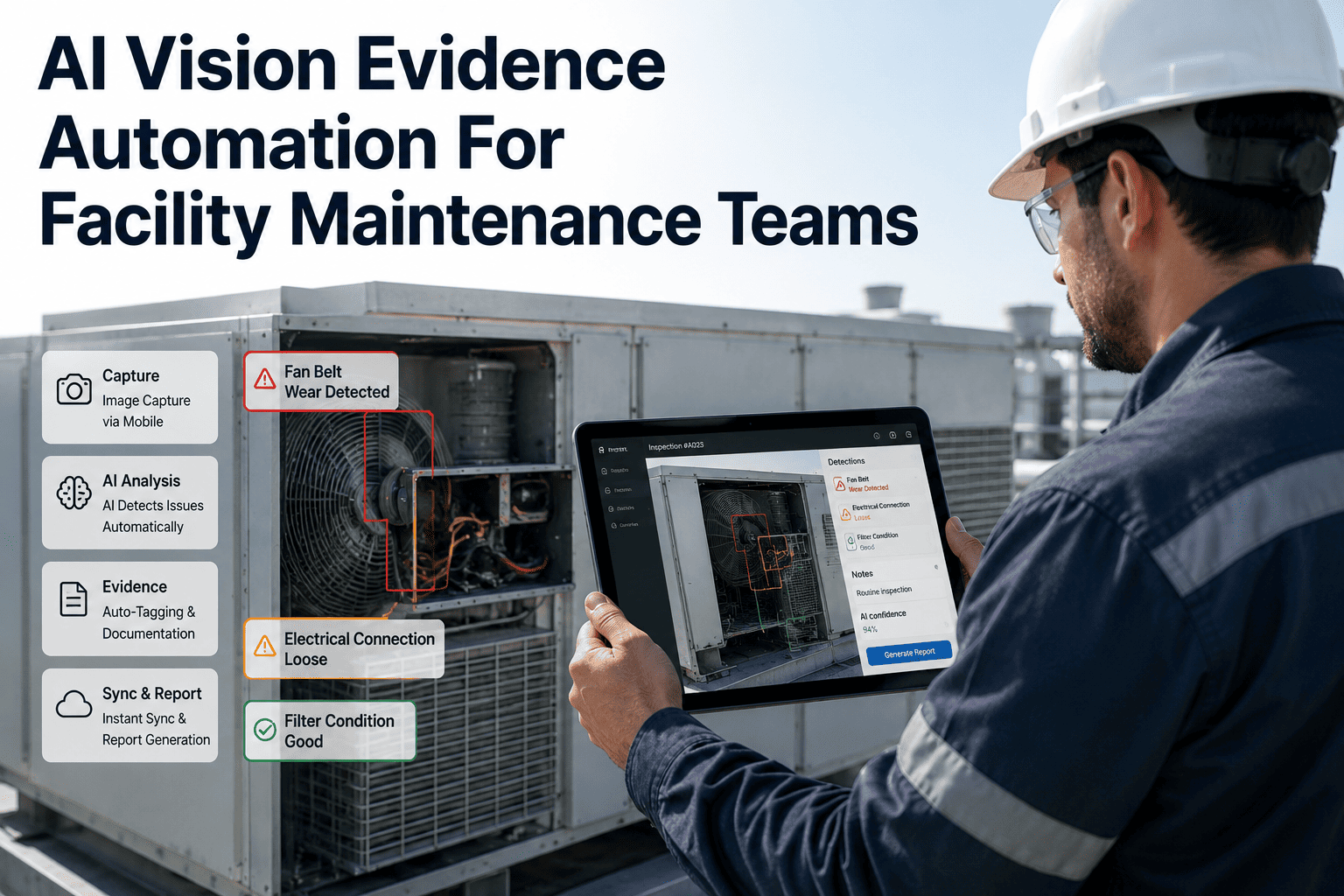
Maintenance triage — the process of sorting defects by urgency and routing the right resources to each — is the most consequential bottleneck in facility operations, and the one most often handled inconsistently. When triage depends on individual inspector judgment, shift-to-shift communication, and manual work order entry, critical defects compete with routine tasks in the same unranked backlog. Visual maintenance triage powered by AI vision solves this by applying consistent, asset-specific priority logic to every defect the moment it is detected — so planners receive an already-sorted queue where every item has a photo, a severity tier, and a routing recommendation attached. OxMaint's AI vision and CMMS integration makes this workflow fully automated: from camera detection to classified triage decision to routed work order, the system handles the judgment that previously lived only in an experienced planner's head. See how OxMaint automates visual maintenance triage in a live demo.
Visual Triage · AI Vision · CMMS Workflow Automation
Triage Every Defect Correctly. Every Time. Without a Planner in the Loop.
OxMaint AI Vision assesses every detected defect against your facility's triage criteria — urgency, asset criticality, safety risk — and routes it into the right CMMS workflow automatically before a planner opens the queue.
Triage Tier System
How OxMaint AI Vision Classifies Every Defect into a Triage Tier
Tier 1 · Urgent
Immediate Action Required
Safety risk, active failure, or critical asset impact. AI triggers immediate work order, supervisor notification, and optional shutdown request. Target resolution: within 1 shift.
Examples: electrical panel anomaly · active fluid leak near live equipment · structural crack propagation · PPE non-compliance in a high-risk zone
Tier 2 · High
Planned Repair Within 48–72 Hours
Degrading asset condition with risk of escalation. Work order created with medium-high priority, assigned to next available planned maintenance window. Asset flagged for monitoring.
Examples: belt tracking deviation · bearing staining · condensate overflow · filter saturation visible
Tier 3 · Scheduled
Batched into Next Maintenance Window
Non-urgent defect with no immediate safety or production impact. Work order created, batched into the appropriate PM window, and assigned without planner action required.
Examples: surface corrosion on non-structural element · minor coating failure · housekeeping deficiency
Tier 4 · Monitor
Logged and Watched
Early-stage condition noted but not yet actionable. OxMaint logs the detection with photo, sets a re-inspection flag, and alerts if severity progresses to a higher tier.
Examples: early rust bloom · surface discolouration · minor vibration at component
CMMS Workflow Integration
What OxMaint Routes Into Each CMMS Workflow Based on Triage Tier
| Triage Tier |
CMMS Workflow Triggered |
Notification |
Target Resolution |
| Urgent |
Emergency Work Order + Escalation Workflow |
Supervisor + Shift Manager (immediate) |
Within 1 shift |
| High |
Priority Corrective Work Order |
Maintenance Planner (within 2 hours) |
48–72 hours |
| Scheduled |
Standard Work Order — batched into PM window |
Planner queue update (daily digest) |
Next PM window |
| Monitor |
Inspection Log Entry + Re-inspection Flag |
None unless tier escalates |
Next inspection round |
OxMaint · Visual Triage · CMMS Integration
Your Planner Should Manage Exceptions — Not Triage Every Defect Manually.
OxMaint AI Vision pre-triages every defect before it reaches the planner queue — with severity, routing, and photo evidence already in place.
Results
What Changes When Triage Is Visual and Automated
89%
of defects correctly triaged by AI without planner intervention
62%
reduction in planner time spent on triage and work order creation
3.4×
faster mean time from defect detection to technician dispatch
37%
fewer urgent escalations due to earlier-tier defects caught and addressed sooner
Expert Perspective
Triage has always been the hidden expertise in maintenance planning — the ability to look at a list of defects and instantly know which ones need a technician today, which can wait until Friday, and which need to be escalated to the plant manager right now. What AI vision does is take that judgment, make it explicit in the form of configurable rules, and then apply it consistently to every defect detected across every shift. The planner's role shifts from sorting and assigning to managing exceptions and continuous improvement. That is a much more valuable use of skilled maintenance time.
Sandra Lim
Maintenance Planning Lead · 18 years in commercial and industrial FM · CMRP, CAMA
FAQs
Visual Maintenance Triage with AI Vision — Common Questions
Can planners override or adjust the triage tier assigned by AI for any specific work order?
Yes. Every AI-assigned triage tier can be reviewed and overridden by the planner from the work order queue. When a planner adjusts a tier, OxMaint logs the change and reason — this feedback is used to improve triage accuracy for future detections on the same asset type.
Start a free trial to explore the planner override and feedback workflow in OxMaint's triage queue interface.
How does OxMaint handle triage for assets that have a history of repeated defects?
OxMaint's visual triage engine incorporates asset history into triage decisions — a defect on an asset with three prior occurrences of the same type in 90 days is automatically escalated one tier above the standard classification, and the work order includes a recurrence alert flag. This surfaces systemic asset issues to the planner rather than treating each recurrence as a standalone defect.
See how recurrence logic affects triage in a live demo.
Does OxMaint support different triage criteria for different facility types — e.g. healthcare vs manufacturing?
Yes. OxMaint's triage engine is configurable per site, asset class, and facility type. Healthcare facilities can apply NFPA-aligned severity criteria for clinical area assets, while manufacturing sites can weight production impact into triage scores. Each site's triage rules can be configured independently within the same OxMaint account, making the system suitable for multi-site operators managing mixed facility types.
Can the triage system automatically batch low-priority defects into existing planned maintenance work orders?
Yes. OxMaint's Scheduled and Monitor-tier defects are automatically evaluated against existing PM work orders scheduled for the same asset or zone. Where a match exists, the defect and its photo evidence are appended to the upcoming PM work order rather than creating a new standalone WO — reducing planner queue volume and improving the efficiency of planned maintenance visits.
Book a demo to see how OxMaint merges triage findings into PM schedules.
OxMaint · Visual Triage · Free to Start
A Sorted, Routed Work Order Queue Waiting for Your Planner Every Morning. That's Visual Triage.
OxMaint AI Vision handles defect detection, triage, and CMMS workflow routing — so your maintenance team acts on the right thing at the right time, every shift.