A cement plant's rotary kiln operates at 1,450°C for 330+ days per year, processing rock through a 60-meter rotating cylinder under loads exceeding 2,000 tonnes while supporting extreme temperature gradients and corrosive chemical conditions that degrade mechanical components far faster than in conventional manufacturing. Kiln maintenance encompasses more than just repair — it requires integrated condition monitoring across seven distinct mechanical and thermal systems, each with its own failure modes, warning signs, and preventive intervention windows. The kiln main bearing supporting 2,000-tonne axial load generates subtle vibration trends 4–8 weeks before catastrophic failure; the girth gear meshing at low speed under high torque exhibits backlash changes that predict tooth pitting 6–10 weeks ahead; the refractory lining thinning from chemical attack shows measurable shell temperature changes 8–16 weeks before breakthrough. A complete kiln maintenance program coordinates all seven systems — bearing alignment, girth gear drive, refractory integrity, support roller adjustment, tyre migration management, shell scanning, and thermal stress control — into a unified condition assessment and intervention framework. This guide shows cement plant maintenance engineers how to structure a comprehensive rotary kiln maintenance program that catches failures before they cascade into unplanned shutdowns costing $150,000–$400,000 per day in production loss.
The Seven Critical Systems of Rotary Kiln Maintenance
Rotary kiln reliability depends on coordinated maintenance across seven interdependent mechanical and thermal systems. Failure in any single system creates ripple effects through the others: a bearing misalignment causes kiln shell deformation that accelerates refractory wear; refractory failure creates hot spots that crack the shell; girth gear wear increases vibration that destabilizes support rollers. Mature kiln maintenance programs treat these seven systems as an integrated whole, measuring condition across all seven simultaneously and scheduling coordinated interventions that optimize repair scope and downtime duration. Sign Up Free to deploy OxMaint's seven-system kiln monitoring framework across your production line.
System 1: Kiln Main Bearing and Support System Maintenance
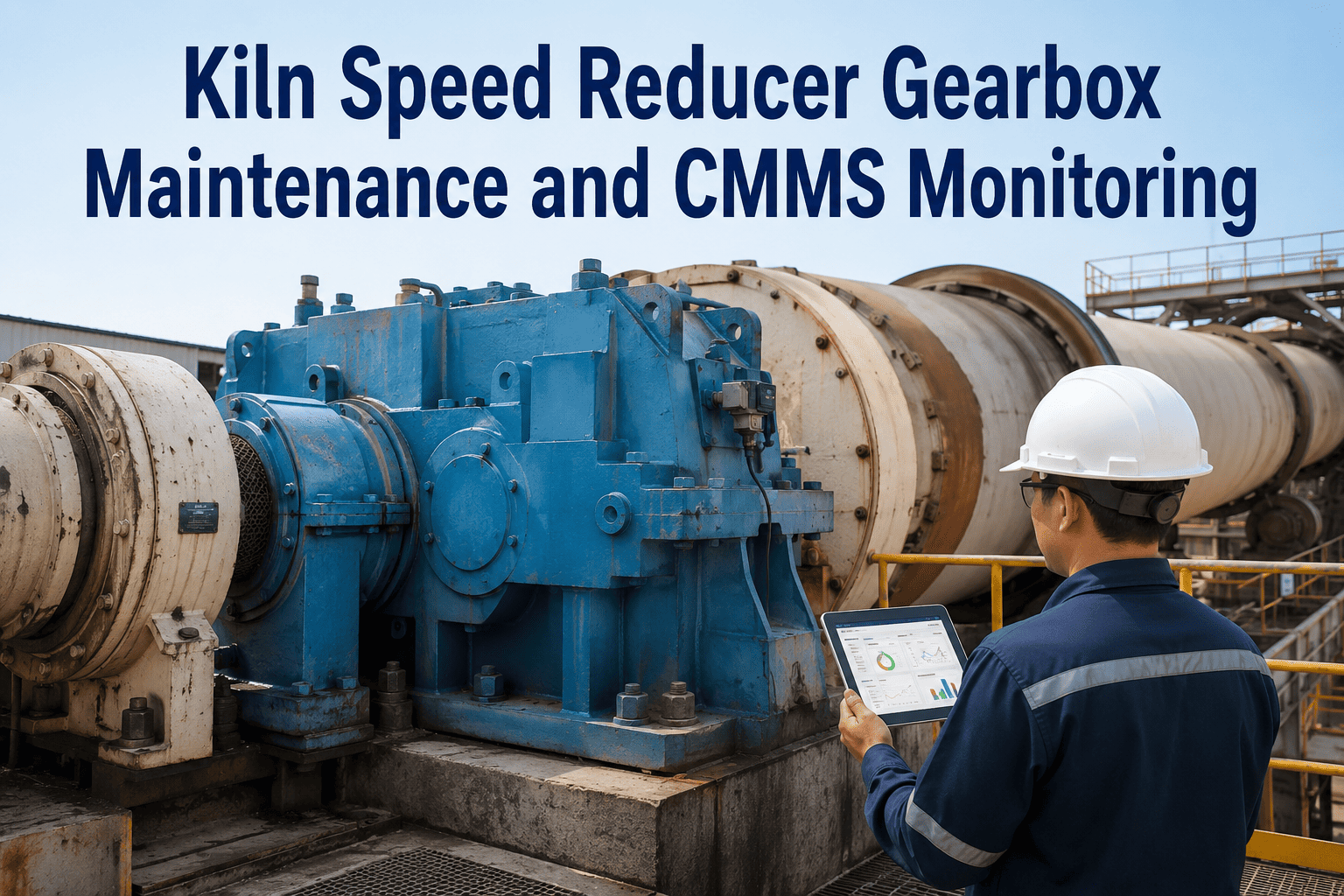
The kiln main bearing and its support roller stations carry 2,000 tonnes of rotating mass at 1–4 RPM under radial and thrust loads generated by kiln rotation, material weight, and thermal expansion. Bearing failure is gradual — temperature rises over 2–4 weeks, vibration increases measurably, then catastrophic seizure occurs within days. Early detection requires continuous bearing temperature monitoring combined with vibration analysis trending. Book a Demo to see how OxMaint coordinates bearing temperature, vibration, and alignment data into integrated failure prediction models.
Kiln Main Bearing Housing
Monitor bearing temperature continuously (target <80°C under normal load; alert >85°C; critical >95°C). Track bearing lubrication pressure and cooler outlet temperature. Weekly vibration envelope analysis on bearing housing detects wear particle generation 4–6 weeks before failure. Scheduled bearing replacement interval: 8–12 years or upon reaching wear threshold. Preventive replacement cost: $180K–$240K.
Support Roller Stations
Each support roller operates under 200–400 tonne radial load. Measure vertical and horizontal alignment at each roller station monthly using dial indicators. Roller bearing temperature trending reveals wear (target <70°C, alert >75°C, critical >85°C). Lubrication pressure at each station must stay within OEM specification (typically 20–30 bar). Misalignment >5mm detected on dial measurement triggers realignment work within 30 days to prevent accelerated roller and shell wear.
Thrust Roller System
Thrust rollers absorb kiln axial thrust from material feed. Bearing temperature monitoring (same thresholds as main bearing) is critical because thrust roller failure cascades to main bearing damage within days. Measure thrust bearing clearance (axial play) quarterly; clearance >10mm indicates pad wear and requires corrective maintenance within 60 days. Thrust roller replacement cost: $120K–$160K.
System 2: Girth Gear and Drive System Maintenance
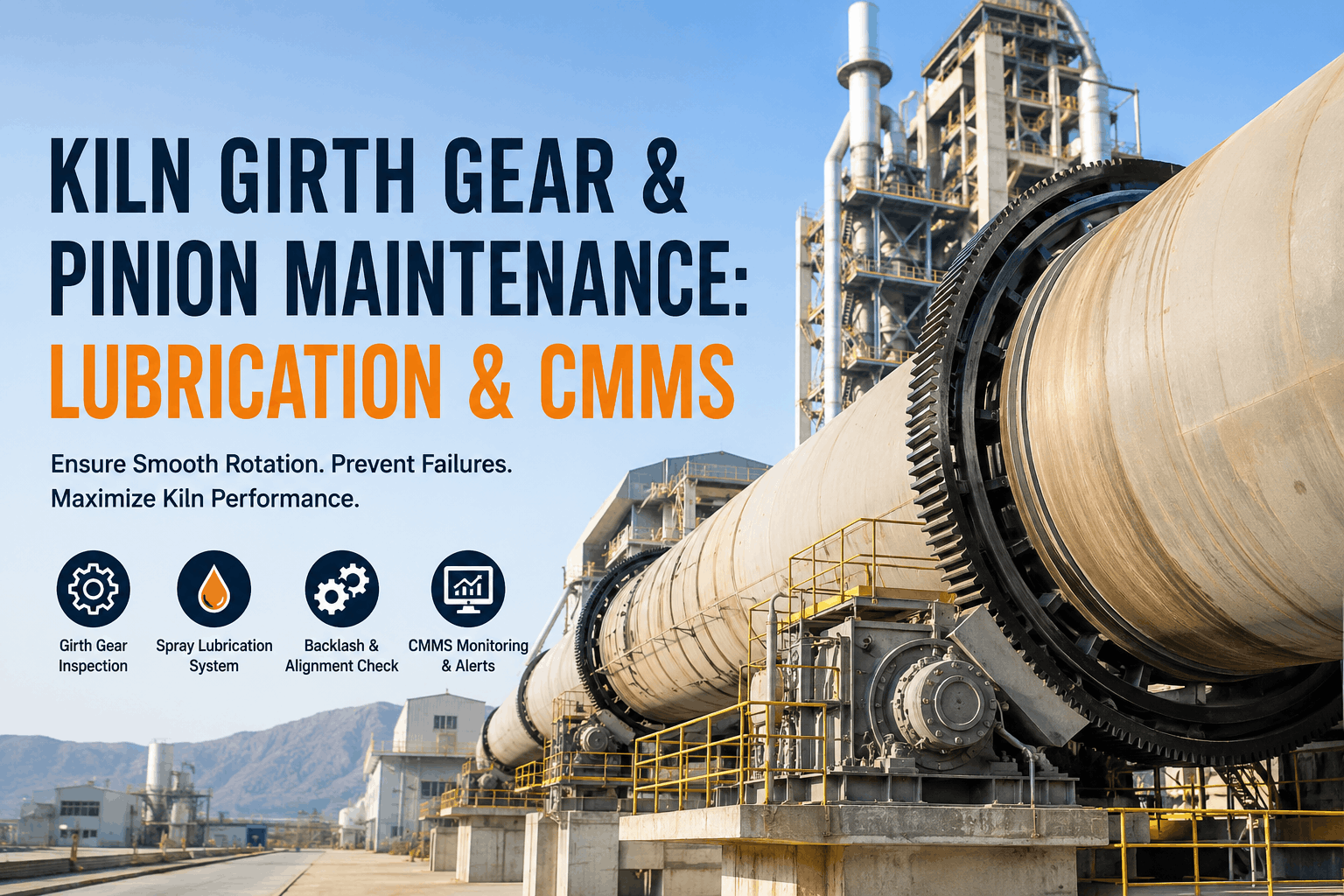
The girth gear meshing with the main drive pinion transmits motor torque to kiln rotation. Gear failures are among the most expensive kiln events: an unplanned girth gear failure costs $800K–$2M including 3-week downtime, emergency procurement, and secondary damage to the pinion and gearbox. Gear degradation develops over 6–10 weeks with detectable warning signs: increasing backlash, declining lubrication spray coverage, tooth surface spalling visible on borescope inspection. Proactive replacement costs $320K–$480K and prevents catastrophic failure entirely.
Backlash Measurement and Tooth Profile Assessment
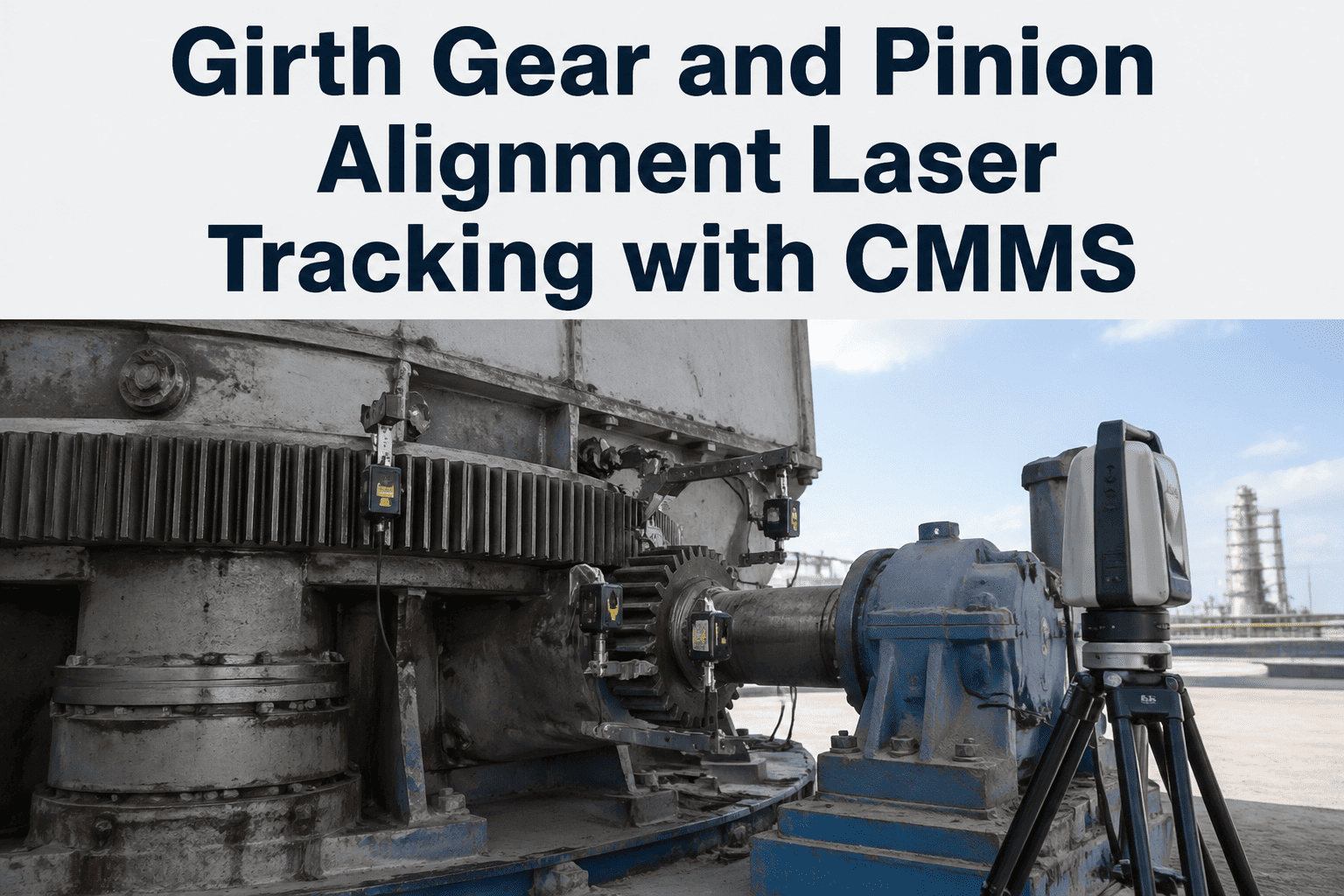
Measure gear backlash monthly using dial indicators at four positions around the gear. Normal backlash: 4–8mm; alert zone 8–12mm indicates tooth wear; critical zone >12mm requires gear replacement within 45 days. Use borescope inspection quarterly to visually assess tooth surface condition; spalling, pitting, or step wear patterns indicate imminent failure. Blue paper test checks lubrication coverage uniformly across tooth face — uneven coverage indicates spray nozzle misalignment.
Drive Motor Current and Vibration Trending
Motor current signature analysis (MCSA) detects gear mesh degradation through harmonic analysis. Current THD (Total Harmonic Distortion) trending reveals gear tooth impacts; >5% THD indicates wear starting. Vibration analysis on gearbox housing at gear mesh frequency (typically 400–800 Hz) shows amplitude increases as tooth surface degrades. OxMaint correlates both signals: increasing current AND increasing mesh harmonics = imminent gear failure requiring replacement.
Lubrication System and Spray Nozzle Management
Verify lubrication pump pressure (typically 30–50 bar) daily; pressure drops indicate pump wear or line obstruction. Check spray pattern using blue paper immediately after each lubrication cycle; coverage should be 85%+ across tooth face. Clean or replace spray nozzles if coverage drops below 70%. Lubrication oil analysis quarterly (ISO 4406 particle count, acid number, viscosity) detects contaminant ingress. Premature gear wear often traces to contaminated lubricant.
System 3: Kiln Refractory Lining Maintenance and Thermal Management
Refractory represents 8–12% of total kiln maintenance budget but protects against shell damage costing 10–15× refractory replacement cost. Lining degradation is measurable and predictable: shell temperature scanning reveals hot spots 8–16 weeks before breakthrough; thickness measurement using ultrasonic techniques tracks wear rate; coating stability visual inspection identifies spalling pattern changes. A kiln operating with gradually deteriorating refractory reaches a critical failure threshold where shutdown becomes unavoidable — successful management schedules reline before that threshold rather than attempting endless patch repairs.
Rotary Kiln Maintenance Master Schedule and OxMaint Integration
Mature kiln maintenance coordinates all seven systems through a master maintenance schedule that balances calendar-based PM, condition-based triggers, and coordinated outage planning. OxMaint consolidates condition data from all seven systems into a single dashboard, flagging when multiple systems approach maintenance thresholds simultaneously and recommending consolidated outage schedules that reduce total downtime. Sign Up Free to start building your facility's master kiln maintenance schedule integrated with real-time condition monitoring.
| Maintenance Task | Frequency | Kiln Condition Trigger | Duration (Planned) | OxMaint Alert Type |
|---|---|---|---|---|
| Bearing Temperature Monitoring | Daily | >85°C = investigate; >95°C = critical | N/A (monitoring only) | Continuous SMS/email alert |
| Girth Gear Backlash Measurement | Monthly | Backlash >8mm or increasing trend | 1 hour | Auto work order if >10mm |
| Shell Temperature Scanning | Weekly | New hot spots >50°C above baseline | 30 minutes | Escalation if hot spot growth detected |
| Support Roller Alignment Check | Monthly | Misalignment >5mm detected | 3 hours | Auto work order; schedule within 30 days |
| Refractory Thickness Measurement | Quarterly | Thickness <120mm or wear >2mm/month | 4 hours | Reline scheduling triggered at alert thresholds |
| Bearing Replacement (Preventive) | 8–12 years | Vibration increase or temperature trending upward | 5–7 days downtime | Capital planning alert 6 months prior |
| Kiln Refractory Reline (Full Campaign) | Every 3–5 years | Thickness <100mm or multiple hot spots | 7–21 days downtime | Coordinated with other capital projects |
Frequently Asked Questions: Rotary Kiln Maintenance
What is the most common cause of unplanned kiln shutdowns?
Kiln bearing failure accounts for 25–30% of unplanned stops; refractory failure/hot spots account for 20–25%; girth gear degradation 15–18%. Most of these failures are detectable 4–12 weeks in advance through bearing temperature trending, shell temperature scanning, or gear backlash measurement. Prevention requires continuous monitoring, not just reactive response.
How long does a full kiln refractory reline typically take?
A full burning zone reline (60–80m kiln, 4–5m diameter) requires 7–14 days total: 1–2 days cooldown, 3–5 days brick removal/installation, 2–3 days inspection/prep, 1–2 days heat soak before restart. Partial zone patch repairs complete in 3–5 days. Plants pre-ordering refractory brick based on thickness trending complete projects in minimum time.
What bearing temperature is acceptable for kiln operation?
Normal operating range: <80°C. Alert threshold: 80–85°C (investigate cause). Critical threshold: >95°C (begin planning for immediate maintenance). Temperature >100°C indicates imminent bearing failure; reduce kiln load and prepare emergency maintenance within 24 hours. Rising temperature trend (even if <85°C) is more important than absolute value — indicates wear acceleration.
How often should kiln shell be scanned for hot spots?
Weekly thermal imaging during normal operation. More frequent scanning (daily) if troubleshooting active hot spot or refractory campaign recovery. Scanning frequency increases during high-alkali cycles or when seasonal changes affect kiln coating stability. OxMaint establishes baseline shell temperature map and alerts when new hot spots appear or existing hot spots grow.
What does girth gear backlash tell you about remaining gear life?
Backlash 4–8mm is normal and acceptable. Backlash 8–12mm indicates measurable tooth wear; schedule replacement within 6–8 weeks but not urgent. Backlash >12mm indicates advanced wear; replacement required within 3–4 weeks or risk sudden failure. Backlash increasing rapidly (growing >1mm/week) is higher warning than absolute value — indicates accelerating tooth destruction.
How do you prevent kiln bearing failure?
Continuous bearing temperature monitoring is essential (daily logging minimum). Ensure lubrication pressure remains within spec (20–30 bar typically). Maintain support roller alignment within ±5mm. Reduce bearing load during high-ambient-temperature periods. Upgrade to synthetic bearing oil if experiencing temperature issues. Replace bearing preventively at 8–10 year mark or upon first temperature trend upward — don't wait for catastrophic failure.
Should you attempt partial refractory repairs or plan for full reline?
Partial repairs buy time but cost 60–70% of full reline while delivering only 40–50% of reline benefit. Use partial repairs to extend life 6–12 months while planning full reline. Strategy: patch repairs on multiple outages while trending thickness decline, then schedule full reline when thickness reaches alert zone (100–120mm). This balances production continuity against ultimate economic efficiency.
What's the relationship between kiln speed and refractory wear?
Higher kiln speed (faster RPM) increases material throughput but also increases mechanical stress on refractory and accelerates coating wear. Optimal kiln operation balances feed rate, kiln speed, and retention time to maintain stable burning zone temperature and maximize coating stability. OxMaint tracks wear rate against kiln operating parameters to identify if speed adjustments could extend refractory life.