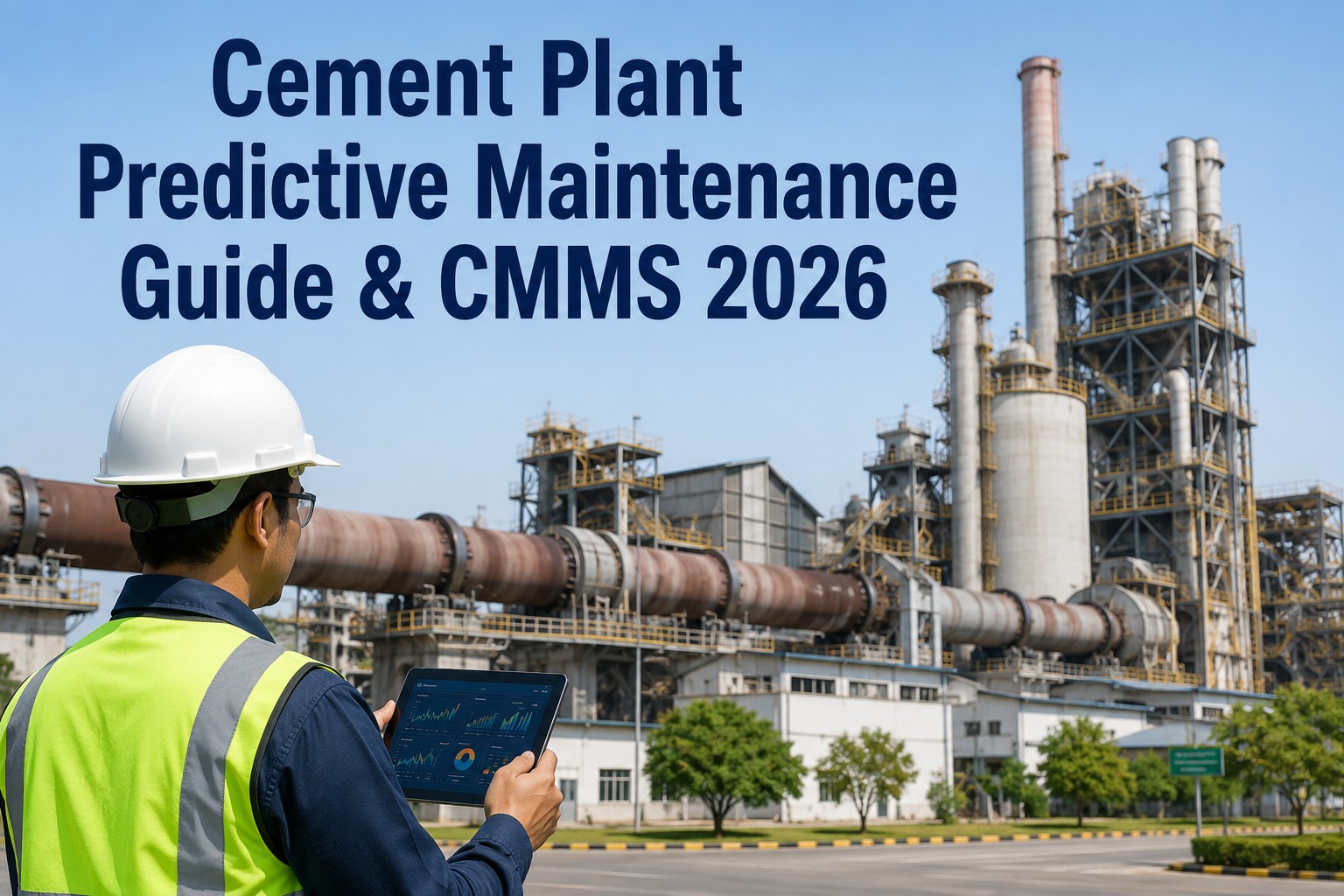
AI and machine learning have crossed the line from pilot to production in cement predictive maintenance, moving beyond dashboards into prescriptive work orders that dispatch crews before failures propagate. A modern cement plant now feeds kiln bearing temperatures, girth gear vibration signatures, and mill motor current into ML models that flag anomalies four to eight weeks before a catastrophic event — enough runway to plan the outage, order the spare, and avoid the $180K–$420K per day cost of an unplanned kiln stop. The teams winning in 2026 are the ones treating AI PdM as a CMMS-native workflow, not a data-science experiment. You can Start Free Trial to wire these models into your existing asset register and start scoring critical equipment within the first maintenance cycle.
What if your kiln told you it was failing — 6 weeks before it did?
Cement AI predictive maintenance is no longer a pilot waiting for a data scientist. In 2026 it runs inside the CMMS, scoring bearings, gears and mills on plant data you already collect — and writing the work order before the failure mode propagates.
From pilot project to plant-floor workflow in 2026
Roughly 1 in 3 cement producers have an "AI PdM" initiative — and roughly 1 in 8 of those have a model that actually triggers a work order. Here is what separates the 12% from the rest.
The economics are brutal and well-understood. A single unplanned kiln stop on a 5,000 TPD line costs between $180,000 and $420,000 per day in lost clinker, fuel wasted on cool-down and reheat, and idled labor. A main bearing failure on a 4-stage preheater kiln can take the line down for 9–14 days. Girth gear tooth pitting on a ball mill — often invisible until vibration crosses an alarm threshold — costs $90,000–$250,000 in emergency repair and 6–11 days of lost throughput. Against those numbers, an ML model that catches the failure mode four to eight weeks out does not need to be perfect. It needs to be right once.
Where ML is actually catching failures on cement assets today
These are the four use cases that have moved from conference papers into shift handover logs at running plants. Each one is solvable on data most CMMS-connected plants already collect.
Kiln main-bearing temperature & oil-condition ML
Models trained on 12–18 months of bearing metal temperature, oil return temperature, inlet/outlet delta, and rotational speed detect the slow thermal drift that precedes a babbitt failure. One 4-stage preheater kiln in Southeast Asia caught a thrust-bearing failure 7 weeks early — planned outage cost $38K versus an estimated $1.9M unplanned event.
Girth gear AI defect detection
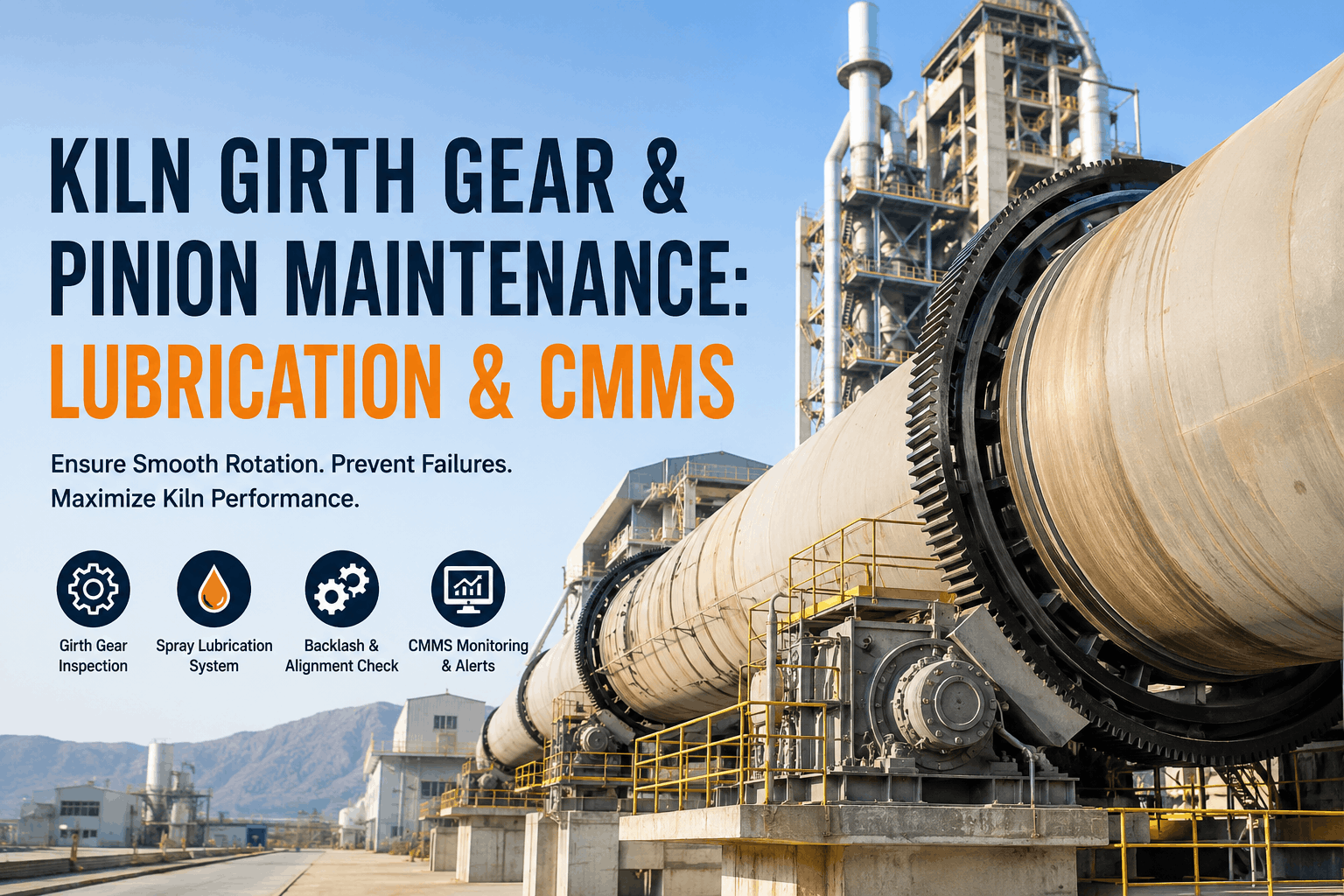
Convolutional models score images from a fixed inspection camera plus vibration envelope spectra on the pinion. The model flags tooth pitting, spalling and misalignment before the sideband amplitude crosses a classical alarm. A 3.8m ball mill deployment identified a 14-tooth pitting cluster 5 weeks before scheduled inspection — repair moved to a planned window.
Mill vibration AI & prescriptive tuning
Unsupervised anomaly models on mill shell vibration, motor current and feed rate detect the resonance shift that signals grinding-media wear, diaphragm damage or feed starvation. The prescriptive layer recommends the specific adjustment — add 1.2 tonnes of media, reduce feed 4%, inspect diaphragm — instead of just firing an alarm.
Preheater fan & ID fan bearing prediction
The highest-ROI ML use case in cement by frequency: variable-speed fan bearings fail fast and the spare lead time is long. A regression model on vibration RMS, temperature, speed and load predicts remaining useful life within ±9 days — enough to order the $4,200 bearing and schedule the 8-hour swap.
The 4-phase incremental rollout that avoids a science project
The plants that succeed do not boil the ocean. They pick one critical asset, prove the model on it, then expand. Here is the timeline most production deployments follow in 2026.
Data foundation & asset selection
Pick one asset worth more than $250K whose failure stops the line — usually the kiln main bearing or the raw mill girth gear. Audit the historian: 12 months of 1-minute data minimum, 4–6 sensor tags per asset, gap-fill missing windows. Tag the last 3 known failure events as labeled training data.
Model training & anomaly baseline
Train an unsupervised model (autoencoder or isolation forest) on the asset's normal operating envelope, then layer a supervised classifier on labeled failure windows. Target a false-positive rate under 8% on the held-out set — anything higher and the crew stops trusting the alerts.
Shadow scoring & CMMS integration
Run the model in shadow mode for 30 days alongside existing vibration alarms. Wire the top-scoring anomalies into the CMMS as draft work orders — not auto-dispatched yet. Reliability engineers review and confirm/dismiss each one. This is where the model earns trust.
Live prescriptive dispatch & expansion
Flip the first asset to auto-dispatch with a reliability-engineer approval gate. Measure: confirmed catches, false alarms averted, unplanned downtime hours avoided. On a confirmed win, expand to the next 3–5 critical assets using the same pipeline.
What one plant actually saved — a worked example
A 180-asset integrated cement plant spending $42K/year on vibration analysis, oil sampling and contracted PdM retrofitted ML predictive maintenance on 14 critical assets. Here is the 12-month outcome.
| Metric (12-month period) | Before ML PdM | After ML PdM | Delta |
|---|---|---|---|
| Unplanned downtime hours (14 critical assets) | 386 hrs | 241 hrs | −145 hrs (−38%) |
| Emergency work orders per quarter | 22 | 9 | −59% |
| Mean detection lead time before failure | 2.4 days | 31 days | +13× |
| Spare-parts emergency air freight spend | $87K | $19K | −$68K |
| Annual ML platform + sensors cost | $0 | $46K | +$46K |
| Net annual maintenance savings | — | — | +$412K |
The plant recouped the platform and sensor investment in under 7 weeks. The single largest contributor was a girth gear pinion bearing catch on the finish mill — flagged 5 weeks ahead, repaired in a planned 14-hour window instead of an unplanned 6-day outage that would have cost an estimated $1.1M in lost cement sales.
Data, model and integration requirements that actually work
If a vendor or internal team cannot answer these four questions with specifics, the deployment will stall in pilot. Use this as a buyer's checklist.
Data: 12 months, 4 tags, 1-minute resolution
Per critical asset: 12 months of clean historian data at 1-minute resolution, 4–6 sensor tags covering vibration, temperature, load and speed, plus 2–3 labeled failure events. Without labeled failures the model runs unsupervised and the false-positive rate typically doubles.
Model: supervised + unsupervised hybrid
Unsupervised anomaly detection (autoencoder or isolation forest) for unknown failure modes; supervised classification (XGBoost or LSTM) on labeled failures for known modes. Target under 8% false positives and a remaining-useful-life estimate within ±10 days.
Integration: CMMS-native, not a parallel dashboard
Model scores must write back to the asset record in the CMMS, auto-generate draft work orders with prescriptive actions, and route to the right reliability engineer. A separate AI dashboard that nobody opens during a shift is the number-one reason PdM pilots die.
Trust: shadow mode + engineer approval gate
Every model runs 30 days in shadow before live dispatch. Reliability engineers confirm or dismiss each alert in the CMMS — that feedback retrains the model. The first confirmed catch is what flips the culture from skeptical to dependent on the system.
Stop reacting to kiln failures. Start predicting them.
Wire AI predictive maintenance into your CMMS and score your 14 most critical cement assets in the first maintenance cycle.
Cement AI predictive maintenance — straight answers
How much data do we need before ML predictive maintenance works on a cement kiln?
Plan for 12 months of historian data at 1-minute resolution per critical asset, with 4–6 sensor tags covering bearing metal temperature, oil return temperature, vibration, motor current and rotational speed. You also need 2–3 labeled failure events for supervised learning — without them the model runs unsupervised only and the false-positive rate typically doubles. If your historian has gaps, fill them before training; models trained on patchy data produce patchy predictions.
Can AI predictive maintenance integrate with our existing CMMS, or is it a separate system?
A production-grade ML PdM layer should write model scores and prescriptive recommendations directly into your CMMS asset records and auto-generate draft work orders — not sit in a parallel dashboard. The number-one reason cement PdM pilots fail is the AI lives in a tool nobody opens during a shift. You can Start Free Trial to see how scores flow into the work-order workflow, or Book a Demo for a CMMS integration walkthrough.
What is the realistic false-positive rate, and how do we keep crews from ignoring alerts?
Target under 8% false positives on held-out validation data. In practice, run the model 30 days in shadow mode alongside existing vibration alarms, with reliability engineers confirming or dismissing each alert in the CMMS — that feedback retrains the model. The first confirmed early catch is what flips crew culture from skeptical to dependent on the system.
Which cement assets deliver the fastest ROI for ML predictive maintenance?
In order: preheater and ID fan bearings (high failure frequency, long spare lead times), kiln main bearings (catastrophic cost when they fail), girth gear pinions on ball mills (slow degradation that ML catches before pitting propagates), and mill shell vibration (tuning savings plus failure avoidance). A single fan bearing catch on a 5,000 TPD line typically pays for the entire annual platform cost.
Do we need a data scientist on staff to run AI predictive maintenance?
No — not if the platform is CMMS-native and ships pre-trained models for common cement asset classes. The reliability engineer owns the decision (confirm/dismiss/alert), the platform owns the model retraining. Plants that try to build custom models in-house without a dedicated ML engineer typically spend 14–20 months in pilot and never reach auto-dispatch. Buy the platform; keep your engineers focused on the assets.
Your next kiln failure is already in the data. Catch it 6 weeks early.
Deploy AI predictive maintenance on your 14 most critical cement assets in the first maintenance cycle — no data-science project required.
Free 14-day trial · No credit card