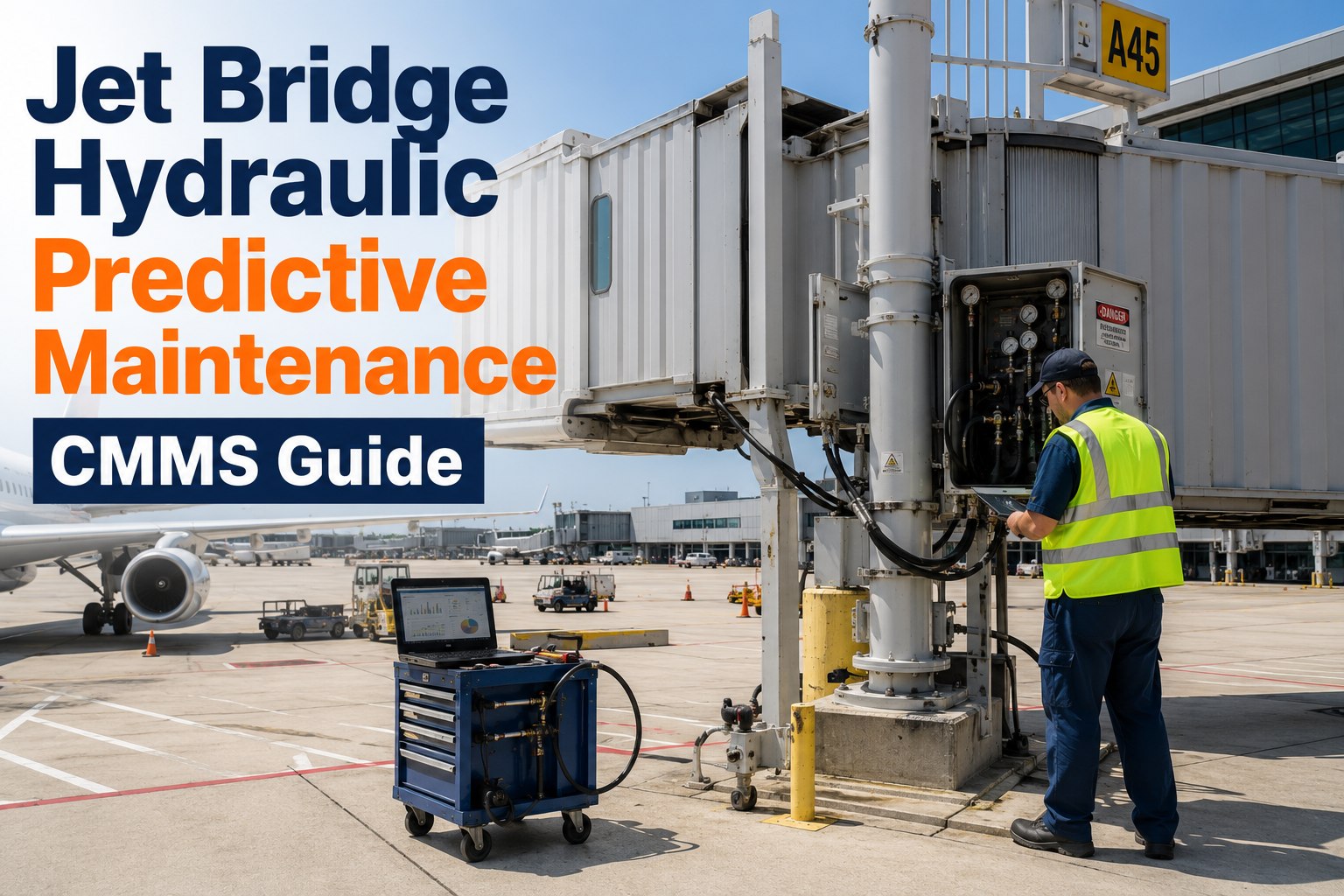
JLJet bridge predictive maintenance is the single most effective way to prevent costly boarding delays, passenger injuries, and cascading gate disruptions at modern airports. This jet bridge hydraulics CMMS guide for 2026 walks maintenance and reliability teams through hydraulic pressure trending, seal failure prediction, actuator response time monitoring, and fluid condition analysis — the four pillars of a jet bridge PdM program that keeps passenger boarding predictable. A failed jet bridge is the most visible airport asset failure a passenger will ever experience, and the cost of unplanned hydraulic breakdowns can exceed $15,000 per hour in delayed turnarounds. By deploying an AI-powered CMMS like OxMaint, ground operations teams can transition from reactive firefighting to condition-based maintenance. Ready to eliminate hydraulic surprises at your gates? Start Free Trial and see how predictive analytics transforms your jet bridge reliability.
JET BRIDGE PdM GUIDE 2026
Can your jet bridge hydraulics survive 40,000 boarding cycles without an unplanned failure?
Most airports wait for a blown hydraulic seal or a seized leveling actuator to schedule maintenance — and by then, a single gate outage has already cascaded into 12+ delayed flights. Jet bridge predictive maintenance flips that model: AI-driven CMMS analytics flag wear trends weeks before failure, keeping every passenger boarding on schedule.
SEAL FAILURE PREDICTION
How to predict jet bridge hydraulic seal failures before they leak
Hydraulic seals on jet bridge lifting cylinders typically degrade over 1,800–2,400 operational hours, but variance in temperature cycles, fluid contamination, and side-loading can cut that lifespan by 40%.
Track micro-leakage pressure decay rates
A healthy jet bridge cylinder holds rated pressure within a 2% decay over 10 minutes. When OxMaint's AI detects the decay curve steepening beyond 4% over consecutive cycles, it auto-generates a priority work order to inspect rod seals and wipers — typically 3–4 weeks before visible fluid weeping occurs.
Monitor hydraulic fluid particulate contamination (ISO 4406)
Seal degradation accelerates rapidly when fluid cleanliness drops below ISO 21/19/16. OxMaint logs fluid analysis results against each asset and flags upward particulate trends, correlating them with filter change intervals and seal replacement history so you intervene before abrasive wear destroys the cylinder bore.
Correlate actuator cycle counts with seal temperature spikes
Thermal sensors on leveling motor housings capture friction-induced heat from failing seals. When OxMaint detects a 15°F+ rise above baseline during standard docking cycles, it predicts imminent seal hardening and schedules replacement during the next low-traffic overnight window — not during a peak departure bank.
ACTUATOR & LEVELING MOTOR MONITORING
Jet bridge actuator response time monitoring with a CMMS
Response time — the seconds elapsed between a docking command and full actuator extension — is the earliest mechanical indicator of internal wear, fluid starvation, or valve degradation in jet bridge hydraulics.
In a worked example, a mid-size hub airport with 38 jet bridges was experiencing 4–6 leveling motor failures per quarter, each costing roughly $8,200 in emergency parts and labor plus an average of 90 minutes of gate downtime. After implementing OxMaint's jet bridge hydraulics CMMS to track response time trends and motor current draw, the team identified six actuators with degrading performance curves and replaced them during scheduled overnight windows. The result: zero unplanned actuator failures the following quarter and an estimated $54,000 in avoided reactive maintenance costs.
HYDRAULIC FLUID ANALYSIS
Hydraulic fluid analysis for jet bridges: what to test and when
Jet bridge hydraulic systems hold 15–40 gallons of ISO VG 46 fluid, and contamination accounts for 70–80% of all hydraulic component failures — making fluid analysis the highest-ROI predictive task in your PdM program.
When FHI exceeds 7.0 on a 0–10 scale, OxMaint auto-triggers a fluid change or filtration work order. An FHI above 8.5 escalates to immediate inspection of pumps, valves, and seals.
| Test Parameter | Healthy Range | Warning Threshold | Critical Action | Sampling Interval |
|---|---|---|---|---|
| Viscosity (cSt @ 40°C) | 41.4–50.6 | 36–41 or 51–55 | Investigate thermal/contamination source | Quarterly |
| Water Content (ppm) | Under 200 | 200–500 | Run vacuum dehydration; inspect reservoir breather | Monthly |
| Particulate (ISO 4406) | 19/17/14 | 21/19/16 | Replace filters; flush system if persistent | Monthly |
| Acid Number (mg KOH/g) | Under 0.5 | 0.5–1.0 | Fluid oxidation — schedule full fluid change | Quarterly |
| Wear Metals (Fe, Cu, Al) | Under 15 ppm | 15–40 ppm | Spectroscopic analysis; inspect cylinders/pump | Quarterly |
WHEEL BEARING & ROTATION MONITORING
Jet bridge wheel bearing monitoring: catching rotation failures early
The rotation drive system — wheels, bearings, and drive motors that pivot the bridge — handles loads up to 12,000 lbs and is the second most common jet bridge failure point after hydraulics.
Vibration Trend Analysis
- Mount wireless accelerometers on rotation drive bearings; baseline RMS velocity under 0.12 in/sec
- OxMaint auto-flags when vibration doubles baseline over 5 consecutive rotations
- Trigger bearing lubrication or replacement work order before spalling occurs
Drive Motor Current Draw
- Monitor amperage during full 90-degree rotation cycle; baseline 8–12A for standard drives
- Sustained 15A+ draw indicates bearing drag or brake drag — auto-generates inspection ticket
- Correlate current spikes with temperature data to isolate mechanical vs electrical faults
Rotation Time Consistency
- Log full rotation time from PLC; healthy range 45–60 seconds depending on bridge model
- 10%+ slowdown over 30 days triggers predictive work order for drive inspection
- OxMaint stores every cycle timestamp for FAA/TSA compliance audit trails
HOW OXMAINT HELPS
How OxMaint's AI-powered CMMS transforms jet bridge maintenance
OxMaint unifies work order management, predictive analytics, asset tracking, and spare-parts inventory into one platform purpose-built for maintenance and reliability teams managing high-traffic airport assets.
AI-Driven Failure Prediction
OxMaint ingests sensor data, fluid analysis results, and cycle counts to predict jet bridge seal failures and actuator degradation weeks in advance — cutting unplanned hydraulic downtime by 30–50% and reducing emergency callouts by up to 60%.
Automated Work Order Generation
When predictive thresholds breach, OxMaint auto-creates prioritized work orders with parts lists, safety procedures, and technician assignments — eliminating paper workflows and ensuring the right maintenance happens during the right traffic window.
Spare-Parts Inventory Optimization
OxMaint tracks hydraulic seals, filter elements, and actuator components against predicted replacement dates, auto-generating purchase requisitions when stock falls below safety thresholds — ending the costly cycle of overnight expedited shipping for critical spares.
Compliance & Audit Readiness
Every maintenance action, fluid sample, and sensor reading is timestamped and stored in a tamper-evident log — delivering instant FAA, TSA, and airline audit reports without weeks of manual record compilation from spreadsheets and clipboards.
See OxMaint predict jet bridge failures on YOUR assets
Book a 30-minute demo and we'll show you exactly how OxMaint's AI analytics would have caught your last three jet bridge hydraulic failures — weeks before they happened.
FREQUENTLY ASKED QUESTIONS
Jet bridge predictive maintenance CMMS: your questions answered
What is jet bridge predictive maintenance and how does it differ from preventive maintenance?
Predictive maintenance (PdM) for jet bridges uses real-time sensor data — hydraulic pressure, fluid condition, vibration, and actuator response times — to trigger maintenance only when actual degradation is detected, whereas preventive maintenance follows fixed time or cycle-based schedules regardless of asset condition. PdM typically reduces unnecessary maintenance tasks by 25–30% while cutting unplanned failures by 30–50%. You can Start Free Trial to see how OxMaint's AI makes this transition seamless.
How does a CMMS predict jet bridge hydraulic seal failures?
A CMMS like OxMaint predicts seal failures by continuously tracking hydraulic pressure decay rates, fluid particulate contamination levels (ISO 4406), and actuator cycle counts against historical baselines. When the AI detects a pressure decay exceeding 4% over consecutive cycles or a particulate trend spike, it auto-generates a work order typically 3–4 weeks before visible fluid leakage occurs.
What hydraulic fluid tests should be done on jet bridges and how often?
Jet bridge hydraulic fluid should be tested monthly for water content (under 200 ppm) and particulate contamination (ISO 19/17/14 or better), and quarterly for viscosity (41.4–50.6 cSt), acid number (under 0.5 mg KOH/g), and wear metals (under 15 ppm). OxMaint auto-schedules these tests and logs results against each asset for trend analysis.
How much does jet bridge downtime cost and what is the ROI of a predictive CMMS?
Unplanned jet bridge downtime costs an average of $15,000+ per hour in delayed turns, crew reassignment, and passenger compensation. A mid-size hub with 30–40 jet bridges typically invests $35,000–$60,000 annually in an OxMaint CMMS subscription and achieves payback within 4–6 months by eliminating 3–5 major unplanned hydraulic failures per year. Book a demo for a custom ROI model.
Can OxMaint integrate with existing jet bridge PLC and SCADA systems?
Yes. OxMaint supports standard industrial protocols (OPC-UA, Modbus, MQTT) to ingest real-time data from jet bridge PLCs, hydraulic pressure transducers, vibration sensors, and motor current monitors. The platform also integrates with ERP systems for procurement and with airline scheduling APIs to prioritize maintenance during low-traffic gate windows, ensuring repairs never conflict with peak departure banks.
Stop reacting to jet bridge hydraulic failures — start predicting them
Join the airport maintenance teams using OxMaint to cut unplanned jet bridge downtime by 30–50%, eliminate paper work orders, and keep every boarding on schedule. Your passengers — and your bottom line — will notice the difference.
Free 14-day trial · No credit card


