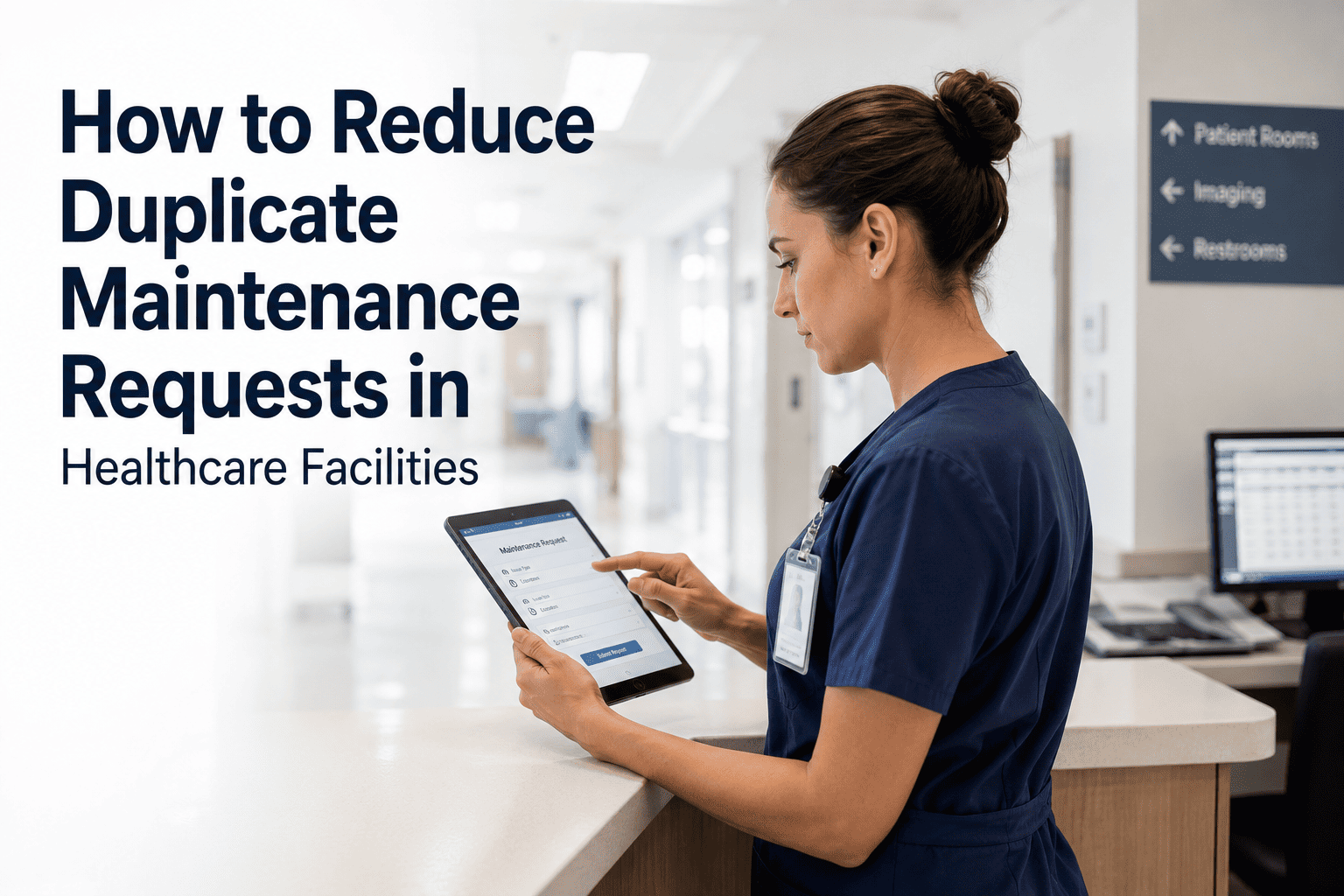
A ward nurse reports a failed HVAC unit by phone at 6am. A second nurse logs the same fault by email at 7am. A third submits a paper form at handover. Three separate requests — one issue — and now a technician has attended twice, a supervisor has approved two work orders, and the compliance record shows the fault was "resolved" on one ticket while still open on the other two. Duplicate maintenance requests in hospitals are not a minor administrative nuisance. They inflate backlogs, distort priority queues, waste scarce biomedical and facilities technician time, and create compliance documentation that does not accurately reflect what happened. In a Joint Commission survey environment, that matters. Start a free trial to see how Oxmaint eliminates duplicate requests through structured digital intake and asset-linked work order management.
35K+
Medical devices and infrastructure assets the average hospital manages — each a potential source of multi-channel duplicate requests
4.8×
Higher cost of unplanned reactive maintenance versus the same repair completed as a scheduled preventive task
30–45min
Per shift lost by supervisors manually matching requests to technicians in facilities without automated routing
40%
More equipment fault reports captured in the first 90 days when mobile digital submission replaces paper and phone intake
Why Duplicate Requests Are a Healthcare-Specific Problem
Every facility generates duplicate maintenance requests. In a hospital, the conditions that produce them are more severe — and the consequences more significant — than in any other environment.
24/7 Multi-Shift Operations
A fault present at midnight is still present at 6am shift change and again at 2pm handover. Three shifts — each with no visibility into what the previous shift reported — produce three separate submissions for the same fault. Without a single shared queue showing open requests, every shift starts blind.
Multiple Reporting Channels
Phone, email, paper form, verbal handover, and helpdesk walk-in all operate in parallel across most hospital facilities departments. A single fault reported via two channels creates two unlinked records — unless both feed into one system with deduplication logic. They almost never do.
Large Distributed Reporter Population
Clinical staff, housekeeping, porters, security, and administrative staff all report faults. None of them have sight of each other's submissions. A broken door handle on a surgical ward may be reported by the surgeon, the scrub nurse, the cleaning staff, and the ward manager — as four separate events with no indication that any of the others have already submitted.
No Status Visibility for Reporters
When a clinical staff member has no way to check whether their submission was received and is being actioned, they submit again. Then again. The duplicate is not impatience — it is a rational response to a system that gives no confirmation signal. Fixing duplicate submissions without fixing the confirmation problem only moves the frustration downstream.
Compliance Pressure Creates Over-Reporting
In a Joint Commission or CQC environment, clinical staff are trained to document and escalate. A fault that is not visibly being actioned gets re-submitted as an escalation — not because the original was missed, but because the reporter cannot tell whether it was. The compliance culture of healthcare amplifies duplicate generation compared to other industries.
PM and Reactive Requests Colliding
A piece of equipment due for scheduled preventive maintenance receives a reactive fault request on the same day. Two separate work orders are raised — one from the PM schedule, one from the clinical floor. A technician attends for the reactive job and closes it. The PM work order remains open. No one connected them, and the PM record shows as incomplete at survey.
The Real Cost of Duplicates — Beyond Wasted Technician Time
Wasted Labour
Direct operational cost
A technician dispatched to a job already completed by a colleague on the previous shift wastes a full attendance — travel time, on-site time, and the administrative time to close and reverse the duplicate work order. In a hospital managing hundreds of active requests per week, duplicate attendances compound into a measurable FTE loss per month. Supervisors spending 30–45 minutes per shift manually reviewing the queue for duplicates lose over 15 hours per week to an entirely preventable process.
Distorted Priority Queue
Operational risk
A backlog inflated by duplicate tickets is not a reliable indicator of actual workload. Priority classification systems rank requests by volume as well as urgency — when the same fault appears three times, it receives disproportionate priority weighting over a single genuine high-urgency fault submitted once. The right jobs get delayed by duplicates of lower-priority work. In a clinical environment, a misclassified priority delay is a patient safety risk, not just an efficiency problem.
Compliance Record Corruption
Regulatory risk
When a fault generates three work orders and only one is closed with photo evidence and technician sign-off, the asset's maintenance record shows two unresolved events for the same fault. During a Joint Commission Environment of Care review or a CMS Conditions of Participation audit, an asset record with unresolved work orders — even if the physical fault was corrected — creates a compliance finding. The record is the evidence, not the repair.
Clinical Staff Trust Erosion
Retention and culture risk
When clinical staff repeatedly submit maintenance requests and receive no confirmation, no status update, and no evidence of action — or are told a technician "already attended" for a fault they can still see — they stop trusting the maintenance reporting process. Disengagement compounds the problem: faults go unreported entirely, removing early detection and driving worse outcomes downstream. The duplicate problem is a symptom of a broader request transparency failure.
Every Duplicate Ticket Is Evidence of a Process That Is Not Working
Oxmaint gives every clinical and facilities staff member a single digital submission channel — with instant confirmation, real-time status visibility, and asset-linked deduplication that prevents the same fault generating two work orders regardless of who submits it or when. Sign up free or book a demo to see it in your environment.
7 Structural Fixes That Eliminate Duplicate Requests
Duplicate requests are a structural problem — produced by the design of the intake and tracking system, not by individual behaviour. Each fix below addresses a specific structural cause. Implementing all seven eliminates the conditions that generate duplicates entirely.
Consolidate All Intake to One Channel
Every request — regardless of how it originates — must enter a single system and generate a reference number. Phone calls logged by the helpdesk, emails forwarded into the CMMS, mobile app submissions, and QR code scans all create the same structured ticket in the same queue. When clinical staff can see that a ticket already exists for their issue before they submit, the duplicate is prevented at the source. When they cannot see it, the system must deduplicate on their behalf.
Send Automated Acknowledgment Within 60 Seconds
The primary driver of repeat submissions in healthcare is the absence of any confirmation that the original was received. An automated acknowledgment — sent immediately on submission with a reference number and expected response window — stops the follow-up submission before it happens. This single change reduces duplicate volume significantly in most hospital environments within the first two weeks of implementation, with no workflow change required for the maintenance team.
Link Every Request to a Specific Asset Record
A request that says "HVAC not working on Ward 6" is ambiguous — it could be one of six air handling units, two fan coil units, and a chilled water valve all on the same ward. An asset-linked request using a QR code scan or a structured asset picker identifies the exact piece of equipment. When the next person submits for the same asset, the system checks whether an open work order already exists for that specific device and routes the new submission to the existing ticket — rather than creating a new one.
Display Open Request Status at the Point of Submission
When a clinical staff member opens the submission form and selects an asset, the system should surface any existing open work orders for that asset before the new submission is completed. A prompt — "There is already an open request for this asset, submitted 4 hours ago and assigned to a technician" — gives the reporter the information they need to decide not to submit again. This is the single most effective deduplication mechanism and requires no manual review by the maintenance team.
Merge Duplicate Submissions Automatically — or Flag for Review
When two submissions arrive for the same asset within a defined time window — regardless of channel or reporter — the system should either merge them into a single work order automatically or flag the second as a probable duplicate for a supervisor to approve or reject in one click. This catch-all operates for duplicates that bypassed the pre-submission warning: same asset, similar fault category, within the same shift or 8-hour window. The merged record preserves both submission timestamps and reporter names for compliance purposes.
Connect Reactive Requests to the PM Schedule
A reactive fault request arriving for an asset with a PM work order due within 48 hours should not generate a separate work order. The CMMS should check the PM schedule at intake and, where the fault is within the scope of the upcoming PM task, combine them into a single attendance. This eliminates the PM-reactive collision described earlier and ensures the compliance record reflects a single, comprehensive maintenance event rather than a reactive repair with an orphaned PM record.
Close the Loop — Send Status Updates to the Original Reporter
When a work order is assigned, updated, and closed, the original reporter should receive a notification at each stage — without needing to ask. This is the final and most durable deduplication mechanism: a reporter who can see that their submission is in progress, with a named technician assigned, does not submit again. A reporter who receives a closure notification with photo evidence does not re-escalate. Post-closure communication is not a courtesy — it is the operational mechanism that prevents the next duplicate cycle.
Healthcare-Specific Triage — Four Priority Tiers Every Hospital Needs
Deduplication eliminates the volume problem. Priority triage solves the sequencing problem. Without a defined four-tier system in a clinical environment, the right jobs do not get attended in the right order — and no amount of deduplication fixes that.
| Priority |
Response Target |
Clinical Scope |
Duplicate Risk |
|
P1 Critical
Life Safety
|
Within 1 hour — no SLA extension |
Emergency power, fire suppression, life-safety HVAC, structural hazard, gas alarm |
Extremely high — multiple departments escalate simultaneously. Requires immediate visible status broadcast to all reporters |
|
P2 Urgent
Clinical Impact
|
Same shift — within 4 hours |
HVAC in clinical zone, medical gas fault, clinical equipment failure, water supply interruption, patient area lift |
High — persists across shift change without resolution, generating second and third submissions from incoming staff |
|
P3 Compliance
Regulatory Interval
|
Within mandated inspection interval |
Scheduled PM tasks, regulatory inspection due dates, equipment certification renewals |
Moderate — PM and reactive collision risk when scheduled and fault-generated requests are not linked at intake |
|
P4 Routine
Non-Clinical
|
Planned backlog — within 7 days |
Cosmetic repairs, non-clinical lighting, administrative area equipment, minor fixtures |
Lower individually, but highest volume tier. Without visible backlog status, persistent duplicates inflate the queue and distort resource allocation across all tiers |
The Compliance Documentation Problem Duplicates Create
When the Joint Commission surveys your Environment of Care chapter, surveyors examine work order history for regulated assets. An asset with two unresolved work orders for the same fault — where only one was closed — appears non-compliant even if the physical repair was completed correctly. The closed work order is the compliance evidence. An orphaned duplicate is a compliance gap. A CMMS that merges duplicates and closes them with a single verified record eliminates this risk automatically. Sign up to Oxmaint or book a demo to see how the asset maintenance record is structured for Joint Commission and CMS documentation requirements.
Metrics That Show Deduplication Is Working
Percentage of incoming requests flagged as duplicates of an existing open work order. Baseline measurement before system changes tells you the scale of the problem. Target: below 5% after structural fixes are in place.
Track weekly for the first 90 days post-implementation
Percentage of reporters who submit more than once for the same fault in a single shift or 8-hour window. High rates confirm the acknowledgment confirmation is not working or not reaching the right person.
Should drop over 60% within 2 weeks of automated acknowledgment being enabled
Open work orders older than their SLA window with no assigned technician, no status update, and no closure. These represent either genuine backlog or unmanaged duplicates that were never merged and never closed.
Should be zero on any regulated asset at the point of any survey
Technician Repeat Attendance Rate
Percentage of work orders requiring more than one technician visit for a fault already closed in the CMMS. High rates indicate either ineffective deduplication — a second ticket was raised after the first was closed — or a first-visit fix failure that must be addressed separately.
Baseline, then track monthly to distinguish duplicate from quality issue
Frequently Asked Questions
Q
Does deduplication risk suppressing legitimate escalation requests?
Only if the system is configured incorrectly. A second submission for the same asset should not be automatically discarded — it should be evaluated against the existing open work order and either merged or, if the SLA is being breached and the fault remains unresolved, used to trigger an escalation. The second submission is evidence that the first is not progressing fast enough. A well-configured CMMS treats the second submission as both a duplicate check and an SLA alert trigger — suppressing the ticket duplication while preserving the escalation signal.
Q
How should facilities teams handle requests from clinical staff who bypass the system?
Channel bypass happens for two reasons: the official channel is harder to use than calling or texting directly, or the official channel has failed the reporter in the past. Address both. Make the submission channel as fast as any informal method — a QR code scan takes 20 seconds, faster than finding a phone number. Then demonstrate that submissions via the official channel are acknowledged and actioned faster than bypasses. Within 60–90 days of consistent fast response and confirmation, most clinical staff voluntarily consolidate to the structured channel. Mandating it without improving the experience produces compliance without adoption.
Q
Can duplicate reduction improve Joint Commission survey outcomes?
Directly. The Joint Commission Environment of Care and Life Safety chapters examine work order records for regulated assets. Orphaned duplicate work orders that were never closed — because the actual repair was done under the first ticket and the duplicate was never addressed — create unresolved maintenance findings on regulated equipment. Eliminating duplicates and ensuring every work order is either merged and closed, or independently resolved and documented, removes the most common source of documentation findings during survey preparation. Facilities that transition to structured digital work order management with asset-linked deduplication consistently report improved survey readiness and reduced pre-survey remediation effort.
Q
How long does it take to see measurable duplicate reduction after implementing a CMMS?
Automated acknowledgment produces the fastest impact — typically a 40–60% reduction in repeat submissions within the first two weeks, because most duplicates are confirmation-seeking behaviour rather than genuine parallel reports. Asset-linked intake and pre-submission status display take longer to embed as clinical staff adopt the new submission channel, typically reaching full benefit at 60–90 days post-implementation. Full deduplication — including PM-reactive collision prevention and orphaned ticket closure — is a 90-day outcome from a structured implementation with proper asset register and PM configuration in the CMMS.
Eliminate Duplicate Requests. Protect Your Compliance Record. Give Clinical Staff Confidence.
Oxmaint gives healthcare facilities a single structured intake channel, instant automated acknowledgment, asset-linked deduplication, and closed-loop status communication — so clinical staff stop submitting twice, technicians stop attending for already-resolved jobs, and your compliance record reflects what actually happened. Purpose-built for hospitals, clinics, and multi-campus health systems.
Asset-Linked Deduplication
Automated Acknowledgment
Clinical Priority Triage
Joint Commission-Ready Records
PM-Reactive Integration