Reliability centered maintenance (RCM) is the gold-standard methodology for manufacturing plants that need to shift from reactive fire-fighting to a predictable, failure-mode-driven maintenance strategy. This RCM implementation guide breaks down how to deploy RCMII methodology on a plant floor — covering criticality analysis, FMEA maintenance integration, task selection, interval optimization, and the CMMS configuration required to keep your findings alive. By codifying your failure mode analysis into a structured system, you can reduce unplanned downtime by up to 40% and boost overall equipment effectiveness. Ready to operationalize your reliability program with AI-driven automation? Start Free Trial and configure your RCM framework today.
Is Your Plant's RCM Data Sitting in a Binder Instead of Driving Work Orders?
Most manufacturing facilities complete a reliability centered maintenance analysis, then fail to translate those FMEA findings into daily preventive maintenance tasks. The result? The same failures keep recurring. OxMaint bridges the gap between analysis and execution.
What is Reliability Centered Maintenance in Manufacturing?
Reliability centered maintenance (RCM) is a structured framework — originally developed for the aviation industry and adapted as RCMII for manufacturing — that identifies the minimum, most effective maintenance tasks required to ensure physical assets continue to do what users want them to do. Unlike traditional run-to-failure approaches, RCM manufacturing methodology dictates that maintenance tasks must be driven by specific failure modes and their operational consequences.
Preserve Function
RCM focuses on preserving the specific function of an asset, not just the physical component. A pump moving 500 GPM has a different functional failure than a pump moving 200 GPM.
Identify Failure Modes
FMEA maintenance analysis identifies exactly how an asset fails (seal leakage, bearing wear, impeller cavitation) rather than simply stating "pump fails."
Apply Task Logic
The SAE JA1011 decision tree determines whether a failure mode warrants scheduled restoration, on-condition monitoring, or a run-to-failure strategy.
Operationalize in CMMS
RCM findings must be configured in your CMMS as PM triggers, condition-monitoring alerts, and spare-part reorder points — or the analysis dies on the shelf.
How to Implement RCM in a Manufacturing Plant: Step-by-Step
A successful RCM plant implementation requires a phased approach. Attempting to analyze all 5,000 assets simultaneously is the fastest way to stall your reliability program. Focus on the critical 10–20% of assets that drive 80% of your downtime and maintenance costs first.
Asset Selection & Criticality Ranking
Inventory active assets and rank them by safety, environmental, and operational consequences. A 180-asset food processing plant typically identifies 25–35 critical assets for the first RCM iteration, focusing on bottlenecks that directly impact OEE.
Failure Mode and Effects Analysis (FMEA)
Document functions, functional failures, failure modes, effects, and consequences for each critical asset. A robust FMEA maintenance analysis should yield 8–15 distinct failure modes per complex machine, categorized by severity.
Maintenance Task Selection
Apply the RCM decision logic to assign on-condition tasks, scheduled restoration, discard, or run-to-failure. Ensure every task is technically feasible and worth doing based on risk and cost.
Interval Optimization & CMMS Configuration
Convert selected tasks into PM schedules within your CMMS. Set task intervals based on manufacturer data, historical failure rates, and condition-monitoring thresholds. If a task isn't triggering a work order, it isn't being done.
Continuous Improvement & Feedback Loop
Maintenance optimization RCM is never "finished." Use work order completion data, failure histories, and condition-monitoring trends to refine task intervals, eliminate ineffective PMs, and update FMEA scores quarterly.
RCM Task Selection: Condition-Based vs. Time-Based vs. Run-to-Failure
Not every failure mode warrants a preventive maintenance task. The core of reliability centered maintenance guide principles is matching the maintenance strategy to the specific failure pattern. Research shows 68% of industrial failures are not age-related, making blind time-based PMs ineffective for complex mechanisms. Use the decision matrix below to map failure modes to the correct maintenance optimization strategy.
| Failure Mode Pattern | Recommended Strategy | CMMS Configuration | Expected Downtime Reduction |
|---|---|---|---|
| Age-related wear (e.g., filter clogging) | Scheduled Discard / Restoration | Time-based PM trigger (e.g., every 90 days) | 35–45% |
| Degradation with warning (e.g., bearing vibration) | On-Condition (Predictive) | Condition-monitoring threshold alert | 50–70% |
| Random failure (e.g., electronic relay) | Run-to-Failure (RTF) | Spare parts stocking + rapid response WO | 10–15% |
| Safety/Environmental risk | Proactive/Redesign | Mandatory inspection PM + Engineering Change | 80%+ (Risk Mitigation) |
| Hidden function (e.g., backup generator) | Failure-Finding Task | Scheduled functional test PM | Avoids catastrophic failure |
RCM Analysis Cost Justification: A 180-Asset Plant Example
Reactive Maintenance Baseline
A 180-asset manufacturing plant spending $42,000 annually on emergency MRO parts and 1,200 hours of unplanned maintenance labor loses an additional $85,000 in production downtime — a total cost of $127,000/year.
Post-RCM Implementation
After implementing RCM analysis and configuring the outputs in OxMaint, the plant reduces emergency parts spend by 40%, cuts unplanned labor by 50%, and drops downtime by 35% — yielding $54,000 in annual savings and a 9-month payback period.
Stop Losing RCM Insights to Spreadsheets and Paper
See how OxMaint transforms your FMEA findings into automated, failure-mode-driven work orders that actually prevent downtime.
How OxMaint CMMS Powers Your RCM Maintenance Strategy
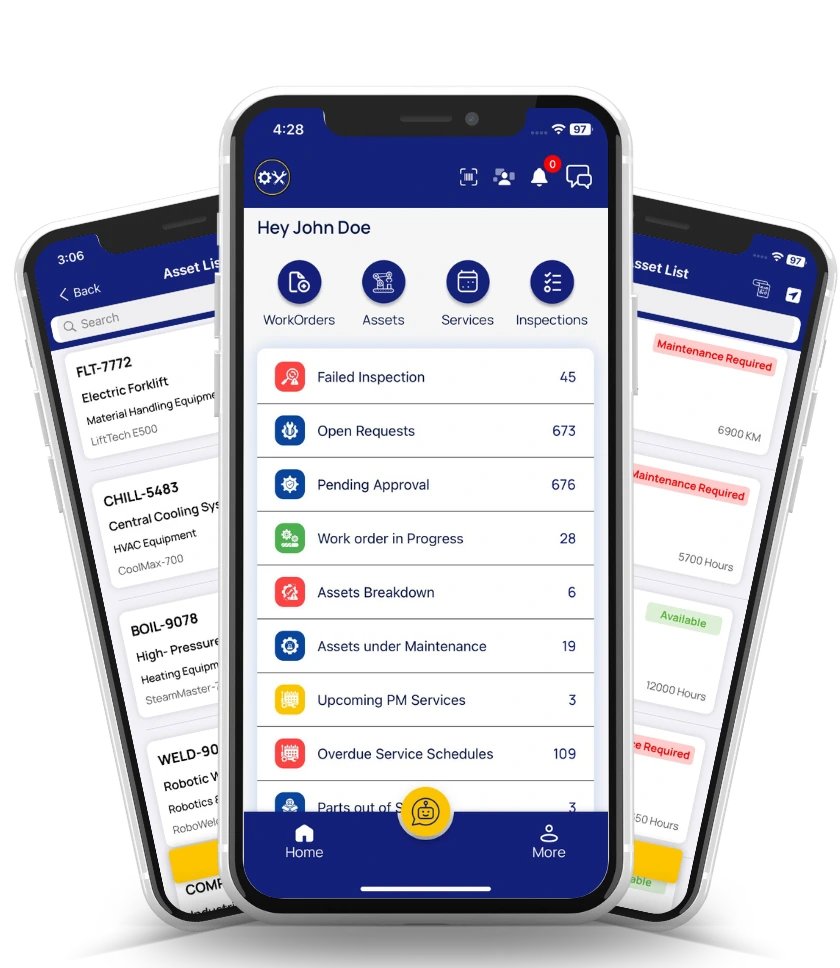
The gap between a theoretical RCM analysis and actual maintenance execution is where most reliability programs fail. OxMaint closes that gap by turning your FMEA maintenance data into living, automated workflows that guide technicians, trigger alerts, and feed performance data back into your analysis.
Failure-Mode-Driven PM Libraries
Map every preventive maintenance task directly to its originating failure mode. When a technician completes a PM, OxMaint logs the asset condition against the specific FMEA failure mode, enabling data-driven interval optimization.
Outcome: Eliminate 25% of ineffective PMs in year onePredictive Maintenance Integration
Connect IoT sensors and condition-monitoring data to OxMaint. When vibration or temperature thresholds are breached, the system auto-generates a work order linked to the specific failure mode predicted to occur.
Outcome: Cut unplanned downtime 30–50%Criticality-Based Asset Tracking
Rank and color-code every asset by operational criticality. OxMaint's asset hierarchy ensures that your most critical RCM-analyzed equipment receives priority scheduling, spare parts reservation, and compliance tracking.
Outcome: 99.5% PM compliance on critical assetsMaintenance Analytics & FMEA Feedback
Track MTBF, MTTR, and failure frequencies in real-time dashboards. Compare actual failure rates against FMEA predictions to continuously refine your RCM analysis and justify task interval adjustments.
Outcome: 15–20% maintenance cost reduction annuallyFrequently Asked Questions About RCM in Manufacturing
What is the difference between RCM and FMEA in maintenance?
FMEA (Failure Mode and Effects Analysis) is a specific analytical tool used to identify how assets fail and the effects of those failures. RCM (Reliability Centered Maintenance) is a broader methodology that uses FMEA as its analytical engine, but adds a decision logic tree to determine the appropriate maintenance task for each identified failure mode. You can configure your FMEA CMMS structure in OxMaint to ensure findings drive actual work orders — book a demo to see how.
How long does an RCM plant implementation take?
A focused RCM implementation on a critical asset baseline of 20–30 machines typically takes 3 to 6 months. The timeline includes asset selection, FMEA workshops, task selection, and CMMS configuration. Full plant-wide rollout can take 12–18 months depending on asset complexity and data availability.
How much does RCM analysis cost for a manufacturing facility?
A typical RCM analysis costs between $15,000 and $50,000 for external facilitation, depending on plant size. Internal costs include 80–120 hours of engineering time. However, the ROI is substantial — most plants achieve 300% ROI within 12 months by reducing unplanned downtime and emergency MRO spend by 30–50%.
Can a CMMS automate RCM maintenance tasks?
Yes, a CMMS like OxMaint is essential for operationalizing RCM. It automates the generation of preventive maintenance work orders based on failure-mode-driven intervals, tracks condition-monitoring alerts, and logs completion data. Without a CMMS, RCM findings remain theoretical documents that rarely influence daily maintenance execution.
What is RCMII and how does it differ from standard RCM?
RCMII, developed by John Moubray, is the modern adaptation of the original RCM methodology created for the aviation industry. It places greater emphasis on the operational consequences of failure and proactive task selection for manufacturing environments. RCMII is the standard framework referenced in most modern reliability centered maintenance guides and aligns with the SAE JA1011 evaluation criteria.
Transform Your RCM Analysis Into Measurable Uptime
Join manufacturing reliability leaders using OxMaint to automate FMEA-driven maintenance, predict failures, and cut downtime by up to 50%.
Free 14-day trial · No credit card