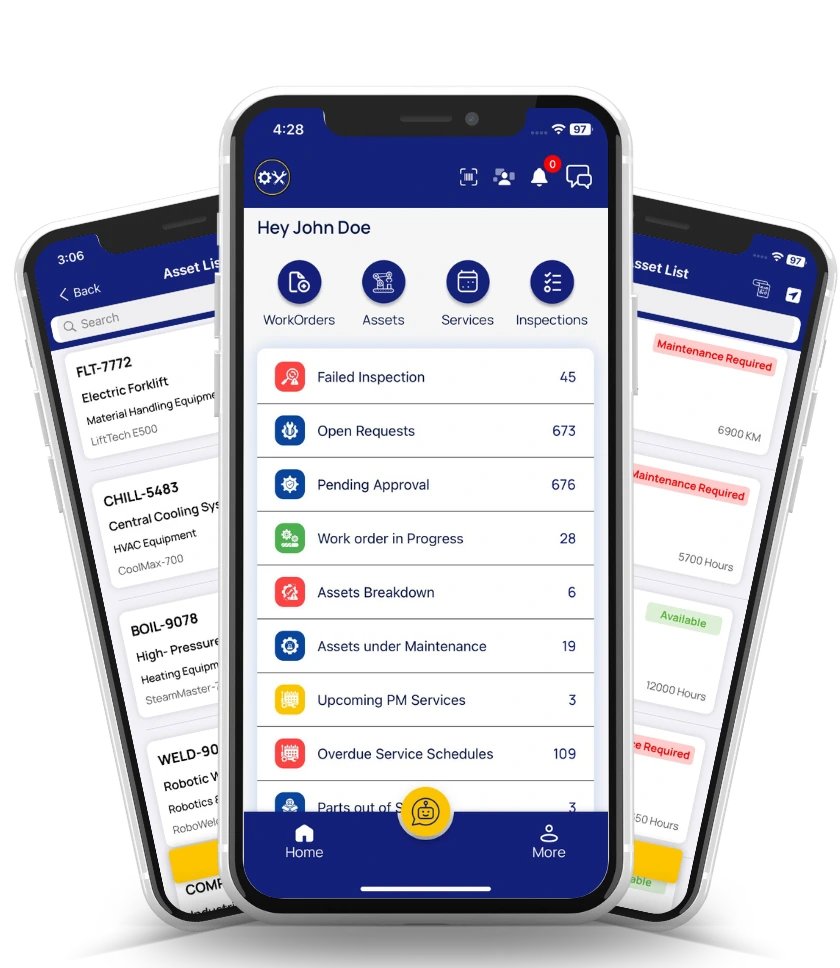
Passenger boarding bridge maintenance is the difference between a gate that turns aircraft on time and a gate that triggers delays, passenger complaints, and contractual penalties. A single jet bridge averages 8–12 docking cycles per day, making it one of the highest-cycle, safety-critical assets at any airport — and when one goes down, gate operations feel it instantly. OxMaint helps terminal and ground operations teams keep PBB uptime high through CMMS-driven preventive maintenance cadence, safety inspection tracking, and rotational component service — all in one AI-powered platform. Whether you manage 4 gates or 40, a structured PBB maintenance program protects both compliance and on-time performance. Ready to see it on your assets? Start Free Trial or read on for the full guide.
Is one down jet bridge costing your terminal $12,000 per hour in gate disruption?
A single out-of-service passenger boarding bridge can cascade into delayed turns, missed slots, and passenger dissatisfaction within minutes. OxMaint's CMMS keeps every PBB inspected, serviced, and audit-ready — so no gate goes dark on your watch.
What a complete boarding bridge inspection covers
Industry guidance from ACI, IATA, and manufacturer OEM specs (ADB SAFEGATE, thyssenkrupp, CIMC-TianDa) converges on roughly 15–18 critical inspection zones per PBB. Below is a structured passenger boarding bridge inspection framework organized by system — the same hierarchy OxMaint uses to auto-generate work orders.
Structural & Tunnel
- Inspect tunnel extension/retraction rails for wear, cracking, deformation
- Check column pivot pins and torque arms at 2,000-cycle intervals
- Verify canopy bellows and weather seals — replace before monsoon/winter season
- Inspect steel structure for corrosion, especially at gate apron connections
- Confirm auto-leveler limit switches respond within 0.5 sec
Drive & Rotational
- Lubricate drive wheels and travel motors every 90 days or 500 cycles
- Test rotation bogie motor brushes and encoder feedback
- Inspect traction batteries / hybrid drive charge levels daily
- Verify e-stop buttons cut drive power in under 0.3 seconds
- Check emergency manual override engagement and release
Electrical & Controls
- Test PLC docking logic and proximity sensor alignment
- Inspect aircraft interface panel and 400 Hz GPU contacts
- Verify auto-leveler height sensors and bumper bar sensitivity
- Check pre-conditioned air (PCA) unit control signals
- Inspect cabling on cable chain / festoon for fraying and fatigue
Safety & Emergency
- Test all emergency stop circuits and door interlocks weekly
- Verify proximity sensors prevent aircraft contact — no override active
- Inspect fire suppression system pressure and nozzle clearances
- Check emergency lighting and battery backup (90-min minimum)
- Confirm operator pendant response and auto-reverse function
PBB PM schedule: daily, monthly, quarterly, and annual tasks
A reliable PBB maintenance program runs on layered cadences. The table below maps the standard preventive maintenance intervals for jet bridges — the same schedule OxMaint encodes as automated work-order triggers, so no task depends on someone remembering a clipboard.
| Interval | Key Tasks | Downtime Window | OxMaint Action |
|---|---|---|---|
| Daily / Pre-shift | Visual walkaround, canopy seal check, e-stop test, pendant function test, cleanliness | 10–15 min | Auto-generated checklist pushed to technician mobile app |
| Weekly | Drive wheel inspection, cable chain visual, emergency lighting test, sensor wipe-down | 20–30 min | Scheduled work order with photo evidence and sign-off |
| Monthly | Lubrication of pivot points, battery load test, PLC fault log review, PCA filter check | 45–60 min | PM trigger with parts kit reservation and labor estimate |
| Quarterly | Drive motor brush inspection, encoder calibration, structural bolt torque audit, canopy alignment | 2–3 hrs | Multi-technician work order with OEM checklist template attached |
| Annual / OEM | Full structural NDT inspection, control system firmware update, safety system recertification, complete cable replacement assessment | 4–8 hrs | Major overhaul project with compliance documentation export |
Key metrics that drive jet bridge reliability
World-class PBB reliability programs target above 99.2% gate availability — but you can't improve what you don't measure. These four KPIs, tracked automatically in OxMaint, separate a proactive PBB maintenance program from a reactive one.
Benchmark for acceptable gate uptime across a 24-hour cycle window with 8–12 turns per day.
Mean time to repair from fault report to restored service — the window before a gate disruption cascades.
Share of scheduled preventive tasks completed on time — the leading indicator of future breakdowns.
OEM-recommended interval for drive system lubrication and component inspection on high-traffic gates.
How OxMaint transforms PBB maintenance from reactive to predictive
Consider a 24-gate terminal running PBBs at an average of 10 cycles per day. At a conservative disruption cost of $8,000–$12,000 per hour of gate downtime, even a 2% availability gap drains $140K+ annually in direct operational impact — before counting reputational damage and airline penalties. OxMaint closes that gap.
Automated PM scheduling
OxMaint generates preventive work orders based on cycle counts, calendar intervals, or meter readings — no clipboard, no missed quarterly lubrication. Outcome: PM compliance jumps from typical 60–70% levels to above 90% within the first quarter.
Predictive failure alerts
AI-driven analytics flag patterns in motor current draw, vibration data, and fault-log frequency — predicting drive failures and sensor degradation before they ground a gate. Outcome: 30–50% reduction in unplanned PBB downtime.
Spare parts & inventory tracking
Every PBB work order auto-reserves parts kits — drive wheels, pivot pins, cable assemblies — so technicians never wait on procurement mid-repair. Outcome: MTTR cut by 35–45% with pre-staged critical components.
Audit-ready compliance docs
Every inspection, safety test, and component replacement is logged with technician sign-off, photo evidence, and timestamp — exportable for ACI, IATA, and airline audits in one click. Outcome: audit prep time drops from days to minutes.
A 24-gate terminal's shift from clipboards to CMMS
A mid-sized regional airport was managing 24 jet bridges with paper logs and a shared spreadsheet. PM compliance hovered near 62%, unplanned PBB outages averaged 3.2 per month, and audit preparation consumed a full week of the maintenance manager's time each quarter.
Net result: $143K in annualized disruption cost avoided, 75% fewer unplanned outages, and a maintenance team that spends time preventing failures instead of chasing them.
See OxMaint on your jet bridges — book a 30-minute demo
We'll walk you through a live PBB maintenance workflow: automated PM triggers, inspection checklists, parts reservation, and compliance export — mapped to your gate count and equipment mix.
Passenger boarding bridge maintenance: common questions
How often should passenger boarding bridges be inspected?
PBBs require daily pre-shift visual inspections, weekly functional checks, monthly lubrication and system tests, quarterly drive and structural audits, and a full annual OEM-level recertification. High-traffic gates exceeding 10 cycles per day may need more frequent lubrication intervals — OxMaint auto-adjusts cadence based on actual cycle counts, so inspection frequency always matches real asset usage.
What are the most common PBB failure modes?
The top four failure modes are drive wheel wear (accounting for roughly 25–30% of unplanned outages), auto-leveler sensor drift, cable chain fatigue, and control system PLC faults. Proximity sensor misalignment and emergency stop circuit failures also rank high. OxMaint's predictive analytics catch early vibration and current-draw signatures from drive motors, flagging potential failures 2–4 weeks before they ground a gate.
What standards govern jet bridge maintenance compliance?
PBB maintenance falls under a combination of OEM specifications (ADB SAFEGATE, thyssenkrupp, CIMC-TianDa), IATA Ground Operations Manual (IGOM) guidelines, ACI safety recommendations, and local aviation authority regulations. ISO 55000 asset management principles also apply. OxMaint structures every work order and inspection record to align with these frameworks — book a demo to see the compliance export in action.
How much does a CMMS for PBB maintenance cost?
OxMaint pricing scales with the number of assets and gates managed, but most mid-sized airports (10–40 gates) see ROI within the first quarter through reduced unplanned downtime alone. A single avoided gate disruption at $8,000–$12,000 per hour typically covers annual software cost many times over. The platform also eliminates hidden costs of paper-based systems — lost inspection records, overtime for audit prep, and expedited parts shipping.
Can OxMaint integrate with existing airport gate management systems?
Yes. OxMaint supports API integrations with common airport operational databases (AODB) and gate management systems, pulling cycle counts and usage data automatically. This means PM schedules adjust in real time based on actual docking events rather than estimates — you can Start Free Trial and connect your first gate system within minutes.
Every gate. Every cycle. Every inspection — covered.
Join the terminal operations teams using OxMaint to keep passenger boarding bridges reliable, compliant, and ready for every turn. Set up your first PBB asset in minutes.
Free 14-day trial · No credit card required