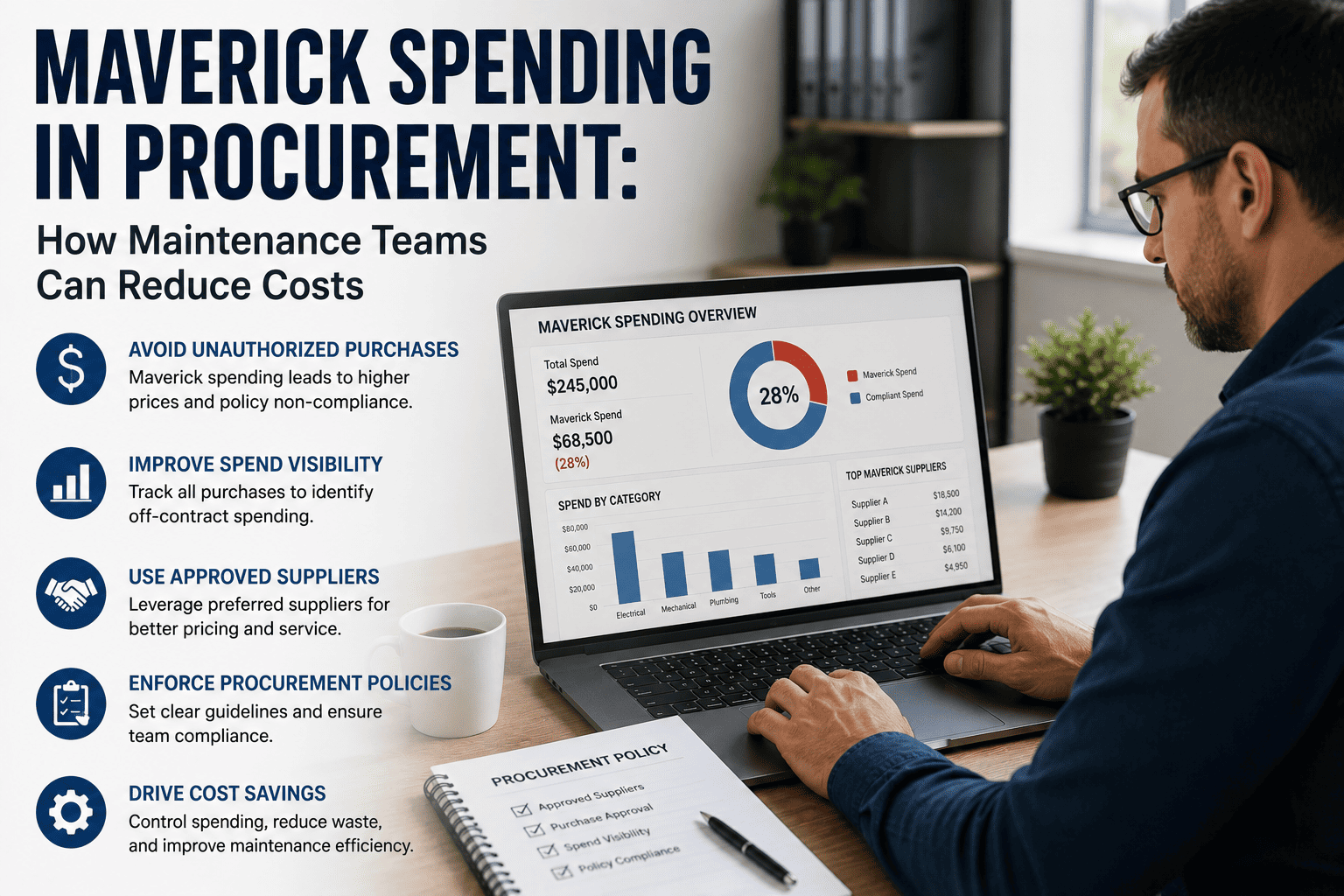
Every maintenance team buys outside the approved supplier list at some point. A technician grabs parts from a local vendor to avoid downtime. A manager calls a contractor who is not on the approved list because it is faster. A rush order goes out without a purchase order because the system is too slow. Each of these decisions feels justified in the moment — and each one quietly erodes the savings, contracts, and budget visibility your organization worked to build. This is maverick spending, and in maintenance-heavy operations it is one of the most common and least visible sources of budget overrun. Sign up free on OxMaint to connect work orders to purchasing, or book a demo to see how procurement control works in practice.
See Every Purchase Your Maintenance Team Makes — Before It Bypasses the Contract
OxMaint connects work orders to purchase requests, preferred suppliers, and spend approvals — so maintenance buying happens inside the system, not around it. Full spend visibility, no spreadsheets required.
What Maverick Spending Actually Is
Maverick spending — also called rogue spending or off-contract spend — is any purchase made outside your organization's approved procurement process and contracted supplier relationships. It is not always intentional. Most of it is not. It happens when compliant buying is slower or harder than buying directly, when technicians cannot find approved parts quickly, or when emergency repairs force a call to whoever answers the phone.
What it looks like in maintenance
Technician buys parts from a hardware store to finish a repair same-day
Contractor called directly by a site manager — no PO, no approval
Recurring consumables ordered from a non-contract supplier because it is faster
Emergency HVAC part purchased at list price when a contract rate exists
Duplicate parts ordered because inventory records are not visible or trusted
40%
of indirect spend in low-visibility organizations is unmanaged purchasing — Hackett Group
20%
of potential annual savings lost due to maverick spending — Zoho Procurement Research
16%
loss in negotiated contract savings directly attributable to off-contract purchases
15%
average total expenditure savings when professional procurement management is applied — CIPS
Why Maintenance Teams Are a High-Risk Zone for Maverick Spend
Facilities management and maintenance represent up to 20–30% of total organizational spend for many operations. Yet it is also one of the least governed procurement categories. The reason is structural — procurement defines contracts, but maintenance drives the actual buying through day-to-day work orders, emergency calls, and field decisions. When those two functions do not share data, the gap between approved spend and actual spend widens automatically. Sign up on OxMaint to close that gap from the work order level.
01
Reactive maintenance pressure
Unplanned breakdowns create urgency that overrides process. When a pump fails and production stops, nobody waits three days for a PO approval — they buy from whoever has the part.
02
Poor parts visibility
When technicians cannot find approved parts quickly in a catalog, they default to known local suppliers. Duplicate records, outdated inventory, and search friction are leading causes of off-contract MRO buying.
03
Slow approval workflows
Complex approval chains do not prevent maverick spend — they cause it. When the compliant path takes longer than the work demands, technicians take the workaround. Friction in the system creates rogue buying.
04
Split ownership between teams
Procurement owns supplier contracts. Maintenance owns day-to-day usage and demand. When these teams operate on separate systems with no shared data, off-contract purchases accumulate in the gap between them.
05
No spend visibility at work order level
When purchasing is tracked in finance but not linked to individual work orders or assets, there is no way to know whether a spend event was on-contract or off-contract until the invoice arrives — often weeks later.
06
Decentralized site operations
Multi-site organizations face this at scale. Each site has its own supplier relationships, and without centralized purchasing data each site independently develops its own spend patterns — multiplying the off-contract exposure.
The Real Cost: What Maverick Spend Does to Your Maintenance Budget
The direct cost — paying list price instead of contract price — is only one part of the problem. Every off-contract purchase carries a cluster of downstream costs that are harder to see but just as real. Book a demo to see how OxMaint surfaces spend leakage at the work order and asset level.
Paying list price or spot price instead of negotiated contract rates. For MRO parts, the price difference between spot and contract purchasing can be 15–40% on identical items. Across a large parts spend, this compounds quickly.
When spend fragments across multiple suppliers instead of consolidating with preferred vendors, you lose the volume threshold that unlocks discounts. Maverick purchases quietly erode the spend base that justifies better contract terms at renewal.
Every maverick purchase generates manual work: invoice reconciliation, supplier onboarding, exception approvals, and dispute handling. Processing each off-contract transaction costs significantly more than a compliant PO purchase through an established supplier channel.
Purchasing outside the approved system means purchases do not update inventory records. Technicians buy parts that are already in stock — because the system does not show what is available. Duplicate inventory ties up working capital and creates disposal costs.
Unapproved suppliers have not been vetted for quality standards, insurance coverage, ESG compliance, or contractual liability. When something goes wrong — a failed part, a workplace incident, a quality failure — the absence of a vetted contract creates significant organizational exposure.
Where Maverick Spend Hides in Maintenance Operations
Spend analysis is the starting point for any reduction effort. You cannot address what you cannot see. The categories below consistently appear as high-maverick-spend zones in maintenance and facilities operations.
Emergency MRO parts
Unplanned equipment failure requiring same-day parts
Invoices without PO numbers from unknown vendors
High
Maintenance contractors
Site manager calls preferred technician directly
Labour invoices without job references or WO links
High
Consumables and PPE
Local convenience purchasing by individual technicians
Multiple small invoices from retail or local suppliers
Medium
Specialist tools and equipment
One-off project need bypasses standard catalog
Capital or tool spend from non-approved suppliers
Medium
Facility services (cleaning, waste)
Locally arranged services not routed through procurement
Recurring service invoices from unnamed vendors
Lower
5 Controls That Actually Reduce Maverick Spend in Maintenance
Enforcement alone does not work — sustainable control comes from making the compliant path easier than the workaround. The five controls below address both the process and the data gaps that produce off-contract spending in maintenance teams. Sign up free on OxMaint to implement purchasing controls directly from your maintenance workflows.
01
Connect work orders to purchase requests
The single most effective control in maintenance operations. When a technician raises a part request from within a work order, the system can enforce supplier selection, spending thresholds, and approval routing before the purchase happens — not after the invoice arrives.
Result: Off-contract parts buying drops because compliant purchasing is built into the repair workflow, not a separate process.
02
Build and maintain a trusted parts catalog
Technicians buy off-contract when they cannot find what they need in the approved catalog quickly. Standardizing material master data — removing duplicate part numbers, aligning nomenclature, and linking parts to preferred suppliers — makes the compliant option findable in seconds.
Result: One organization reduced off-contract purchases by 25% within 90 days of implementing a consolidated, standardized MRO catalog.
03
Set tiered approval thresholds, not blanket controls
Complex approval workflows cause maverick spend. Set auto-approval for low-value purchases from approved suppliers, simplified approval for mid-range spend, and full procurement review for high-value or non-catalog purchases. Match the control level to the actual risk of the transaction.
Result: Technicians follow the process because it takes less time than workarounds, not more. Compliance becomes the path of least resistance.
04
Track spend at asset and work order level
When purchasing data is only visible in finance, it arrives weeks after the decision. Linking procurement spend to individual assets and work orders gives maintenance managers real-time visibility into which jobs are generating off-contract costs — before they compound into a budget variance.
Result: Maintenance managers can see, in real time, which assets are generating the highest off-contract spend and intervene at the asset level, not just at budget review.
05
Reduce emergency purchases through preventive maintenance
Emergency purchases are the hardest category to control because urgency overrides process by design. The only structural solution is reducing the frequency of unplanned breakdowns. Every reactive job is a potential maverick purchase. Every preventive task completed on schedule is a purchase made at contract price, on plan, with visibility.
Result: Organizations that shift from reactive to preventive maintenance see measurable reductions in both emergency parts spend and off-contract supplier usage.
How to Measure Your Maverick Spend Rate
Before you can reduce off-contract spend, you need to know how much you have. The calculation is straightforward — the challenge is having the data to run it accurately. Book a demo to see how OxMaint surfaces this data from your existing maintenance records.
30%+
High exposure
Common in maintenance operations with no CMMS-to-procurement link and reactive-dominant work mix
15 – 30%
Moderate — improving
Partial controls in place; compliance tracking exists but enforcement is inconsistent
5 – 15%
Managed
Approved supplier catalogs, spend visibility tools, and PO enforcement in place
Under 5%
World-class
Work orders linked to purchasing; compliant buying is the default path for all maintenance spend categories
How OxMaint Reduces Maverick Spend in Maintenance Operations
Maverick spend in maintenance happens when buying decisions are made outside the system that manages the work. OxMaint brings both together — so purchasing controls are active at the point where the buying decision is made, not after it. Sign up free — no hardware required to get started.
WO
Purchase Requests Linked to Work Orders
Every part or service request is raised from within a work order. Supplier selection, budget category, and approval routing are enforced at the point of request — before any off-contract purchase can happen.
SV
Spend Visibility Per Asset and Site
All maintenance purchasing spend is tracked against the asset and work order that generated it. Managers see real-time spend by supplier, category, and site — not just a monthly finance report.
SP
Preferred Supplier Catalog
Approved suppliers, contracted parts, and pre-negotiated rates are accessible directly from the work order interface. Technicians find compliant options faster than workarounds — making the approved path the default, not the exception.
PM
Preventive Maintenance Scheduling
Planned PM work generates planned purchase requests — at contract prices, with visibility, and without urgency pressure. Every reactive job replaced by a planned job is an emergency purchase avoided.
Bring Maintenance Buying Inside the System — Not Around It
OxMaint links work orders to purchase requests, preferred suppliers, and approval workflows — giving your team the fastest compliant path and giving your finance team the spend visibility they need. Start free and see what your current off-contract spend actually looks like.
Frequently Asked Questions
What is maverick spending in procurement?
Maverick spending — also called rogue spend or off-contract spend — is any purchase made outside an organization's approved procurement process or contracted supplier relationships. In maintenance operations, it most commonly appears as emergency parts purchases from non-approved suppliers, contractor engagements without a purchase order, and recurring consumable orders from local or convenience vendors that bypass negotiated contracts. It is often unintentional, driven by urgency, slow approval processes, or poor parts visibility rather than deliberate policy violation. Sign up on OxMaint to surface off-contract spend patterns in your maintenance operation.
How much does maverick spending cost maintenance organizations?
The direct cost is the price premium — paying spot or list price instead of contracted rates, which can be 15–40% higher for MRO parts. Organizations lose up to 20% of potential annual savings due to maverick spending, and up to 16% of negotiated contract savings are eroded by off-contract purchases. Beyond the direct price difference, maverick spend creates administrative overhead in invoice reconciliation, duplicate inventory from unrecorded purchases, lost volume leverage at contract renewal, and supplier risk exposure from unvetted vendors. Facilities management and maintenance represent up to 20–30% of total spend in many organizations — making it one of the highest-impact categories to control.
How do you reduce maverick spending in a maintenance team?
The most effective approach is making compliant buying faster than the workaround, not just enforcing compliance after the fact. Five practical controls work in maintenance contexts: connecting purchase requests to work orders so supplier enforcement happens at the point of need; building a trusted, searchable parts catalog that removes friction from approved purchasing; setting tiered approval thresholds rather than complex blanket approval chains; tracking spend at the asset and work order level for real-time visibility; and reducing emergency purchases through preventive maintenance, which is the only structural solution to urgency-driven off-contract buying. Book a demo to see how OxMaint implements these controls within maintenance workflows.
What is a good maverick spend rate for a maintenance operation?
World-class procurement operations maintain maverick spend rates below 5–10% of addressable spend. Maintenance operations with no CMMS-to-procurement integration and a reactive-dominant work mix commonly see rates of 30% or higher. A rate of 15–30% indicates partial controls are in place but enforcement is inconsistent. Reaching below 10% requires linking the maintenance system to purchasing so approved supplier selection is enforced at the work order level — not managed separately as a procurement policy that maintenance teams work around when under pressure.