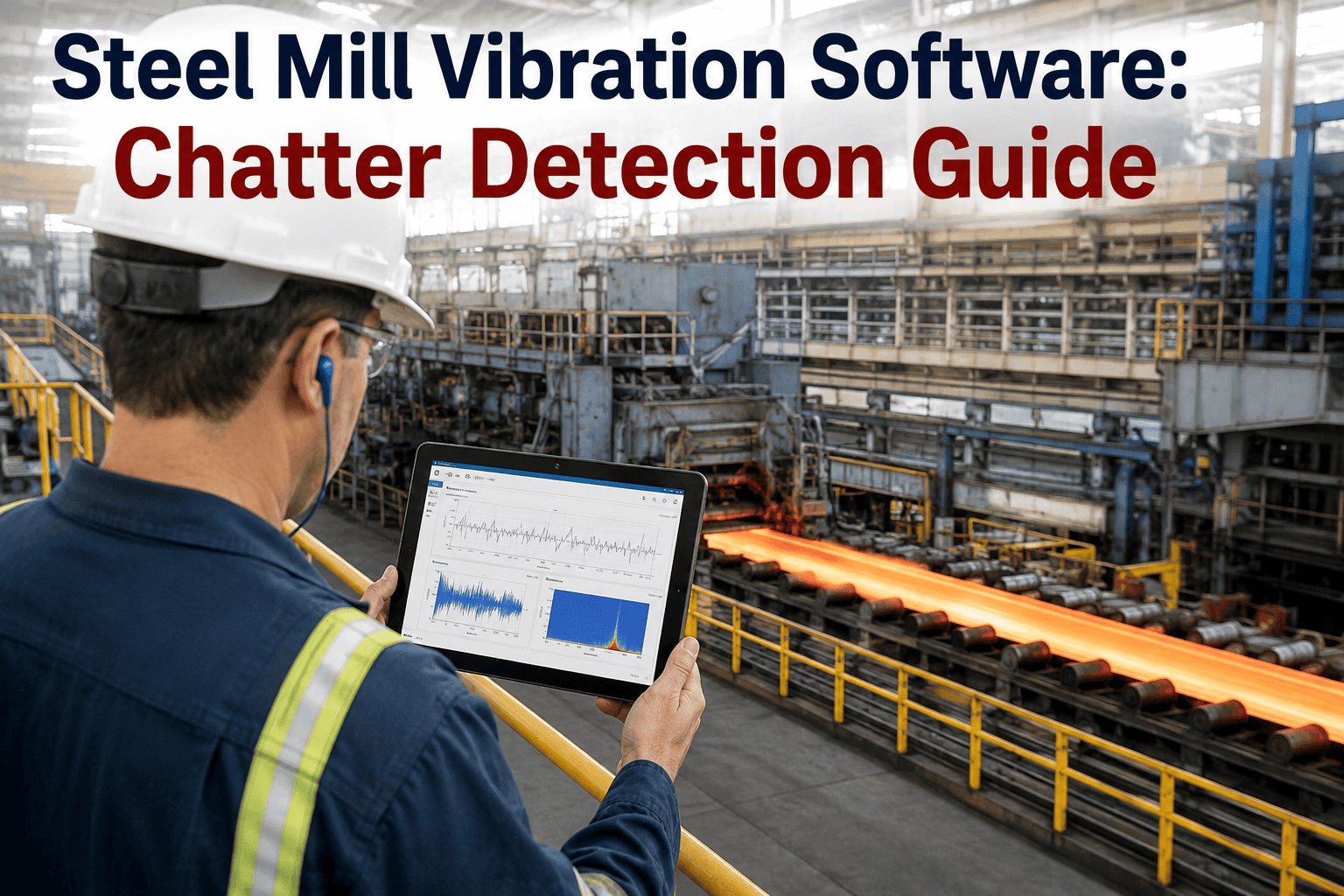
A rolling mill main drive motor that crosses from Zone B into Zone C on the ISO 10816 vibration scale is not yet broken — it is telling you, in a language auditors, insurers, and OEMs all recognize, that a bearing or coupling fault is developing weeks before it becomes a bearing seizure and a mill stand stoppage. Steel plants run thousands of rotating assets — mill drive motors, ID/FD fans, gearboxes, coolant pumps, continuous casting drives — and every one of them has a documented, internationally agreed vibration limit under ISO 10816 and its successor ISO 20816. The standard itself is not new. What most plants lack is the system that measures every asset against the correct zone, on the correct schedule, and turns a Zone C reading into a scheduled repair before it becomes a Zone D failure. Book a demo to see how OxMaint classifies every rotating asset against ISO 10816 zones automatically.
Steel Vibration ISO 10816 Software: The Compliance PdM Guide
Classify vibration severity zones A through D across every rolling mill motor, fan, pump, and gearbox in your plant — the standard OEMs, insurers, and reliability audits already expect you to be running.
Why ISO 10816 Compliance Is a Production Problem, Not a Paperwork Exercise
Steel plant reliability engineers already know the zone boundaries. The gap is rarely knowledge — it is coverage. A plant with 400 monitored motors, fans, and pumps generates thousands of readings a month, and a spreadsheet-based programme quietly drops the assets that do not have an obvious champion. Every dropped asset is a Zone C reading nobody saw until it became a Zone D failure on the mill floor.
Where ISO 10816 Applies Across a Steel Plant Asset Register
Every rotating asset in a steel plant — from a small auxiliary pump motor to a 15 MW rolling mill main drive — falls into one of four ISO 10816-3 machine groups. The group depends on power rating and foundation stiffness, and the group determines which zone boundaries apply. Applying one universal limit across the whole plant, instead of the correct group per asset, is the single most common reason a compliance programme fails an audit.
The A/B/C/D Zone System, Applied to Steel Plant Rotating Equipment
ISO 10816 evaluates broadband RMS vibration velocity, in millimetres per second, measured on bearing housings in the horizontal, vertical, and axial directions. The result is sorted into one of four zones, and the zone — not the raw number alone — is what drives the maintenance decision. A reading of 3.0 mm/s is a non-event on a large flexibly mounted fan and a shutdown trigger on a small rigidly mounted pump motor.
| Machine Group | Typical Steel Plant Assets | Zone A/B Boundary | Zone B/C Boundary | Zone C/D Boundary |
|---|---|---|---|---|
| Group I — Small, up to 15 kW | Instrumentation drives, small auxiliary pumps | 0.71 mm/s | 1.80 mm/s | 4.50 mm/s |
| Group II — Medium, 15–300 kW | Coolant pumps, conveyor drives, mid-size fans | 1.12 mm/s | 2.80 mm/s | 7.10 mm/s |
| Group III — Large, rigid foundation | Mill main drive motors, large ID/FD fans | 1.80 mm/s | 4.50 mm/s | 11.20 mm/s |
| Group IV — Large, flexible foundation | Skid-mounted blowers, spring-isolated fans | 2.80 mm/s | 7.10 mm/s | 18.00 mm/s |
OxMaint stores the correct ISO 10816 group and zone boundaries against every rotating asset in your register, so a reading is classified automatically the moment it is logged — no manual chart lookup, no misclassified foundation type.
What a Rising Vibration Trend Is Usually Telling You
A severity zone tells a maintenance engineer that a machine is in trouble — not why. The standard is a broadband screening tool; the frequency at which the vibration peaks points toward the root cause, and that is where the maintenance action actually gets defined.
Unbalance in a rolling mill fan impeller or coupling shows up at running speed (1x RPM) and is the most frequent cause of a slow, steady climb through Zone B into Zone C. Misalignment between a motor and gearbox typically appears at twice running speed (2x RPM) and often follows a recent coupling or bearing replacement where alignment was not re-verified. Bearing defects generate their own characteristic defect frequencies well above running speed, and are frequently the fastest-moving fault — a bearing can cross from Zone B to Zone D within days once spalling begins. Gear mesh wear in mill drive gearboxes produces sidebands around the gear mesh frequency and is a leading cause of unplanned gearbox rebuilds when left undiagnosed.
Turning Zone Boundaries Into a Working Compliance Programme
The difference between a plant that passes its next reliability audit without a scramble and one that discovers gaps mid-audit is whether the zone classification, the reading schedule, and the resulting work order all live in one connected system.
ISO 10816 is not a difficult standard to understand — the zone boundaries have been published for decades and most reliability engineers can recite them from memory. What breaks down in practice is coverage: a plant with hundreds of motors, fans, and gearboxes needs every single one classified against the correct group, read on the correct schedule, and escalated the moment it crosses into Zone C. That is a data problem, not a knowledge problem, and it is exactly the kind of problem a connected CMMS is built to solve.
Frequently Asked Questions
What is the difference between ISO 10816 and ISO 20816?
ISO 20816 is the current, consolidated series that merges ISO 10816 with the shaft-vibration standard ISO 7919. The zone concept and velocity limits carry over unchanged, so a reading judged against ISO 10816-3 gives the same verdict under ISO 20816-3. See how OxMaint tracks both standards per asset.
How often should a Zone C machine be re-checked?
A weekly reading cadence is standard practice once an asset crosses into Zone C, replacing the routine monthly schedule used for Zone A/B machines. The goal is to trend the fault closely while the repair is planned and scoped for the next available window.
Why does the same vibration reading mean different things on different machines?
ISO 10816-3 classifies machines into four groups by power rating and foundation stiffness, and each group has its own zone boundaries. A rigid foundation transmits vibration directly and requires tighter limits; a flexible foundation isolates it and permits higher readings for the same severity.
Does a severity zone tell you what caused the fault?
No — ISO 10816 is a broadband screening tool that flags that a problem exists. Identifying whether it is unbalance, misalignment, or a bearing defect requires spectral analysis at the frequencies associated with each fault type. Book a demo to see the full diagnostic workflow.
What is the most common mistake plants make applying ISO 10816?
Misclassifying the foundation type as rigid when it is actually flexible, or vice versa. This single error can shift a machine's vibration reading by a full severity zone and lead directly to an incorrect maintenance decision.
Every Motor, Fan, Pump, and Gearbox — Classified, Trended, and Audit-Ready.
OxMaint registers every rotating asset with its correct ISO 10816 machine group, classifies each reading into a zone automatically, and routes Zone C and Zone D escalations to the right team before a developing fault becomes an unplanned mill stoppage.