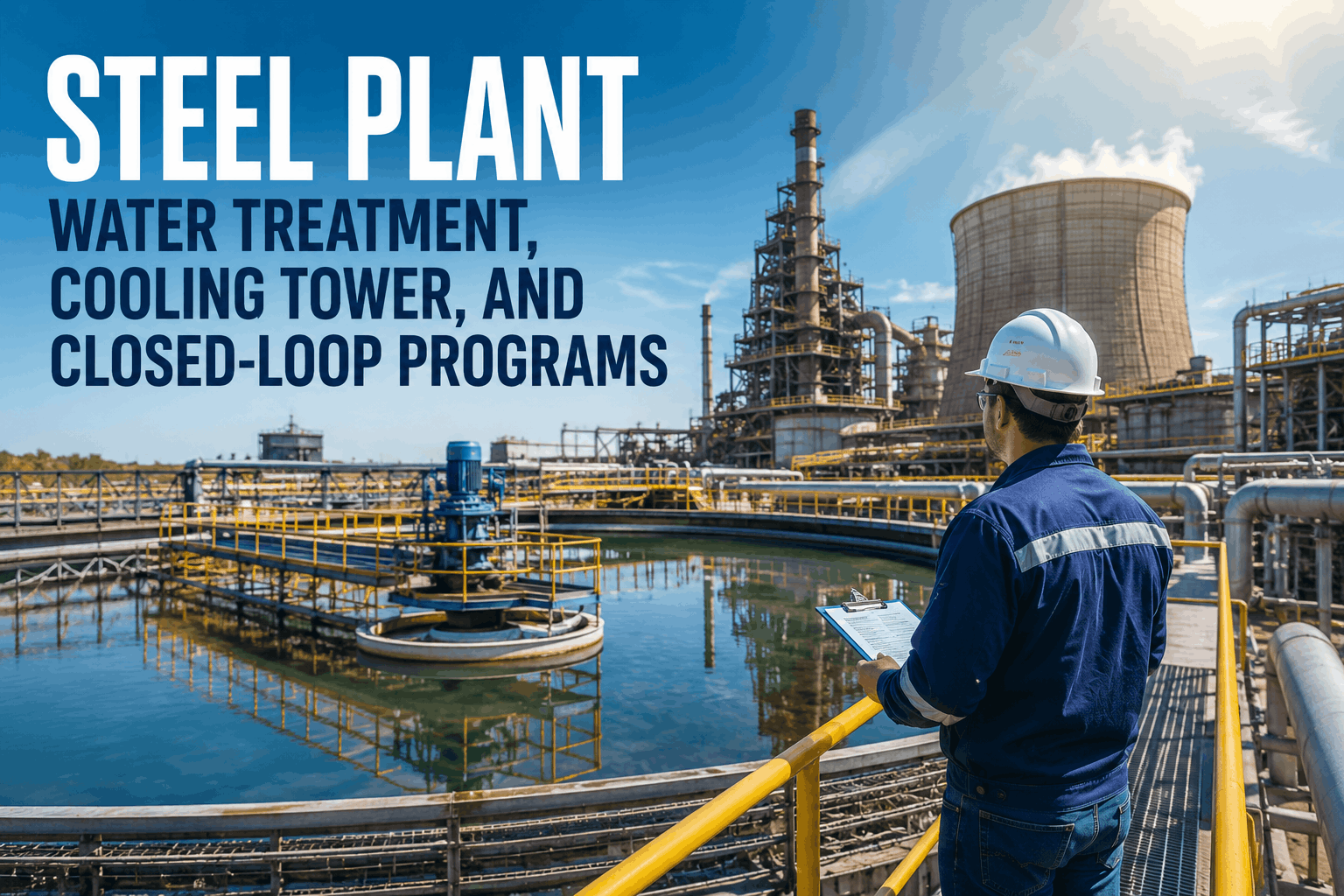
Steel plant water treatment and cooling system health directly determine refractory life, energy performance, and continuous-caster availability — yet most facilities still manage chemistry logs and cooling tower PM on spreadsheets, risking unscheduled downtime that can exceed $50,000 per hour. A purpose-built CMMS for water treatment maintenance in steel plants replaces paper logs and reactive repairs with automated chemistry monitoring, mold cooling water quality tracking, and cooling circuit preventive maintenance schedules that protect blast furnaces, EAFs, and rolling mills. OxMaint brings work orders, predictive analytics, and asset tracking into one AI-powered platform so reliability teams can stop failures before they happen. Start Free Trial to see how automated water treatment PM transforms your cooling system reliability.
Is a single cooling water failure costing your plant $50K per hour in lost production?
Steel plant water treatment and cooling system health is the invisible backbone of ironmaking, steelmaking, and rolling — yet chemistry drift, biocide gaps, and missed cooling tower PM silently shorten refractory life and trigger unplanned outages. OxMaint's AI-powered CMMS automates water quality monitoring, cooling circuit maintenance, and mold cooling system health so your team prevents failures instead of reacting to them.
Why steel plant cooling health drives refractory life and energy performance
In integrated steel plants, water-cooled systems govern everything from blast furnace stave coolers and BOF lance tips to continuous-caster molds and rolling mill stand bearings. A 2°C rise in mold cooling water temperature from scale buildup or flow restriction can cut refractory campaign life by 15–20% and spike energy draw across pumps and chillers.
Consider a mid-size integrated plant running two blast furnaces, a BOF shop, and a three-strand slab caster. If mold cooling water conductivity drifts 200 µS/cm above target because biocide dosing was missed for three consecutive shifts, calcium carbonate scale forms on mold copper plates within days. The result: uneven heat transfer, surface defects on cast slabs, and a premature mold tube change that costs $18,000–$35,000 per strand plus 4–6 hours of lost casting time. A CMMS-driven water treatment maintenance program catches the drift at the first measurement, triggers a corrective work order, and logs the root cause — turning a six-hour outage into a 20-minute dosing adjustment.
CMMS-driven water treatment maintenance checklist for steel cooling systems
A defensible steel plant water treatment program spans cooling circuit chemistry, mold cooling water quality, cooling tower health, side-stream filtration, and biocide program tracking. Here is the tiered PM checklist that OxMaint automates, schedules, and audits for maintenance and reliability teams.
Cooling Circuit Chemistry Monitoring
- pH logging at every cooling water sample point — target 8.2–9.2 for open recirculating circuits
- Conductivity trending with auto-alerts at 1,500–2,500 µS/cm depending on inhibitor program
- Free chlorine residual checks — 0.2–0.5 ppm for oxidizing biocide programs
- Inhibitor residual testing — phosphonate, azole, and zinc levels per chemistry provider spec
Mold Cooling Water Quality
- Daily suspended solids check — target below 10 NTU on mold cooling circuits
- Flow verification per mold strand — alarm if delta from baseline exceeds 5%
- Inlet/outlet temperature differential logging to detect scale buildup on copper plates
- Glycol or alternative antifreeze concentration verification for closed mold loops
Cooling Tower Health & Filtration
- Quarterly fill cleaning and drift eliminator inspection per CTI guidelines
- Side-stream filter backwash cycle verification — daily auto, weekly manual confirm
- Legionella risk assessment and bulk water sampling — quarterly minimum
- Biocide program tracking — oxidizing and non-oxidizing dose logs with timestamp verification
Steel plant cooling system PM schedule and downtime cost comparison
The table below maps the standard PM cadence for water-cooled equipment in steel plants against the failure cost when those tasks slip through the cracks. A CMMS like OxMaint enforces every cadence with automated work orders and escalations.
| Cooling System Asset | PM Task | Cadence | Failure Cost Without CMMS |
|---|---|---|---|
| Blast furnace stave coolers | Flow & temp log, visual leak check | Daily | $120K–$400K per stave failure event |
| Continuous-caster mold | Conductivity, pH, flow, ΔT monitoring | Per shift | $18K–$35K per premature mold change |
| EAF shell & roof spray coolers | Inhibitor residual, suspended solids | Weekly | $25K–$60K per shell panel replacement |
| Cooling tower (induced draft) | Fill cleaning, drift eliminator check | Quarterly | $8K–$15K lost efficiency + Legionella risk |
| Side-stream filtration skid | Backwash cycle, media inspection | Daily auto / weekly manual | $5K–$12K fouling damage per event |
| Rolling mill cooling spray headers | Nozzle inspection, flow balance | Monthly | $3K–$9K per clogged-header roll defect |
How much does a water treatment CMMS save a steel plant?
A CMMS for water treatment maintenance in steel plants pays for itself by preventing a single major cooling system failure per year. The formula below estimates annual savings for a plant with 40–60 cooling-critical assets.
For a 180-asset steel plant spending $42,000 per year on water treatment chemicals and contract labor, an OxMaint CMMS subscription typically returns 4–7× its cost in the first 12 months. The platform eliminates paper work orders, ensures biocide and inhibitor doses happen on schedule, and provides audit-ready records for environmental compliance — turning a cost center into a measurable reliability advantage.
How OxMaint protects steel plant cooling system health
OxMaint maps four concrete capabilities to the exact failure modes that plague steel plant water treatment and cooling system programs. Each one replaces a manual gap with an automated, auditable workflow.
Automated chemistry & biocide PM triggers
OxMaint generates work orders automatically when pH, conductivity, or chlorine readings fall outside tolerance — assigned to the right technician with dosing instructions and root-cause fields. Outcome: eliminate 95% of missed biocide doses and chemistry drift events before they scale.
Predictive analytics on cooling water trends
AI models analyze temperature, flow, and chemistry trends across mold cooling circuits and furnace stave coolers to predict scale formation, fouling, and flow restriction weeks before failure. Outcome: cut unplanned cooling-related downtime 30–50% and extend refractory campaign life.
Audit-ready compliance records
Every biocide dose, Legionella sample, inhibitor test, and cooling tower inspection is timestamped, geo-tagged, and stored in a searchable audit trail aligned with CTI and ISO 55000 expectations. Outcome: pass environmental and safety audits in hours, not weeks, with zero spreadsheet gaps.
Mobile work orders for water treatment techs
Technicians receive mobile work orders with chemistry targets, dosing instructions, and safety procedures at every sample point — completed offline in the field, synced automatically. Outcome: eliminate paper logs and reduce average PM completion time by 40% across cooling system assets.
See OxMaint protect your cooling systems — book a 30-minute demo
Walk through a live water treatment PM workflow on a steel plant asset hierarchy. See how automated chemistry alerts, mobile work orders, and predictive cooling water analytics prevent the failures costing your plant $50K per hour.
Steel plant water treatment CMMS — your questions answered
What does a CMMS do for water treatment in a steel plant?
A CMMS automates the scheduling, execution, and documentation of every water treatment PM task — from daily pH and conductivity logging to quarterly cooling tower cleanings and biocide dose tracking. OxMaint triggers corrective work orders automatically when chemistry readings drift outside tolerance, assigns them to the right technician with instructions, and stores every result in an audit-ready trail so no dose, test, or inspection slips through the cracks.
How does mold cooling water quality affect caster performance?
Mold cooling water quality directly governs heat extraction from molten steel, which controls solidification uniformity, slab surface quality, and copper plate life. Even a 2°C rise in mold water temperature from scale or suspended solids can cut refractory and mold tube life by 15–20% and produce surface defects that require slab scarfing. Continuous monitoring of pH, conductivity, flow, and temperature differential — automated in a CMMS — catches drift before it affects the cast.
How often should cooling tower PM be performed in a steel plant?
Steel plant cooling towers require daily water chemistry checks, weekly biocide dose verification, monthly drift eliminator and fill visual inspections, and quarterly full cleanings per CTI guidelines. Side-stream filter backwash should run automatically daily with weekly manual confirmation. OxMaint enforces this cadence with auto-generated work orders and escalations if a task is missed — Start Free Trial to automate your tower PM schedule today.
Can OxMaint track biocide and inhibitor dosing programs?
Yes. OxMaint logs every biocide and inhibitor dose with timestamp, technician, volume, and target asset. The platform schedules oxidizing and non-oxidizing biocide cycles, alerts when a dose window is missed, and trends residual levels over time so you can prove compliance during environmental audits and optimize chemical spend across all cooling circuits.
How long does it take to implement a water treatment CMMS in a steel plant?
Most steel plants are live on OxMaint in 2–4 weeks. The platform imports your existing asset hierarchy, PM schedules, and chemistry targets, then automates work order generation from day one. Mobile adoption for field technicians typically reaches 90%+ within the first month. Book a Demo to see a tailored implementation plan for your cooling system assets.
Stop reacting to cooling water failures. Start preventing them.
Join the steel plants using OxMaint to automate water treatment PM, predict cooling system failures before they happen, and protect the water-cooled equipment that keeps furnaces, casters, and rolling mills running.
Free 14-day trial · No credit card