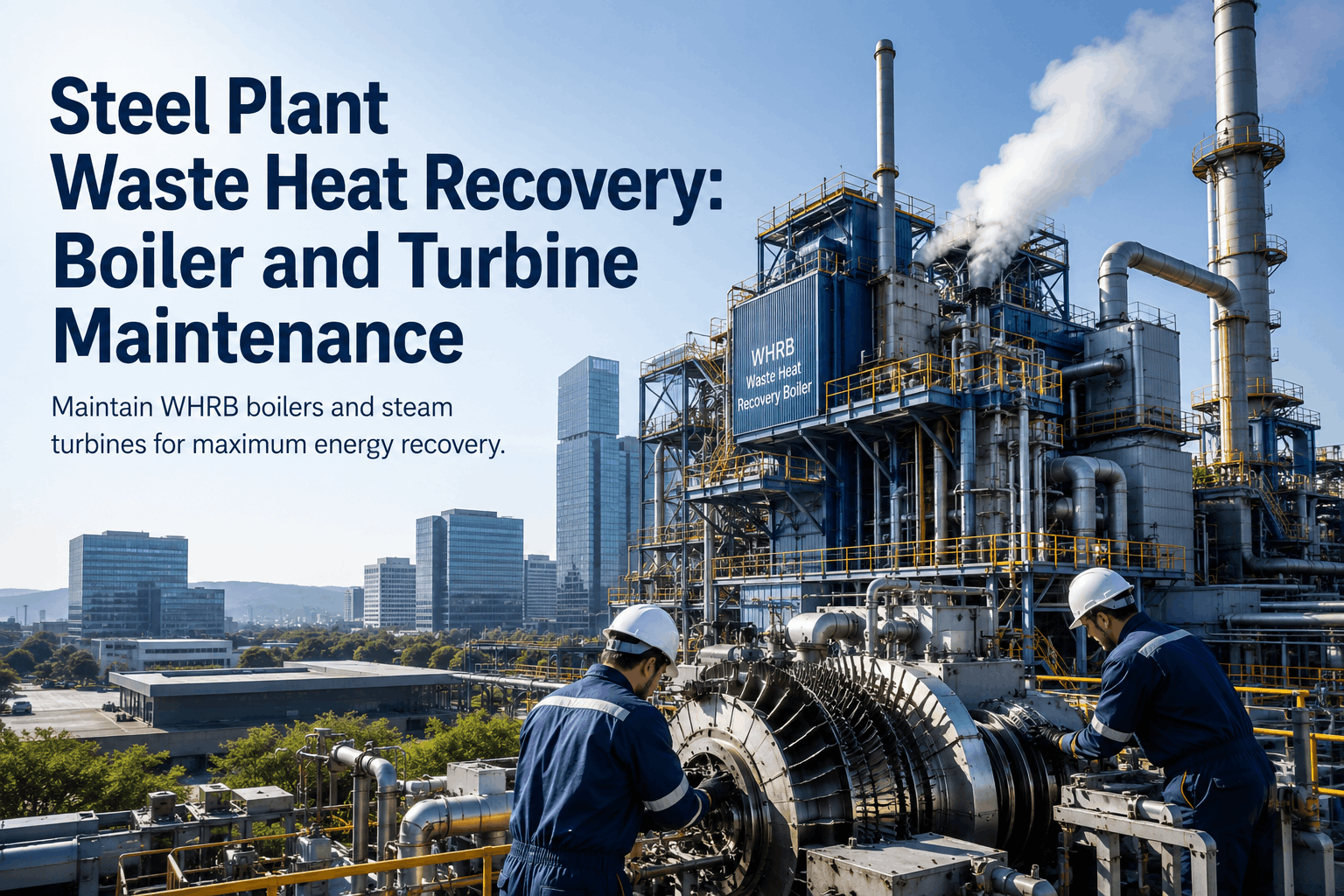
Steel Plant Waste Heat Recovery: Boiler and Turbine Maintenance
By Alex Jordan on June 19, 2026
A waste heat recovery boiler (WHRB) begins an operating campaign generating 18 tons/hour of steam from blast furnace exhaust gases. The boiler performs flawlessly — no alarms, no visible problems, no work orders raised. But after 18 months of continuous operation, the same boiler generates only 14.2 tons/hour of steam. No failure event triggered this degradation. No alert system caught the slow performance decline. The energy manager notices it only during routine calculation of power plant efficiency — by which time the mill has silently lost 4 tons/hour of recoverable steam capacity for an entire year. The degraded WHRB represents $3–8 crore in unrecovered energy value that evaporated without trace, documentation, or awareness. Steel plants operate massive waste heat recovery systems — blast furnace gas boilers, coke oven gas boilers, continuous casting cooler recovery systems, EAF off-gas capture — that represent 15–25% of total plant energy recovery potential. Yet these systems often operate under-maintained because they don't trip traditional failure alarms and performance degradation happens slowly. OxMaint applies energy equipment PM discipline to WHRB maintenance: boiler efficiency trending, steam quality monitoring, tube fouling detection, turbine seal inspection, and heat exchanger approach temperature tracking. Every efficiency loss is visible in real time. Start tracking your WHR equipment performance or schedule a waste heat recovery efficiency demo.
Energy Recovery · WHRB Maintenance · Boiler and Turbine Reliability
Maintain Waste Heat Recovery Systems for Maximum Energy Capture
Steel plants lose 15–25% of recoverable energy to under-maintained waste heat boilers, degraded turbine seals, and fouled heat exchangers. OxMaint tracks WHRB efficiency, steam quality, and turbine performance — surfacing slow performance degradation before it silently costs you millions annually.
of total recoverable energy lost at integrated steel mills due to under-maintained waste heat recovery systems and fouled boiler tubes
$3–8Cr
annual unrecovered energy value at a 2M-ton mill from WHRB degradation and missed efficiency optimization opportunities
18 Mo
typical timeline for WHRB boiler to degrade from 18 t/hr steam generation to 14.2 t/hr without triggering alarms or visible failures
2–4%
annual efficiency improvement potential through condition-based maintenance of WHRB tubes, heat exchangers, and turbine seals
Silent Loss
WHRB systems degrade without failure events — you only discover losses through performance analysis. A fouled boiler tube doesn't announce itself with an alarm; it gradually reduces heat transfer efficiency. A degraded turbine seal doesn't catastrophically fail; it slowly increases steam loss. A scaled heat exchanger doesn't shut down; it quietly reduces approach temperature. OxMaint continuously tracks efficiency metrics, flags degradation trends, and triggers maintenance work orders before silent performance loss becomes measurable loss of recoverable energy.
Waste Heat Recovery Systems in Steel Plants: Four Critical Equipment Categories
Blast Furnace Gas (BFG) Boilers: Particulate-Laden Exhaust Energy Recovery
Blast furnace exhaust gases at 200–250°C contain abrasive dust and corrosive compounds. BFG boilers capture heat using tube banks exposed to harsh flue gas conditions. Tube fouling (dust/scale accumulation) reduces heat transfer 2–4% annually. Soot blowing systems must operate reliably to clear accumulated deposits. OxMaint tracks soot blower operation frequency, boiler temperature differential (fouling indicator), and scheduled tube cleaning intervals to maintain BFG boiler efficiency above 85%.
Coke Oven Gas (COG) Boilers: High-Temperature Recovery from Coke Operations
Coke oven exhaust at 400–500°C drives high steam pressure recovery (up to 90 bar). COG boilers operate at extreme temperature gradients that stress tube metallurgy and internal corrosion protection. Failed refractory, tube wall thinning, and scale formation accelerate at high temperature. OxMaint monitors COG boiler water chemistry (oxygen scavenging, alkalinity control), tube wall inspection scheduling, and refractory condition to prevent catastrophic tube failure and maintain steam quality.
Steam Turbines: Converting Recovered Steam to Power and Electricity
WHR turbines operate across wide steam quality ranges and pressure drops. Seal degradation, blade erosion, and bearing wear reduce power output without obvious failure modes. A 5% degradation in turbine efficiency represents $400K–$800K annual power loss at a typical mill. OxMaint tracks turbine inlet/outlet pressure differential (efficiency indicator), seal leakage rates, bearing oil analysis results, and vibration trends to flag degradation before efficiency losses accumulate into measurable lost production.
Heat Exchangers and Economizers: Maximizing Heat Transfer from Cascade Cooling
Continuous casting coolers, rolling mill scales, and EAF off-gas cooling systems generate hot water/process fluids. Heat exchangers recover this energy to preheat boiler feedwater or drive process heating. Scale formation, biological growth in cooling water circuits, and fouling deposits reduce heat transfer coefficient. Approach temperature (difference between hot side outlet and cold side inlet) increases when fouling occurs. OxMaint monitors approach temperatures, triggers cleaning schedules, and tracks water chemistry to maintain economizer efficiency.
Steam Condensers: Efficient Return of Condensate to Boiler Feed
Condensers operate under vacuum to maximize steam expansion in turbines. Scale or biological fouling of condenser tubes reduces vacuum (back-pressure increases, turbine efficiency drops). Failed air evacuation systems allow non-condensable gases to degrade vacuum further. OxMaint tracks vacuum level (condenser fouling indicator), cooling water temperature differential, and air removal system operation to maintain consistent turbine back-pressure and power output.
Support Equipment: Pump Reliability, Flow Control, and Condensate Return Systems
Boiler feedwater pumps, condensate return pumps, cooling water circulation pumps, and control valve integrity support the entire WHR system. Pump cavitation, seal leakage, or bearing degradation degrades system flow and heat recovery. OxMaint tracks pump discharge pressure, flow rates, bearing vibration, and seal leakage to predict pump failures before flow degradation impacts boiler operation or heat exchanger performance.
WHRB Maintenance Workflow: From Efficiency Monitoring to Corrective Action
Energy Equipment Monitoring · Degradation Detection · Maintenance Response
Step 1 · Monitor
Efficiency Tracking
Continuously measure steam generation (t/hr), boiler outlet temperature, feedwater temperature, and fuel input to calculate boiler efficiency. Track turbine efficiency via pressure differential and power output. Trending reveals slow degradation before performance loss becomes material.
→
Step 2 · Detect
Anomaly Analysis
When boiler efficiency drops >2%, or turbine pressure differential increases >5%, trigger investigation. Efficiency degradation indicates specific failure mode: fouled tubes, failed soot blower, turbine seal leakage, or condenser fouling. Analysis narrows scope for maintenance response.
→
Step 3 · Respond
Corrective Action
Generate maintenance work orders tied to efficiency degradation triggers. Boiler tube cleaning, soot blower service, turbine inspection, condenser cleaning — each actionable from efficiency analysis. Post-maintenance tracking confirms efficiency recovery and validates fix.
Steel Plant Energy Recovery · WHRB Maintenance · OxMaint CMMS
Stop Leaving Energy Recovery on the Table
WHRB systems degrade silently — efficiency losses aren't visible until they become measurable lost energy. OxMaint tracks boiler efficiency, steam quality, turbine performance, and heat exchanger approach temperatures — surfacing degradation in real time so maintenance can intervene before millions in recovery value disappear.
WHRB and Turbine Maintenance: Efficiency Performance Benchmarks
Equipment Component
Baseline Efficiency
Red Flag Threshold
Root Cause
Maintenance Response
BFG Boiler Efficiency
85% +
<2% drop month-over-month
Tube fouling, soot buildup
Soot blowing, tube cleaning schedule
COG Boiler Efficiency
88% +
>2.5% efficiency drop
Scale formation, refractory wear
Boiler blowdown, chemical treatment, refractory inspection
Turbine Efficiency (Power)
82% +
Pressure delta >5% increase
Seal leakage, blade erosion, bearing play
Seal replacement, bearing inspection, blade survey
Condenser Vacuum
0.08–0.10 bar abs
>0.12 bar indicates fouling
Tube fouling, air in-leakage
Condenser tube cleaning, air evacuation verification
Boiler Feedwater Pump
Stable flow, <1% cavitation
Discharge pressure variance >8%
Impeller wear, seal degradation
Pump vibration analysis, seal inspection, flow test
Continuous Efficiency Monitoring and Degradation Trend Analysis
OxMaint ingests boiler efficiency data (steam generation, fuel input, temperature differential) continuously. Efficiency trending analysis calculates month-over-month and year-over-year trends, flags >2% efficiency drops as anomalies, and correlates degradation with specific failure modes. Maintenance teams see efficiency decline in real time instead of discovering losses during annual energy audits.
Steam Quality Monitoring and Water Chemistry Discipline
WHRB steam quality depends on boiler water chemistry (dissolved solids, pH, alkalinity, oxygen content). OxMaint tracks daily chemistry testing results, flags deviations from specification, and alerts when blowdown or chemical treatment is required. Proper water chemistry prevents scale formation (which reduces efficiency 2–4% annually) and internal corrosion.
Soot Blowing and Tube Fouling Management for BFG Boilers
BFG boiler soot blowing must operate reliably to clear particulate and dust deposits from tube surfaces. OxMaint tracks soot blower operation frequency, steam consumption (indicator of blower health), and boiler temperature differential (efficiency metric). When temperature differential increases beyond threshold, it signals fouling — triggering increased blowing frequency or scheduled tube cleaning.
Turbine Seal Inspection and Bearing Condition Monitoring
WHR turbines operate under variable steam conditions. Seal degradation allows steam leakage, reducing power output without obvious failure. OxMaint schedules turbine seal inspections based on steam consumption trends, tracks bearing vibration and oil analysis results, and flags blade erosion indicators. Early detection prevents cascading failures that force emergency turbine outages.
Heat Exchanger Approach Temperature Tracking and Fouling Management
Heat exchanger approach temperature (hot outlet minus cold inlet) indicates fouling. Increasing approach temperature signals scale or biological growth reducing heat transfer. OxMaint monitors approach temperatures for economizers, condensers, and process heat recovery, triggers cleaning when fouling is detected, and tracks water chemistry to prevent buildup.
Energy Cost Accounting and Recovery Value Calculation Linked to Maintenance
OxMaint calculates the cost of recovered energy (steam generated × fuel equivalent price), links energy output to equipment maintenance history, and quantifies the financial impact of efficiency degradation. When a fouled BFG boiler loses 1 t/hr steam capacity for a year, OxMaint calculates the lost recovery value (typically $600K–$1.2M annually) — making the ROI case for preventive maintenance cleaning obvious.
WHRB Case Study: Blast Furnace Gas Boiler Efficiency Recovery
18 t/hr
initial steam generation from BFG boiler — baseline efficiency established month 1 of continuous operation campaign
14.2 t/hr
steam generation after 18 months — 23% capacity loss from silent tube fouling without alarms or work orders triggered
$1.1M
annual unrecovered energy value from 3.8 t/hr capacity loss at year 2 pricing — lost before fouling was visually discovered
"We didn't have an incident — our WHRB just silently degraded. When we finally noticed during annual efficiency review, we had lost a year of capacity and nobody had flagged it for maintenance. OxMaint now alerts us when boiler efficiency drops more than 2% month-to-month. Last month we caught a fouled condenser before it cost us half a million in lost recovery. WHRB maintenance went from reactive accident-response to proactive efficiency optimization."
— Energy Manager, Integrated Steel Mill, USA
Waste Heat Recovery Maintenance FAQ: Energy System Questions
How often should BFG boiler tubes be cleaned to maintain efficiency?
BFG boiler soot blowing should operate every 2–4 hours depending on flue gas dustiness. Periodic chemical cleaning (every 12–18 months) removes stubborn deposits. When boiler efficiency drops >2% month-to-month, increase blowing frequency or schedule immediate tube cleaning.
What water chemistry parameters must be monitored daily in a WHRB boiler?
Daily testing: dissolved solids (TDS), pH, alkalinity, and dissolved oxygen. Maintain TDS <3000 ppm, pH 9.5–10.5, and oxygen <0.05 ppm to prevent scale formation and internal corrosion. Deviations trigger immediate blowdown or chemical treatment.
How do we detect turbine seal degradation before power output drops measurably?
Monitor steam consumption relative to power output (heat rate). Increasing heat rate indicates seal leakage. Track bearing vibration and oil analysis for wear particles. Schedule seal inspection when heat rate increases >5% or when vibration exceeds specification.
What does heat exchanger approach temperature tell us about fouling risk?
Approach temperature is the difference between hot side outlet and cold side inlet. Increasing approach temperature indicates fouling. If approach is normally 5°C and climbs to 8°C, fouling is occurring. Schedule cleaning when approach exceeds design specification by >15%.
How do we calculate the financial impact of WHRB efficiency degradation for justifying maintenance investment?
Formula: (Baseline steam generation - Degraded generation) × 2.5 (steam-to-fuel conversion factor) × fuel cost/unit = annual recovery loss. Example: 1 t/hr capacity loss × 2.5 × $40/fuel unit = $100K annual loss. Cleaning cost $12K is justified if it recovers efficiency.
What preventive maintenance schedule should we follow for COG boilers operating at high temperature?
COG boiler PM: daily water chemistry testing, weekly refractory inspection for cracks/spalling, monthly tube wall thickness measurement (ultrasonic), quarterly blowdown, bi-annual tube cleaning, annual NDT inspection of high-stress areas. High temperature operations demand aggressive PM.
Can we use OxMaint to integrate WHR energy data with our power generation accounting?
Yes. OxMaint tracks efficiency metrics and can integrate with energy accounting systems to calculate recovered energy value, link maintenance work orders to efficiency improvements, and quantify ROI of maintenance investments. This creates financial visibility into the energy equipment maintenance portfolio.
How often should WHRB pumps and support equipment be inspected to prevent failures that degrade system efficiency?
Monthly: vibration analysis and discharge pressure check. Quarterly: bearing condition assessment and flow measurements. Annually: seal inspection and performance testing. If any parameter drifts >5% from baseline, schedule maintenance immediately to prevent efficiency loss from degraded system flow.
Your waste heat recovery system is either an asset or a liability — depending on maintenance discipline.
Well-maintained WHRB boilers, turbines, and heat exchangers recover 15–20% of plant energy value. Under-maintained systems silently degrade, losing millions annually while managers believe everything is fine. OxMaint surfaces efficiency degradation in real time so maintenance can intervene and protect recovery value.
Protect Your Waste Heat Recovery Investment with Condition-Based Maintenance
WHRB systems degrade without alarms. Efficiency losses aren't visible until they become measurable — and by then millions in recovery value have disappeared. OxMaint monitors boiler efficiency, steam quality, turbine performance, and heat exchanger fouling in real time. Maintenance responds to degradation before silent losses accumulate. Start free in 48 hours.


-programs.png)


