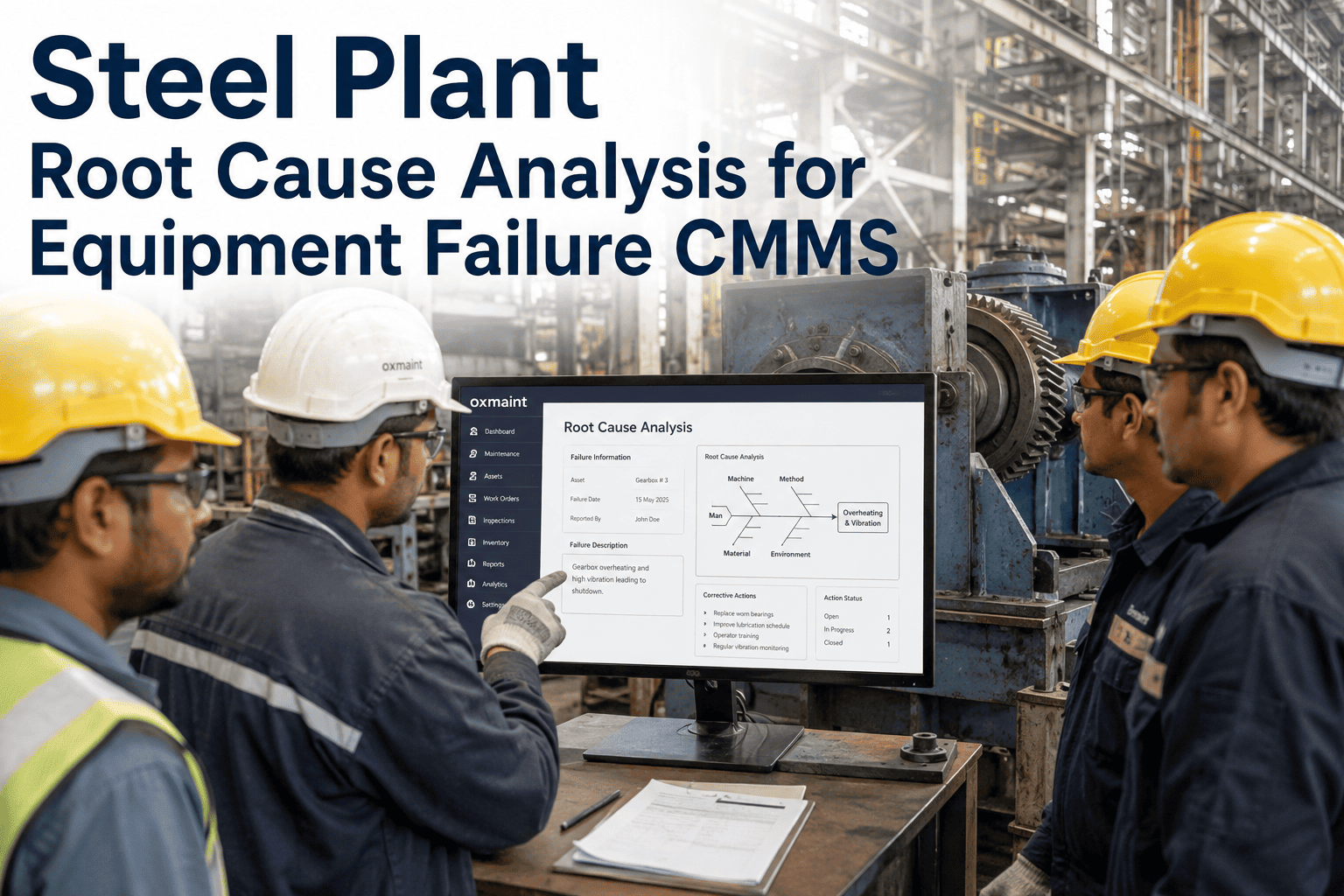
Steel Plant Root Cause Analysis: RCA for Critical Equipment Failures
By Alex Jordan on June 19, 2026
Root cause analysis in steel plants is not a post-failure forensic exercise — it is a maintenance system that prevents repeat failures before they halt production. Yet most steel plants operate as pure troubleshooters: a blast furnace cooling system fails, technicians replace the pump, and production resumes. No investigation into why the pump failed. No analysis of why the previous pump failed identically six months earlier. No systemic correction of the condition that makes pump failure inevitable. The result is maintenance teams perpetually firefighting the same failures, spare parts inventory bloating with emergency replacements, and production reliability trapped at 85% OEE when 95%+ is achievable through disciplined root cause analysis. A pump fails three times in four years at a US steel plant. Reactive technicians spend $930,000 replacing pumps. RCA teams discover misalignment, pipe stress, loose foundations, and missing operational procedures — all contributing simultaneously. Fixing those root causes costs $150,000 and eliminates pump failures entirely. OxMaint root cause analysis management embeds 5-Why drill-downs, fishbone categorization, and corrective action tracking directly into work order closure — ensuring every significant failure investigation produces actionable corrections and the plant measures whether the fix actually worked.
Every Failure Investigated. Root Cause Found. Repeat Failure Prevented.
OxMaint embeds structured root cause analysis into maintenance workflows — 5-Why drill-downs linked to work orders, corrective action ownership, and recurrence monitoring that proves whether fixes actually worked
Reduction in maintenance spend through RCA-driven prevention vs reactive troubleshooting across heavy industrial operations
15–20 Years
Extension to critical asset service life beyond design targets through RCM-integrated root cause prevention
40–70% Reduction
Unplanned downtime at facilities applying systematic RCA to critical asset failures
Six RCA Failure Investigation Phases Embedded in OxMaint Workflows
Root cause analysis follows a discipline sequence: failure event documentation, evidence collection, team assembly, cause hypothesis testing, corrective action definition, and verification monitoring. Most steel plants execute only the first two phases — then wonder why identical failures repeat. OxMaint RCA management automates all six phases and prevents case closure until corrective actions are verified complete.
Phase 1: Failure Event Capture
Foundational — data collection at point of failure
When equipment fails and a work order is created, OxMaint captures the failure state: operator observations, meter readings before shutdown, operating hours on the component, recent maintenance history, and photographs of the failed asset. This initial documentation is the foundation for all subsequent investigation — a failure event without captured state becomes an RCA with incomplete evidence.
Phase 2: Evidence Review
Critical — all available data sources consulted
RCA teams access prior work orders for the failed asset, preventive maintenance compliance records, previous failure events on identical or similar components, sensor data trends, lubrication analysis reports, and operator interviews. OxMaint links all historical records to the current failure event in chronological view — revealing patterns that single incidents would never disclose.
Phase 3: RCA Method Selection
Tactical — matching method to failure complexity
OxMaint provides templates for 5-Why analysis (straightforward single-cause failures, 15–30 minutes), Fishbone diagrams (multi-factor failures, 2–4 hours), and FMEA/FTA (catastrophic failures, 1–2 days). Teams select the appropriate depth based on failure consequence and repair cost — over-investigating trivial failures wastes time; under-investigating critical ones guarantees repeats.
Phase 4: Root Cause Identification
Investigative — systematic hypothesis testing
5-Why analysis answers: Why did the bearing fail? (It overheated.) Why did it overheat? (Cooling flow was blocked.) Why was cooling blocked? (Maintenance was skipped.) Why was maintenance skipped? (PM schedule changed without updating the system.) Why wasn't the system updated? (No procedure for PM change verification.) Each answer becomes a testable hypothesis leading to the next "why" until the root system failure emerges.
Phase 5: Corrective Action Planning
Preventive — defining specific fixes with ownership
OxMaint generates corrective work orders automatically from RCA findings. Each corrective action has an assigned owner, deadline, success metric, and budget. Multi-step corrections (e.g., repairing alignment, replacing bearings, updating PM procedures) are sequenced and tracked. Incomplete corrective actions block RCA case closure, preventing investigations from becoming shelf documents.
Phase 6: Recurrence Monitoring
Validation — proof that the fix actually worked
After corrective actions are completed, OxMaint monitors the asset for recurrence over a 90-day verification period. If the failure mode reappears, the RCA case automatically reopens and escalates — indicating either incomplete root cause identification or implementation failure. Only when the monitoring period passes failure-free is the RCA case closed and the learning archived.
Root Cause Analysis
Every Failure Investigated. Every Root Cause Found. Every Repeat Failure Prevented.
5-Why analysis, fishbone diagrams, corrective action tracking, and recurrence monitoring — all embedded in the maintenance workflow.
RCA Implementation: Four-Week Deployment Timeline for Steel Plants
Implementing systematic root cause analysis requires staff training, process definition, and integration with maintenance systems. A four-week implementation timeline establishes RCA discipline across critical asset failures while maintaining production operations.
Week 1: Team Training
Foundation building
5-Why method training — facilitators certified
2-hour session
Fishbone diagram process and documentation
2-hour session
OxMaint RCA module setup and user access
Training complete
Maintenance team ready for RCA
Trained
Week 2: Pilot RCA
Process validation
First three failures analyzed using 5-Why
Walk-through with facilitator
Corrective actions generated and assigned
Tracking initiated
Process refinement based on feedback
Adjustments made
Process proven effective
Confidence built
Week 3–4: Full Deployment
Organization-wide rollout
All significant failures trigger RCA workflow
Automatic activation
RCA case closure prevented until corrective actions verified
Discipline enforced
Recurrence monitoring dashboard active
Continuous visibility
RCA system producing plant-wide insights
Operating normally
OxMaint RCA Platform: Four System Integration Points
Root cause analysis effectiveness depends on access to complete failure history and integration with corrective action workflow. OxMaint RCA management connects failure data, analysis tools, corrective action tracking, and recurrence monitoring into a unified system.
Asset Failure History Integration
When an RCA is initiated, OxMaint displays all prior failures on that asset in chronological sequence. Patterns become immediately visible: a cooling pump has failed three times in eighteen months, always during summer peak production. Identical failure history on similar assets at other plants suggests a systemic design issue, not a one-off event. This pattern visibility is impossible with paper records and scattered failure documentation.
5-Why and Fishbone Templates
OxMaint provides structured templates guiding RCA teams through 5-Why analysis (each answer becomes the next question level) and fishbone diagram construction (six cause domains: people, method, material, machine, environment, management). Templates ensure consistency across investigations and prevent superficial root cause determination that leads to fix failure and recurrence.
Corrective Action Work Order Generation
RCA findings automatically generate corrective action work orders with assigned owners, deadlines, and success metrics. Multi-step corrections (bearing replacement, alignment repair, procedure update, training) are sequenced and linked in OxMaint. The RCA case cannot be closed until all corrective actions are marked verified complete — preventing investigations from becoming archive documents without implementation.
90-Day Recurrence Monitoring
After corrective actions are completed, OxMaint monitors the asset for failure recurrence over a 90-day verification window. If the same failure mode reappears, the RCA case reopens automatically — indicating either incomplete root cause identification or failed implementation. Only when the verification period passes failure-free is the RCA archived as a resolved learning.
"Before RCA, we replaced a condensate pump nine times in four years. After RCA discovered misalignment and pipe stress issues, we fixed the root causes once and haven't replaced that pump in three years. The $150,000 RCA investment saved us $930,000 in repeated failures."
— Maintenance Director, Power Generation Facility — USA
Frequently Asked Questions: Root Cause Analysis in Steel Plants
Q1What is the difference between troubleshooting and root cause analysis?▼
Troubleshooting is trial-and-error repair (swap parts until the machine runs again) that addresses symptoms. RCA is formal evidence-based investigation that identifies why the failure happened and why controls failed to prevent it — enabling permanent fixes.
Q2Should RCA be conducted on every equipment failure or only major incidents?▼
RCA should be applied to failures above a significance threshold: high-cost repairs, safety incidents, production shutdowns, or recurring failures. Low-cost consumable failures (light bulbs, hoses) are run-to-failure. OxMaint allows users to set RCA trigger rules by cost, consequence, or failure type.
Q3How long does a root cause analysis typically take?▼
A 5-Why analysis takes 15–60 minutes for straightforward failures. A fishbone diagram investigation takes 2–4 hours. A comprehensive FMEA or fault tree analysis for catastrophic failures takes 1–2 days including team sessions and documentation. Complexity should match failure consequence.
Q4What if an RCA identifies multiple root causes instead of one?▼
Most significant failures have multiple contributing causes. Good RCA always finds multiple root causes — indicating the failure resulted from simultaneous misalignment of conditions (e.g., high stress + poor lubrication + missed PM). Each contributing cause requires separate corrective action.
Q5How does OxMaint prevent RCA cases from becoming shelf documents?▼
OxMaint automatically generates corrective action work orders from RCA findings and prevents case closure until all corrective actions are marked verified complete. This workflow enforcement ensures investigations produce implementation, not just documentation.
Q6What is the recurrence monitoring period and how does it work?▼
After corrective actions are completed, OxMaint monitors the asset for 90 days. If the same failure mode reappears during this window, the RCA case automatically reopens — indicating incomplete root cause identification or implementation failure. Only passing the 90-day monitoring period closes the case.
Q7Can OxMaint be used for cross-plant failure analysis?▼
Yes — OxMaint supports multi-site deployment. When identical equipment fails at different plants, the system identifies the pattern and escalates to corporate engineering for systemic investigation. This prevents local RCA from missing plant-wide design issues.
Q8How are RCA findings documented for regulatory compliance?▼
OxMaint generates comprehensive RCA reports with evidence records, investigation findings, corrective actions, and verification results. Reports are exportable as PDF with digital signatures intact for regulatory inspection, audit, and litigation defense documentation.
Root Cause Analysis
Every Failure Analyzed. Every Root Cause Found. Repeat Failures Eliminated.