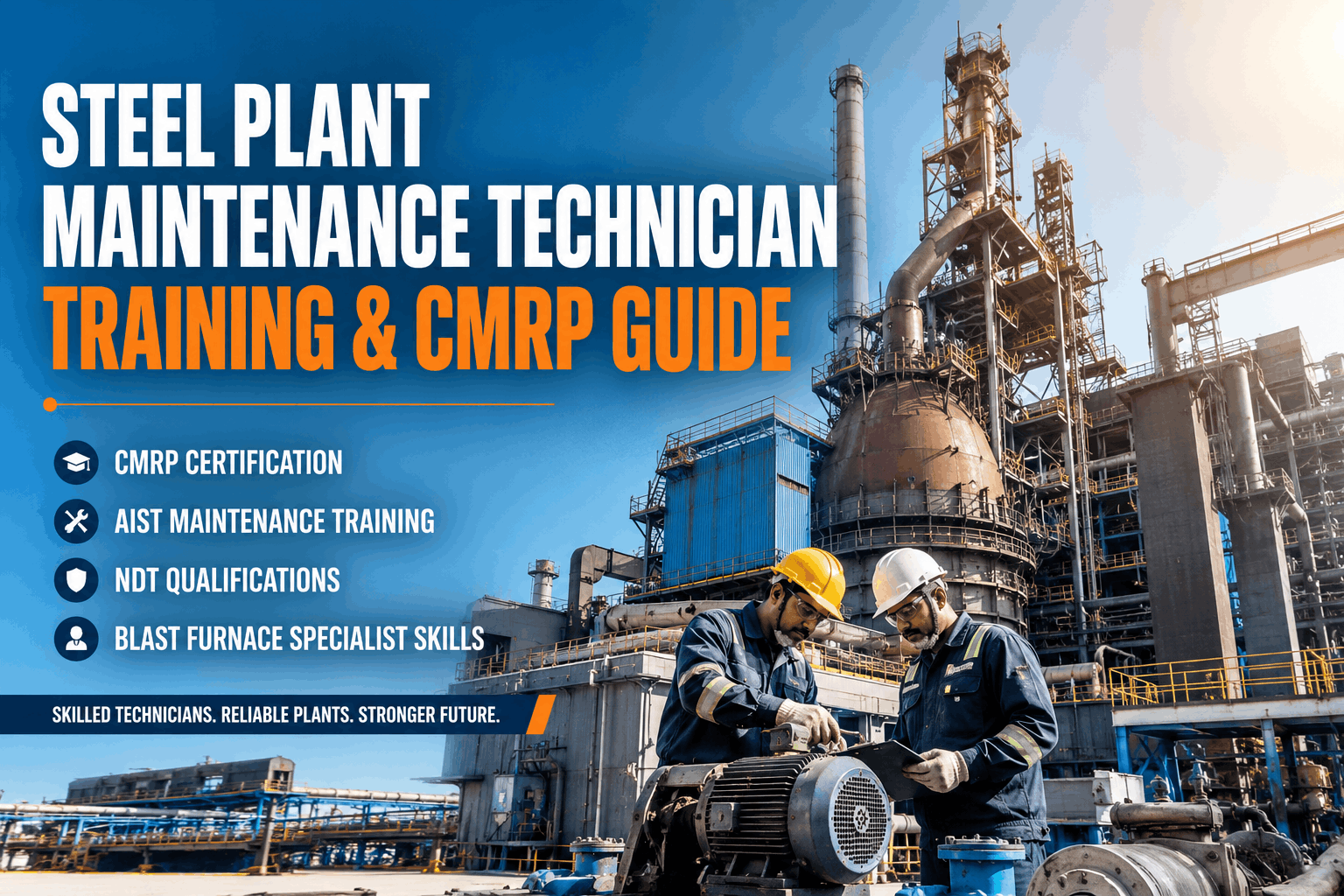
Maintenance technician training is the highest-ROI investment a steel plant can make—yet 70% of U.S. mills spend <$200 per technician annually on structured training while world-class facilities invest $2,000–$3,500 per technician yearly. A technician trained in predictive maintenance diagnostics, root cause analysis, and equipment-specific failure modes prevents 8–12 critical failures annually per technician, generating $400K–$600K in avoided downtime and emergency repair costs for a 500-ton facility. Training ROI hits 200–300% within 12 months through failure prevention, labor productivity gains, safety incident reduction, and extended equipment life. U.S. steel mills investing in certified technician programs see 15–25% reduction in maintenance labor per ton, 30–50% reduction in equipment downtime, and 40–60% improvement in first-time fix rates—translating to $1.2M–$2.5M annual savings for mid-sized operations. Steel plants with documented training programs and technician certification pathways also report 30–40% lower technician turnover, reducing recruitment and onboarding costs by $150K–$300K annually. Start a free trial or schedule a consultation to build your training ROI business case.
Maintenance Training ROI and Business Case for Steel Plants
Build the financial case for maintenance technician training—quantifying failure prevention value, labor productivity gains, safety benefits, and long-term workforce retention impact. Calculate training payback period and secure executive approval for your training investment.
Why Technician Training Delivers Superior ROI in Steel Plants
Maintenance technician training compounds in value in ways that capital equipment investments do not. A technician trained in vibration analysis, bearing diagnostics, and electrical troubleshooting identifies equipment degradation 30–90 days before catastrophic failure, enabling planned repairs that cost 60–75% less than emergency breakdowns. The same technician trained in root cause analysis reduces repeat failure rates by 40–60%, extending equipment life by 3–5 years and deferring replacement capital. A blast furnace operator co-trained with maintenance technicians on stave cooling, ironstone quality sensing, and thermal shock prevention identifies equipment stress conditions early, preventing the $400K–$800K cost of a mid-campaign furnace reline or partial rebuild. Training also drives culture transformation: mills with robust technician development programs report 30–50% higher operator compliance with preventive maintenance activities, 20–30% improvement in work order closure discipline, and 40–50% higher technician suggestion implementation rates. The multiplier effect—one trained technician influencing five peers, who influence operators, who identify failures early—typically generates 3–5X the direct cost savings within 18–24 months. Steel mills that view technician training as an expense category rather than investment strategy systematically underperform on reliability KPIs and lose $500K–$1.5M annually in preventable failure costs that would have been recovered through training investment.
Five Critical Training Content Areas and Their Failure Prevention Impact
Effective steel plant maintenance training focuses on five content domains that directly map to the highest-cost failure categories. Vibration Analysis and Bearing Diagnostics training enables technicians to identify bearing degradation 4–8 weeks before seizure, preventing failures in blast furnace stave cooling systems (avg. failure cost $180K–$250K), converter tilting mechanisms (avg. $120K–$180K), and caster drive motors (avg. $80K–$150K). Root Cause Analysis and Failure Prevention training teaches systematic investigation methodology that reduces repeat failure rates by 40–60% and identifies latent defects in equipment design or maintenance processes that affect 5–10 similar assets. Thermal Imaging and Hot Equipment Diagnostics training prevents refractory failures, electrical contact degradation, and bearing overheat failures that typically emerge without warning in high-temperature steel equipment. CMMS and Data Management training ensures technicians consistently complete work orders on time, capture failure codes and component details accurately, and provide data quality required for predictive analytics—mills with CMMS discipline achieve 85%+ planned maintenance penetration vs. 45–50% at mills with poor data discipline. Equipment-Specific Operator Training (furnace operators, caster attendants, maintenance technicians working together) reduces process-induced failures by 30–40% through shared understanding of safe operating windows, thermal shock prevention, and early degradation indicators. Steel mills deploying all five content areas with 40+ hours annual training per technician and documented certification see 50–65% overall failure rate reduction within 18 months—translating to $1.2M–$2.5M annual savings depending on facility size.
Quantifying Training ROI: Failure Prevention, Labor Productivity, and Retention Value
Training ROI in steel plants compounds across four distinct value streams that must be quantified independently to build a defensible business case. The Failure Prevention Stream captures the avoided cost of emergency repairs, equipment downtime, lost production revenue, overtime labor, and emergency parts purchasing—a typical trained technician prevents 8–12 significant failures annually, with average failure cost ($80K–$150K per event) yielding $640K–$1.8M annual prevention value for an 80-person maintenance team. The Labor Productivity Stream measures the reduction in labor hours to complete standard repairs through improved first-time fix rates (reducing repeat visits 40–60%), faster diagnostic speed (trained technicians complete diagnostics 30–50% faster), and improved work planning (reducing unproductive tool gathering and parts chasing)—typical value $150K–$300K annually per 80-person team. The Technician Retention Stream quantifies the cost avoidance from reducing turnover through career development visibility, skills-based advancement pathways, and industry certification (which increases technician marketability within steel industry and improves retention to competitive employers)—typical value $80K–$180K annually per 80-person team through reduced recruitment, onboarding, and lost productivity from departures. The Extended Equipment Life Stream captures refractory life extension (25–35% longer campaign life through better thermal management and early intervention), motor and bearing life extension (3–5 years through proper installation and alignment practices), and reduced replacement capital requirements—typical value $200K–$400K annually through deferred replacement and extended maintenance intervals. Total training ROI across all four streams for comprehensive annual programs ranges $1.1M–$2.9M annually for a 500-ton facility, representing 180–350% ROI on typical $300K–$600K annual training budgets.
Building Your Training Business Case: Five Financial Components
An executive-ready training business case quantifies five discrete financial components that aggregate to total training ROI. First, calculate Failure Prevention Value by identifying your top 20 failure categories from the past 24 months (using CMMS data or incident reports), calculating the average cost per event (labor, parts, lost production), estimating the percentage preventable through training (typically 40–70% for trained technicians), and projecting annual failure prevention over your technician population. Second, quantify Labor Productivity Gains by benchmarking your current average labor hours per maintenance task (documenting technician time across 50–100 representative work orders), comparing to industry benchmarks for trained personnel, calculating the hourly labor cost savings, and extending across annual work volume. Third, assess Retention Savings by calculating current technician turnover rate and associated cost (recruitment, training ramp, lost productivity during onboarding—typically $30K–$50K per departure), projecting turnover reduction from career pathway clarity (typically 15–25% improvement), and converting to annual dollar savings. Fourth, model Equipment Life Extension by quantifying current replacement cycles for high-value assets (furnace refurbishment, converter rebuilds, caster drive motor replacement), estimating life extension from improved maintenance practices (3–5 years typical), calculating avoided capital replacement cost, and discounting to present value. Fifth, capture Safety and Compliance Benefits through reduced injury rates (trained technicians have 30–50% lower injury frequency due to better hazard identification and proper lockout/tagout discipline), regulatory compliance risk reduction (OSHA inspections, worker compensation audit findings), and potential cost avoidance from avoiding penalties or workplace incidents. Total business case typically shows 200–350% ROI within 12–16 months for comprehensive programs with strong organizational support.
Overcoming Training Resistance: How to Justify Training Budgets to Finance Leadership
Finance and executive teams often resist training investments because benefits are diffuse, difficult to attribute directly, and emerge over time rather than producing immediate financial impact. Overcome this resistance through four strategic approaches. First, quantify hidden costs of under-training by conducting a failure cost audit—document 20–30 representative equipment failures from the past 18 months, calculate total incident cost (labor + parts + downtime + lost revenue), estimate the percentage that trained technicians would have prevented (40–70% typical), and translate to avoided cost. Second, benchmark against world-class competitors by showing that U.S. steel mills winning market share in specialty grades (automotive, electrical steel, high-strength low-alloy) invest 2–3X more in technician training and achieve 2–3X higher equipment reliability. Third, present training as a capital deferral strategy—show how improved maintenance practices extend furnace campaign life by 2–3 years, deferring $2M–$5M capital replacement projects into the future, creating time value benefit. Fourth, structure training budgets as investment with clear payback milestones—commit to tracking failure reduction, labor productivity improvement, and turnover reduction on a quarterly basis, and tie bonuses or budget continuation to achievement of ROI targets. Steel mills that follow this framework typically secure training budgets of $300K–$600K annually for 80-person teams and see executive buy-in improve after first-year results demonstrate positive impact.
Finance questioned our $400K annual training budget until we mapped it against our $2.2M annual emergency repair budget. After implementing comprehensive vibration analysis and root cause analysis training, emergency repair spending dropped to $800K within 14 months—directly attributable to fewer failures from trained diagnostics. We also reduced technician turnover 28% through career pathway clarity, avoiding $220K in replacement costs. Total Year 1 ROI was $1.4M on $400K investment. Now training is line-item protected funding, and we're expanding to advanced certification programs for senior technicians.
Calculate Your Training ROI Business Case
Oxmaint's training ROI calculator quantifies failure prevention value, labor productivity gains, technician retention benefits, and equipment life extension—delivering an executive business case with 12–18 month payback timelines.
Frequently Asked Questions About Training ROI
Build Your Training ROI Business Case Today
Oxmaint helps you quantify training impact across failure prevention, labor productivity, technician retention, and equipment life extension—securing executive approval and budgets for comprehensive technician development programs.