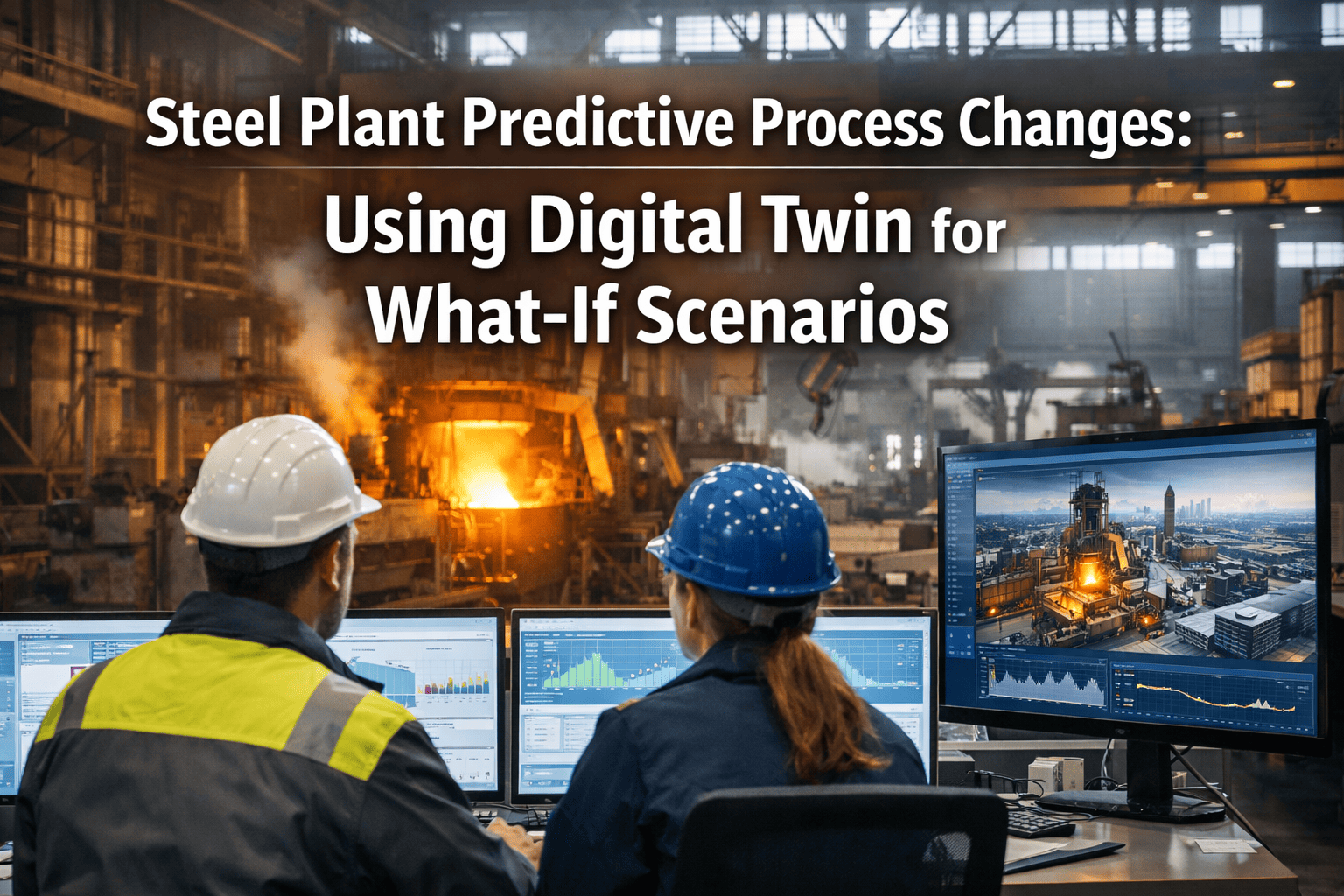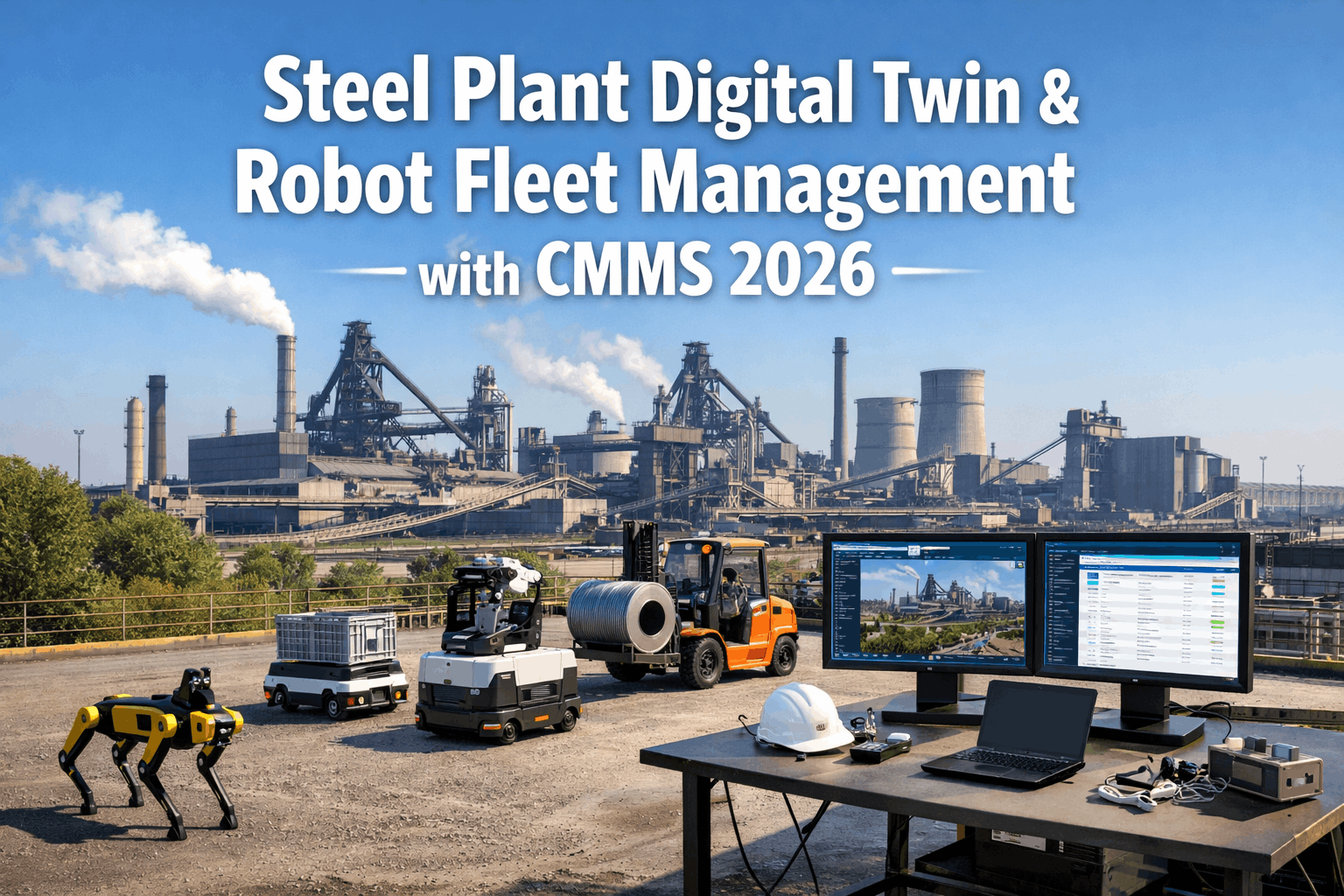
Steel plants operate in one of the most complex, capital-intensive manufacturing environments in the world. A single unplanned equipment failure — whether on a blast furnace, continuous caster, rolling mill, or auxiliary system — can cascade into production losses exceeding hundreds of thousands of dollars per hour. Yet most steel facilities still rely on reactive maintenance schedules, scheduled shutdowns based on calendar intervals rather than actual asset condition, and fragmented data sources that prevent maintenance teams from seeing the complete failure pattern until an unexpected outage occurs. A digital twin for steel plant operations transforms this visibility gap into a measurable advantage: combining real-time sensor data from furnaces, mills, and auxiliary equipment into a virtual model that predicts failures weeks in advance, enables what-if scenario testing before shutdown planning, and validates maintenance decisions against simulated operating conditions. Sign Up Free to build a steel plant digital twin that connects historical failure data, real-time equipment signals, and process simulation into predictive asset health intelligence.
Predictive Maintenance Through Virtual Steel Plant Simulation
Digital twin technology enables steel plants to simulate equipment behavior, predict failures before they occur, and validate maintenance interventions in a virtual environment — reducing unplanned downtime by 40-60% and extending equipment life by 15-25% through early intervention.
What Is a Steel Plant Digital Twin and How Does It Enable Predictive Maintenance?
A digital twin for steel plant operations is a continuously-updated virtual model that mirrors the behavior of physical equipment and processes in real time. Unlike static 3D CAD models or offline simulations, a true digital twin ingests live sensor data from temperature sensors on blast furnaces, vibration monitors on rolling mill drives, acoustic sensors on compressor systems, and pressure transmitters throughout the plant — feeding that stream into mathematical models that calculate equipment stress, predict remaining useful life, and simulate how changes to operating parameters will affect equipment wear rates and failure probability. For a blast furnace running at steady state, a digital twin can ingest the inlet air temperature, combustion efficiency, slag chemistry, and iron oxide reduction rates to calculate coke consumption patterns and predict when refractory brick erosion will exceed safe limits. For a continuous caster, the digital twin combines mold temperature data, strand surface quality readings, and secondary cooling spray patterns to model internal casting stress and forecast crack initiation probability weeks before a surface defect inspection would catch the issue. The financial impact compounds across the plant: each week an equipment failure is predicted in advance rather than discovered through sudden shutdown allows maintenance teams to schedule spares procurement, arrange contractor labor, and plan production rerouting — reducing the cost of an unplanned outage from millions of dollars to the cost of planned labor and parts. Steel plants using digital twin technology Book a Demo to see how OxMaint's predictive maintenance platform connects equipment sensors, failure history, and real-time condition data into a digital twin that forecasts equipment reliability weeks or months in advance.
Continuous sensor integration from blast furnaces, rolling mills, and auxiliary systems feeds live operating data into the digital twin — enabling real-time visualization of equipment stress, thermal profiles, vibration signatures, and chemical process metrics without manual data entry or lag.
The digital twin's mathematical models calculate remaining useful life and predict equipment failure weeks to months in advance by analyzing trend degradation, stress accumulation, and historical failure patterns — giving maintenance teams sufficient lead time for planned intervention.
Before planning a maintenance shutdown or equipment modification, test operational scenarios in the digital twin — predicting how changes to temperature setpoints, flow rates, or duty cycles will affect equipment wear rates and failure probability without risking actual equipment.
Coordinate multiple equipment maintenance interventions during planned shutdowns by simulating production impact of different timing combinations — minimizing total production loss and allowing the team to batch related maintenance work efficiently.
Use digital twin simulations to validate new equipment configurations, test modified process parameters, and commission changes virtually before implementing on the actual production floor — reducing startup risk and identifying operational issues before they affect production.
The digital twin pulls data from existing plant systems — DCS historian, energy monitoring platforms, quality control databases, and ERP systems — creating a unified data model that surfaces hidden correlations between process variables and equipment failures across the entire steel plant.
Five Critical Benefits of Digital Twin Technology for Steel Plant Reliability and Process Optimization
By predicting failures weeks in advance, steel plants shift from reactive crisis response to scheduled maintenance during planned production windows. A blast furnace that would have failed unexpectedly in the middle of a production run instead reaches end-of-campaign through planned maintenance, reducing the cost of unplanned shutdowns by millions of dollars and allowing production to continue at planned volume. Digital twin prediction accuracy of 85-95% on high-consequence equipment (blast furnaces, continuous casters, hot rolling mills) becomes the operational reality that justifies maintenance budget allocation and capital equipment procurement timing. Sign Up Free to begin tracking failure predictions on your critical steel plant assets.
Equipment that operates until sudden failure typically experiences severe damage in final hours — cracked refractory, distorted bearing races, ruptured seals — requiring extensive rebuild or replacement. Equipment that is maintained based on digital twin prediction stops operation during the early-degradation phase, when corrective work restores components to near-original condition. A blast furnace that would normally campaign for 8-10 years under reactive maintenance can campaign for 11-13 years when maintained by digital twin prediction because stress-relieving maintenance happens before failure-mode damage accumulates. This extends the capital equipment ROI window and allows production planning to align with actual equipment service life rather than conservative assumptions.
Reactive maintenance creates schedule chaos: emergency contractors on premium rates, parts expedited at 2-3x standard cost, production rerouting to avoid failed equipment. Digital twin-driven predictive maintenance allows procurement teams to order spares during normal lead times, schedule contractors during planned windows, and batch related maintenance work to minimize labor transitions. A steel plant producing 2 million tons annually can reduce maintenance cost from $18-22 per ton to $12-16 per ton over a 24-month implementation window — translating to $8-15 million annual savings on maintenance labor, contractor fees, and parts purchasing. The financial benefit compounds across every equipment category from auxiliary systems (compressors, cooling towers, pump stations) to primary production equipment.
Traditional preventive maintenance schedules are conservative — replacing bearings every 3 years, overhauling gearboxes every 5 years, replacing refractory annually — because equipment condition cannot be precisely known. Digital twin condition monitoring enables condition-based maintenance: replace the bearing when the digital twin predicts 8 weeks remaining useful life, not on calendar anniversary. This eliminates unnecessary maintenance on equipment that still has 50% of service life remaining and ensures that maintenance happens only when the failure probability curve exceeds acceptable risk. A steel plant can reduce scheduled maintenance events by 30-45% while improving equipment availability because maintenance happens at optimal timing, not on worst-case conservative intervals. The operational result is more consistent production scheduling and fewer surprise maintenance windows that disrupt planned campaigns.
Steel plant optimization — increasing production rate, extending campaign length, or changing product mix — always carries risk of unexpected equipment stress and failure. A digital twin allows maintenance engineering teams to test proposed changes in simulation before implementation: run the caster 5% faster in the digital twin, observe how mold temperature and strand stress change, calculate the impact on refractory wear rate and failure probability, and determine whether the 5% speed increase is sustainable or requires additional cooling capacity. This scenario-testing capability becomes particularly valuable during commissioning of new equipment or major process modifications: the digital twin can validate startup procedures, predict equipment behavior during ramp-up, and identify operational limits before they cause damage. Steel plants using Book a Demo see how digital twin scenario capabilities enable confidence in process optimization decisions without trial-and-error risk.
Digital Twin Implementation Roadmap for Steel Plants: Data, Models, and Monitoring Systems
| Implementation Phase | Primary Activities | Data Sources Required | Typical Timeline | Expected Output |
|---|---|---|---|---|
| Phase 1: Asset Inventory & Data Architecture | Equipment hierarchy mapping, sensor audit, data source identification | DCS, historian, vibration monitoring, thermography records | 6-10 weeks | Data architecture blueprint, sensor deployment plan |
| Phase 2: Sensor Integration & Real-Time Data Flow | Sensor deployment, data gateway configuration, historian integration | Live sensor streams, process variable snapshots, historical trend data | 8-14 weeks | Real-time data lake with 12+ months historical context |
| Phase 3: Predictive Model Development | Failure mode analysis, model training on historical data, accuracy validation | Work order history, failure codes, equipment modification records | 10-16 weeks | Trained models achieving 85%+ prediction accuracy on target assets |
| Phase 4: What-If Scenario Simulation | Process model parameterization, scenario test library, operator training | Equipment specs, process parameters, historical scenario outcomes | 8-12 weeks | Operational digital twin ready for scenario planning |
| Phase 5: Predictive Maintenance Integration | Work order automation, maintenance scheduling logic, alert thresholds | Maintenance protocols, spare parts inventory, contractor availability | 6-10 weeks | Fully-operational predictive maintenance system with automated work order generation |
How OxMaint Digital Twin Platform Delivers Predictive Maintenance at Scale Across Steel Plant Equipment
Building a digital twin for predictive maintenance requires integrated data infrastructure, robust modeling capability, and seamless connection to maintenance scheduling systems. OxMaint provides the platform foundation that steel plants need to implement digital twins at the speed of business. The platform ingests data from DCS historians, real-time sensor networks, work order systems, and quality control databases — creating a unified asset timeline that shows the relationship between process parameters, equipment condition signals, and failure events. OxMaint's machine learning engine trains predictive models on your steel plant's unique equipment, operating conditions, and failure history — producing failure probability forecasts specific to your blast furnace, continuous caster, rolling mill, or auxiliary equipment. When the model predicts that a critical component will reach failure probability in 6-8 weeks, OxMaint automatically generates a work order, notifies the maintenance team of the predicted failure mode, and provides the equipment condition history that explains the prediction. Steel plants that Sign Up Free begin building the digital twin immediately from their existing work order history and sensor data.
Six-Step Digital Twin Implementation Program for Steel Plant Predictive Maintenance
Audit Current Data Sources and Sensor Infrastructure
Map all DCS systems, historian databases, vibration monitoring platforms, and IoT sensors currently collecting equipment data at your steel plant — identifying data gaps and latency issues that must be resolved for the digital twin to function accurately.
Establish Target Assets and Baseline Equipment Condition
Select 3-5 critical equipment assets (high failure frequency, high consequence of failure, significant maintenance cost) as digital twin pilot targets — then calculate baseline MTBF, current maintenance cost, and failure mode distribution for measurement comparison.
Deploy Real-Time Data Integration and Historical Data Consolidation
Connect OxMaint to your DCS, sensor networks, work order system, and historical databases — creating the unified data stream that the digital twin model needs to predict failures and simulate equipment behavior.
Train Predictive Models on Historical Failure Data and Validate Accuracy
Use 12-24 months of historical work orders, failure codes, and sensor data to train OxMaint's machine learning models for each target asset — then test prediction accuracy on known failures to ensure the model is identifying the failure patterns correctly before deploying to live prediction.
Implement What-If Scenario Testing and Process Optimization Analysis
Use OxMaint's digital twin to test proposed operational changes, new equipment configurations, and process parameter adjustments — predicting equipment impact and failure risk before implementing changes on the production floor.
Deploy Predictive Maintenance and Measure ROI Quarterly
Activate automated work order generation from OxMaint's failure predictions, measure unplanned downtime reduction, track maintenance cost per ton, and calculate digital twin ROI quarterly — then expand implementation to additional equipment classes based on pilot results. Book a Demo to see the full implementation workflow.
Digital Twin for Steel Plants: Frequently Asked Questions
What equipment data does a steel plant digital twin require?
A functional digital twin requires real-time process variables (temperatures, pressures, flow rates, chemical composition), vibration and acoustic monitoring, maintenance work order history with failure codes, and equipment specifications — allowing the model to predict failures based on equipment stress accumulation and historical failure patterns specific to your plant.
How long before digital twin predictions become accurate enough for operational decisions?
With 12-18 months of historical failure data and consistent real-time data collection, OxMaint's models typically achieve 85-95% prediction accuracy — sufficient for automated work order generation and maintenance planning. Prediction confidence improves continuously as new failure events validate or refine the models.
Can a digital twin handle equipment modifications and process changes?
Yes. OxMaint's digital twin is designed to test process modifications before implementation, then retrain on new equipment behavior patterns as they occur — continuously adapting to your plant's changing configuration and operating conditions.
What return on investment should a steel plant expect from digital twin implementation?
A typical 2-million-ton-per-year facility implementing digital twin predictive maintenance can expect $8-15M annual savings from unplanned downtime reduction, maintenance cost optimization, and extended equipment life — with ROI payback in 12-18 months from implementation.
Does OxMaint digital twin work with existing DCS and historian systems?
Yes. OxMaint integrates with Honeywell, ABB, Siemens, and other major DCS platforms through standard data interfaces — connecting directly to your historian data, real-time process variables, and maintenance management systems without replacement or disruption.
How does digital twin improve on traditional condition-based maintenance approaches?
Digital twins predict failures weeks in advance by combining multiple condition signals and historical patterns, while traditional condition monitoring reacts to detected anomalies — giving maintenance teams sufficient lead time for scheduled maintenance and part procurement instead of emergency response.
Can digital twin predictions be used for capital equipment replacement planning?
Yes. Long-term digital twin data shows actual equipment service life degradation patterns — enabling capital planning teams to schedule equipment replacement timing based on predicted remaining useful life rather than conservative manufacturer recommendations or industry averages.
What industry standards and regulations apply to digital twin implementations in steel plants?
Steel plant digital twins should follow ISO 20816 for vibration monitoring, NFPA 70 for electrical systems, and API 670 for machinery protection standards — OxMaint's platform is designed for compliance with these standards and integrates with existing safety-critical systems.
Build Your Steel Plant Digital Twin Today
OxMaint provides the data infrastructure, predictive modeling, and simulation capabilities that steel plants need to implement digital twin technology — predict failures 4-16 weeks in advance and optimize maintenance scheduling across all equipment classes.