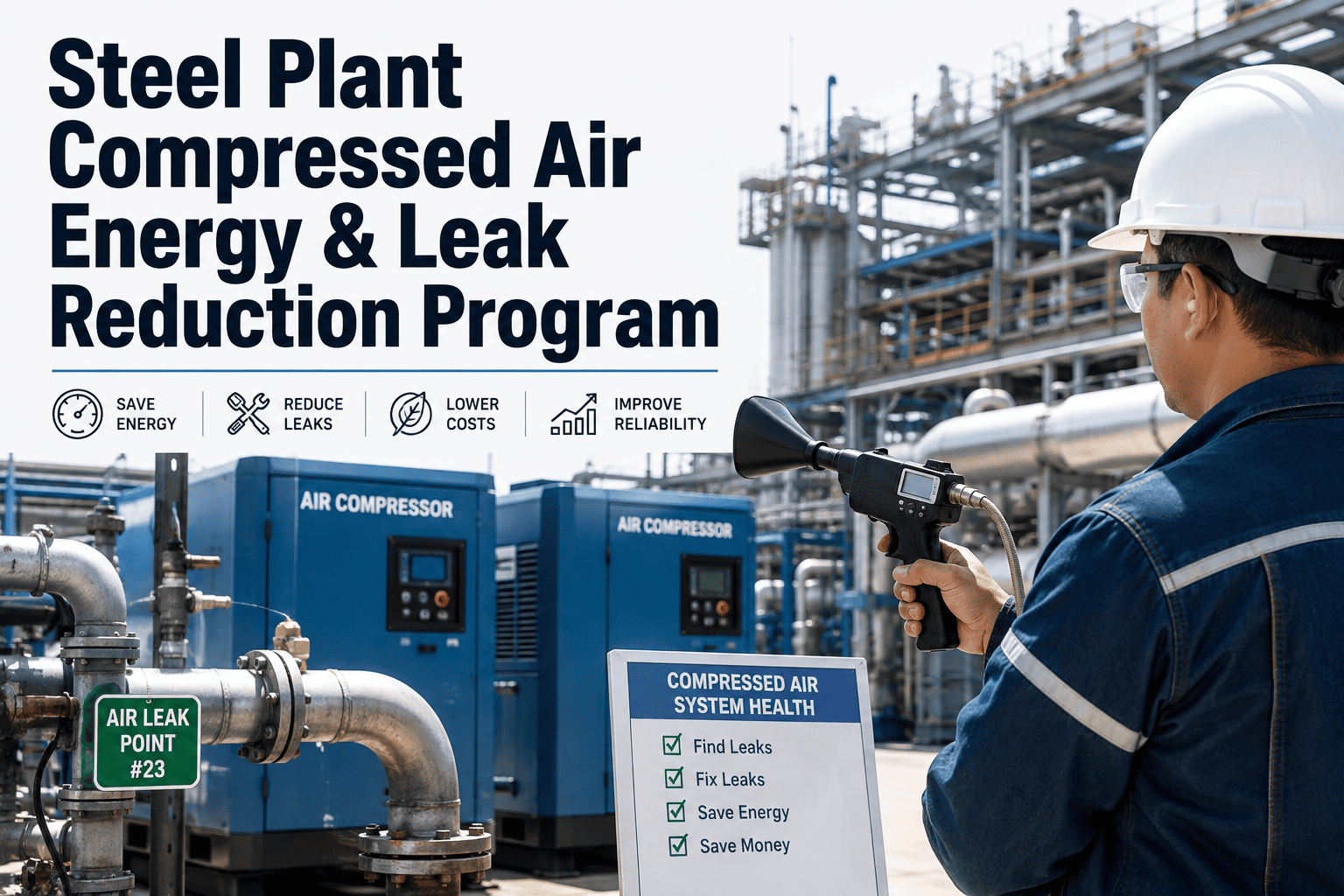
Compressed air consumes 15–25% of total electricity at integrated steel mills, translating to annual costs between $3 million and $12 million depending on plant size and operating pressure. Yet 25–35% of that generated air never reaches production tools—it escapes through leaks in pipe fittings, valve seals, and hose connections, feeds inappropriate applications running 24/7, or pressurizes systems far higher than processes require. For a steel plant spending $5 million annually on compressed air electricity, that wasted fraction represents $750,000 to $4 million in pure energy loss recoverable through systematic leak detection and repair. Unlike furnace upgrades or rolling mill optimization, compressed air waste is preventable through maintenance discipline alone. OxMaint integrates ultrasonic leak surveys, pressure zone analysis, and compressor scheduling into one platform, turning compressed air from a hidden energy sink into a controlled, continuously optimized utility.
Stop Losing $1M+ Annually to Compressed Air Leaks and Inefficiency
Your steel plant generates compressed air 24/7, but 25–35% escapes through undetectable leaks before it reaches production. Detect every leak point, track repair status, measure post-repair savings, and reduce energy waste by 30–40% within 12 months.
Where Compressed Air Waste Hides in Steel Plants
Compressed air leaks are silent and invisible on production floors. Industry data shows that without structured detection and repair programs, leak rates return to pre-repair levels within 6–12 months as vibration, thermal cycling, and normal wear create new failure points. OxMaint treats leak management as a continuous discipline, not a one-time project, with quarterly re-surveys and automated repair tracking that keeps waste below 10% indefinitely.
Pipe Elbow and Fitting Leaks (40% of Total Waste)
Vibration from adjacent process equipment causes fitting threads to loosen and seals to deteriorate at elbows and tee joints. A single 3mm hole at 90 PSI releases 30–50 CFM continuously—equivalent to running a small compressor 24/7 with zero output. Ultrasonic detection identifies every leak point during quarterly audits so repairs can be batched and prioritized by CFM loss.
Dryer and Filter Bypass (30% of Waste)
Compressed air dryers remove moisture to prevent corrosion in pneumatic tools and process lines. When dryer pressure drop exceeds 2 PSI, operators bypass the dryer to maintain flow—sending wet air throughout the system. Moisture then condenses in pipes and solenoid valves, causing premature failures and accelerating new leaks. OxMaint monitors dryer differential pressure and schedules cartridge replacement before bypass becomes necessary.
Pneumatic Tool Valve Leakage (20% of Waste)
Grinding tools, impact wrenches, and spray guns left running during changeovers or parked against machines with held triggers bleed air continuously. A single 5/16" pneumatic tool running idle for 8 hours daily on a Saturday generates 80 CFM of waste. OxMaint integrates compressed air usage data from flow meters and production schedules to identify which tools and zones account for highest idle consumption.
Pressure Differential Losses (10% of Waste)
Compressor discharge pressure often runs 5–10 PSI higher than actual process requirements because operators over-pressurize to compensate for undetected leaks. Every 2 PSI reduction saves 1% on compressor energy. OxMaint identifies over-pressurized zones using flow meter and pressure transducer data, enabling safe pressure reduction once leaks are repaired.
Compressed Air System Components and Maintenance Integration
A typical steel plant compressed air system spans 500+ meters of piping across multiple pressure zones, with 3–8 active compressors, multiple dryers and separators, and hundreds of branch connections. OxMaint tracks each system component independently while linking maintenance tasks to energy consumption and leak detection results so optimization decisions are data-driven.
Compressed Air Maintenance Tasks and Measurement Framework
This reference table covers the maintenance tasks that move compressed air systems from one-time audit approaches to continuous optimization. Every repair creates permanent energy baseline data so ROI is measurable and verifiable against utility billing.
| Component or Activity | Maintenance Task or Measurement | Frequency / Benchmark |
|---|---|---|
| Ultrasonic Leak Survey | Quarterly site-wide audit of all piping, fittings, and hose connections using calibrated ultrasonic detector | Quarterly (12 per year) |
| Leak Repair Tracking | Document every leak repaired with location, repair date, estimated CFM loss pre-repair, and repair labor hours | Continuous — every repair logged |
| Compressor Dryer Cartridge | Monitor pressure drop across dryer; replace when ΔP exceeds 2 PSI or dew point drift detected | Every 12–18 months (condition-based) |
| Compressor Oil Analysis | Monthly oil sampling for viscosity, TAN, water content, and particle count to detect bearing wear | Monthly |
| Cooler Fouling Inspection | Thermal scan of compressor discharge cooler and measure outlet temperature to detect scale/fouling | Semi-annually |
| Compressed Air Quality Monitoring | Weekly dew point check at system discharge using portable hygrometer; monthly ISO 8573-1 lab analysis | Weekly portable; monthly lab |
| Compressor Load Cycling | Review compressor on/off cycles over 48-hour period; calculate optimal load staging sequence for multiple compressors | Monthly or after any major leak repair |
| Pressure Zone Optimization | Identify processes requiring different pressure; establish separate zone pressure controls to avoid over-pressurization | Initial; revisit annually after leak repairs |
Turn Compressed Air Waste Into Verifiable Savings
OxMaint automates quarterly leak surveys, tracks every repair, and measures energy savings against baseline so your steel plant cuts compressed air costs by 30–40% within 12 months. No capital equipment, no production downtime—just systematic maintenance discipline that generates measurable ROI from week one.
Three Telltale Signs Your Compressed Air System Needs Audit
Even plants with annual compressor maintenance often miss the broader system-level waste that drives energy costs. These patterns indicate that your compressed air system is ready for structured optimization and ongoing monitoring.
If your 100 HP compressor is running 65%+ loaded time when production demand suggests 45%, undetected leaks are the most probable cause. Conduct a full ultrasonic survey immediately—a single large leak can account for 15–20% CFM loss.
If operators bypass the dryer to prevent pressure drops below usable limits, your compressed air quality is degrading and equipment failures are accelerating. Dryer cartridge replacement typically costs $400–$800 but prevents $10K+ in pneumatic valve failures.
If your compressed air electrical cost increased 15%+ year-over-year without corresponding production growth, compressor efficiency has degraded or leak rate has increased. Energy audit will identify the cost driver and generate ROI case for repairs.
Compressed Air Optimization: Frequently Asked Questions
How much does a comprehensive compressed air audit cost, and how long is payback?
What is the difference between detecting leaks with a soapy water test versus ultrasonic equipment?
Can we reduce compressor discharge pressure to 80 PSI if all our tools are rated for 90 PSI?
How do we measure energy savings after repairs to prove ROI to management?
How often do new leaks form after we repair the existing ones?
What maintenance keeps a compressed air dryer performing efficiently?
Can utility companies in the USA provide rebates for compressed air efficiency improvements?
How many compressors should run simultaneously if we have multiple units?
Compressed Air Energy Measurement and Continuous Optimization
Energy savings become real only when measured and tracked continuously. OxMaint integrates flow meters, pressure transducers, and compressor runtime data so every leak repair's impact is visible in real-time against baseline utility bills and specific power trends.
Real-Time Flow and Pressure Monitoring
Install calibrated flow meters at compressor outlet, dryer discharge, and each production zone. OxMaint logs every measurement automatically so baseline conditions are established before repairs begin and post-repair improvements are quantified daily rather than waiting for monthly billing cycles.
Specific Power Trending and Compressor Health
Specific power (kW input per CFM delivered) reveals compressor degradation long before mechanical failures occur. OxMaint calculates monthly trending so increasing specific power triggers preemptive overhaul before motor bearing wear accelerates maintenance cost.
Leak Detection Scheduling and Repair Prioritization
OxMaint schedules quarterly ultrasonic surveys automatically and tags every detected leak with estimated CFM loss. Repairs are prioritized by financial impact (CFM × hours/year × energy cost) so the highest-ROI leaks get fixed first and larger leaks never fall through seasonal staffing changes.
Pre-Repair and Post-Repair Energy Baseline Comparison
OxMaint captures baseline compressor runtime, kWh consumption, and specific power before repairs begin. After repairs complete, the same metrics are collected daily for 30 days so actual energy recovery is verified against utility billing and reported to demonstrate verifiable ROI.
Case Study: Steel Mill Recovers $1.8M in Annual Compressed Air Savings
A 2-million-ton-per-year integrated steel mill in the Midwest discovered that compressed air waste had become a major cost driver after electricity billing increased 18% despite flat production volumes.
"Our facility spent $4.8 million annually on compressed air electricity. When we conducted the first ultrasonic leak survey, we found 187 individual leak points releasing 385 CFM collectively—equivalent to running a full 75 HP compressor on pure waste. Our maintenance team had been doing annual compressor overhauls and dryer replacement, but without visibility into system-level losses, we were fixing symptoms instead of causes. After implementing OxMaint's leak detection scheduling, repair tracking, and energy verification, we discovered that a single large leak at a header junction was responsible for 80 CFM of loss alone. Within six months of systematic repair prioritization, we recovered 310 CFM—reducing our compressor electricity consumption by 32%. That single year generated $1.8 million in verified energy savings. Quarterly ultrasonic re-surveys now detect new leaks while they're still small, so we maintain that 30%+ efficiency improvement indefinitely instead of watching waste climb back to pre-repair levels."
— Utilities Manager, Integrated Steel Mill, Midwest USA
Unlock $1M+ in Annual Compressed Air Savings
OxMaint detects every leak, tracks every repair, and measures every kilowatt recovered. Your steel plant's compressed air system can reduce energy consumption by 30–40% through maintenance discipline alone—with payback in 30–60 days. Schedule a consultation to see your plant's specific compressed air optimization opportunity and expected ROI.